Monday, June 17, 2024

If you go down to the woods today...

 Despite a mixed weather forecast, Sunday morning seemed rain free so we took a chance and headed back to Swarland Woods to look for invertebrates. 

Only our second visit here after a brief inspection in the spring, we walked a similar route, taking us clockwise around the outer edge of the wood. Under the trees, it was quite dark now that the leaves were fully open resulting in it being very quiet with little of note to see. 

Once out on the sunnier rides, things improved with lots of insects in various attractive spots.

Of the ones I have been able to identify, often through photographs, 5 species were new to me (bold).

Hoverfly Xylota segnis lots

Hoverfly Sericomyia silentis

Hoverfly Volucella bombylans several

Tenthredo maculata

Sawfly Tenthredo maculata several


Club horned Sawfly Abia faciata

Club horned Sawfly Abia faciata egg laying on honeysuckle, quite scarce I believe.

Long horned Moth Nemophora degeerella 

Long horned Moth Nemophora degeerella 10+ lekking in a sunny glade, lovely.

Green Dock Beetle now pink

Green Dock Beetle now pink.

Blue tailed Damselfly

Large Red Damselfly

Micro Moth Micropterix aruncella 

Micro Moth Micropterix aruncella  

Speckled Longhorn Beetle

Speckled Longhorn Beetle several.

Black and Yellow Longhorn Beetle

Black and Yellow Longhorn Beetle, several all on dog rose.

Tetragnatha spiders.

Weevil Polydrusus pterygomalis

A small green Weevil Polydrusus pterygomalis on sycamore.


Figwort Weevil Cionus scrophulariae

Figwort Weevil Cionus scrophulariae 9+ on foodplant. A target of mine for some years so pleased to finally find some. 

Snipe Fly Chrysopilus cristatus

Snipe Fly Chrysopilus cristatus 2, male and female.

Large Knapweed Aphids Uroleucon jacaea

Large Knapweed Aphids Uroleucon jacaea on knapweed showing very unexpected behaviour by all of them waving side to side like tiny out of sync flags. Maybe a county first as not found near here.

Its days like these when some detective work combined with expert help from Facebook specialist groups work wonders.

Later in the afternoon when returned from a meal out, we were very surprised to see a Common Shrew hunting around the short grass of our drive . It reminded me of the Water Shrew we saw in the open a few years back. I managed a few record shots then it went back into cover behind the bird feeders.


Monday, June 10, 2024

Unbridled Joy...

Right, where was I...last post I mentioned something about a Bridled Tern....


Part I. Arriving on 1st June, the resident seabird wardens on the island were amazed at its presence and soon put the word out. This is a bird of global equatorial distribution, so it would be more suited to the Caribbean, Indian Ocean or North coast of Australia than an outcrop of rock in the North Sea.

As Coquet Island is not a place where visitors can land, there were a couple of options available for those wanting to see the bird. 

From the mainland, most birders set up opposite the island at Hauxley Dunes small car park where, using a telescope, the bird’s favoured location was 1.41 kms ( 0.8 miles) over water or if looking from Boulmer 8.41 kms! In late afternoon light this was not too bad but in the morning into the sun it was more difficult. Adding to the problem was that it would head out to sea on fishing sorties for a few hours at a time leaving observers frustrated.

The alternative was to climb aboard one of the Puffin Cruise boats out of Amble that, on a high tide, could get in much closer to the bird.

My first attempt was on the Monday early evening. It was a fine day and I pulled into the car park to find around 8 people watching from the top of the dune. I gathered my scope and stool and found a good position to scan the island. The bird had been frequenting the tall stone steps and the solar panels area so at least it was possible get directions on to it, but on arrival the bird was away fishing. No one seemed to be really concentrating either so I hunkered down, screwed my eye into the eyepiece and waited. The ‘white’ Terns could be seen ok, so it was just a case of looking for a brown backed one to appear. Due to the number of birds flying around this was not as easy as it may seem and every odd angled flying Puffin caused me to pause and look again. There are an awful lot of Puffins!

Fifty minutes passed without a view, then a glimpse of something ‘different’ in the flying melee caused me to stop and take a breath. No, not a Puffin this time, there it was, the Bridled Tern in over the island and circling around the solar panels. Its long brown wings stood out and even the bright white sides to the tail could be seen when it was at the right angle. I gave a constant commentary until I was sure all others waiting could see it. When it landed it was no more than a speck, so better to see it flying around. It was on show for around 20 minutes and eventually went out of view in some grass. Success!

Impression of view from Mainland.

Part II. Although I had at least seen the bird, it all felt a bit unsatisfactory due to the distance involved. Luckily others felt the same, so a couple of friends had organised a full birders charter of a Puffin Cruise boat at 3pm on Tuesday 4th June.

We arrived at Amble quay nice and early for our boat to hear the news that the previous two boat trips had not seen the tern. Those were standard, hour long Puffin Cruises. This time we had a longer time out there to just wait and see what happens. The bird usually appeared back on the island late afternoon or early evening presumably to roost?

Around 40+ intrepid sailors left the harbour onto a lightly lumpy sea and headed the short way over the sound. Luck was on our side. Even as we made our first approach, the call went up, ‘There it is!’. Sure enough the Bridled Tern was circling around with other terns in its usual spot. It made several attempts before finally landing on the bare bank side where we all managed great views for around half an hour. Now all of its features could be seen clearly and a lot of photos were taken.


Above Bridled Tern and tern twitchers.

Roseate Tern


Eventually it got up again, flew around a bit then headed SE out to sea again, not returning while we were there. We hung on another half an hour or more and enjoyed close Roseate Terns, Puffins, Grey Seals and even 3 Black tailed Godwits as the flew towards the mainland.

Northumberland has a good track record of attracting rare terns, and this bird is the county’s 6th Bridled Tern since the first in 1988. For me, it is my 3rd having seen birds at Hauxley in 1988 and 1989, making it a long 35 years since my last sighting. At the time of writing, the bird is still around and may spend the summer here. So, if you’ve not seen one, get on an afternoon Puffin Cruise and Good Luck!

Wednesday, June 05, 2024

A fine weekend!

 That made a nice change, a sunny warm interlude in the weather.

On Sunday while most were squinting down the scope into the glare of a Northumberland sun rise for a tropical tern, we played it cool and headed inland to one of our local upland patches for the first time in ages. Our target? Odonata.
A sea of Cotton Grass waving in the wind.

Not another soul did we see.

The Pond.
From the car, there is a walk of about a mile through forestry to get to the best pond. On route it was quiet but we did have Raven, Redpolls and Cuckoo calling while in clearfell a Tree Pipit showed well as it displayed next to the ride.


Displaying Tree Pipit

As the morning warmed we took a sit and wait tactic beside the pond. It was still and bright but it took another hour before it was warm enough for the insects to emerge. Here we had lots of Large Red, Common Blue and Azure Damselflies then the stars appeared. Four spotted Chasers and a beaut of a male Broad bodied Chaser, still not too common up here.

Azure Damsel

A big Broad bodied Chaser. Stunner

Common Blue Damsel

Glittering Four spotted Chasers

Newly emerged Four spotted Chaser.

While we sat, we pondered the Bridled Tern on Coquet Island and half planned to try this tea time but I couldnt make it, so Monday was the day for me...


Tuesday, May 28, 2024

Red backed Shrike

 As mentioned last time,  this has been a good month for Red backed Shrikes in the UK. The Northern Isles have had the lions share with up to 30 odd a day on Fair Isle only with plenty of Icterine and Marsh Warblers too. This makes it all the more frustrating when odd birds appear either side of the patch but despite searching, we've had no luck.

So, not wanting to miss out on at least some of the action, a nice male popped up about 6 miles from home at Football Hole near the Long Nanny at Low Newton, so we called along on Friday night for a look.

It was a pleasant sunny evening and we soon saw the shrike sitting around a hawthorn hedgerow across a field corner. It was always a bit distant for photos but decent views were had as it sallied down into the grass for an unseen prey species. At one stage he even began singing in the lee of a bush while catching the last rays of evening sunshine.

Male Red backed Shrike.


On Sunday some good migrant grounding weather encouraged us to head off to Holy Island where there was bound to be things of interest.

We got an exhausted soaking as we covered the Chare Ends, Excavations, Straight Lonnen and Crooked Lonnen with little to show for it. We had single Lesser Whitethroat, Common Whitethroat and Garden Warbler plus we flushed a 'long headed' warbler that may have been an Icterine or an Acro but it was never seen again. Bird of the moring was a ringtail Harrier hunting in the fog and rain. Better views by other obserevers showed the bird to be a first summer male Hen Harrier.

Later in the afternoon, after we had left, Andy Mould found and photographed a Green Warbler, a county first no less, but despite many searching, the bird was only seen briefly once more and that was the end of that.

On Bank Holiday Monday, Jane and I went back up on to the island to have a picnic over the high tide. Its great being cut off on there, like a proper island. No tourists and just quite big skies.

I didnt really search for passerines, but had 3 Little Stints with 150 Ringed Plovers on the causeway on our way home.


Wednesday, May 22, 2024

No Megas Here....

 Do you ever feel things are just passing you by? As if you are an observer looking in through a window rather than being involved. That's what this spring has seemed like to me. On the socials I am seeing posts and images of some amazing birds, not too far away from here, but they may as well be on the moon. They're like a work of fiction.

Things such as flocks of Red backed Shrikes to eye watering American Buntings and even a potential full first for the world! Well that is exaggerating, a first for the Western Palearctic ( if its not just natural variation on a more local European species ). I'm even missing things on my doorstep at places I visit on a regular basis, with Osprey along our coast path yesterday and an Icterine Warbler just along the road last night.

What can I do about it? Bugger all I suppose. Keep away from Social Media might help. Bury my head in the sand? Maybe things will improve this weekend, we'll see.

That's a disappointing look on what I've not seen, now its time for an equally disappointing look at what I have.

A trip up to Holy Island last Wednesday on an impromptu day off was a case of 'look what you could have won', with 1 Spotted Flycatcher and, oh no, that's it. One Spotty Fly. To keep the chin up, Purple Milk Vetch and a nearby Mother Shipton moth were nice re-aquaintances, but Shrikes they are not.

On the way up, in a lovely sunny day, we stopped at Low Newton to see Gary's two Temmincks Stints on the scrapes. Both showed well, being as close as its possible to get on this wetland as they shuffled around the grassy edge with a few Dunlin and Ringed Plover while several Avocets towered over them.

One of the Temminck's Twins.


Purple Milk Vetch

On the way back home I glanced a local flash that has occurred in a field near us over the winter and was pleased to find a pair of Avocets that seemed to be nesting. Its quite an exposed spot but with the support of half a dozen Lapwing pairs breeding too they might keep crows at bay.

Avocet pair with Lapwing chick, centre.

On Saturday, the deluge of Red backed Shrikes arrived seemingly everywhere, so we could have raced up to Holy Island on Sunday for seconds or comb Boulmer for our own.

That's exactly what we did. Foxton Golf Course to Boulmer Village via Seaton Point and back was as profitable as Holy lsand had been last Wednesday. Except without the Spotted Flycatcher.

We had 2 Little and 8 Sandwich Terns fishing the haven plus one each singing Grasshopper Warbler and Lesser Whitethroat.

A stop at the Aln Estuary area had another 2 Little Terns, the local Ruddy Shelduck again, 2 White Wagtails, 2 Goosander and a male Marsh Harrier. There were no migrant waders at all, which is unusual as 3 miles along the road at the Coquet Estuary they reported bigger than usual numbers of Dunlin, Ringed Plovers etc.

And that's about it really...Apology for not searing your eyes with Indigo Bunting or Indian Golden Oriole shots. You probably didn't expect it, did you... 


Monday, May 13, 2024

The Merry Dancers

 Probably my most significant observation since the last entry on here has to the the celestial one. Everyone in the country either saw or slept through the greatest Aurora display for 21 years, where all things scientific combined into a coincidence that may be a once in a lifetime event!

We enjoyed it from 11.30pm until about 1am when it began to fade. One little tale is worth a mention to show some strange reactions from people. Next door but one to us is the old school house now a holiday cottage. This means we have different neighbours most weeks. Some are quite sociable and friendly while others are scarcely noticed. Over the years Ive had some nice encounters with holiday makers checking my moth trap ( with permission of course) and one chap came to the door to ask if he could paint our shed! At first I thought he meant give it a coat of emulsion but as it is stone that seemed very odd. He was an amateur artist who I left to it after I had gone to work. I never did see his results...

Anyway back to Friday night. We were on the drive in awe of the glowing spectacle over head when a face appeared at the open dorma window in the school house roof. In case they wondered what we were up to I said and pointed to the 'Aurora', thinking it might be a nice addition to their holiday. The response? The chap shut the window!

They cant say I didnt try when they saw Breakfast Telly in the morning....

I managed some shots on my phone...

Thats the School House roof to the right, occupants not fussed...

This is facing due North. The Aurora was faint here, it was best high overhead slightly to the South East. 

Along our village road facing Southish.


Wednesday, May 01, 2024

Time and the White Hare

 Crikey where does the time go?

In late March I mentioned we had lost a close friend in sudden circumstances. What with various investigations taking place, the funeral only took place on Monday so it has been difficult trying to keep business as usual. There is nothing like this kind of shock to the system to get you thinking about mortality and life in general. Its all too easy to complain about trivia when really we should be grateful when we wake up each morning.

Since my last post, I've been out around the doors, not going too far ( I rarely do these days). In light of recent events, I would like to be able to take a more free and relaxed approach to natural history observations. There is no need to fixate on stuff, whether it is about staying local to the exclusion of all else or having to twitch the latest mega 300 miles away. None of it matters you know. Just take a breath and follow your instincts without pressure, just enjoy the time you have left and do what ever it is you want to do. Feel free to change your mind and approach at a whim, just to gain personal enjoyment on any day. We all have fixed commitments, work, family etc, but in your free time, be free!

Spring has been very slow in coming to my corner of Northumberland, as it always is. I can only think it is the close proximity to a winter retaining North Sea that removes our spring from the equation. As with most recent Aprils the wind has been a cool northerly for weeks now, blocking newly emerging nature of all sorts. Spring bird migrants have been delayed in arriving, butterflies almost non existant and the moth trap has lain redundant for weeks. Still there is no stopping the change in the air.

My first signs of a few migrants came on 21st April with ironically, early for here, Sedge Warbler and Whitethroat while Grasshopper Warbler and Redstart was more fitting.

A leucistic Brown Hare ( creamy white all over) crossed our path at that time too. I must check out the mythology around these, surely there will be some tales of ghostly white hares, no doubt bringing a curse on all who's path she crosses...

The White Hare.

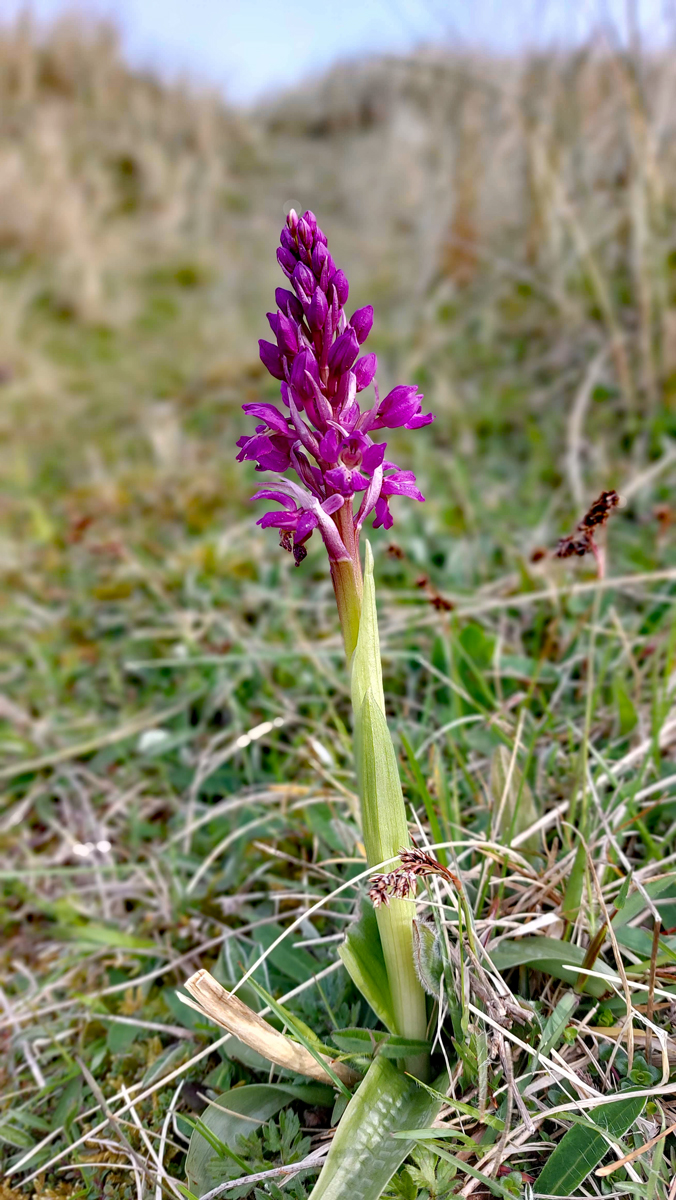
A wander around the dunes at Warkworth had a nice display of just emerging Early Purple Orchids too. I must try and get back this week to see them at full opened glory.

In our garden, Holly Blues are out at the slightest hint of sun and a lovely big Hoverfly, Criorhina floccosa was easy to photograph in the chill air.  

The bee mimic hoverfly Criorhina floccosa complete with its diagnostic white flank tufts.

For such a common bird along our coast I had never seen a Stonechat's nest until the other week. While looking for a Grasshopper Warbler a small bird flushed from a clump of marram near my path. I was over the moon to find a nice small, flattened, tunnel leading to a small cup containing 5 eggs. I took one photo with my phone and left her to it.


Stonechat nest.

Whimbrel arrived on the patch on 22nd April witha single bird on the rocky shore beside us.

So with Orange Tips now on the wing and a seemingly drier break in the weather lets hope this Bank Holiday marks the start of a good spell of wether for wildlife / birding!

Early Purple Orchid, one of 200+ at Warkworth.

'Gropper'

Willow Warbler