Showing posts with label Coues's Arctic Redpoll. Show all posts

Monday, February 08, 2016

Up to the Guts....

A day off today, with a reasonable weather forecast, so we went birding...

With no planning whatsoever John and myself began at Amble Harbour and worked north.

Amble was very quiet indeed with nothing of note. Further along the river, a few ducks were worth a look, 100+ Wigeon, 1pr Gadwall, 4 Red breasted Merganser, 2 Goosander and 2 Goldeneye fed on a low tide, while a Little Egret flew over the point to the Gut  er Old Water.

At this stage we discussed the local site names for our usual birding spots. Traditionally, all bird records from most of the Coquet estuary were labelled Warkworth Gut. This name, however, is just wrong. Warkworth Gut is a small muddy creek running from the south behind Amble Marina and not the channel edged in saltmarsh and reedbed that runs to the north. This place, where most birds are found, is called Old Water. Now there are some tidal pools at the head of Old Water we have imaginatively named 'Old Water Pools'.

Just to confuse matters further, there is a small, difficult to view 'Gut' opposite the weir laybye, that could also be called Warkworth Gut, but it doesnt have a separate name, it is just known as 'the river above the weir'.

There, that's that clarified. Several Guts, but the real one rarely has birds...

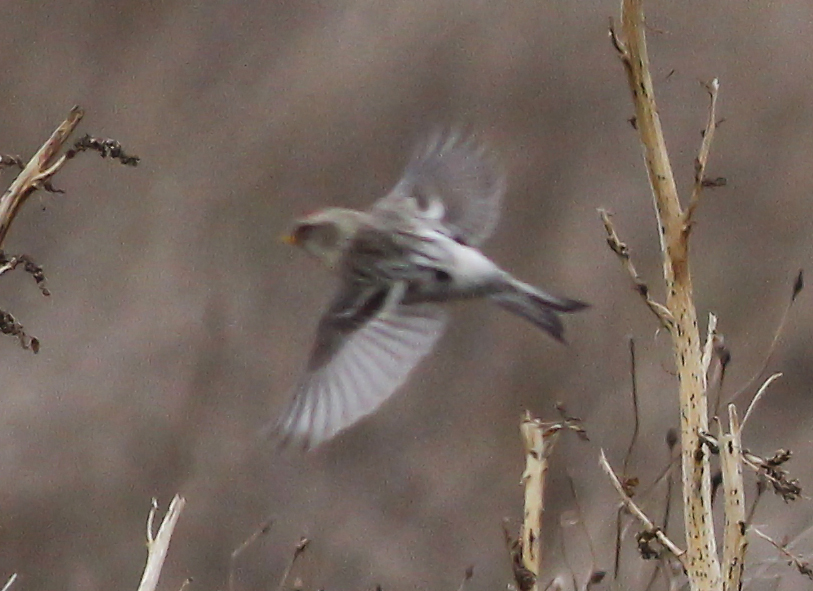
Back to the birds. As we were here it would be rude not to call in to see the Coues Arctic Redpoll for the 5th time. Today the bird was running a bit late and left us standing twiddling our thumbs for half an hour before it and it's colleagues flew in to the usual fence line to allow viewing. There was some discussion about the identity of the rest of the flock. These birds get no easier. Most could feasibly be Mealies rather than the assumed Lessers. In fact only 2 birds out of 30 or so were obvious Lessers, one a very red breasted male and another browner bird, both small compared to the rest. There are definitely 3+ Mealies, the rest are just Redpolls....

Coues on its usual post....
 From Birling we headed up to Boulmer via Foxton Bends where 500+ Wigeon were unsuccessfully  scanned for yanks. At Boulmer we walked both north and south along the shore. There were lots of birds to search through, many hundreds of gulls and coastal waders with a few wildfowl too but it was a day of spectacle rather than substance. A Peregrine hunted the rocks and a Twite flew south. On the flash, a few Mallard were joined by a juv Pale bellied Brent Goose. It was the shere number of gulls and waders though that caught our attention the most. As the tide neared the high mark, the waves washed piles of seaweed around exposing tasty morsels for the birds. There were 8+ Purple Sandpipers, 50+ Turnstones, 20+ Bar tailed Godwit, 100+ Dunlin, 40+ Sanderling, 2 Grey Plovers, 200+ Curlew, 50+ Redshank on the shore. It was great to watch them swirl around and return to the beach every so often.

A sample of waders flying around.

Nearby a young Grey Seal watched us pass then went back to sleep.

Not a bad day, certainly better than being office bound that's for sure!

Grey Seal

Sunday, January 31, 2016

Redpoll...week 4.

You will all be getting sick of me chuntering on about the Coues's Arctic Redpoll at Birling / Warkworth by now, but today we managed some great views and this time I even had the camera instead of the scope.

I've jumped the gun a bit though so first things first. I met John at Warkworth at 7.30 this morning just as it was getting light. It was nice and calm for a change, overcast and cold. To start things we walked down towards the beach and along to view the salt marsh, to check the local Twite flock for the first time this year. As expected, about 15 Twite showed well, in less than good light, but with them were 2 Redpolls, one a sure fire Mealy, the other more ambiguous. I dont recall ever seeing redpolls in this habitat before...

While here, a Barn Owl hunted the car park banks and a host of waders roosted along the edge, where Bar-tailed Godwit and Little Egret were both new for the year.  

Twite in the gloaming at first light.
From here we walked back up and followed the field north along the golf course to view the redpolls. Today numbers were up to 34 birds and the Arctic was easily picked out as they came in and sat, obligingly, along the fence line.

Coues's Arctic Redpoll showing well, sticking out like a sore thumb. This shot shows its bull-head and necked appearance well.
We stood back from the fence a few yards and the birds came in every so often. Here the Arctic is showing its typical puffed up pose, complete with huge, unstreaked white rump.
In this shot, the Arctic has not had time to fluff up, giving an altogether different appearance. It appears to be a first winter male as there are odd reddish feathers in the upper chest / cheek area. 
 This is my fourth audience with exilipes and he never fails to impress. What a little cracker!
As we watched, John and I met with John Richardson and Sasha Elliott who also got some nice photo's. Pleased to meet you Sasha....

From here, we returned to the car for a refill of tea, pasty and cake ( no....) then off down to the harbour and estuary. Highlights here were a nice male Goosander, 3 Purple Sandpipers and the adult Mediterranean Gull has finally returned, albeit a little bit late....

So, a nice winter morning out with some excellent birds. If only all weekends were like this....

Mediterranean Gull with Black headed Gulls, Little Shore, Amble.


Sunday, January 24, 2016

And more Redpolls....

This morning was spent down at Warkworth with John.

We started in the gloaming with a nice Barn Owl hunting the car park. I had seen a second bird up the road near Hipsburn on my way too.

If only I could get the redpoll to sit for me!
While there, it would have been rude not to have a third look at the Coues's Arctic Redpoll at Birling ( which is just one field from Warkworth Golf Club). How pleased am I that John wanted to give it another go, because today it gave us some great views. Early on, we were the first ones looking, and sure enough the little flock of Redpolls were feeding in the usual spot down at the SE corner of the field. Using a little field craft, we stood on the field edge near the fence, with the light behind us. I took my scope but didnt think the light was any good for photos, a mistake I won't be making again in a hurry.

As we stood quietly, the birds arrived from the south just over our heads chattering away to themselves before dropping in to feed only a few yards from us! Despite quartering the ground with the scope we could only find three birds, a Mealy and 2 Lesser Redpolls. As is their way, they got up again, danced around a bit and dropped back in. On one occasion though, when they got up, they all landed on the fence line only about 30 feet away where they could be seen very well indeed through the scope.


A rapid count gave us about 26 birds - 1 Arctic, 2 Mealies and 23 Lesser Redpolls, but they dont sit around and off they went across the field into the hawthorns, where we could clearly seen the Arctic and 3 Mealies! So a finally best guess gives us 1 Arctic, 3 Mealies and 22 Lessers. A while later we managed to get more good views in the beach car park as they flew in for a wash and brush up. This time I suspect there were even more Mealies, but an accurate count was impossible as they hopped through thick thorn cover.

I think John got some shots of the flock on the fence, so when he sends me one I'll add it to the post ....

On our way back to the car, a male Merlin hunted a Skylark over head, frightening the poor thing into song, though I didnt see any kill right till both were out of sight high over the sea.

Back home, a second Chiffchaff was feeding in the ditch along the lane, while the first one was still in the garden....


Monday, January 18, 2016

Redpoll update...

What a lovely weekend that was, sunny cold and crisp, just the job after weeks of clarts* and rain.

A few walks around the homelands added another 10 species to the 2016 Patch List, mainly very common stuff like Greylag, Greenfinch, Reed Bunting and Yellowhammer, but also 2 Willow Tits fighting and buzzing around at Craster soon to be joined by an equally tricky patch bird, a Treecreeper. Rock Pipits and a Shag were in Craster Harbour too, so its slowly coming along.

I might have seen more, If I hadn't been tempted back down to Johns patch at Birling to see what our Redpoll looked like in the sunshine.

After a full week of debate that had the emotions churning, at last, young Jonathan Farooqi has caught a photo, capturing the bird's very essence. Forget the Garner Redpoll Code for just a moment and wallow in this image for me.... in particular image number 8 from the top.

Now take yourself back 30 years, if you were birding then, and just think what your reaction would have been if you had found this in a hedge with a load of brown birds. All of us, to a man, would have shouted ARCTIC REDPOLL! 

I posted my own redpoll CV in the last episode, so you know that I have watched a lot of Mealy Redpolls over the years, but have never known one in the wild or in captivity to show that amount of whiteness or, more importantly, feather bulk and posture ( fluff, to you and I). Martin Garner suggests using 'jizz' before going into the minutiae. This bird, as soon as it settles, puffs itself into a round cotton wool ball, Every time. Only when coming in to feed does it take on a different persona, becoming all tight feathers and slimmer, like a fat bloke breathing in on the beach.( Not a word from you lot either).

So, on Sunday we managed some good views of the redpoll in both of its forms, both slim and fluffed, but mainly at a bit of a distance. The scope gave good views though. At one point it was on the ground scuffling for seed where it could be compared to Lesser Redpoll and Linnet.  This flock also has probably 2 Mealies in there, and one bird it associated with in particular was a big brown Mealy.

The bird still has a few problems that dont seem to fit with our current understanding of redpolls. That bill for instance gives it a Mealy look about it.  But I think thats the problem, we just dont know all there is. These birds are very difficult and may even merge in some areas though studies in Canada didn't think they interbred. Maybe Coues's Redpoll is more 'flexible' that we think....

*mud for those south of the Tyne....

Notes from yesterday done in the car after my fingers had thawed out, hence scribbled writing. Colour added later back home.

Good enough for the Handbook....


Sunday, January 10, 2016

White out....

I just want to post some info on the Redpoll John found at Birling Carrs today. John had noted a redpoll flock last week and fancied he glimpsed a paler bird in with the lessers. They are feeding in a rotting game crop full of seed right next to the golf course at Warkworth.

This morning we had a wander around and sure enough the flock of about 20 birds came dancing into the tall stands of seeding crop. The birds perched for a minute then dropped to the ground and were mainly invisible. As we approached up they would go and fly off some distance only to come back 10 minutes later. This was the pattern for the next hour before we had to leave.

So what did we observe. We have posted snippets of info and two pics that John took on social media but it doesn't explain the story.

Our bird was the only pale individual in an otherwise brown flock, so no two bird theory here.

At first sight against a dull, damp, dark background a white flash of rump like a Brambling was very exciting.  Once our eye was in, the bird could even be picked out in flight against the sky let alone a dark background.

Once, it landed close to us where the distant white snowball looked very much greyer and Mealy-like, but only a back view was had before they dropped out of sight.

At long range the bird looked even better, a very whitish bird like a beacon amongst the little buff lessers.

Looking at Johns photo's below it is easy to cry Arctic, but lets be very critical first.The bird looks like a first winter with pointed tail feathers? The colour of the tail seems odd with those white streaks, this is due to the wetness of the habitat soaking the feather so maybe the tail tips are wider and rounded when dry, its hard to tell.

This wetness might be having an effect upon the extent of white rump showing too, smoothing feathers down and exposing a more pale, basal area.

The mantle is quite dark and dirty looking, but again is this a weather related illusion?

Dark solid looking ear coverts with greyish surround and large red 'poll' do fit a Mealy and lack the buffiness of Arctic ( Coues Arctic). The bill didnt appear stubby and can easily be seen  in flight.


Now this second image for me gives more info, but is a bit contradictory.

The under tail coverts first seem to have only one fine streak but look at that errant streaked feather sticking out to the side. That is quite obvious.This is a second thicker streaked undertail feather. I think.

The flanks have nice dark tramlines drawn down them but are partially obscured.

Its such a shame the face is hidden because this does look different and very creamy buff, under and around the black chin and the supercillium.

These comments still leave us hanging really. I dont think a 100% certain i.d can be made so far. The bird needs further observation and, hopefully more photos taken.

On social media quite a few comments have been made shouting Arctic, even saying definitely, but let me say, how can we be sure from these two images. I have consulted Garner's Winter Guide, and Birdling World 1996 as well as online images and nothing really helps.

Personally, I have a good Redpoll 'CV'.

Myself and John are experienced observers. I have kept them in captivity as a child, helped a Mealy captive breeder, used to be a ringer and have caught, ringed and handled a good few, I have seen lots of Mealies in Northumberland, uncountable Lessers since childhood,indeed this was the first flight call I could identify when aged about 9 or 10 yrs old. I have found and watched the nests and display of Lessers in the wild, watched Iceland Redpolls in Iceland and have found 2 Arctic Redpolls in Northumberland ( Alnmouth and Druridge Bay Country Park) accepted by BBRC.

I just want to put it out there that we kind of know what we are talking about.

So why can we not be sure of this bird after watching it in snippets for an hour, yet people online can name it from two images that took  1/600th of a second?

Lets hope its publicity gets other birders onsite to check it out and hopefully get some clinching shots. You never know it might be our third self found Arctic Redpoll!!

Wednesday, January 05, 2011

Up to the Holbolls....

Holbolls not illustrated...
Well, I see Alan Tilmouth and Nigel Foggo have put my Mealy Redpolls to shame with a very nice Coues's Arctic Redpoll at Widdrington Tip.

If you are one of those birders poo-pooing the 'Coues's' bit as a new fangled taxonomistic load of rubbish, then look back to my 1938 edition of 'The Handbook' and there we find, not only Coues's, but Lesser, Mealy ( none of this 'Common' nonsense), Greenland, Hornemann's and Holbolls Redpoll. 


Wait a minute, Holbolls? What on earth is Holbolls? In 1938 it is an 'uncertain form' and is retained in brackets as a form of Mealy Redpoll from farther north and east in Scandinavia, Russia and Siberia. Its good to know that one of this form was recorded on Holy Island in November 1923...

Rarer still, at Widdrington Tip this week, have been......some birders. I bet if you had walked into Cresswell hide last weekend and mentioned the tip, more birders would have heard of Holbolls Redpoll before one recognised where this site was.

Some years back myself, Nigel and JWR all used to live at Stobswood, just opposite the old brickworks next to this tip site. We used to see Glaucous Gulls and Hoodies each winter here when the site was still operational, and nearby in the woods wildlife abounded with breeding Willow Tit, Tree Pipit and even Wood Warbler. Woodcocks rode through the village at dusk on summers evenings and all five owl species could be seen annually. Mealy Redpolls were annual too, attracted in by the birch trees and by the calls of captive, aviary bred, Mealies kept by one resident for showing purposes.Some good plants are to be found too in this fragment of ancient woodland with Broad leaved Helleborine, Musk Thistle etc.

Only Nigel is a regular there these days.

It just goes to show that if you use some imagination and do your research there will be little places worth checking out not too far from the well beaten birders track. You don't have to sit in a hide all day just because everyone else does...