Showing posts with label East Chevington. Show all posts

Wednesday, February 07, 2024

This is the Smews...

What is it with Smews? Or Smew?

Over the years Ive seen plenty of them, harking back 30 years we would get up to 9 on Druridge Bay Country Park that sometimes included one or two males as well as the commoner red headed females. In recent years, as most of my birding time is not near large bodies of fresh water, they have become decidedly scarce for me. I cant even remember the last male I've seen but it might have been the one a lot of years ago on the River Coquet above the Warkworth Wier one fine New Years Day.

This year there seems to be more Smew around so I thought I might try and see a drake if one was available near by.

Getting back to my question, what is it with Smews? They are certainly proving elusive for me this year. When we were in Fife a couple of weeks ago, a drake was wintering on a reservoir not far from us, but not on the day we went. Back home, a redhead has been showing quite well on the QE2 Lake near Ashington. I drive past the car park every day I am in the office, technically I might have been able to see the bird from the car as I went past but didnt, so last week I called in on two mornings.  Not a sniff, so when a drake was reported as showing well at East Chevington the other day, it was an offer I couldn't refuse, after all this is a big water body that holds a lot of wildfowl, why would it move on?

Yesterday I parked at the south end of Hadston T junction road and walked in to Chev from the North. At the centrally positioned L shaped hide I met Mark Eaton with Sam and Rosie ( golden retrievers). Mark had been here a while and yes you guessed it, the white nun had done a bunk!

I gave it half an hour to scan around. Of note were 2 Otters, 4 Red breasted Mergansers and a dozen or more Goldeneye with a Cetti's Warbler singing in the background.

On my walk back to the car, I did a short detour into DBCP for a scan in case it had flown on to this traditional site for them, but it wasn't there. A few more Red breasted Mergansers, Tufted Ducks and Gadwall were all I could see with a Willow Tit calling away in the car park.

I hear the redhead is still on QE2, so might have a look on my way to work on Friday. See if I can make it 5 unsuccessful attempts in a month... 


Above -Successful Smews from the past...

Monday, March 07, 2022

County Tick...

Seems a bit frivolous in light of the state of the world right now, but it's good to get out into the fresh air to clear an anxious mind.

 For a change the wind had dropped right off giving us a lovely spring-like day. John wanted to check out new bins at 'In-Focus' who had an open day at Hauxley reserve so this seemed as good an opportunity as any to try for an elusive, but now resident, county tick.

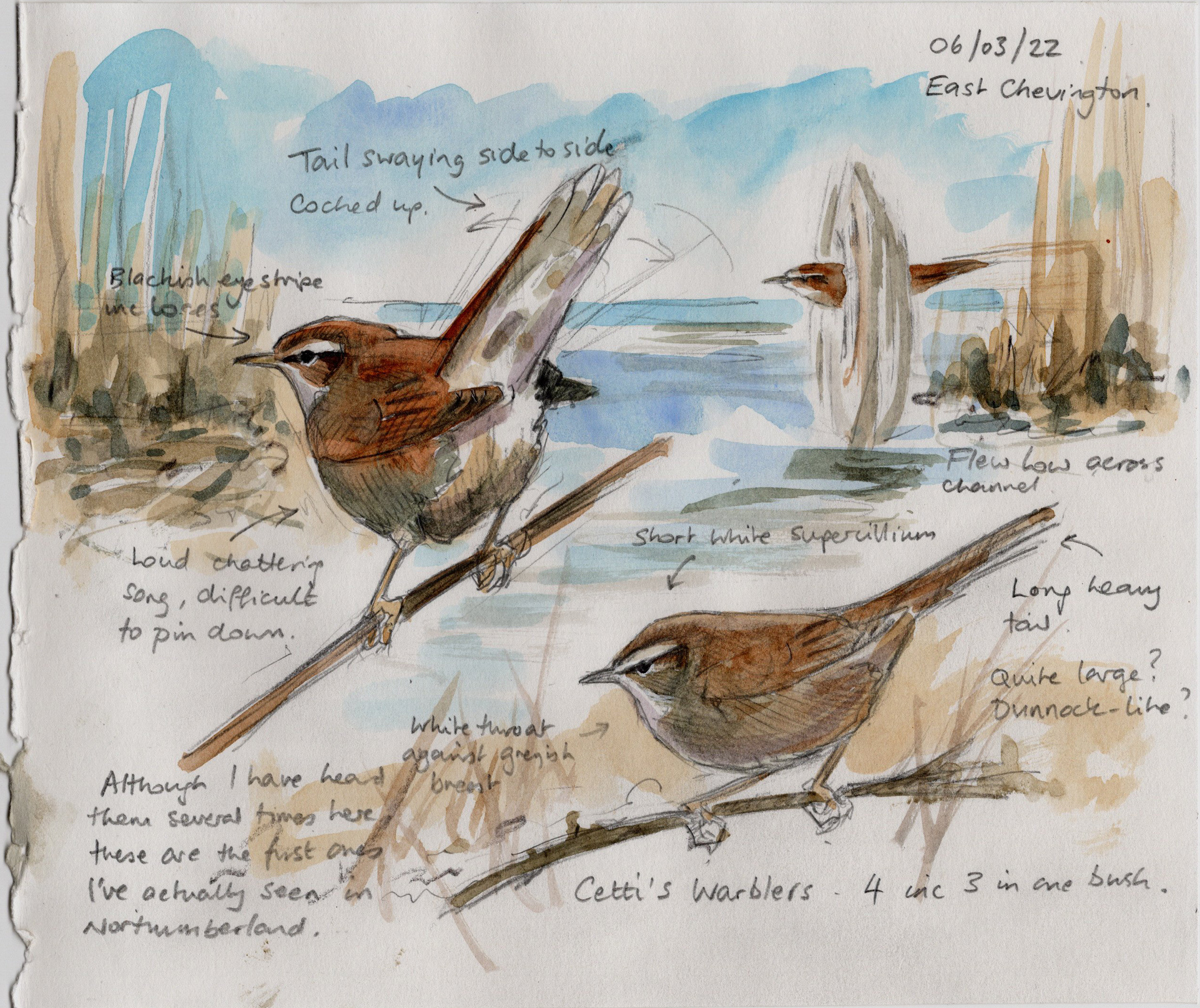
The ever skulking, impossible Cetti's Warbler has been a reasonably new resident in Northumberland with records dotted all along the coast over the past decade, but the stronghold for them here are the large reedbeds of East Chevington. I have heard singing birds there several times over the years but none have shown. We even twitched one that had been at Low Newton for a period recently to no avail. In addition they can be found at Big Waters and occasionally in other spots too so it was always going to be a list addition, one to keep in the back pocket, so to speak. 

A lot of people are happy with adding a bird to a list on call alone, something that I do for the local patch year list, but whenever its a county or UK first, I like to have a sight record, just for completeness.

The weather and timing were good for a chance of seeing these ginger, swamp dwellers and we had planned an early spring visit for a few years but just hadn't gotten around to it. There is always something else happening. Having seen Cetti's in various places further south and abroad, there was never any great push to get one up here, but is was always in the back of my mind.

We parked up at the south end of the North Pool and headed up to the South East corner hide, a good place for them. As we arrived at the track to the hide, the machine gun rattle of a male Cetti's could be heard in the tall reeds about 100 mtrs away. The sun shone and it was calm on this side of the reeds so hopefully one might appear.  

After about 15 mins the song came again, much closer this time, in a wedge shaped island of reeds between two cut channels. Surely we had this one in the bag now, its right outside the hide and it has to venture into the open to move around. Then after a few minutes, a small brown bird flew like a bullet out of the reed base across the water and it was gone. Seen, but not quite what we had in mind.

As we waited, a Water Rail flew across the same channel, squealing as it did so. It then landed, did a funny jig around before vanishing into cover.

Then, Cetti's song came from behind the hide at our backs in some hawthorns.

We left the hide and moved along the track. Here some sparse small bushes grow from the long grass, and there at the far left was a movement. Through the bins it was calling, tail swinging Cettis Warbler. It looked a bit agitated, then it was soon joined by a second bird just as jittery as the first. They chased around tails waving and calling as they went. Then a third bird appeared that we took to be a female, as it remained quite calm and quiet as the other two ran around the bush for a while before breaking away into thicker cover.

Not bad, 4 sightings of at least 3 birds far exceeded our expectations, leaving my Northumberland List on a nice rounded 360 sp.


 After that we headed up to Hauxley where Willow Tit and a few hundred Pink feet were the highlight ( after the superb Swarovski NL Pures of course).

Back home this afternoon in the warming sun, my fist Bumblebee and Peacock Butterfly of the year were both on the wing.


Monday, June 14, 2021

Pacific Heights.


For some reason I couldn't sleep on Saturday so got up early to do the moth trap. Numbers still aren't up to usual standards but 97 moths of 36 species is enough to keep the interest going. After the catch was processed and photographs taken, it was time to up date our local moth page on FB.

It was while sat at the desk editing images that the Northumberland WhatsApp Rare Birds group came to life. A photo was uploaded, taken by Dave Elliott showing the departure of a Swift with a white rump low over water at East Chevington reserve. Even the rear-on image looked to me that it was not an abberant Common Swift. The bird was banking over showing a very slim pointed wing vertical to the water. Knowing the extreme transient nature of 'Apus' the image was taken at 7.30am and there was no further news by 9am. As the day warms, insects would rise on thermals and so will the swifts. It was currently cool and cloudy.

Then at around 9.30 information was released saying that the bird was still present, with no identification as yet.

With fixed plans for the afternoon, if I was going to have a look I better go now, so thats what happened. Arriving at a queue of cars parked along the lane side at Chev, the news was that it had not been seen for 20 minutes, however when I saw Tom Cadwallender he told me the bird was still here but away up at the far north of the reserve near Druridge Bay Country Park.

The car was given a 10 point turn and I headed up to the park, parking the car right beside the north entrance to the reserve coast track. As I made my way south, three birders were stopped on the track around 100 mtrs away looking towards the lake. I assumed they were watching the bird, but no sooner had I built my hopes up, they all just carried on wandering down to the west facing hide.

By now I was almost at their spot. Looking toward the hide, a birder was watching through his bins but he was facing directly north, an area above some trees to my right, so I stopped and scanned. With the naked eye, nothing. The bird could be more distant so a scan with the bins was similarly empty, then all of a sudden one bird came into my field of view and it had a huge wrap around white rump! It came very close giving excellent views against the trees. Immediately it could be seen not to be a Common Swift, its shape was all wrong with a narrow waist and slim more pointed wings it scythed around with Common Swifts  and to me, was all day long a Pacific Swift!

After a couple of minutes it flew back down to the water so I headed to the hide where around 20 birders stood around outside. Someone asked 'Well, what is it?'  'Its a Pacific isnt it!' was my excited response only to be doused by a 'Is it though?' by very experienced birders. White-rumped Swift was not eliminated. This was a bird I have no experience of but I have seen Pacific Swift in China. If only we had a field guide because given these brilliant views, there isn't really a danger of confusion. We commented on the slimmer structural build, the pale scalloped under parts and the size. Some felt it should be bigger than Common Swift, but guide measurements show them to be the same.

By now it was a big twitch with lots of people taking photographs so no doubt its identification would be confirmed soon.

I left after an hour, not believing what had just happened. After last weeks stint, now this! Northumberland is getting some great birds again this year.

By the time I was home, the information services were posting images of the now identified Pacific Swift and everyone was getting good views. I could get on with today's plans quite happy...

Northumberland List 356  British List 423


Tuesday, June 08, 2021

Red necked Stint.

 Its taken a little while to get over the excitement of this weekend's birding up here. What a spell Northumberland is having this past week, with good birds galore descending on the county like flies on the proverbial.

On Friday there were 2 Rose-coloured Starlings, one at 25 miles either side of me that I didn't go for as I'm sticking it out for one locally. My fat ball feeders are well stocked and waiting... also Mike Carr was working at the burn mouth near our village when he had a Bee-eater fly over north. Unfortunately it didn't stop for breath and bypassed me at home. Its another one to watch out for.

Down the coast at East Chev, Dave Elliott had two good mornings, on the first he found a female Woodchat at Hadston Dunes, then next day a singing Great Reed Warbler at Chev south pool reedbeds. The shrike was only present until 9am then vanished as silently as it arrived, though the warbler is still present. Interestingly another, this time male, Woodchat was found yesterday up the coast from us at Goswick golf course. Two in a year in Northumberland is unprecedented.

However great these bird are both in looks and to find, the grand finale was down to Alan Curry on the less than salubrious River Blyth Estuary. 

On Saturday evening around 8.30pm just as most birders are cracking open a bottle or tinnie, Alan was grilling the handful of Ringed Plovers on the mud when, alongside a Little Stint for field guide comparison he found the UK's 8th recorded, 7th alive, Red-necked Stint! 

For us old timers, we were lucky enough to see the Wansbeck bird of 95 and we never thought there would be a second chance at one in the county. We are now the only UK county to have more than one record of this cracking little peep with both sightings only 3 miles apart.

Like the Aug 95 bird, this one was in full summer plumage  and as there have been no British records for a decade it was going to attract some attention. One birder on Twitter, tweeted by 9pm, 'I'm on my way, from Somerset!' Being cool after one sighting 26 years ago and seeing hundreds in China, I kept my powder dry until Sunday morning before following the masses.

I met up with John at Boulmer at 6am, sifted through 70 or so Starlings on the shore looking for a whole lotta Rosie, without luck, then we headed down the A189 to Blyth. A moderate number of travellers were on site from dawn and the bird was showing out on the flats albeit quite distantly, but giving decent scope views.


The twitch is on..

We left the site happy with our views, totally unaware of how things would pan out later as the tide rose...

Our next stop was up at Chev for the Great Reed Warbler, on the way back home. Several people had difficulty with this bird, waiting hours for only a song, but we were there 10 minutes and out he popped, right on top of the phragmites, chugging, croaking and swaying at the same time, bending reeds double with his song thrush sized mega warbler bulk. Like the stint, this is only my second in Northumberland, though there have been a few other occurrences I didn't bother going for. Because I'm not a twitcher.

Then it was back up to civilisation at Boulmer, motivated by the success of others we cast around hoping for our own rarity but it was not to be. You can't have everything so it was time to call it a day and head home for lunch. A good day.

Red-necked Stint, River Blyth.

Great Reed Warbler, East Chevington.

Back home I caught up with some sketches from memory and some dodgy phone scoped reference material when the Twittersphere started showing more stint images as the twitch increased apace. There are photos and there are photos but eventually some of the shots were practically unbelievable. The tide had pushed the bird onto a spit on the opposite shore. Birders, seeing an opportunity made the half hour jaunt across to the far side and were treated to spectacular views down to 20 feet!

Of the best images, Tom Tams, Alan Curry, Josh Jones all stand out but there were others too that made me feel quite jealous that I didn't linger. We all knew better views would be possible as the tide came in...

It seems most of the country made the pilgrimage north for this Siberian stint but as I write this today, it has flown off on its globe trotting travels to where, who knows....

What a bird...

Tom Tams kindly let me use one of his amazing images of the Red necked Stint at point blank range.


Tuesday, June 25, 2019

What a week!

I'm going back a few weeks now to Monday 3rd June....I should have one of those wavy 70's special effects...

Sitting at work just having my lunch in front of a computer, I glanced at What'sApp on my phone. A message had just appeared - 'BAIKAL TEAL, East Chevington North Pool now'. This was not wholly unexpected as this bird has travelled around eastern England for a few weeks now, but yesterday it had gone past us and into Scotland. We thought we had missed out on its north bound itinerary. However, Scotland wasnt to its taste, and it was now loafing on the bankside here at East Chev.

I downed tools [keyboard] and headed off up the road for this genuinely wild, long distance vagrant, ***it has been to Spurn, so it must count*** arguably one of the finest looking of all the wildfowl. As its name suggests it should be breeding now somewhere east of the Siberian Yenisey on tundra pools, not hanging around the ex Northumberland coal field.

A few birders were already watching the bird when I arrived, and what a little stunner it was too, with the green and yellow harlequin face pattern of an adult drake. Although it was quite distant, good scope views could be had on the bank and out on open water. At the time of writing, it has moved down to Druridge Pools where it looks set to put the summer in.

Although some people are concerned that it is a species widely kept in captivity and it may have just hopped a fence, it was unringed and certainly behaved like a wild bird, being very uneasy and flighty even at range. Numbers have increased from a few hundred thousand birds in the 2000s up to a million birds now wintering in South Korea so why wouldnt it be the real deal?

We will have to wait until the powers that be decide on that one, but I've already added it to my list.
More importantly, it is in 345th position on my Northumberland List and is a great bump start to a slow year, arriving in the county with a few other good birds such as Broad billed Sandpiper, Red necked Phalarope and American Wigeon.

Northumberland's first Baikal Teal, East Chevington.
In June it pays northern birders not to rest on their laurels, and sure enough only two days later a visiting birder looking at a Garganey on Monks House Pool turned up Northumberlands second ever BAILLON'S CRAKE after one in 1942.

This small roadside pool,a  former local patch for the master, Eric Ennion, is a proper mass of thick impenetrable juncus, so I didnt hold out much hope of having a repeat performance of the 1989 Sunderland bird. I hung back awaiting news. I just sat down to my tea, when the message came, the bird was out scratching around the mud, in the open!

As with the Teal, the pause button was pressed, tea put in the oven, Springwatch recorded, and off I went, all of 15 miles north of home. I skidded to vehicle abandonment and jumped out. 20 birders were just gazing around as they do. 'Has it gone? I asked Ian Fisher. 'Its just gone behind those rushes a few minutes ago' was the response. Thats that then I thought and got the scope out as a token gesture. After 10 mins, Tariq Farooqi gave the call, 'There it is!' resulting an a 30 second panic until I could locate the tiny hunched scrap of feathers picking around in a tunnel of rush. Eventually it emerged into the open and had a bath and a preen for 10 minutes before skippng off out of sight where it was never seen again....  wow, what a bird. Not a full lifer, but one I never thought I'd see again, let alone in the home county.

These tiny marsh creepers are quite scarce and difficult to see anywhere in Europe even though they are widespread breeders. It is believed that some may breed in the UK after a survey found several calling birds on marshes in Wales, but in this kind of habitat, we could never be sure.

The county tick [346] was tinged with some ( very little) remorse that many of the top Northumberland Birders couldnt make it up north from Newcastle etc. A bitter sweet experience for sure...

Northumberland's second Baillon's Crake, Monk's House Pool.


Tuesday, February 27, 2018

Anyone think of a headline about a Bittern?.....

Saturday was chilly but bright, so Jane, Peggy and I took a drive west over to Harwood Forest for a walk. Little Peggy is very timid of loud noises so our coastal bird scarers have her a nervous wreck in minutes.

Harwood is very remote and is generally silent and free from traffic or industrial noises so seemed ideal for an afternoon walk. Only the usual pine forest species were active with Crossbills, Siskins and Coal Tits, Sparrowhawk and Great spotted Woodpecker plus 3 Roe Deer to break the monotony.


Sunday was bitterly cold, dry and breezy. The kind of wind that chilled the bones within minutes of exposure. The beginnings of this 'Beast from the East' had John and me seeking shelter where ever it could be found. Once out of the wind, the day wasn't too bad at all.... 

A short scan of the Coquet Estuary from Amble Marina seemed a little quiet, with 29 Whooper Swans N being the highlight.

Down at Druridge Bay Country Park, we scanned the lake for wildfowl. This used to be the county's premier site for Smew 20 years ago but not these days. Maybe the cold on the continent will drive a 'white nun' across the North Sea. Its years since Ive seen one here.


At the boat launch, this darvic ringed Black headed Gull has wintered here from Norway for the last 5 years. On the water, 5 Red breasted Merganser and a Pochard were the best, while down at the feeding station 10 Bullfinches were cleaning up the last of the feed.

The area was quite busy with dog walkers so we drove around to East Chevington and walked up to the L shaped hide to get out of the wind. These steel structures are cold in July, but at least they keep the wind chill off.

From here, 3 Otters cavorted at the south end of the pool for a while and on the lake, 32+ Goldeneye had a lone Long tailed Duck for company.

After a short wait John called me to look north, where a Bittern had jumped from the reeds and was flying along the north shore before dropping back into the phragmites at the NW corner. 

Distant Otters...

Distant Bittern....
 So what started as a bit of an ordinary day didnt turn out badly after all....


Sunday, October 15, 2017

Rainbow Rising....


Today, we had a plan.

I was to meet John at Alnmouth, we would have a look down to East Chevington for the Cetti's Warbler then a run on up to Budle Bay for wild Canada Geese.

That started to change when I had a call from John as I left the house at 6.40am saying that he had a puncture, could I pick him up. That was the easy bit done, so should we head 10 miles south or 15 miles north? The Cetti's won, being a county tick for us both, so we arrived on site just at sun up.

We were soon in the right spot awaiting a machine gun blast of Cetti's wake up call, but all was quiet. Two cream crowned Marsh Harriers, 9 Pintail, 57 Tufted Ducks, 15 Little Grebes with loads of assorted commoner wildfowl kept us occupied, while over head there was a light trickle of visible migration with a few Redpolls, Skylarks, Meadow Pipits etc heading south overhead.

Half an hour later, Dave Elliott appeared from the small steel hide in the corner and indicated that our bird was vocal, even though we couldn't hear it over the breeze. We nimbly (?) clambered over two fences and a ditch to get to the spot but the reeds were silent. Apart from John and myself, Alan and Andy were with Dave hoping to get a view of the Cetti's. I would be pleased to hear it. Then very faintly I heard a distant rattle. No one else moved. I must have imagined it. Another few minutes passed and again there it was, this time Dave and John heard it but it was very faint. After a while it came a bit closer and we could all pick it out doing its choppy song deep in the phragmites.

Now, this steel hide is, lets be honest, bloody awful. Every movement by its tenants sounded like a drum solo, and it did its best to shield us from all outside sounds, so off we popped outside to see if that was better. Dave left us to continue his search elsewhere but we lingered on hoping for a view.

After a while we were joined by top father and son team, Tariq and Jonathan Farooqi, Bob Biggs, Chris Barlow and Gary Wren, all hoping to add this skulking warbler to the county list.

A few more larks and pipits headed south followed by a low fly past from a Grey Plover, lit beautifully in the morning sun, then, at 9.25am, things took a very surreal turn.

I heard from above and behind us a loud 'blloop' or 'blleep' call. A single note. Down in the subconscious, it made me freeze and every thing seemed to stop until the Farooqi's said 'Bee-eater!'

I looked up and there straight above was a lone Bee-eater! I could not believe my eyes. We are in Northumberland in October with a Shorelark 300 yards away and I am watching the slim, spiked form of a Bee-eater! Then, Farooqi Jnr called 'there's two!' and sure enough, a few yards behind the first was its travelling companion.

A panic ensued to ensure all present were on these fast moving small birds in a featureless sky and luckily all present indicated success. The birds continued north to Druridge Bay Country park giving glimpses of blue, turquoise and orange from a generally silhouetted small dot in the sky.

John kept them in his scope for a full 10 minutes until they just vanished into the distance over Hauxley.

I am not ashamed to say, the air was punched! Bee-eater is much sought after in the  county with no real twitchable birds ever, so to jam in on these two was amazing!

After the adrenalin pumping excitement, the Cetti's was all but forgotten, a nice juv Black Tern flew in briefly and then south and I didn't even care about not getting on to the Bittern that flew up briefly near us. No, the morning was a good one, and I am sure the tale will be regaled well into the future. We didn't make it up north for the geese either.

For the few birders at the other hide who missed them we were genuinely gutted, but now the day is done, I am just sitting here basking in my first Northumberland Bee-eaters!    Things don't get much better...

Notes not done in the field, but back home this evening. I have tried to show them as we saw them with a lot of shadow and hints of colour.  It is difficult to get teh colour down as we had it showing snippets of jewellry! 

Sunday, February 12, 2017

DBCP and East Chevington in a storm...

Out alone today, and just for a short while too as the weather was awful. A strong NE wind that felt like a gale at times, it was cold and often laden with stinging sleet.

As I turned the corner from our drive and headed through the village I was met with a very unusual sight indeed, a Guillemot, in summer plumage now, was standing on the roadside looking for all the world like a lost penguin. It had clearly been storm driven off its usual maritime course before first light and as daylight came, it was as surprised as me to find where it was standing.

I picked it up and took it back home for a quick physical inspection. It seemed fine and was keen to snap chunks out of me, so into the cat basket it went and I transported if off to a more suitable location.

At first I thought about Amble Harbour, but it was low tide and there were too many large gulls around for a tired auk, so I took it to Druridge Bay Country Park for a fresh water wash and brush up. Here, the lake often holds fish eating birds such as the recent Pacific Diver, it was relatively sheltered ( for an ocean going bird, maybe not for soft humans) and I thought it would give Guillie a chance to recover while the sea flattened off a bit, so it could fly back to its usual habitat. The sea is only a matter of a 100 mtrs from the lake so it could even smell it, for later on.

The cat box was opened and the bird couldnt wait to run down the boat launch and swim off strongly. It seemed fit enough, preening and flapping before settling in with some wintering coots.

  
While here, I decided to check the other birds around.

There were a good number of wildfowl including 6 Scaup, 5 Pochard, 44 Tufted Duck, 8 Red breasted Merganser, 4 Goldeneye, 4 Wigeon, 4 Gadwall, 2 Little Grebe, 20+ Coot, 20 Moorhen, 20+ Mallard plus a Sparrowhawk, Redwing, Siskins, 3+ Bullfinch and 10+ Tree Sparrows.

A walk down to the north end of East Chevington North Pool found a similar selection of species including - the now regular Pacific Diver, showing well, the closest bird on the water, 1 Slavonian Grebe, 8+ Scaup, 5 Red breasted Mergansers, 30+ Goldeneye and 4+ Pochard.

Then it was time to head hom to get warmed and to have some breakfast...

A drake Merganser facing into a strong Nor Easterly...