Sunday, December 13, 2020

Spoke too soon... Hoodwink 2020


Sunrise at Boulmer this morning.
Aren't contentious birds a pain. This week a gull at North Shields Fish Quay has split opinion even between world renowned experts. It is either a Yellow-legged Gull or a Northern Herring Gull of the form 'ommisus'. It's not that I don't have the interest but I do have the experience to say that some birds will defy explanation.  Plain and simple. The gull will always be a split decision.

Little did I know that I would get my own bone of contention this morning along at Boulmer.

Myself and John walked up to Longhoughton Steel for the usual stand and stare that can be so productive here. It was cold and grey with a biting SE wind. We soon totalled up 11 Red throated Divers, 2 Goldeneye and a nice drake Goosander all south.

Quite a few auks were dotting around. Flying north and south, some on the sea. They don't really get much of a look as the majority are just 'auk sp' Some close ones can be seen to be winter plumaged Guillemots and an odd Razorbill just over the breakers.

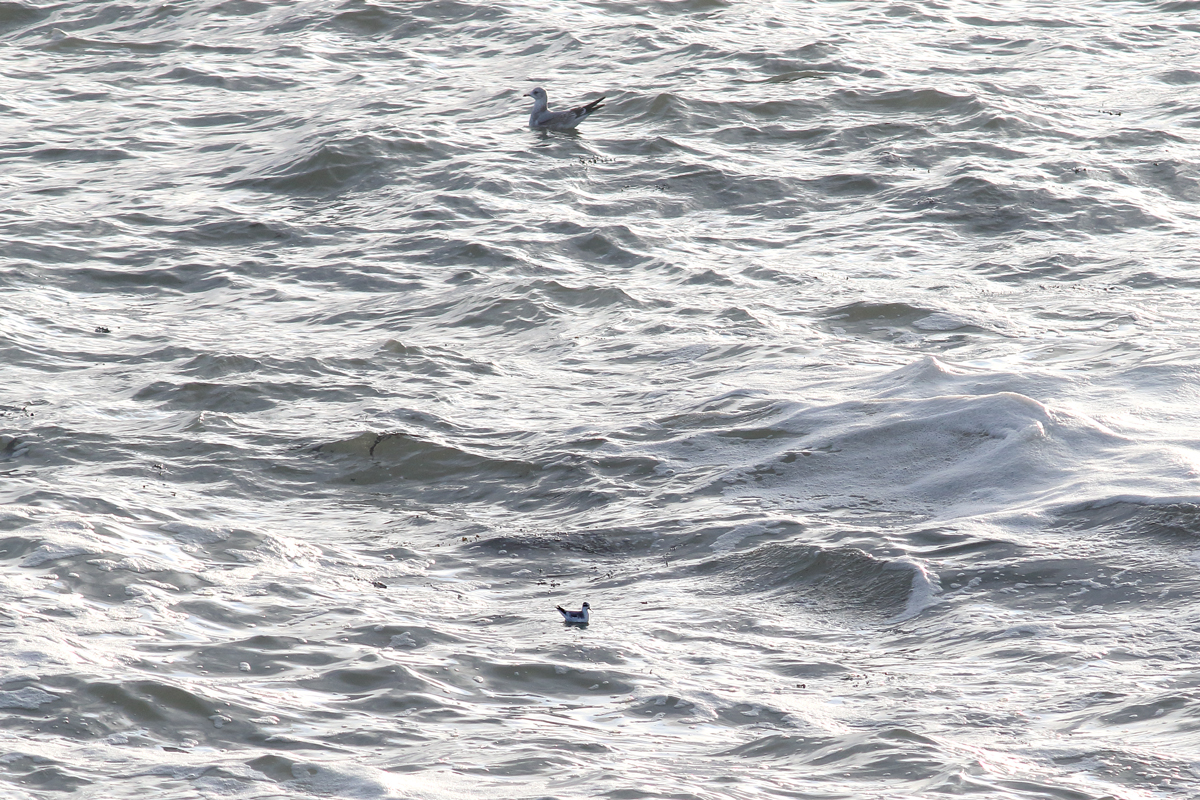
It was at this point in the lumpy sea a black and white dot caught my attention. An auk yes, but in summer plumage? I commented to John that there was a very black and white auk out there that appeared to be in breeding dress, but it was only giving peek-a-boo views over wave troughs and I soon lost it from view.

About half an hour later we were considering heading back to the car for tea when John called that he had the black headed auk in flight moving south. Before I tell the tale I must show this Tweet from me a week ago - 


This was in response to some photos posted last weekend. I stand by that. They were Common Guillemots.

Now that is out of the way, back to this morning. I immediately got on the bird as it came in and flew with a winter plumaged Guillemot south at breaker range. At Longhoughton Steel, the rock formation makes this still a few hundred metres out but it was a decent view in the scope.

For all the world, this bird looked like a Brunnich's Guillemot and that's saying something coming from a Brunnich's-sceptic like me!  

Giving a great comparison side by side with a Guillemot we followed their progress for a full NE to SE sweep of the view until gone. Compared to the Guillemot, it was shorter, more stocky. A completely oval melon with wings.

What on earth can we do with that. We didn't take cameras as it was dull and there wasn't thought to be anything to photograph so it was down to notes. I rattled off a scribbled field note and updated at home.

A genuine Brunnich's or a juv Razorbill? 

Later on, we had a look along to Seaton Point about a mile south of our first sighting. We counted 13 Purple Sandpipers, 8 Grey Plover and 15 Knot over flown by a Kingfisher on a rising tide, when John picked out our bird again. On the sea, like my first view, up and down behind breakers and waves only giving tantalising glimpses of a very black and white, black headed auk with a bright white wing bar. It showed nothing new to add to the notes. Then we lost it. It seemed to be swimming and diving southward but after about 10 mins of snippets that was it, lost in the ever more rough sea.

We wondered if this could be the bird seen by Daniel Langston a few weeks back? Who knows.

I just wonder, as I always do in these cases, just what would that bird look like if you could walk up and view it from 10 mtrs? Would the results remain the same?

Another hoodwink that got away....


Tuesday, December 08, 2020

Dull.

Spent Sunday morning along at Boulmer where I met up with John for our usual recce.

It doesn't get light now until about half past eight now so we hung around by the car park watching the sea and the waders on the beach. Two flocks of Red throated Divers flew N quite high up, 9 and 8 birds. A few Gannets were still moving along with single figures of Common Scoter and Eider.

On the shore were 18 Bar tailed Godwits, 244 Dunlin 1 Purple Sandpiper and a couple of Grey Plover amongst many others. Here is was worrying to see how much disturbance these birds get from people and dogs. While still dark first thing a woman with four dogs was striding along wearing a headlamp, throwing a ball from a grab stick for the dogs. They covered every single inch of that beach making the birds fly out and along to a different area before flushing them again to fly back.

Its not just dog owners either its the blind stupid too. 


This pair above just marched straight up to the birds feeding until they flushed, for no reason what so ever. There was plenty of room higher up the shore to walk without causing a disturbance. Luckily the Save our Shorebirds County Council Wardens were on duty so they caught up with these and many others and tried to educate them about stopping birds feeding during the short days.

We walked along to Longhoughton Steel where we sat and watched the tide drop back. Here we had 83+ Curlew, 72 Golden Plover, 8 Knot, 2 Purple Sandpipers, 8 Red throated Divers S, 1 im drake Long tailed Duck N .

When we headed back to the cars the wardens were still working hard, swimming upstream with a lot of bemused folk who are out of their own habitat. The sooner they can get back to the shopping centres the better.

Before we left, 3 Red breasted Mergansers dropped into the haven.

A slow morning full of frustrations...


Saturday, December 05, 2020

Looking Good.

 Its a few weeks now since I last had a seawatch, so with yesterdays low pressure settled over southern England giving us blustery, SE winds and rain, I thought I would try an hour today while Jane visited the hairdresser. December isn't renowned for good movements of birds at sea, but there's always a chance of something interesting like Grebe or White winged Gull to bolster the now flagging Local Patch year list.

I sat out at the usual spot on Cullernose Point. It isn't so good here late in the season being so exposed, so if the weather had been really bad, I would have sought shelter along at Craster, but the wind had dropped off to an E2 making Cullernose bearable.

After half an hour, I had added 3 Red throated Divers N, 2 Great Northern Divers S, 2 Goldeneye and a Common Scoter N but that was about it. Distantly a few tardy Gannets lingered.

What could I do to improve my lot? Cullernose Point has a short fast tide race only about 50 mtrs out with foam and pulled up seaweed flotsam that I have always thought looked good for a Phalarope. I moved to the point with my binoculars only and scanned down the cliff and into the bubbly water offshore...Although there is rarely a phone signal here, I pulled my phone from my pocket and hopelessly checked it. Interesting, a WhatsApp message had made it through. It was Ben down at Low Steads near Boulmer where he had seen a Grey Phalarope offshore that had then flown north towards Howick and was lost from view.

Great minds thank alike as I was already scanning for these little pelagic waders. With renewed effort I began another scan, and Bingo! There it was, a small Grey Phalarope bobbing and spinning like a cork in exactly the spot I have thought for years should attract a phalarope! Its not often a plan like that comes together but here I was watching a new patch bird for me, taking me to a record breaking patch total of 166 for the year.

Although a little distant for a photo, it was giving great views in the scope as it spun around icking at plankton from the surface, oblivious of the gulls hanging around and the big waves rolling in.

Fortunately the little bird lingered for over an hour allowing county year listers Dave Dack and Graham Sorrie to catch up with it having come 25 miles from Morpeth...

During a heavy hail and sleet squall, the phalarope looked even more tiny and vulnerable at sea, but it lust lay flatter and pointed its bill upwards into the deluge until it passed.


Thursday, December 03, 2020

The Raider

 Since I have been working from home, I have been watching the garden birds much more closely than usual, making some form of notes almost every day. Usually at this time I only see the garden in daylight at weekends so it is interesting to get to grips with what exactly is going on out there.

Take the Sparrowhawk for instance. This is a bird I assumed would visit occasionally to attack the bird table visitors, and Id see one maybe once a month in winter. What actually happens is that these birds are as frequent to our feeders as the Blue Tits! 

My kitchen window observations ( and the back bedroom window when I am at the computer) show that there are currently at least 1 juvenile female and a juvenile male making several visits each and every day. I was wondering why the seed feeders are often barely touched. Yesterday I had three sightings, 2 of the female and 1 of the male. Today there are no sightings yet but they are around. The other garden residents are very quiet or making those high pitched alarm calls, so the hawks are probably sitting quietly in cover waiting their chance.

Whilst this is a wholly natural process, my artificial feeding increases bird densities in this area, but the passerines seem to have a strategy for it in that most small birds have dispersed, I hope? My Tree and House Sparrows, for instance, are down to single figures of each, but not far away there are some game feed crops that attract seed eaters so I am hoping they have just gone there for a change. 

As birds numbers decrease, so the Sparrowhawks must also move on to find enough prey, allowing more birds to return, such is the circle of predator / prey relationships... I might give my feeders a move around into the other side garden at the weekend just to reduce the hawks familiarity with its ambush...


Monday, November 30, 2020

Stressful Suppression.

 For those of a sensitive nature, you may wish to look away as I am about to tease and suppress simultaneously.

Last night I set our el cheapo camera trap out for the first time away from the garden. What I caught on it, I am in two minds whether to publish at all, for fear of repercussions. 

But I will. 

The location is withheld as this species is severely persecuted up here, so much so that I have only seen two locally in 11 years. Please do not draw attention to this as I do not want to be plagued with calls asking for access, locations, drop a pin etc. I just wont do it.

So, keep shtum and prepare yourselves - 

Add caption

I wont write the name in case a Google search brings it up but I am sure you will identify it.


Sunday, November 29, 2020

Dip dip dipper.

 We are now in to the quiet dark days of winter sure enough. After a lovely sharp sunny frosty day yesterday, today was just dull, in more ways than one. Before I get on to today, a quick note about yesterday.

My garden view point.

Saturday was the #GardenBirdRace day on Twitter. Just like the spring lockdown version, a lot of people entered. At first I couldn't really be arsed and now I regret that a bit as conditions were ideal all morning with no wind, nice sunshine and  a sharp white frost. You could hear a pin drop a field away. As I fed the birds first thing, a Woodcock flushed from below our bird table. Its always good to get on actually in the garden rather than over it. While topping up the feeders, a pair of Grey Partridges flew along the back field, but that was about it. I had other things to do.

By early afternoon, some cloud cover had removed the brightness and all jobs were finished so I took myself outside onto the drive for a couple of hours. Here I soon racked up a straight 40 species without much trouble. The highlights were a total of 5 Woodcock, 2 Grey Partridges, 2 Sparrowhawks, Kestrel, a Brambling, 2 Yellowhammers, some Oystercatchers, our Tree Sparrows and the local Barn Owl.

Biggest misses were Magpie, Great black backed Gull, Meadow Pipit, Redwing and Song Thrush.

Some talk of county listing on Twitter the other day with my fellow Northumberland Birders, sent me on a twitch up the road this morning. Cetti's Warbler is a relatively new bird in our county and one I have only heard singing here in the past. For a British or County tick I like to see the first one, so there have been recent sightings only 6 miles north of us at Newton Pool that had us loitering around there this morning. To cut a long story short we didn't see much at all and Cetti's is still a gap on my list...but it gives me a target to claw back over the quiet weeks ahead, and one my peers already have so it would bump me up a notch...


A gloomy Kestrel this morning.

Tuesday, November 24, 2020

Weekend Catch up.

Late November and December are the absolute worst time of the year for me. After the rush of autumn, it feels that all hope is lost. At least when we get to January we are looking forward to longer days and the new things in store for us in the coming year. So, for the next 5 or 6 weeks I will be mostly bumbling around making the best of a bad job.

And so it was on Saturday. I managed a couple of hours out on the patch, so decided to have a sit and wait along at the Rumbling Kern. On the sea were 6 Red throated Divers and a Great Northern flew North out on the edge of science. A female Common Scoter loafed with a few Eiders and a couple of late Gannets also moved north. On the rocks, 2 Grey Plovers were my first on the deck here this year while 6 Meadow Pipits, 1 Rock Pipit and a Stonechat were in the scrub behind the cliff.

On returning to the car ( when time is limited I take the car all of half a mile to the layby) 3 Grey Partridges watched me and a pair of Mediterranean Gulls were with Black headed's in the fields behind.

A Blue Lick Bucket.

Two Mediterranean Gulls

Sunday dawned clear and frosty and stayed that way all morning. For a change I met John up in the Alnwick Moors for a wander.

As you would imagine at this time, uplands are generally devoid of life but its still nice and bracing plus there were no other people around.

1 or 2 Peregrines, a few Buzzzards, 2 Ravens, Crossbills and unusually, 2 fly over Snow Buntings were about all we saw. 

For those wondering how far I have travelled between flat coastal farmlands and conifer clad moors, its about 10 miles.

Crossbill

Ravens. Look at the conk on that.

Monday was my final day off. It was cold and dull, almost dark, all day so I didnt take any photos.

A walk from Boulmer up to Longhoughton Steel had a very close in adult Great Northern Diver, showing some summer chequer board pattern on its back, 1 then 2 Snow Buntings flew West and South respectively, an adult male Peregrine stooped and knocked a wader into the sea, distantly up at Sugar Sands, 1 Purple Sandpiper, 3 Knot, 10 Bar tailed Godwits, 4 Grey Plover, 400 Golden Plover, 20 Sanderling and 80 Dunlin were roughly counted but Redshanks and Turstones were scattered throughout. About 6+ Red throated Divers were offshore, and 30+ Common Scoter flew S.

Back home, a dog walk to our small pond showed an increase in Teal with 31 birds present.


Friday, November 20, 2020

Its all about the timing...

 I am on a days leave today. Using them up before the year end. Around 10 am I walked Peggy down to the small pond in the estate to see if the rough sea had put any ducks on it. It really is a small pool surrounded by trees so is never getting much, but a Gadwall or even a Green winged Teal is a possibility so I went for a look.

It was really quiet and still, very little moving. 14 Teal, a pair of Mute Swans, 3 Little Grebes and a few Moorhens were all I could see, then, at the very back along the edge, a Water Rail ran half the length of the pool into some bulrushes. Nice, to get a reasonable view here. 

We were about to continue our quiet stroll when there was such a rushing of wind noise! I almost ducked and looked around, it sounded like someone waving a branch around, nothing, then I looked up to see a big immature Peregrine in full speed stoop at a Woodcock! The wind rush was from its wings, it sounded like a jet. The Woodcock must have just come in off when the Peregrine stooped, luckily for it, it plunged into the willow scrub at the back of the pond, forcing the falcon to slam the brakes on and back peddle over the tree tops. The Woodcock was gone, and the Peregrine slowly made its way west without a meal.

On the way back up the track, I was giving the pond another look when a second  Water Rail flew right through my binocular view and landed in the same spot as the first. There was such a squealing in the rushes then silence again and the pond returned back to its usual self... a bit of lucky timing is always helpful

It is these small things that make watching a local patch so enjoyable. Its not always about rare and scarce...


The spot at the back where the swans are is where the Water Rails ran into and just left of there is the Woodcock sanctuary!


Thursday, November 19, 2020

American Pipit...

 Yesterday Clive Saunders, a local birder, was pleased to find a Water Pipit near where he lives, on the beach. That was until he posted it on Twitter and comments said the bird was actually a Buff-bellied Pipit! You'll get a Water Pipit there one day Clive!

Unfortunately work Zoom meetings prevented me from leaving the back bedroom cell yesterday, but when the bird was relocated this morning I put my plan into action. It wasn't much of a plan really, clock off, drive 12 miles, see bird, drive back and clock on. Give or take, that just about sums it up. It was a bit like one of the Lord of the Rings trilogy except I wan't attacked on route and it went much more smoothly.

On the beach opposite Links Avenue, Amble a small crowd of independent visitors all happened to be exercising in one place whilst keeping a mostly socially acceptable distance apart. It just so happened that the Buff bellied Pipit was also present.

A first for Northumberland, it was not even on my radar, though with records on the rise, maybe it should have been. It was quite a subtly distinctive bird, being easily picked out from the neighbouring petrosus and littoralis Rock Pipits and one or two Meadow Pipits along the strand line. As with all pipits it was giving those to who field craft is an unknown entity, the run around. I was pleased with my scope views in nice sunshine and even managed a few record shots...  


Another excellent bird, only 12 miles from home, it was my 5th new Northumberland bird this year. 

Tuesday, November 17, 2020

Wacky Wagtails 2


Cast your mind back all of three weeks to the 1st of November, Here, and that odd looking Wagtail on the beach at Boulmer. Today the sighting has really taken off.

Mark Eaton posted some images from yesterday that Ross Ahmed picked up on and contacted Per Alstrom ( stay with me, I'm almost there) who replied back to say the bird looked very like a Masked Wagtail x White Wagtail Hybrid. Masked is from Iran and Kazakhstan and such places. 

Needing no further encouragement, I went back on the internet trawling all over for information and images that might confirm our bird. The more I looked the more I sank in a mire of confusion and unknown info.

Some images on a Kazakh website looked promising and one from Dubai posted by Ross looked even better, but none were exactly like our bird. Just similar.

Then I came across a lengthy but readable Dutch paper on the seperation and identification of Pied Wagtail and White Wagtail. It contained some encouraging comments - 


 Wow. If we cant separate European birds that arrive here in good numbers what chance a Middle Eastern vagrant unless it was a field guide example.


And on it goes... these birds are really difficult.


Looking at this image above our bird is score 2. 60% chance it is a Pied Wagtail.Even giving it the benefit and scoring 1, It doesn't look like its come from very far really.

Then we get to upper tail colour. In my previous blog post at the time the dark upper tail made it a Pied Wagtail to me, then I was advised that Masked Wagtail also have dark uppertail coverts. Returning to the paper, there are so many shades of grey rump a kodak grey colour gradation is required to log them all.  

The Dutch paper goes on - 

For some intermediate birds, we do not really know what such birds are; they were collected far outside the normal range of yarrellii. They might be the result of interbreeding between alba and another taxon; in Asia, interbreeding has been recorded with personata, ocularis and baicalensis (Alström et al 2003) (Per Alstrom again) However, these three taxa show grey upperparts and rump (without black) in all plumages. In addition, these skins showed white neck sides like alba, while the combination alba x personata (the most likely type to occur in Iran, and sometimes referred to as ‘persica’) could perhaps be expected to show traces of the dark neck-sides of the latter taxon. Cramp (1988) also reports occasional black suffusion on mantle, scapulars and sides of breast in male ‘alba-like birds’, not only from western but also central Europe far from the breeding range of yarrellii.

So, here we are back to Masked x White Hybrids again, but no one knows what they really are.

When things get this complicated I wonder about making it simpler. If these birds readily hybridise, what would a Pied x White look like? Its infinitely more likely a proposition.


Until I found a page from our now gone great birder, Martin Garner - 

Wacky Wagtails   

Have a look. He and many others watched a bird on Helgoland in 2007 that looks like ours. Like me he considered subpersonata. After some thinking and discussion with top birders like Martin Cade and Gary Woodburn  et al they also provided images like the Boulmer bird, all taken in the UK.

What do these observers think?

They think its a PIED WAGTAIL! Back to my original result.

Oh dear, I think there are some individual creatures out there that will always have us flummoxed and you know, not all oddities are rare birds. Probably best to leave it as 'alba' wagtail sp... or even sub sp...


Monday, November 16, 2020

Its oh so quiet...

 ...but not so still with a moderate SW breeze blowing. It was fair until 11am when the heavens opened.

Down at Boulmer, we walked the Longhoughton Steel end seeing very little indeed. A Peregrine showed twice and 5 Meadow Pipits were on the main track but that was about it.

Back at the car park for tea, a female Merlin went north over the rocks, a male Red breasted Merganser was in the rising tide of the haven and the usual waders were on the shore with 80+ Dunlin, 5+ Grey Plover, 13 Bar tailed Godwits, 7 Knot and 300+ Black headed Gulls. 

One second year gull had us quizzing about Caspians and Yellow legged but it was just a Herring Gull.

A walk south to Seaton Point for a sit and watch type of thing. 3 Red throated Divers were offshore a nice plump Woodcock struggled in off the sea low and landing on the rocks before we lost it, then the rain began.

When we used to do our Winter Atlas tetrads, they began after 13th November, so I suppose this is the start of early winter. The weather forecasts some stiff  Northerlies on Thursday so they might produce more than the expected Little Auks, if it comes true.

So quiet in fact we were pondering a young Herring Gull for a while...


Friday, November 13, 2020

Hoodlums!

 The other night Jane was making tea when the dog took an unusual interest in the microwave. On investigation, the fattest House Mouse you could ever see popped out and ran back behind! We cleared the bench and with some deft keepering, using a coffee pot, the said bariatric rodent's freedom was no more...It was released several hundred yards away at the opposite side of our village.


I posted on here in July when I saw a House Mouse at our bird feeders, the first I had seen for many years, but now we may have the start of a colony. We will be keeping an eye on the situation...

Yesterday Paul Cassells found a Black Redstart on the coast just along the road from us. I was working and couldn't get away while it was light enough so we went to check it out today, at lunchtime. Unfortunately the coast path and layby were more like a scene from the Great North run with loads of people out enjoying lockdown so I didn't bother looking too far. It comes to something when we can't even walk around where we live because of people walking around where they don't! Some Lockdown.

The highlight of 20 minutes out was our semi resident Hoodlum, the Hooded Crow who lives in the vicinity of the local farm. It showed really well in nice light, even giving me some anti-social verbal abuse at one stage, befitting of his / her kind...what a star. Hoodlum was the 6th species of crow around our village today. It would be nice to get a Chough. 


Hooded Crow


Wednesday, November 11, 2020

A final flurry...

 On Sunday morning the weather was quite good for a late arrival of thrushes on the coast. It was misty with a light SSE breeze.

I popped down to Boulmer for a few hours from 8am and spent my time in the southern half of the patch, taking in the village down to Seaton Point and Foxton GC layby.

It was very obvious that thrushes were arriving in small numbers, some grounded and many continueing their migration westward. High flying Blackbirds, like Dunnocks, are always a fixation for me, these familiar birds spend most of their lives less than 20 feet from the ground, then in migration get up to good heights across open country. Isnt migration amazing!

Overall I counted 1 Brambling, 70 Fieldfare, 34 Redwing, 91 Blackbirds, 1 Mistle Thrush and 22 Song Thrush coming in. There was little else, I couldn't even flush a woodcock.

Looking out to sea, 3 Pintail associated with 8 Wigeon offshore and the usual common waders fed in the muddy patches between the rocks.

Monday was a return to the working bedroom office but as I have mentioned, I still had a couple of short dog walks locally. Along the coast path were 1 Woodcock, 12 Blackbirds, with another 10 in my garden eating windfall apples and a Brambling called from the small wood.

In the afternoon there was some excitement when young Dan Langston came up with the goods yet again, his razor sharp eyes never let him down, by finding a Dusky Warbler on the very spot on Seaton Point where I was counting Thrushes yesterday. It was later in the day and I couldn't get away from work but it was made easier when the bird was very difficult to see well in dead bracken and hawthorn.

Tuesday was similar, another Woodcock on the coast path with 2 Brambling, 8 Blackbird, 1 Song Thrush and a few Redwing calling in the fog over head. 

Lunch was a more leisurely affair today when I clocked off to nip along for Daniel's Dusky.

What an excitable bird. It gave us the run around for an hour, giving only calls and flight views or tantalising shaking bracken stems until it eventually sat out in sunshine for all of a few seconds. I wasn't quick enough with my camera but Dan was, capturing my exact view. Thank you Dan for not only finding another new species for Boulmer, but for giving me one of your photos too...check out his blog in the side bar...

You might need to click on this but its a nice 'birder's' shot of the Dusky Warbler by Dan Langston. 

Back home into the office, more familiar fare was in the garden as a male Blackcap fed on apples.

Its great to see the local season going out with such a bang!


Monday, November 09, 2020

Viz-mig.

Now that all of my work time is spent at home I can record some birds and wildlife on most days. Usually I would be away to the office during the hours of daylight so blog posts would be thin on the ground, not least because I see very little.

This week I have tried to have half an hour viz mig each morning, soon after sunrise, just along the road, maybe 100 mtrs, from our house.  This is not a hill top, an escarpment or an island in the landscape, its just a random bit of east coast that is 19 metres above sea level on a rise in the road. It gives a clear 360 view thanks to the decimated intensively farmed surrounding countryside.

The view below is facing north along the coast road. Migrating birds seem to follow the line of the road give or take a hundred metres so counting is pretty straight forward.

Not a usual viz mig spot.

My timings and counts are below - 

2nd November 0715 - 0745

Snow Bunting          1 S
Crossbill 6,4,6       16 S
Siskin 9,4              13 S
Goldfinch 15,9,6   30 S
Meadow Pipit         1 S  
Redpoll 3,1            4 S

3rd  1530 - 1600 
Whooper Swans 42,12,11     65 S
Didn't have time to count in the morning.

4th 0715 - 0745
Egret sp         1 S likley Great White Egret but no size comparison and bird backlit in morning sun. 3hrs later a Great White Egret flew south at East Chevington so it must have stopped on route?
Whooper Swan     10 S
Twite                     4  S

by 10.30am - 
Pink footed Geese 1800 S
Barnacle Geese         2 W
Skylark                     13 S

5th 0715 - 0745
Brambling         5 W
Meadow Pipit   6 S
Siskin                1 S
Grey Wagtail     1 S 
Song Thrush 4 new in.
Pink footed Goose all day total 2300+ S over our garden.
Crossbill           3 S

6th 0715 - 0830
Pink footed Geese 600+ S 6 N
Crossbill                    10 N
Pied Wagtail                 1 S
Whooper Swan 4, 9   13 S
Fieldfare                        1 W
Song Thrush                 2 W
Meadow Pipit                 6 S  1 W
Canada Geese                50 N
Great spotted Woodpecker  1 S high dropped in to the farm, may have been local?
Peregrine                     1 imm low S.

7th 0850 - 0920
Little moving.
Meadow Pipit    2 S
Rock Pipit         1 S
Redwing            1 W
Fieldfare             10 W


Not big totals but its great to see the change over of birds moving through our site. Soon it will be all over...

Thursday, November 05, 2020

Pipe and Fair Isle jumper...

Naturalists and birders. Does your hobby take you down a certain route into other fields? 

I see other wildlife observers who are well balanced people with other interests. Some have football season tickets or maybe go cycling ( when I say other interests I mean totally separate, ie you don't carry binoculars) . Some go to the gym or swimming or whatever.

How do you get the time? Everything I do in daylight or even to a lesser degree, in the dark, when not working, is in some way linked to the observation of natural history. The only things outside of that box are watching films, when I cant get outside, or listening to music, usually when driving to a birding site.

Every other thing I do involves another species. I take photographs, mainly of wildlife and the environment, I draw things, usually birds, I go for walks, with a wildlife target in mind, I read every day, texts linked to wildlife. We go on holiday, to an area where I know there is some wildlife I would like to see and so on. I never switch off and nor would I want to.

This might seem a bit geeky or obsessive, unhealthy even,  but there is still, variety in there with more than enough for two lifetimes of interest.

Drilling down further, does your wildlife watching have a particular interest within it? You might like the scientific approach or you might be a bit of a statistician, or a taxonomist. 

Personally I like the history of all things wildlife. If you are or have ever been an angler you will know of Mr Crabtree. He was a character drawn in comic strip form by the late Bernard Venables and it is evocative of times now largely lost with the main character teaching a young lad to fish in stew ponds and Mill Pools where the calm green waters reflecting willows have not changed since Constable painted them.


This is the version I am interested in, but linked to natural history.

The country written about by Richard Jefferies, Ian Niall and Watkins-Pitchford. All leafy lanes clad in dog rose and honeysuckle or coastal fields with thick hedges and migrants calling in the mist of an October dawn. Chaps with pipes and Fair Isle sweaters under a thick army great coat and ex-naval 6x30 binoculars.    Amongst the birders, Ennion, Richardson, Wallace, Alexander, Mountfort and others are read over and over again. They make me feel comfortable and give inspiration.

In a world swamped with media overload, smart phones, apps, nocmig, etc its great to get back to basics. As 'Lockdown 2: this time its tedious'  kicks in I'll probably find myself seeking solace with the old fellas. Tonight at dusk, I was walking quietly in the back field with Peggy, the local Barn Owl silently hunted the hedgerow and winking Pink footed Geese moved south overhead and all seemed well with the world... 

The Bird Catcher. Pen and Ink by Ian Niall.


Sunday, November 01, 2020

Pied Wagtails n'that...

The weather at Boulmer this morning was mild and windy from the south, with some rain bearing cloud and odd bright sunny spells.  

We headed north along the shore where it was getting less of the annoying wind. In front of the pub, there was no sign of the Black Redstart but two 'pied' Wagtails drew my attention. One in particular looked to have an unusual head pattern with shadows of the subpersonata race of Morocco. I know very well that Pied and White Wagtails are so variable in the autumn that to claim one of the rare races would mean the bird should be a classic 'nailed on' example and be well documented with photographs, so this bird, was likely just a nicely marked Pied Wagtail Motacilla alba yarrellii .

First impressions of the alba wagtail showing a nice white supercillium and unusually blackish ear coverts with a paler patch below the eye.

A closer look at it, shows it to be a female Pied Wagtail, but even with photos I am unsure of its age?

The blackish rear half of the ear coverts are quite unusual and I can't find any images online to exactly match this bird, but, variability makes things interesting.

Showing the birds right hand side, the ear coverts are not quite as dark as on the left.

The paler mantle has a White Wagtail look about it, but the blackish rump up to the first tertial is a Pied feature. White should have paler grey much lower down towards the tail.


The grey flanks are also a Pied feature. It looks nice and fresh so I suspect its an adult female, a male would show more black above than this. But what about that chequered face pattern? Very nice.

Above - the real article...

These alba Wagtails are very tricky. Is it any wonder they usually get put down as Pied Wag, so without further ado...


This one is an adult male winter Pied Wagtail, showing nice crisp fresh plumage with a primrose yellow tint to the face. The greater coverts all look very white and uniform and the tertials nicely edged white.. 

We continued along 'the front' towards Longhoughton Steel where an errant Halloween balloon flushed a male Snow Bunting from the beach that landed distantly out on the rocks. A Woodcock, fresh in from last nights full moon, lifted from the beach edge around the corner.  Apart from that it was generally quiet though the ever present Stonechats always brighten a sunny spell even further.

Stonechat along the beach edge.

Back at the cars we set up the scopes and checked the beach. As usual the waders were getting a right kicking from dog walkers, but hopefully this might be curtailed soon as there is a new beach scheme coming into operation to protect the habitat and its inhabitants.

This morning there were 31 Sanderling, 100+ Dunlin, 40+ Turnstone, 9+ Ringed Plover, 5+ Grey Plover, 10 Bar tailed Godwit, 1 Knot and loads of Redshank and Oystercatchers. Around the headland were 200+ Lapwings and 400+ Golden Plover.

The only viz mig were a few finches, with 13 Siskin and 21 Redpolls S. 

Offshore there were plenty of Gannets and a few Auks but no passage of note.

So, with another COVID Lockdown looming this week who knows what birding will be available. I am off work from Wednesday for a few days mainly to sort the garden out for winter but with a better looking weather forecast, I might just add another species to my Howick year list to break that record for a second year running...  


Monday, October 26, 2020

Boulmer Black Redstart.


Boulmer

With the clocks changing last night I met John at Boulmer as the sun rose shortly before 7am. It was cold and annoyingly breezy, still it was bright and fair.

We covered most of the headland before lunch doing the Seaton Point south end first via the road and then up to Longhoughton Steel after breakfast at the car park.

With the wind in the south, it was as quiet as autumn can be. Birders forget in the aftermath of a rush of good birds that our birding is solely based upon the vagaries of the weather. Had this autumn been southerly since August the story would have been very different indeed. We are in for a long 'hangover' from what has been a great season locally.

The female type Black Redstart was seen twice but was very elusive, giving only a short glimpse then off over the roof tops. The village front sea defences are a reliable spot for them in both migration seasons with one wintering last year. I wonder if this is that bird returning?

Black Redstart, then it was gone.

As we walked the road south a few Crossbills were on the move with 4, 3 and 7 all south, along with 5 Redpolls, 5 Siskins and about 20 Skylarks. A Willow Tit called from roadside scrub.

Along at Seaton Point we scanned the ploughed field hoping that the Desert Wheatear might have just been overlooked but there was no sign. We had 63+ Curlew, 41+ Lapwing, 200+ Golden Plover 3 Grey Heron and 2 Mistle Thrush.

Down on the shore were 50+ Dunlin, 44+ Sanderling, 12+ Ringed Plover, 7 Bar tailed Godwits, 3 Grey Plover and 2 Purple Sandpipers while along at Longhoughton Steel there was no sign of the Snow Bunting seen earlier by Ben, probably due to the dog walking masses being out. A very tame juvenile Dark bellied Brent Goose was nice on the rock edge grazing on seaweed.

A couple of Grey Partridge and a ridiculous Speckled Wood a mile from any trees were the only thing of note on the way back.

The sea had a few Gannets and Auks moving north but little else. Hopefully there will be a change in the weather early in November for a final flurry of migration action. We are always greedy for more!


Juvenile Dark bellied Brent Goose, Boulmer.


Tuesday, October 20, 2020

2020 Vintage.

 Since lockdown over the weekend from the 20th March this year, little did we know how the birding would pan out locally. As birders we all hope for big things at the start of the year, some on their local patches, some all over the UK for their British List. 2016 was a classic that we thought may not be beaten for some time, but maybe 2020 has pipped it to the post? It depends on where you go birding I suppose.

Northumberland has had a real cracker of a year, I think, rivalling those top hot spots like Spurn, Gibraltar Point, Flamborough etc for quality.

In my own area, Howick to Boulmer a distance that could easily be walked there and back, it has been the best year I can remember since calling them local patches back in 2005 and in all probability the best year they have ever had. Boulmer and Howick are now places that many birders have visited, some on multiple occasions, when previously it has been somewhere to drive past on the way up the coast. I don't think it will ever be an area that many birders will come to routinely, it is too out of the way and like many patches, 90% of the time has no birds worth the gamble, but they are sites worth remembering now.

Here are the noteworthy species seen since March...

White-billed Diver, Storm and Leach's Petrel, Great Shearwater, White-tailed Eagle, Hen Harrier, Quail, Spoonbills, American and Pacific Golden Plovers, Buff breasted Sandpiper, multiple Long-tailed and Pomarine Skuas, Sabine's Gull, Med Gull, Caspian and Yellow legged Gull, 8 species of Tern inc Sooty Tern and White Winged Black Tern, Black Guillemot, Little Auk, Water Pipit, Bluethroat, Black Redstart, Desert Wheatear, Blyth's Reed Warbler, Wood Warbler, Yellow-browed Warblers, Siberian Chiffchaff, Willow Tit, Golden Oriole, Great Grey Shrike, Hooded Crow, Raven, Mealy Redpoll, Lapland and Snow Buntings.

I can't believe that lot is all within a 3 miles radius of my back door! I may not have seen them all, but I am very pleased with my lot so far.

If you could be bothered to drive another 20 miles you can add Two-barred Greenish, Desert, Barred, Arctic, Pallas's and Dusky Warblers, multiple Red flanked Bluetails, Brown and Lesser Grey Shrikes, Little Buntings, Red breasted Flycatchers, Hoopoe, Short toed Lark etc.   

 As the nights close in and the trees and shrubs take on a skeletal winter appearance, are we done? November can be a decent month if the conditions are right, but if we get nothing else, 2020 will have been a birding year that others in future are measured by. 

Reading this back, I might have to re-post an updated version as a year ending piece...