Showing posts with label Craster. Show all posts

Wednesday, April 26, 2023

Spring. Its all a myth....


Its easy to get disillusioned with a local patch when you see reports going    on all around you of spring migrants teaming through. From our place, I see tales of waders, passerines and raptors popping up in all manner of parks, reservoirs and suchlike so when I step out into a stiff icy cold Northerly with no birds I am reminded that 'spring' on the          Northumberland coast is almost a myth. Its like those Christmas Cards of  Dickensian scenes when we look out on Christmas day to 10 degrees and    rain...

 But, there are some things that the weather cant hold up forever. Birds   that  winter in Africa and breed in the northern hemisphere will eventually battle through regardless, its just that Northumberland is one of the final places to see any.

On Sunday we headed out hoping that today would see some arrivals, and for once we were lucky. 

The route was from Cullernose Point to Craster in the hope of a Ring Ouzel or at least a Wheatear.

The view south along the coast from Cullernose.

As it happens, the first of 5 new patch birds for the year came before I had left the car park. A Willow Tit buzzed briefly from the blackthorn scrub then promptly vanished.

We moved one vehicle along to Craster then the other back to Cullernose for the walk north. At Craster a pair of House Martins were new and were looking a potential breeding site in the waterworks. 

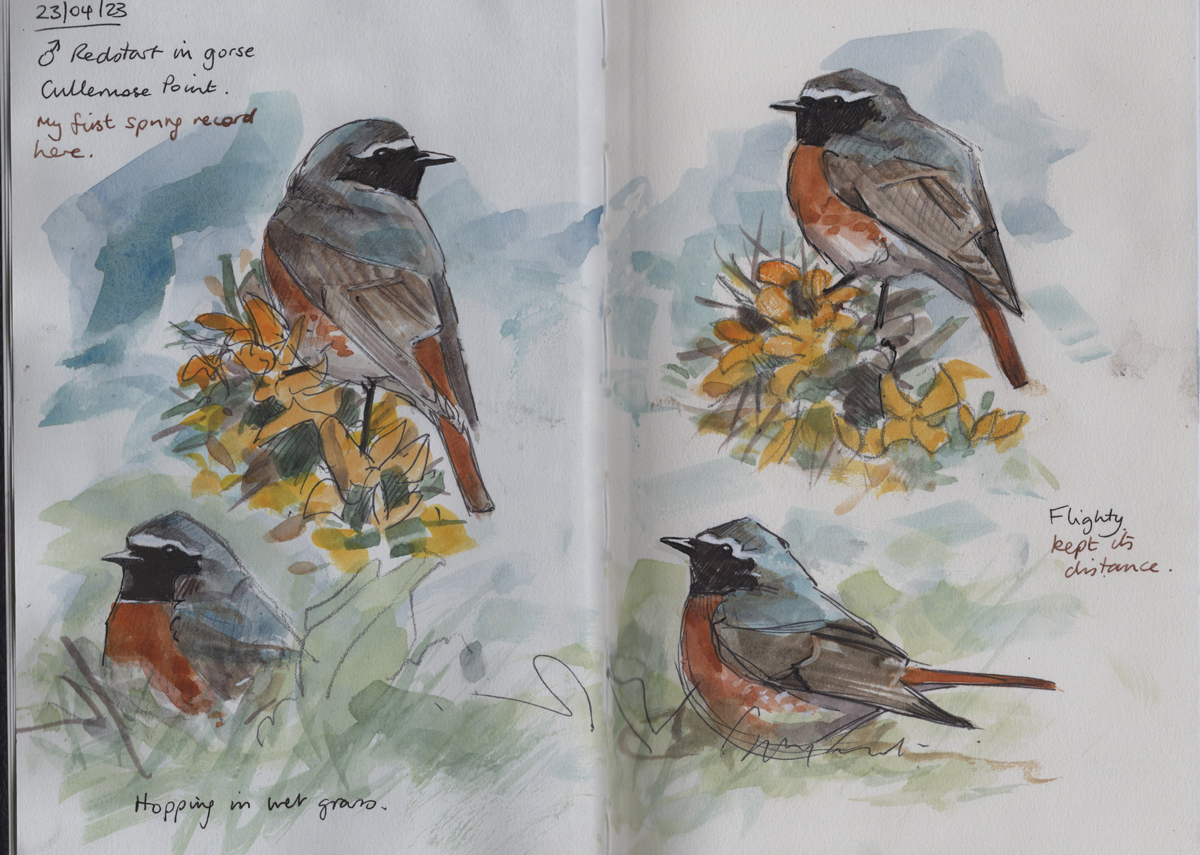
In these cliff hugging gorse bushes, above, is a short but sheltered farm access track that sometimes holds a few new arrivals. As we ventured in, a small bird flicked up off the grass -  a belter of a male Redstart! This is spring tame fare along the south coast but here it was my first spring Redstart in 14 years. Result. Further along a pair of Wheatears bobbed around on a pile of sand in the field, patch tick 4 in the first half an hour. Nearby a female Shelduck emerged from an open hay barn to meet her mate. No doubt she will have a nest behind the bales.

Redstart


The rest of the way to Craster held no more surprises, but the cover held good numebrs of Chiffchaffs, a few Willow Warblers and Blackcaps . The scrub here looks excellent and rarely sees a birder, including me, so I must make more of an effort.


This is the view just to the left of the top image. Dunstan to the left and Craster Heughs to the top right.

We walked around by the harbour and up into the Heughs where a rattling Lesser Whitethroat was the final addition to the year list. Roe Deer flushed and a Sparrowhawk flew overhead. All along, there was asteady but light northerly passage of mostly Swallows with an odd Sand Martin with them. 

As we drank tea and ate biscuits at the car, a report came through of a Crane flying N at Tynemouth and Whitley Bay. In the unlikely hope it might track another 30 miles we headed off back to Cullernose to wait it out. As expected, there were no further reports..

At midday, it was time for home, its seems spring has finally sprung after all... 

Eristalis intricaria Hoverfly on Blackthorn.

Razorbills loafing on Cullernose.

Roe Doe


Monday, January 23, 2023

Noddy...

As mentioned last Sunday, this week we would give my local patch a once over on Sunday morning to add a few species to the list.

The morning was darkly overcast and cold with a brief icy shower around 9am. 

I met up with JWR at our Village Hall  and headed down the road to Seahouses Farm. Th eplan was to get in position over looking the sea and rocks at Rumbling Kern shortly after first light. The plans were curtailed a bit as John had forgotten his bins, resulting in a cross country dash to his house to pick them up. As it happens, there was nothing lost because it was scarcely light by the time we returned.

Down on the Rumbling Kern we were soon joined by Daniel who obviously had a similar plan to us.

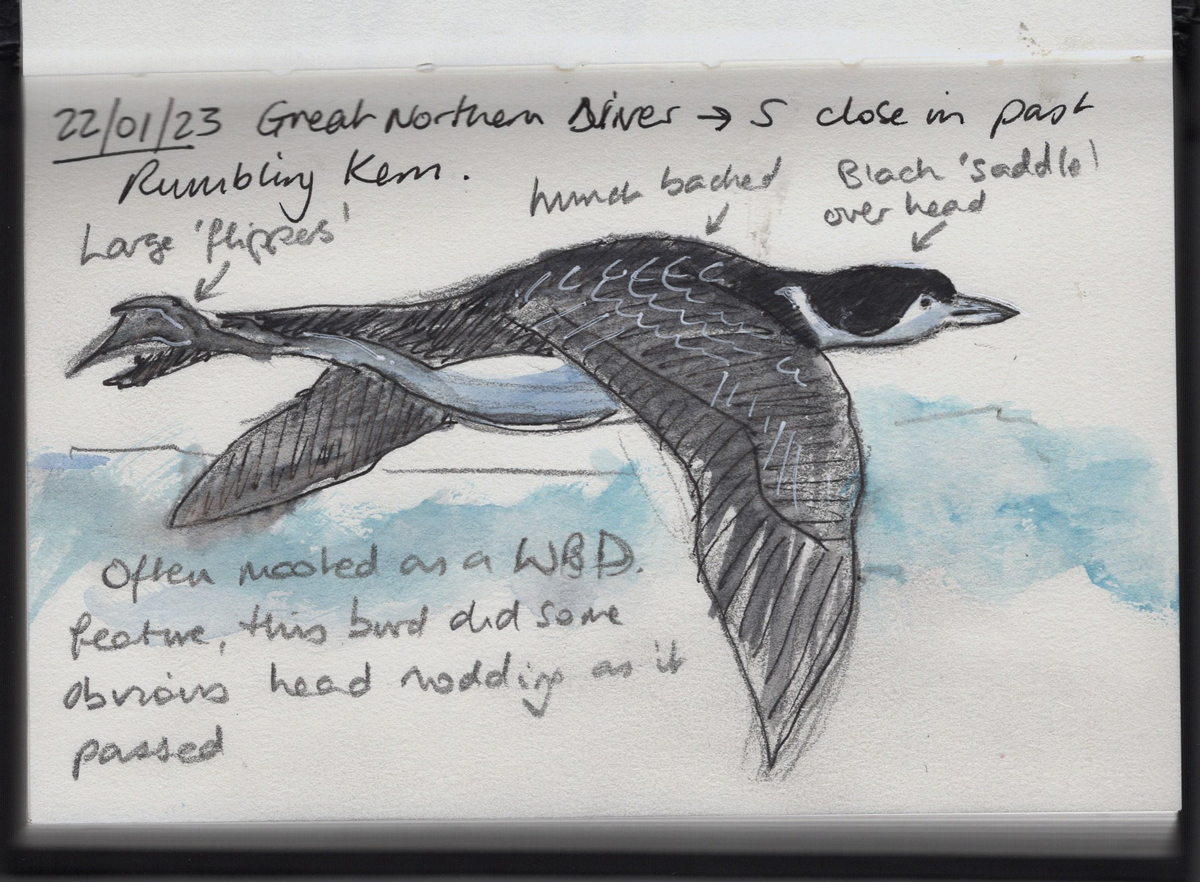
The sea was quiet but the few birds we did meet were mostly new for 2023 - Red throated Diver 4 on the sea, 1 south followed by a close in Great Northern Diver S giving a nice view as it passed. One notable thing about this sighting was that the GND was nodding its head all the way past. This is an oft mooted White billed Diver feature so beware, it does little to split the two.


 Also, 2 Razorbills close in and a light passage of Herring Gulls, though they may be just leaving a roost on the sea.

Down at the Howick Burn mouth statistically the  best patch bird of the day here was on the beach, a Ringed Plover! Just about annual but never easy on this rocky coast line, so a grounded one this early was very welcome. Surprisingly the same or another was seen along at Craster later on too.

A pile of rotting weed at the burn attracted a few passerines with 4 Rock Pipit, 2 Meadow Pipit, 5 Robins, 2 Pied Wagtail and a Blackbird, while 2 Grey Plovers and 4 Lapwings were down the shore. 

We walked back by the Teepee track seeing very little so we drove along to Craster for tea and cheese rolls.

Around Craster were 8 Purple Sandpipers, 1 Goldcrest, 3 Bullfinch, 2 Treecreeper and 2 Greenfinches.

That was the morning about done with 6 patch year ticks added - RTD, GND, Razorbill, Purple Sandpiper, Greenfinch and Ringed Plover. Total 86 sp.

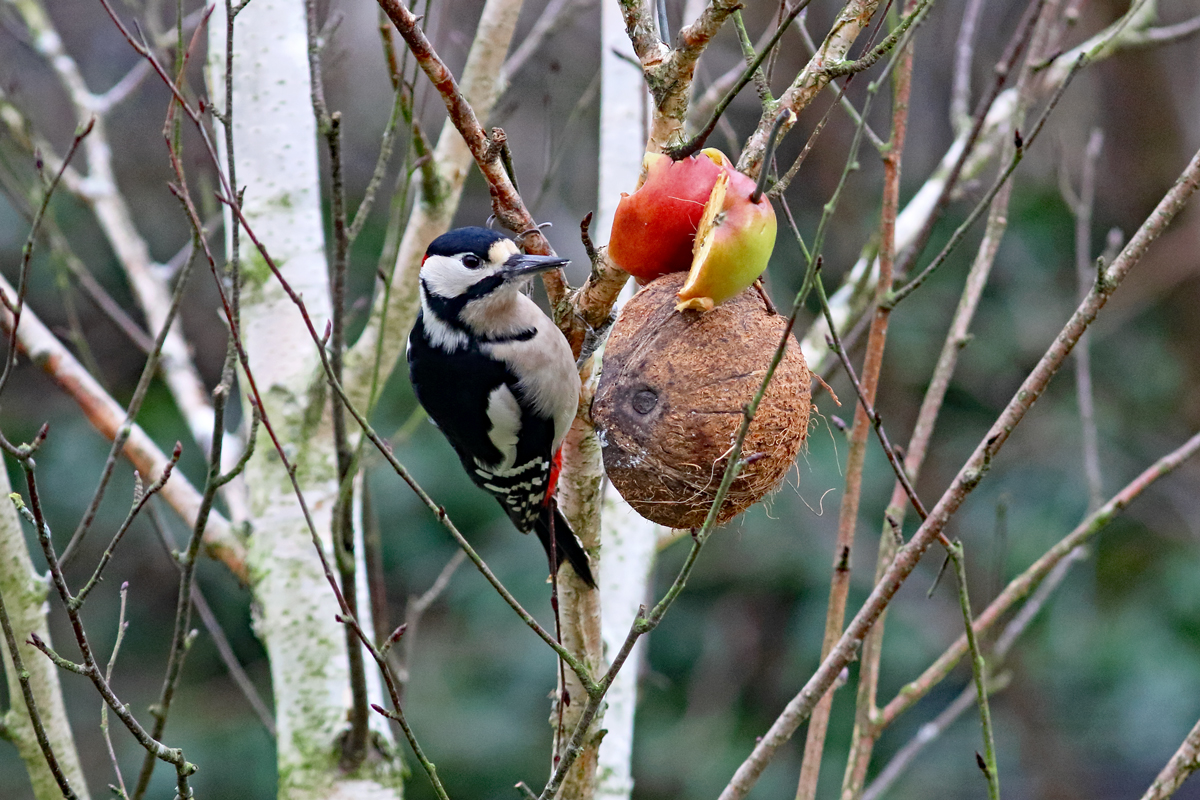
For the first time, I even charged the camera but t was a bt dull for photography really. Still, here's a Great spot from the window in the afternoon...


Tuesday, September 06, 2022

A local Easterly...

 Busy, busy, busy now that Autumn is in full swing and the wind has been from the eastern half over the past week. There is never enough time to do everything.

On 31st August I managed a couple of short seawatches at The Bathing House. An hour in the morning resulted in some decent birds with 1 ad Pomarine Skua, 1 close in juv Long tailed Skua, that bonked one of 25 Arctic Skuas on the head forcing it to land before moving away north. A great comparison of size and structure could be had during the interaction. 1 drake Velvet Scoter was a surprise  along with small numbers of Common Scoter, Wigeon and Teal.  It really is that time of year. 80 Manx Shearwaters completed the show.

It felt good so after work I popped down to Cullernose, but an hour and a half showed that most passage was now over. Still, 2 Long tailed Skuas, 14 Arctic Skua, 1 poss Pom but too distant and 30 Manx made it still worth while.

On Saturday 3rd September rain and easterlies looked good for an arrival of migrants to off we went to check the coast path area. Up at Holy Island and the Isle of May birds were falling in with plenty of scarcities too, but a random bit of mainland isnt really like that. We just hope for scraps really...in this case, I didnt even get those. No migrants at all, not so much as a Chiffchaff. Some compensation was had on the way back when I flushed a lovely Convolvulous Hawk-moth from the verge. It was soon pocketed and taken home for photos then released after dark.


Convolvulous Hawk-moth, one of our largest moths. 

Sunday 4th dawned foggy and mild with a light south easterly breeze. I met John at Boulmer where we were filled with hope of what the morning might uncover, after all this is a big headland into the North Sea.

The final tally is less than inspiring so here are the highlights - Curlew Sandpiper 1 juv on the beach with Dunlin, 3 Black and 1 Bar tailed Godwit flew S, 9 Brent Geese N at sea. The only passerine that got us going was an 'educational unstreaked acro' in a ditch near the car park. Doesnt that phrase make your heart sink? All I wanted was a Wryneck, not of this educational nonsense ( a phrase used to try and get some meagre enjoyment from stringing a common species). The acro turned out to be  Reed Warbler no matter how hard we tried. It is still a decent bird on this patch really, Ive only ever seen maybe 4 or 5 in the area.


Above -  Reed Warbler, top 2 mine, bottom one is by JWR a much nicer shot than my efforts. 


As the wind was set firmly from the east,a couple of days annual leave were booked for Monday and Tuesday.

On Monday a half hour sea scan had 8 Red throated Divers and 3 Arctic Skuas S with 1 Arctic N, but the glare from the sea was appalling so I gave up and went along to check Craster. On route back, a juv Peregrine went over N and a Whimbrel S .This is the north end of my patch and its not been visited much this year.

A good yomp around Craster Village fuelled with numerous juicy Brambles at last had a few birds.

Pied Flycatcher 2, Lesser Whitethroat 2, Blackcap 2, Calling phylloscs 12, non seen but 1 Willow Tit showed well. More insect migrants included 6 Red Admirals and a Hummingbird Hawk-moth.

The moth trap has produced some good stuff this week too but thats for another post...


Sunday, January 17, 2021

Craster via the Hips Heugh.

 This morning dawned clear, fine and cold. Just right for a walk into some of the less visited places around home. The loop from home to Craster and back is a shade over 4 miles, taking in the fields just inland to the north then back by the usual coast route.

Only half a mile NW of home are a few long term set a side fields. I always forget how good they look for feeding finch and bunting flocks and possibly some attendant raptors. Today they held a nice selection of passerines with 40+ Reed Buntings, 60+ Goldfinches, 30+ and 100+ Linnet flocks, 7 and 16+ Yellowhammers, 50+ Chaffinches and 6 Grey Partridges.

Some of the Reed Buntings in dock.


Above - Reed Buntings

Year list targets this morning included - Brambling, Greenfinch ( yes thats right), Red legged Partridge, Woodcock, Merlin, Peregrine and Willow Tit. Its fair to say that I largely failed with this lot, but there is plenty of time until spring to seek them out. Rome wasn't built in a day.

While watching the Reed Buntings the pair of Ravens came over, calling, much to the consternation of the local Jackdaws who got up in to the air making a racket overhead. The Ravens took no notice whatsoever and even did a little bit of a display flight in tandem.

Raven low overhead, calling.

Down into Craster, a pair of Collared Doves were my first proper local birds but the Willow Tits were nowhere to be seen. Off shore, 100+ Common Scoter were loafing around still, a carry over from before Christmas. 30+ Golden Plover were on the rocks and a Red throated Diver flew N.

On the Cullernose cliffs, a few pairs of Fulmars were chattering and squabbling. I might check to see if they actually breed this year as I have never seen eggs of young at this site, despite older reports of many breeding pairs here. 

As I came to the road home, a 'blimp' on top of the Hips Heugh peak turned out to be a Peregrine, that sat for some time watching pigeons and Jackdaws flying around. After failing to catch up with the other birds on my target list, I was relieved to add something to the patch list.

The view north from Craster to Dunstanburgh Castle, the northern edge of my local patch. 

Fulmars on Cullernose cliffs. No seawatching today.

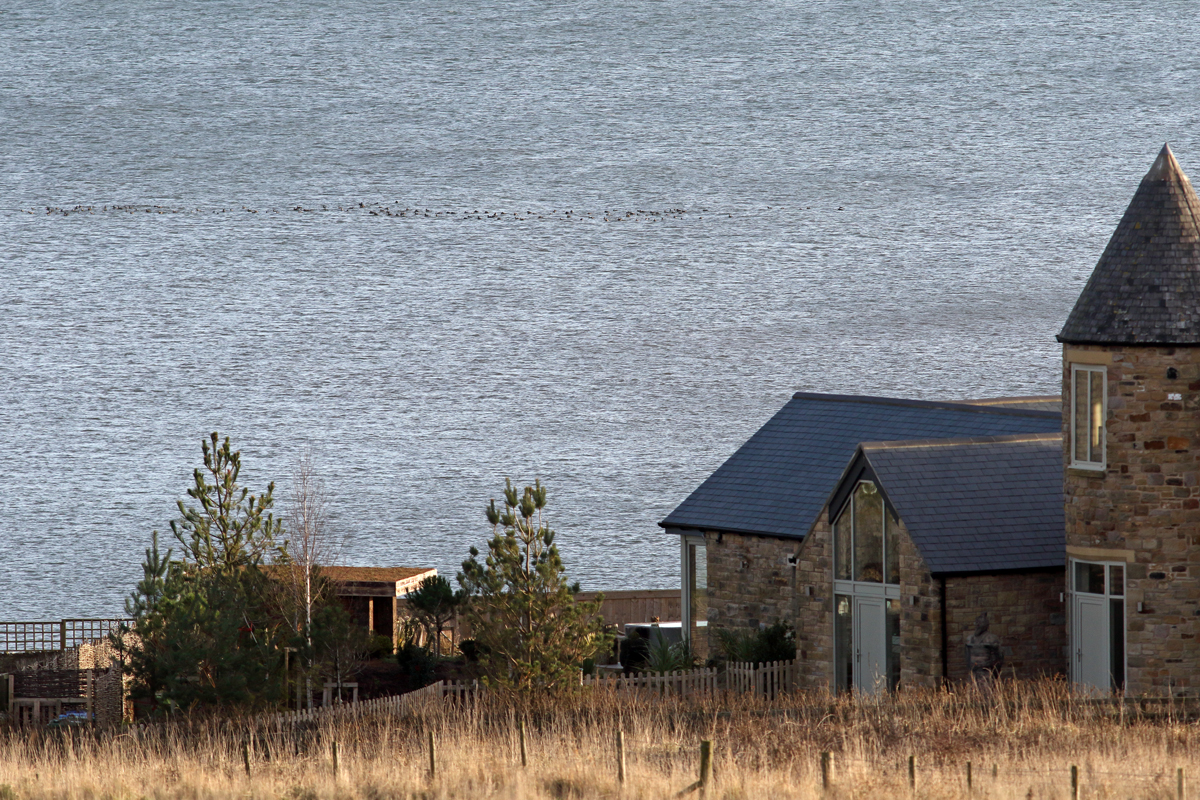
The Common Scoter flock just off the south end of Craster. Imagine living here !

The Peregrine rounds up the 5km list to a steady 100 species with a few possibles yet to be found. There are some spots I have in mind to target the list gap fillers, but they are tricky to access on foot all the way from home, but one of these weekends I'll drive part of the way to avoid walking on narrow main roads for any length of time.


Tuesday, November 05, 2019

First storm of winter or last one of autumn?

The view from my Craster seawatch spot.
The North East wind last night was a roaring animal, bending trees and stripping them clean of foliage. By the time I took Peggy for her first walk this morning, the rain had stopped and the wind, whilst still strong, had dropped slightly. The sea was enormous and roaring as the rollers smashed into the rocky shore. Balls of ivory foam were blowing along the coast road and over the fields.

This was too harsh for a Cullernose seawatch so I headed down to Craster where the view point is lower but has a bit of a wind break.

I watched from 09.15 - 10.30am. The passage was unremarkable, being so late in the season, but there was enough to keep the interest going. The list went like this with all birds going North unless otherwise stated.

Wigeon 8 N 9 S
Common Scoter 207
Velvet Scoter 1 fem
Long tailed Duck 3
Goldeneye 20
Red breasted Merganser 2
Goosander 1 adult drake 1
Red throated Diver 1 N 1 S
Great Northern Diver 1
Little Auk 3

All against a light movement of Gannets, Kittiwakes and larger Auks.


A female Velver Scoter moves N.
From here I decided to check the Craster Heughs for migrants before home for lunch.

First bird, not a migrant, but a bit of a patch mega these days was a Marsh Tit [161], calling and showing well, but I couldn't get a photo, it was too quick for me. This site is a Willow Tit hotspot with up to 6 birds present recently so where this lone Marsh has appeared from is anyones guess. A totally unexpected year list addition.

Real migrants were noticeable by their absence, but a few Blackbirds high in a hawthorn over the path were scrutinised. Then I saw that in the middle of them was a lone Waxwing! This will likely be the bird Ben had in the village on Sunday, but as it is a first for 2019 I was well pleased to get it. This makes Waxwing being added to every one of my patch year lists since I moved here in 2009 and this week is a prime time to get one.

Also here 500+ Pink footed Geese flew around to the west.


Above -  Waxwing, an adult male too. It never moved from this spot where every angle was obscured by twigs.
After lunch at home, I thought I had better just pop back out for an hour to Cullernose as the wind had dropped further and it had brightened up a bit.

From 1.10 - 2.10pm I had a nice selection even though most seabird passage had dried up.

Little Auk 6
Pomarine Skua 1 juv very close in, great views.
Common Scoter 7
Dark bellied Brent Geese 6
Long tailed Duck 6
Snow Bunting 1 imm male N then seemed to drop down onto the coast path further north, a good claw back after my off-patch birds on Sunday. [162]
Raven 1 over head.

So, not a bad day in the field really with 3 patch year ticks. At this late date, I'm sure my listing additions will be coming to a close...
Edit -I have just realised I am on 162, equalling my best year ever, 2010. Can it be, dare I say it... beaten?
Edit 2 - I have just updated my spreadsheet and it puts me on 163! After going through it species by species, I am confused... It looks like the record has been broken!!

The view south from Cullernose Point, the Howick Bathing House can be seen then Longhoughton Steel behind that.

Cullernose, the great whin sill cliff.

Goldeneyes and a Red breasted Merganser.


Monday, November 04, 2019

Sunday...

We are getting a lot of 'seawatching weather' recently. Some years we hardly get a day with a northerly. However, not all northerlies produce the goods and its a learning curve of experience to pick out good from bad.

I knew today would be a bad one. The wind was NE and gusty, and to the uninitiated seemed good, but, if you drill down a bit, it was coming off a low in the North Sea, not one that had tracked across the top of Scotland hence there was no pre-north westerly ( are you with me) to blow birds into the upper North Sea and then down further south so they can re-track North.

I know that sounds a bit garbled but I hope you get the gist.

We were on Cullernose from 07.30 until 0855.

It was slow.

Still, we managed 8 Little Auks, all nice and close, some landing in front of us, 1 Common Scoter, 2 Long tailed Duck, 1 Velvet Scoter, 2 Red throated Diver, 2 Goldeneye, 5 Fulmar inc a likely Blue phase going S but only see from its arse end as it disappeared, and 5 Eiders.  Gannets and Auks go without saying.

From here we headed along to Craster for some shelter and maybe some passerine action. We had the shelter.

There had been a reasonable fall of thrushes with 30+ Blackbirds, 8+ Redwing, 4+ Song Thrush, 3+ Fieldfare but no small stuff, not even a Chiff or Blackcap to be had.

Best of the walk were 3 Snow Buntings N, just about 300 mtrs out of patch boundary ( they flew from the patch but I was neither in it or saw them in it so they don't count. 6 Willow Tits are good by anyones standards these days and 7 Grey Partridge, 1 Treecreeper and 4+ Goldcrest added interest.

Time for home I stopped at Johns car back at Cullernose. A short scan of the flooded newly sown field had an adult and a 2nd winter Mediterranean Gull, then just before leaving the mega arrived! A Little Egret [160]no less flew low over the fields and off north! Thats patching for you, only my 4th sighting here in 10 years and one I didnt have any hope of adding to the 2019 year list...

Off work on Tuesday and the weather forecast looks dog rough.... wave watching likley...

Monday, October 21, 2019

Seawatching. In context.

As I indicated in my previous post I was keen to get out on Sunday morning as the weather looked good for some sea passage. Through the night the wind rattled the windows and the rain hammered down.

I met John just along the road at Cullernose but the storm was too great for watching this spot. At Cullernose you sit on an exposed cliff top with no shelter at all. In this north westerly gale and driving rain it would be impossible, so it was a move along the coast, all of 1 mile, to Craster village where there is some shelter behind a stone wall over hanging with garden shrubs. Even better, John had brought his large Fishing brolly purchased just for this type of occasion. What a life saver it was too, we were both tucked out of the rain, on deckchairs with a good view of the sea.

There were not as many birds as I would have expected in these conditions. Still, we watched from 07.45 until 12.00. In this filth what else could we have done?

So, what did we see?

Auks. Lots of auks. We have been Seawatching in Northumberland for the last 30 years so we dont record every bird passing. It would be just too much. Auks, Gannets, Kittiwakes, Fulmars and Shags are routinely ignored as we look for more tasty targets. Maybe thats harsh, not ignored but not counted.

There were thousands of auks heading north with fewer, but still a good number, of Gannets moving with them, the sea a constantly changing vista of bird movement. In with them were...

Whooper Swan 41 S
Wigeon 34 N there hasn't been a good movement of ducks yet this autumn.
Teal 17 N
Mallard 4 N
Goldeneye 17 N
Long tailed Duck 6 N inc some nice drakes very close in.
Common Scoter 7 N
Velvet Scoter 4 N
Red breasted Merganser 3 N
Red throated Diver 12 N plus a few on the sea, but too rough to get a count.
Ringed Plover  2 N
Sanderling 1 N checked for Grey Phalarope, but this is still a scarce bird on my patch with its all rocky shores. Not seen since 2015 [156]
Purple Sandpiper 4 N
Bonxie 1 S very close in milling around.

A second watch for a short time in the afternoon only had 3 Red breasted Merganser and 1 Bar tailed Godwit N

Only Sanderling was a new addition to the year list.

Today was better. The wind had gone right off leaving a pleasant morning with grey overcast skies giving good light for the morning watch.

Today I watched from Cullernose Point 0820 - 1120.

It was clear that more birds were reorientating North especially wildfowl.

Dark bellied Brent Geese 2 N
Shelduck 6 N
Wigeon 258 N
Teal 37 N
Mallard 16 N
Scaup 1 fem N with Common Scoter. [157]
Goldeneye 5 N
Long tailed Duck 4 N
Common Scoter 142 N
Velvet Scoter 3 N
Eider 5 N passage birds, not our harbour locals, they dont get counted loafing off the rocks.
Red breasted Merganser 6 N
Red throated Diver 9 N 1 S
Black throated Diver 2 N with a single Red throat very close in, for comparison.
Great Northern Diver 2 N
Fulmar 1 N at this quietest time for them.
Manx Shearwater 2 N
Sanderling 1 N with 4 Dunlin, two in 2 days is good.
Purple Sandpiper 2 N 1 on the rocks with 2 Golden Plover.
Dunlin 19 N an excellent count here, best for a long time.
Bar tailed Godwit 2 N
Bonxie 2 N
Kittiwake, good numbers, much more than yesterday.
Little Gull 17 N with adults and first winters seen.
Herring Gull ssp from mid morning many, almost all first winters moved N, not counted.
Auks sp less than yesterday but still a lot N.
Little Auk 8 N max 3 at one time.
Puffin 10 N of the auks identified.

Its in a Local Patch context some of these birds come into their own. For example, Ringed Plover, Sanderling, Dunlin and Bar tailed Godwit are all more tricky to see here than Velvet Scoter, Little Auk and Purple Sandpiper even though they are very common over most of the Northumberland coast north and south of me.

What was missing? Pintail are often in Wigeon flocks but not today. Grebes, all being very scarce here except Little. Pomarine Skuas. In these conditions I would expect a few at this time of year.

All of these give something to watch out for during the next northerly spell we have. Hopefully before mid November...

Patch list stands at a very respectable for here 157 species...77.72% of my all time total.


Sunday sewatching from under Johns umbrella, Craster.

Sunday, February 03, 2019

Cold Weather List.

At this time there is nothing like a short sharp spell of cold weather to give the Local Patch list and the patch lister a good shake up.

This weekend has been cold, often below freezing and snowy, more so inland. This has the effect of moving some birds around the countryside as they look for some frost and snow free grass nearer the coast.

On Saturday I was hoping to add the two winter thrushes to the list. On the north east coast they have moved off to the south and west by now so without an arctic blast can be tricky.
In the morning there was no sign but mid afternoon saw the expected arrival of 40 Redwing and 15 Fieldfares into the village. As a bonus, a Water Rail gave its demented mammalian squeal from the ditch running alongside our lane. I stood a while but viewing is difficult. A nice count of 41+ Tree Sparrows were at the garden feeders.

This morning the weather was clear and fine but very cold. The remaining snow was frozen onto dry surfaces. Thesed are the nicest of winter days.

We began at Craster with the intention of relocating the Firecrest but we didnt have any luck. I will keep at it because I think it is a wintering bird so hopefully wont have gone too far. As we looked a Peregrine flew steadily North along the heughs and the village was ringing with Willow Tit calls. At least 5 birds were calling, one of these also went into song for a while.


Tree Sparrows at the garden feeders.

Barn Owl

Kestrel new out of roost with the bully boys waiting.

Song Thrush. A few around today.

A few Goldcrests but no Firecrest.

Great to find so many Willow Tits here including this one singing.
A Barn Owl hunted the paddock and field edges in bright sunshine flushing maybe 15 Meadow Pipits.  The second patch Ringed Plover of the year was in the harbour. This is a good show for this less than annual species here. 8+ Crossbills flew high west, their calls echoing around the rocky cliff faces. Finally 2 Collared Doves were singing from telephone poles in the estate.

We then moved back along to Howick to check some stubble fields for buntings. There were plenty of birds but no scarcer species. There were 20+ Meadow Pipits, 27+ Skylarks, 15+ Linnets, 2 Stock Dove, 200 Golden Plover, 166+ Curlew and 44+ Redwing. 5 Yellowhammers and a Reed Bunting were in the farm yard.

Back at home the view from our kitchen and bathroom windows into the back field gave 4 Fieldfares, a Redwing, 2 Golden Plover, 1 Lapwing, 1 Curlew and 6 Black headed Gulls in a place usually devoid of bird life.

So thats another 7 species added to the list. With common wintering species now drying up, maybe the next few weekends will give something with a bit of zest?


Monday, January 21, 2019

Patch on Fire!

A flexi day off work that coincides with a clear fine frosty day can only be a good thing.

Peggy's walk this morning was down to the Pond Field via the Village Wood. On of the first birds of the day was a Woodcock that lifted from path side vegetation. Soon after that 5 Crossbills flew around some tall scots pines then away over the pond. The pond itself has 75% frozen though not heavily so. The open water held the usual 10 Tufted Duck and 3 Teal plus the male Gadwall was still around. 2 Stock Doves were displaying from tall beech trees.

We returned home and I dropped Peggy off in the house and popped down to Craster to check the northernmost end of the patch, hoping for Willow Tit and Collared Dove. Both of these remained elusive but its something to watch out for during the February doldrums. It was here that my best surprise of the month appeared.

I was only 30 yards from the car along the road when I saw a Goldcrest flickering around in some gorse next to the path, just over a stone wall. Nice, I thought, it might be worth a photo. As I lifted the camera and pressed the shutter to focus I was aware that there were two birds close together in the bush. Through the view finder the camera clicked into focus on a Firecrest! It flew as I pressed the button, chased off by a beligerent Goldcrest. I soon relocated it a bit further along the path though this time further back on the top of the gorse where viewing was very tricky. I managed a few photos over the next 15 minutes before I lost sight of the bird in the thorny scrub. I stood for quite a while but it didnt show again.

The Firecrest spot beside the road.


Male Firecrest in gorse, Craster
This is only the second time I have had Firecrest on patch since the last ones, 2 together, in 2010 at the end of the long walk.

This little one appeared to be a nice bright male with a bright orangy crown stripe.

As I watched, a Raven cronked low overhead. I decided to move on down to the harbour. Here 4 Purple Sandpipers and 12 Turnstones were the only thing of note.

Three out of four Purple Sandpipers 


Raven overhead, cronking.

Its been a good weekend here with  several good patch ticks -

Velvet Scoter
Barn Owl
Woodcock
Firecrest
Raven
Purple Sandpiper

plus Reed Bunting, Snipe, Sparrowhawk and Stock Dove bringing the 2019 Local Patch total to a respectable 82 species. With another weekend left of January and common species such as Redwing, Fieldfare, Collared Dove, Meadow Pipit and Skylark to get, I might reach 90 yet...


Sunday, March 18, 2018

BFTE II

Just when we thought winter had gone out with a bang, it seems to be one of those prog rocking winters with an ending that goes on way beyond the allotted time span.

Yesterday and Today have been about as far from spring as you are likely to get in mid March with 50mph winds, freezing temps and a steady stream of snow blizzards.

Still, I popped out this morning checking the coast at Boulmer and Craster but there werent too many birds about.

At Boulmer, the mere has flooded half the field. A nice Lesser black backed Gull was the only spring arrival here amongst 80+ Curlew, 20+ Golden Plover, 38 Bar tailed Godwits and a Peregrine fly by.

Up at Craster, many hundred of gulls feeding in the frothing surf still failed to turn up any thing out of the ordinary though there were 500+ Black headeds, 50+ Herring, 50+ Common, 6+ Great black backed Gulls and a Kittiwake. A few Gannets ploughed into the wind, moving south, my first of the year.

We found our third dead, emaciated, Song Thrush in the village this morning. Three in about 2 weeks. This one had nothing left on its bones, just a wisp of skin and feather. The sooner 'the beast' is forced back east, the better.

The Swallows will be back in 4 weeks...