Showing posts with label Guided Walk. Show all posts

Sunday, March 26, 2023

Guided Walk


This weekend Jane has been away on a jolly with her friends so that leaves me in charge. After the dog that is. 

Yesterday I was leading a guided walk for Alnwick Wildlife Group on a 3 miles circular route from our Village, taking in local woods, farmland and the coast path. When committing to a guided walk, I always try to have an idea of what to look for and where so people can get the most out of it, but that rarely works out as you'd expect. The other week I added a short note to the AWG newsletter describing the route and what to expect.  

Largely flat walking with some muddy paths so suitable footwear required. 3 miles. Village Hall available for an hour on return for loos or people to catch up, eat their lunch, have tea or whatever? The route will start off inland with fields, woodland etc. Then down to the coast and south back to Howick.

Weather permitting, I’ll put a battery moth trap in the Village Wood to check on the way through. 

There should be some spring flowers with the likes of Marsh Marigold, Lungwort, Primrose, etc. Maybe some early Bees, with Hairy Footed Flower Bee as well as Bumblers. Chance of an early hoverfly too. Woodland birds singing, Woodpecker drumming, Buzzard, Jay, Nuthatch. Chiffchaffs often back by then. Raven possible. Roe Deer, Brown Hare maybe.

Down to the coast with Fulmars and Kittiwakes back at the cliffs.

What I cant predict, a month in advance, is the weather. After a week of generally mild and fair days, it was all change on Saturday with a fresh, cold NW breeze and some short sharp showers to spice things up.

So, how did it go....

Well, the previous night was quite mild and only a light shower was on the menu so the battery bucket trap was deployed into the wood while the Robinson was on our drive for the Garden Moth Survey as usual. The walk was due to start at 9am so at 8.15 I gathered both traps in and took them to the hall. It was dull and cold with rain until 10am, so my plan was, if anyone turns up,  to go through the trap in the hall until the rain eases then we can head off. If no one turns up, at least I am about 100 mtrs from home.

I need not have worried. Regardless of the return to winter, 21 hardy souls filled up our small car park and were ready to be shown local wildlife. 21 is quite a few, and maybe a few too many but at least we will get a walk out of it. The observer experience in the group varied from seasoned experts in botany, environmental, ecological surveys and birders all the way to beginners looking at nature with all levels between.

Now I look at my advert, its wasn't too far off the mark really except for the invertebrates that were never going to be out and about in this weather.

To begin with, there was a nice selection of regular early spring moth species to show. Everyone seemed to enjoy this part and it was a great way to start the walk, now at least most people had seen some new stuff!

The combined two trap catch - 

Taxa

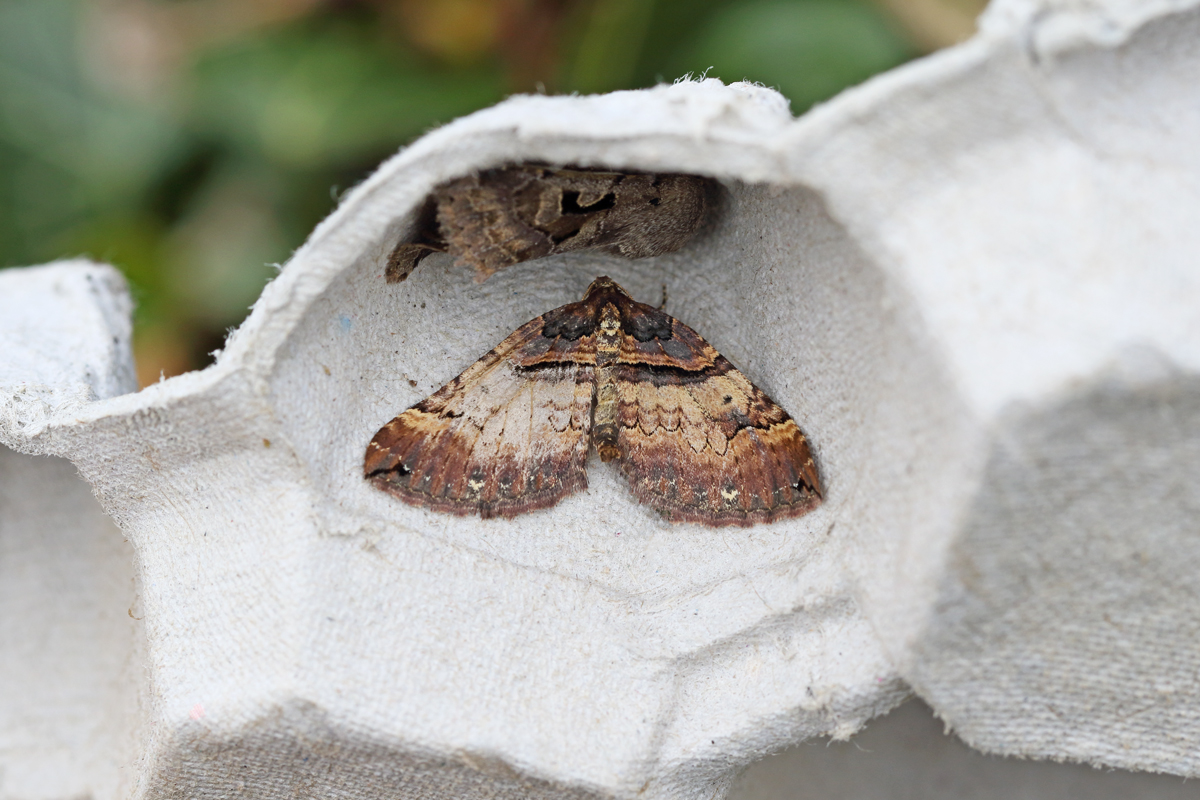
70.066  Shoulder Stripe (Earophila badiata)  1

70.101  Mottled Grey (Colostygia multistrigaria)  1

70.103  Water Carpet (Lampropteryx suffumata)  1

70.156  Brindled Pug (Eupithecia abbreviata)  7

73.069  Early Grey (Xylocampa areola)  8

73.194  Chestnut (Conistra vaccinii)  6

73.241  Pine Beauty (Panolis flammea)  1

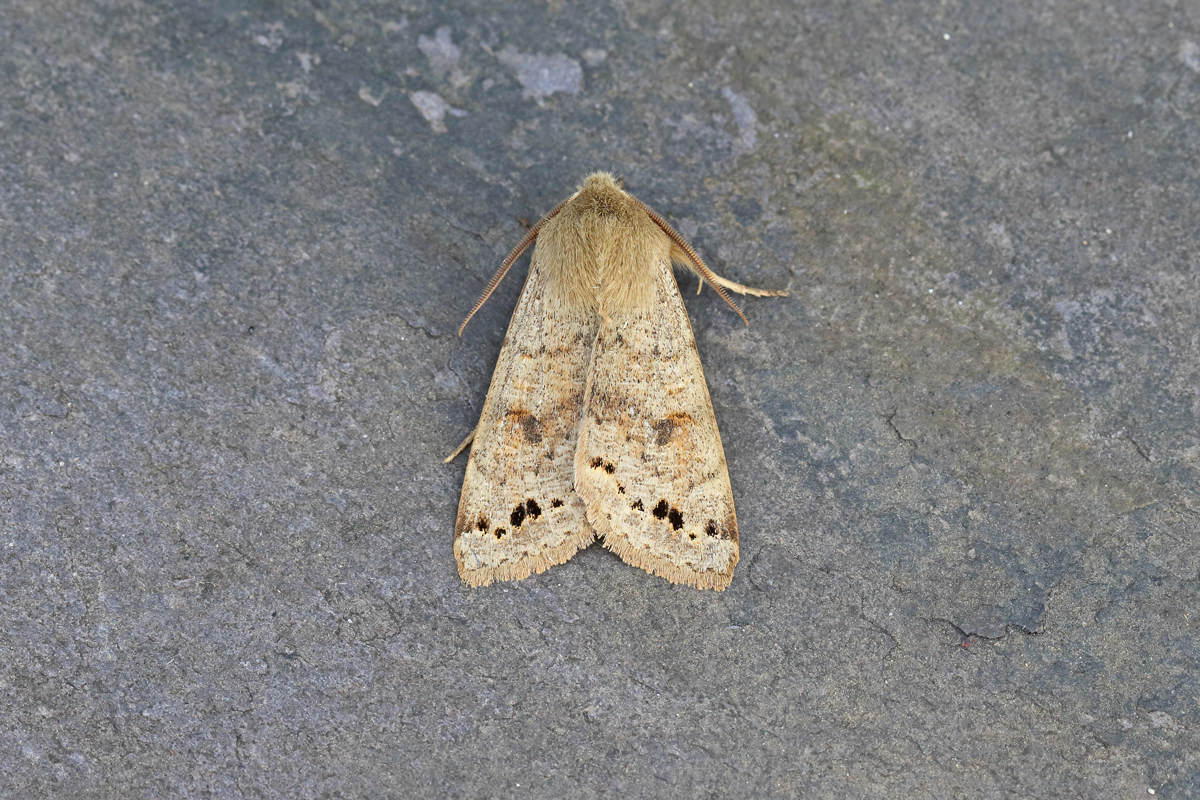
73.242  Clouded Drab (Orthosia incerta)  2

73.244  Common Quaker (Orthosia cerasi)  11

73.245  Small Quaker (Orthosia cruda)  4

73.249  Hebrew Character (Orthosia gothica)  46

73.250  Twin-spotted Quaker (Anorthoa munda)  3

73.336  Red Chestnut (Cerastis rubricosa)  6
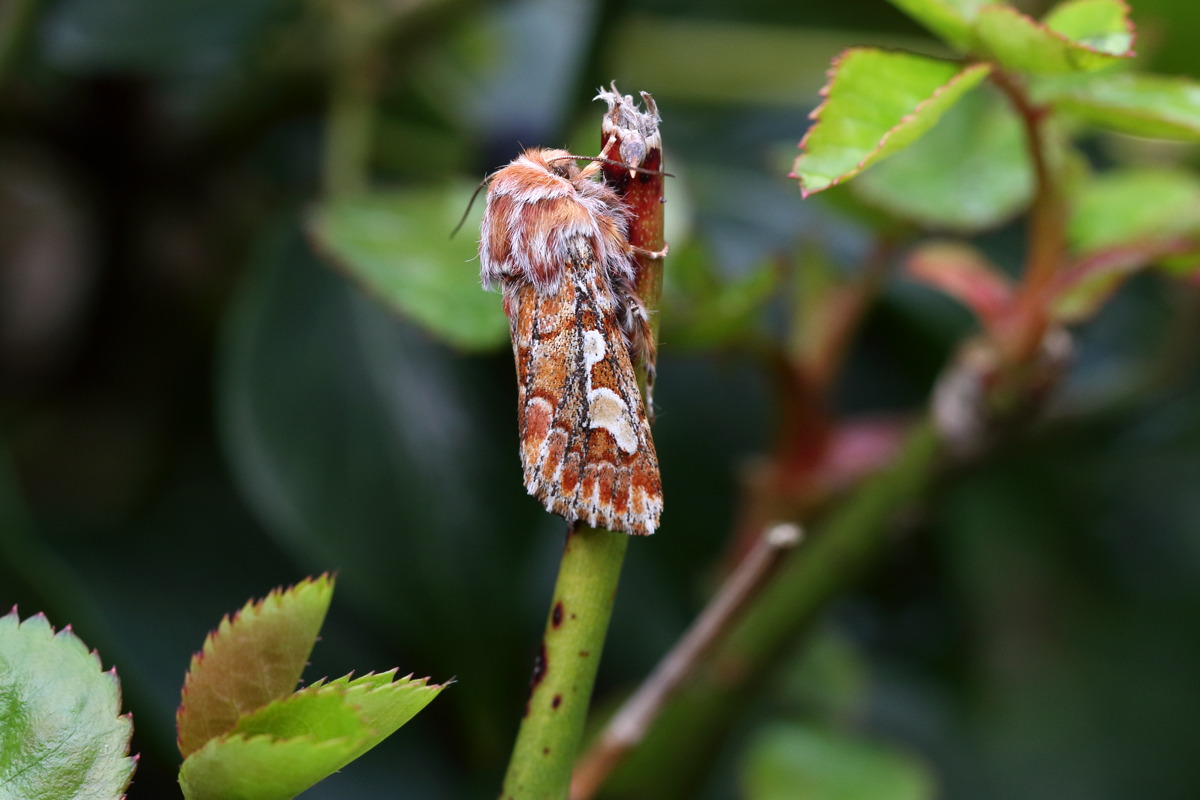
Pine Beauty

Shoulder Stripe with a Hebrew Character hidden above.

Twin spotted Quaker

The muddy route wound our way up through Village Wood where the first Marsh Marigolds were in flower, 4 Chiffchaffs had been singing earlier but not a peep when the guests were here, the Badger set was inspected as were a few of the introduced trees.
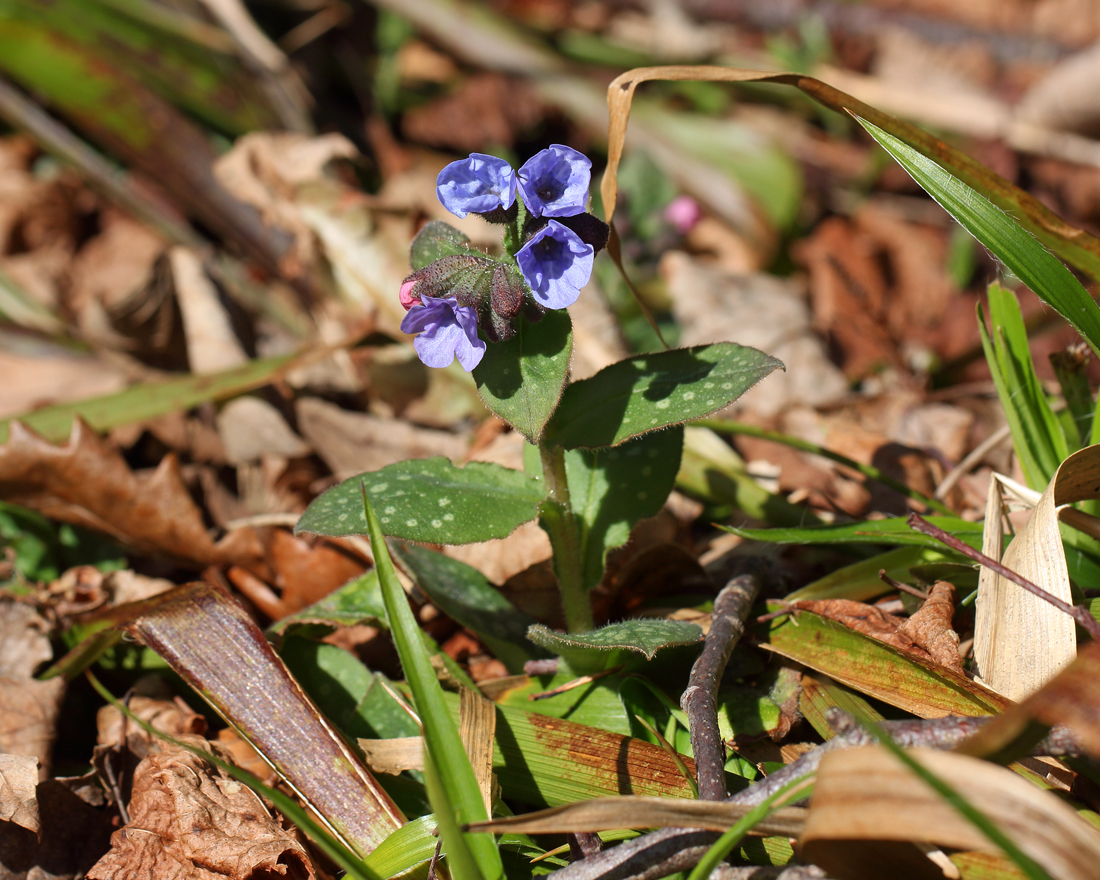
Out at the top we optimistically checked a flowering patch of Lungwort for bees, but that was never an option today. The flowers were nice...

An older Lungwort shot in better weather.

Walking the track north, Butterbur were just beginning to flower, whilst a Roe buck watched us as carefully as we watched him. Other plants such as Opposite leaved Golden Saxifrage and Holm Oaks were given the once over too.

Here the track takes us back east to the coast over exposed farmland. A few Skylarks remained in full song defying the weather.

We reached the coast just south of Craster. From here a party of 8 or more Bottle nosed Dolphins gave prolonged views, the group included a few juveniles too that everyone  was pleased to see. A few birds were noted now, with a bathing Purple Sandpiper, 1 Red throated Diver and a few Shag S, strings of Gannet N, a few Eiders, 2 Canada Geese S ( a patch year tick for me) and a flock of 15+ Sanderling N ( also a new one for the year and often tricky to get on our rocky bit of coast. 

The strappy leaves of Spring Squill hinted of flowers to come, but there were no Wheatears waiting. Along to Cullernose cliffs a few Kittiwakes were out on the ledges along with Fulmars. The walk back to the village along the road only gave us a newly arrived Chiffchaff and a Curlew.

I didnt bother taking a shot of the walking group mainly due to the weather.

As you can imagine, later in the afternoon the sun came out... 


Monday, May 24, 2021

Giving Back...


A downpour just misses the group...[Photo JWRutter]

We have all learned a lot of what we know about natural history thanks to the efforts of others. 

This could be through friends, or early mentors, bird clubs, natural history societies, book authors or whatever, but do you give back?

Beginners wouldn't be expected to, of course, but a lot of us out there have many years of field experience of varying levels. Just about everyone I know who is a naturalist or birder are always willing to help others in some way. I have read about cliqueish behaviour, suppression, standoffishness etc but as a rule this is very rare and we mostly delight in being able to help someone out.

I do this in various ways. The commonest is probably people who are coming to visit Northumberland or Northumberland birders /naturalists going to somewhere I've been before. It takes little time to knock up a map and email some findings so they can enjoy the wildlife you have already done. With local young people and beginners I have given out copies of bird reports, books and advice on how best go about things etc all the while being conscious of  the needs of the wildlife the info is about. For example If I think too many might visit a site for something I have found, I might give advice on places to look, habitat requirements etc where an observer might make a similar discovery for themselves.

Another way to help out is by giving talks to local clubs or leading  a guided walk in an area you are familiar with.

This is what we did yesterday. John and myself arranged to meet up with other members of Alnwick Wildlife Group for a morning birding walk around our patch at Boulmer. Well, Seaton Point really, but its all Boulmer.

13 participants, mostly relatively inexperienced or casual bird watchers, gathered at Seaton Point layby at 8am . We walked the shore around to Boulmer navigation poles and back by the coast path returning to the cars at about 11am.

Boulmer has been very slow in recent weeks so I was worried there might not be much to show them, but a few summer plumaged waders and terns with some id tips and nice scope views always goes down well.

On arrival before the guests came, we had a singing Lesser Whitethroat at the golf course layby, my first here this year.

As we walked the beach the first waders were Oystercatchers displaying around the rocks, then a nice summer plumaged Grey Plover sat out in the seaweed. This could be nailed down in the scope for all to get a view of and it was a new bird for most present. Next up were a small party of Sanderling, Dunlin and Ringed Plover all in breeding dress but it was a male Turnstone in his tortoiseshell finery that got the oos and ahhs.   

While watching the waders, my birds of the morning flew in, 5 Little Terns, a great count for here, to fish in the rock pools. They were tricky to get good views of but the flickering wings hovering and the chattering squeaky calls were well appreciated.

Around the corner on the dune edge a nice Greenland Wheatear did the right thing, glued to a fence post long enough to give close scope views, while nearby a family of Stonechats also allowed close scrutiny.

At sea, 20 Common Scoter and a Red throated Diver flew south while Gannets, Auks and Sandwich Terns were ever present.

As we walked back by the coast bushes 3 Whitethroats, several Reed Buntings, Linnets and Meadow Pipits could all be pointed out and identified by song, behaviour and field marks. 

We arrived back at the cars just before a heavy shower came, but everyone was pleased with the morning and most had at least seen and learned something new about our local birds, which can't be a bad thing.