A nice sunny lunchtime walk to the Pond Field today when, on route I noticed a car parked on the roadside opposite the pink rowan tree. As I passed I said to the occupants, 'Waxwings?' They replied that there were three birds still and as I watched the birds flew up into a birch across the road. I said there had been 40 odd last week but most had moved on.
The couple of observers were on holiday from Yorkshire and asked if I wrote 'the blog'. 'Yes, I do' I replied. They went on to say they had hoped to see some Waxwings on their visit and had googled them, then found my blog that gave them an idea where to look. Isn't that nice! Sometimes I wonder what the point of the blog is, but its these occasional little interactions that make it more worthwhile.
I'm sure they enjoyed the birds, after all, its not often you find a tree with Waxwings that doesn't have a togger hiding below it.
On Monday in foul weather conditions, 9 Waxwings dropped into our village hall car park for 5 minutes before flying off back towards the rowan, so there may be other birds still hanging around somewhere.
We continued our walk down to the Pond Field. The pond sluice was open to reduce levels as the lane into our village was like a river on Monday. 2 Teal, 2 Mallard and a Little Grebe were the only things present but the Chiffchaff was still calling in cover in the wet wood.
Snowing today. The first of the winter. Last night there was a lot of
sleet and hail leaving about 1 cm of wet snow over our cars this morning but
now, there is some proper large flakes falling. It doesn't seem cold enough
for it to lie properly just yet.
Peggy's lunchtime walk today was a slushy wet affair brightened up by the
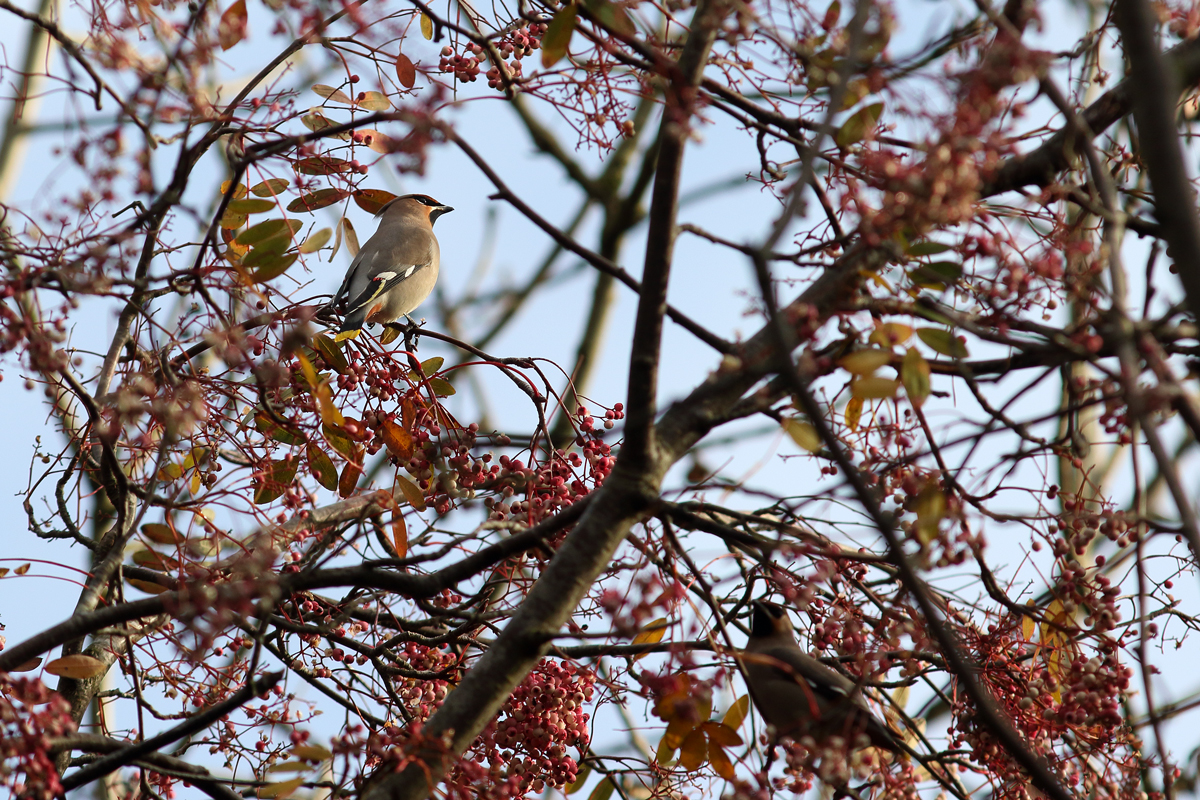
presence of 3 Waxwings in the usual pink rowan tree along the roadside.
When silent these birds can be surprisingly hard to detect and these three
were hunkered down out of the snow in the tree. I was just taking a few photos
when a female Sparrowhawk came out of nowhere, flushing the birds out of
sight. Luckily for them, none were taken. Its good to get some Waxwings
without a togger in sight! Apart from me that is...
Yesterday, as I walked down the pond field track, a very late ( for
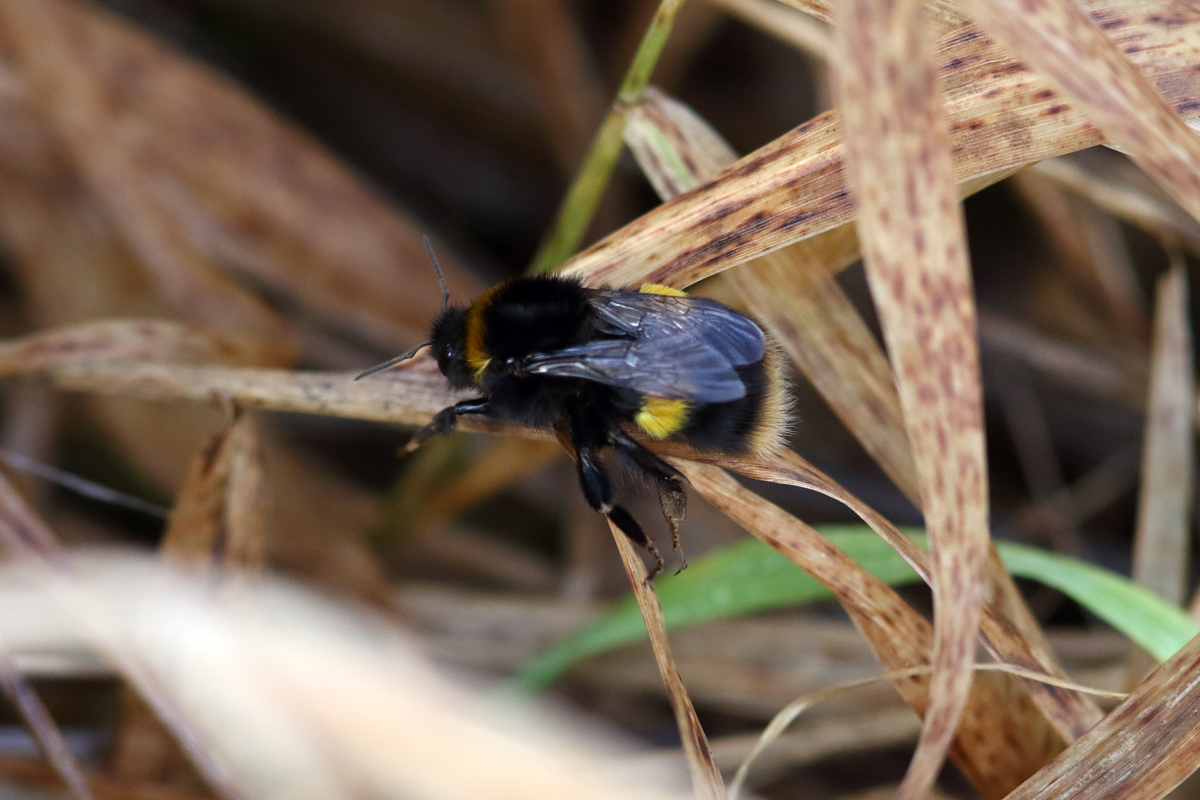
Northumberland) Buff tailed Bumble bee flew past and dropped into the pond
edge reeds. It seemed ok, but I hope it manages to find a spot to hibernate
in.
Its not been a bad week for the naturalist around here, really.
The weather has been variable, though quite moderate.
Mid week a dog walk through the Village Wood had that soft cool, earthy, early
winter smell to it. In the diluted sunshine, a pile of oak logs left
after Storm Arwen attracted attention. It was covered in a colourful array of
small fungi, including one new to me, Purple Jellydisc as well as Hairy
Curtain Crust, Sulphur Tuft and one that remains to be identified. It may need
further scrutiny this week.
In that evening a couple of late Pipistrelles (?), well, bats, were still
hawking under the street lights.
Log Pile
Hairy Curtain Crust
Purple Jellydisc
I think the fungi at the top may be Sulphur Tuft?
Keeping to a fungi theme, I was surprised when Debra Burley found some
Pink Ballerina Waxcaps in Alnwick Cemetary. Ive looked in many good
waxcap grasslands in North Northumberland without success so I gave it a twitch
on my way to work.
After some directional confusion, there were 10 small stout pink Waxcaps
around an area of gravestones...Excellent.
Pink Ballerina Waxcaps
By Friday, the wind had swung to the North and then some, On Google
Earth the northerly could be followed right up to the North Pole. The
'socials' were filed with commentary about masses of Little Auks, it could be
the best showing for years, White Winged Gulls, Brunnichs etc. I jested that
we might even get a Spectacled Eider off it, such was its reach, but, I sort
of knew that we had been here before. Many times.
On my blog in
Nov 2021, before Storm Arwen, I posted a very similar weather map and pondered just
the same. Whilst the record breaking gales blew an unprecedented number of
Brunnichs Guillemots southward, the rest was pretty much standard. This time,
I was more tempered and considered that most Little Auks would be further west
by now so although a good northerly will always give us a few birds, the
chances of a classic were slim.
Early Saturday morning found me traipsing along to my nearest seawatching spot
for a couple of hours. Yes, there wasn't a great deal moving, but there was
just enough to fill the time. From 8am - 10am I had
Great Northern Diver 5 N
Diver sp 1 N
Red throated Diver 7
Goldeneye 2m 1f N and 1f S
Teal 2 S
Common Scoter 16
Purple Sandpiper 2
Eider 7 S
Great crested Grebe 1 S the rarest bird of the day.
Fulmar 6 N
Gannet 7 N
Litttle Auk 1 N at last, and new for the year. Dan and Mark watching
from 300 mtrs south of me managed 74 Little Auks. They must have been too
distant for my eyes is I'll I can suggest.
Brent Geese 2 N
Pink footed Geese 500 S
This brings us to Sunday morning.
JWR came to pick me up to do a recce for next weeks Alnwick Wildlife Group
guided walk from Embleton to Low Newton along the coast. Before we left, I had
a quick task to collect some greenery for Jane's Christmas wreath making
session. While getting some bits of Ivy at the Lane End, the distinctive
trembling calls of Waxwings filled the air. Soon we located 26 of them
perched on top of a tall Ash tree opposite a large ornamental pink Rowan tree.
This tee is still laden with pinkish white berries that are always last to go,
usually eaten by Bullfinches and Mistle Thrushes. As we watched down they came
periodically, like locusts, to systematically clear the tree. The resident
Mistler was having none of it and did his best to keep the viking raid at bay
but he was fighting a losing battle.
All of a sudden a Sparrowhawk dashed through panicking everything and the
Waxwings headed off south to safety.
The start of our walk, Dunstan Steads / Embleton Golf Course with
Dunstanburgh Castle in the distance.
Long tailed Duck. I wont even try to age or sex it.
We moved on to Embleton where the car was left at Dunstan Steads. This is only
about 5 miles from home so still pretty local.
Our walk was quite pleasant witha few bits and pieces to make it
worthwhile.
7 Purple Sandpipers, on the shore and 19 Greenfinches looked
fabulous feeding along the strand line,. At Newton Scrapes,
13 Whooper Swans, plenty of usual wildfowl and a nice
Long tailed Duck showed well as Water Rails screamed in the background.
We got back home at 12, so I took Peggy for a walk to see if the
Waxwings had returned. I was pleased now to find the numbers had gone
up to 40+. I couldn't get an accurate number as they flew off during my best
count but I know there were somewhere between 43 - 45 birds.
So, another grand early winters day out. I wonder when our roll will end?
Waxwings. The shot above has 31 of the 40 odd birds in it.
Its about the time of year to start having a think about plans for the coming one, 2024.
So far I have no fixed ideas, as is usual, so I read as much as possible from books, blogs, social media etc to try and get some juices flowing. It can be difficult in early winter, in the aftermath of our busiest season to get fired up.
Yesterday Andy Mould, a good Northumberland birder and stalwart of Holy Island birding, posted a short tweet ( I am as likely to change that to X as I am to change the name of a Ross's Gull) about his year of garden birds. This had me thinking, whilst a lot of time is spent birding from my garden, I never really summarise it or keep a real eye on what has occurred over the year. With the garden being my Local Patch epicentre, thats one thought for next year.
Another strand I've pondered, is how to change from as many written notes to more sketches and illustrations that I enjoy doing. This always leads me to a dead end as its just not possible to cover a days birding, fully, in sketch form. without missing loads of stuff.
More to think about in coming weeks.
The last 10 days have been spent locally as usual.
Last Friday a nice bit of birding fortune came my way. Late morning, standing at the office printer, in a daze, I glanced out of the first floor windows, to see a lovely sunny early winters day. Just the type of day, you could imagine a flock of Waxwings catching the sun on top of some trees maybe. So, I sauntered the 20 or so feet from the printer to the window and gazed across the car par towards the main A189 dual carriageway. Surely not? There was a single bird sat right at the top of a roadside Ash, It is too far for details it looked like a medium sized dumpy blob. Then more appeared as if from nowhere, 9 in total all on top of highest twigs nicely spaced. Too neat for Starlings. Then the clincher. Two began flycatching like oversized Spotted Flycatchers climbing high to snatch an unseen insect and gliding back, bee-eater fashion to their perch. A flock of Waxwings! Well predicted by me!
To be fair, I have seen them in this exact spot some years ago so it is favoured, but there were a genuine surprise. I decided to check them with my scope that was in the boot of the car, but as I glanced back from my desk they had all gone and did not return. I'm not having much luck nailing these fluffy buggers down...
This brings me to Sunday. We tend to expect very quiet days in winter but if you are lucky a nice little list of birds can be found.
JWR and I met up at Boulmer main car park at 7.45am. From here we decided to wander north around Longhoughton Steel and back and maybe have a sit and wait at the north end, which we did.
Out to sea 3 duck Goldeneye flew S , 6 Red throated Divers loafed and fished, as did 25 or so Gannets, En route to the Steel we had 4 Purple Sandpipers on the rocks. 3 Shelduck flew S and 1 ad and 1 fw Little Gull flew N.
A nice start.
We loitered around the Longhoughton Steel bench for a while. Here, a nice Woodcock arrived in-off, landed briefly then continued west. On the sea towards Howick were 5 Goldeneye inc 2 males, and a nice drake Long tailed Duck with last weeks female. Common Scoter females had increased by one to 8 birds. Over head a light movement of Pinkfeet with 80 and 62 birds south.
Ive not had a Wigeon on my patch list this year so 40 on the shore here can just about be scoped from the south end of the homestead. One to bear in mind.
4 Black tailed Godwits N here was a nice record for our wetland impoverished bit of rocky coast.
The wander back to the car park was uneventful but another sit and watch tea from the car boot gave us some more to look at. 73+ Dunlin, 18+ Ringed Plover, 16+ Bar tailed Godwits, 50+ Lapwings, 4+ Grey Plover and 19 Sanderlings were all regulars but still nice nonetheless.
As we were about to head home, John picked out a little Merlin sitting on the rocks offshore. It sat a while before doing a drag start across the haven towards our waders. Here, it was unlucky when it missed a Dunlin when the bird dropped, in defence, into the shallow water to hide. The Merlin gave up on that and headed, low, back over the bay to the rocks. As it arrived, it flushed the Lapwings and a few more Dunlin high and away, but one Dunlin was a bit slower and remained seated. The Merlin by now was just about a metre over its head and on its way past when it caught sight of the dozing calidrid.
In one move, the Merlin stalled, back pedalled and stuck out a leg, grabbing the wader from its slumber and into the air. They came to rest a short distance away on the weed covered rocks where the falcon administered the last rites before eating every morsel in front of us. Gruesome. but still amazing!
Above - Merlin and top, same bird eating a Dunlin.
As the cold spell melts away to a balmy 10 degrees, it is good to think
of how these small weather features can have an impact upon local patch
birding.
I have already posted this month's birding in just a single km square around
home we've had Woodcock, Water Rail, Little Auk, Blue Fulmar, masses of
Thrushes, Snipe, Pink footed Geese, Golden Plovers, Lapwings etc but as I look
through the apple feeding thrushes and see, I am reminded by Twitter, one of the W's was
missing. Until yesterday that is.
We have had family staying over the weekend and as they packed the car to
leave on Sunday morning the timing was perfect for a quartet of Waxwings to
drop in to the berryless rowan right beside the cars. I called to them,
'Waxwings!' and pointed . Everyone looked and were treated to great views of
the birds only 10 feet away. They had been attracted by a few measly
rosehips growing through the Rowan.
The birds, all soft crests and dove grey pink, fluttered down into the bush
like dancers trying not to get their tutus dirty, but soon they flew off over
the house.
I went around with the camera and some apples to hang in our small birch tree.
The vikings were now in our tall dividing hedge where they had found a few
more hips. These birds are masters at seeking out a few trivial berries that
you or I wouldn't even notice, but again they were off. I finally managed a
couple of cursory record shots at range in a neighbour's apple tree before
they flew off again, this time, for good.
Its a few years since I had patch Waxers so it was good to see them again.
Maybe there'll be more?
At work on Wednesday morning I had a meeting to attend at Ashington Police Station at 10am. I arrived at about 9.45am. As a left the car and strolled up the path to the station door I looked at the few rowan treet here and pondered that they have been a good attraction for Waxwings in previous years but today there were no berries at all and even the leaves were gone leaving only a tracery of bare twigs against a grey sky.
As the auto sliding doors hissed open, I glanced on the opposite side of the path at those bare trees and there above me were 9 fluffed up Waxwings as if on cue! They looked as grey as the sky, sitting hunched and silent looking around. I left the station at 12 to find now 10 birds sat there, but I couldn't see a single berry. There must be some nearby I suppose to keep them sat there for a few hours...
A picture from last year. It was too dark today even if I had taken my gear...
Every morning before work I have a bit of a routine to follow, as do most of us. Mine involves getting up, coffee, dog walk #1, shower, breakfast, feed the garden birds dog walk#2 and then off...
Yesterday morning I was up to stage 6 above, when I heard the unmistakable 'kuuk' of a Raven, and it sounded close. I peered over the back field as a lone Raven flew very low to the ground past me before lifting up, over the village hall and away S. I was watching where it went, when I heard another Raven call, quite softly behind me. I turned to look at the sky above the copse next to our garden anticipating a fly over, when it appeared. First behind some bare branches then, it only pitched up on top of the large Ash tree next to the garden! It sent the Jackdaws and a few Rooks into panic mode. The Raven saw me, coupled by other corvids alarm and mobbing calls, and it flew off. This only angered the other crows even more who went in pursuit until they harried the larger bird out of sight.
What great bird they are, especially when they can be seen from the garden.
Now it was time for stage 7. Peggy's second walk of the morning is usually just a quick dash out before I go. Today we were on the top coast road a few minutes from home when I caught the sound of a Waxwing trilling call. I couldnt see anything and thought I had misheard, when no, there it was again. I stared high up and picked up two birds heading south but decending too. A pair of Waxwings! They dropped straight into our village after their long flight. I could just about see them perched on a tall willow in a garden in the village and saw them drop off at a 45 degree angle.
There was only one place that would pull them down like that - Davey's apple tree. Pegs and me turned ( she had been far enough anyway) and strode back home, passing the apple tree. Its very thick and hanging with fruit so I couldnt see anything. I swapped the dog at home for bins and camera and went back out. Its only 50 yards to Daveys from home, and sure enough right in the centre in the worst viewing place possible were the Waxers, getting stuck in to their apple breakfast.
I watched for a few minutes and grabbed a few record shots before they flew off, stopping briefly and then continuing west.
As I pondered them and wondered about getting back for work, more calls over head dawned on me, this time Crossbills, lots of them. First a low flock of 13 went south, quickly follwed by 5 and then 9 more accompanied by 3 Brambling. A good movement of Crossbills for here.
Now it was really getting time to be off. I could have stood viz migging much longer to see if more Crossbills would follow but time was against me so it was not to be. Still, it was a great half hour around the 'obs' before work....
Some record shots of the waxwings. Pity I couldnt get two in one photo. Hopefully more will arrive over the coming week or two..
We headed off north this morning, though not far, Bamburgh and back.
On the way, first stop at sunrise was Embleton to see if the Waxwings found by Gary Woodburn ( and present since January) were still around. After a short hunt we found two in a garden near the main road. Photographing them in the poor dawn light, was always going to be tricky, but the birds were very confiding so we were quite close. These images are only very slightly cropped to shape. We were also pointing our cameras in the vague direction of bedroom windows, so after snapping a few shots we left the residents to their privacy!
From here was had a short tea stop at Monks House Pool, Seahouses where 13 Shoveler were quite frisky alongside 20+ Teal, several Tufted Ducks, Mallard, Coot and Little Grebe. The dunes- working Exmoor Ponies came to see us, one enjoying a jammy dodger from John before continuing to munch the coarse grasses down to a reasonable level to increase the local flora.
Budle Bay was next up, with its daunting expanse of mud flats.
Spotted Redshank feeding in creek.
The wintering Spotted Redshank was racing up and down the creek feeding behind three Shovelers constantly that, I assume, were churning up edible morsels for it. Also here were masses of wildfowl including many Teal, Wigeon, Shelduck, 300 Pale bellied Brent Geese, 1000 Pink footed Geese. The waders were in equally large numbers with many Bar tailed Godwit being the highlight. A lone Little Egret looked the part fishing in the close creek.
A nearby feeding station was to be our final stop of the morning. Marsh Tits used to frequent here but, as with this species across the rest of Northumberland, this site now seems devoid of them with none reported in the hide logs since last February. Still we enjoyed nice views of Nuthatch, Treecreeper, Great spotted Woodpecker, Yellowhammer, various Tits and finches.
With the weather not being too bad either, it turned out to be a nice morning all round.
Nuthatch
Great spotted Woodpecker
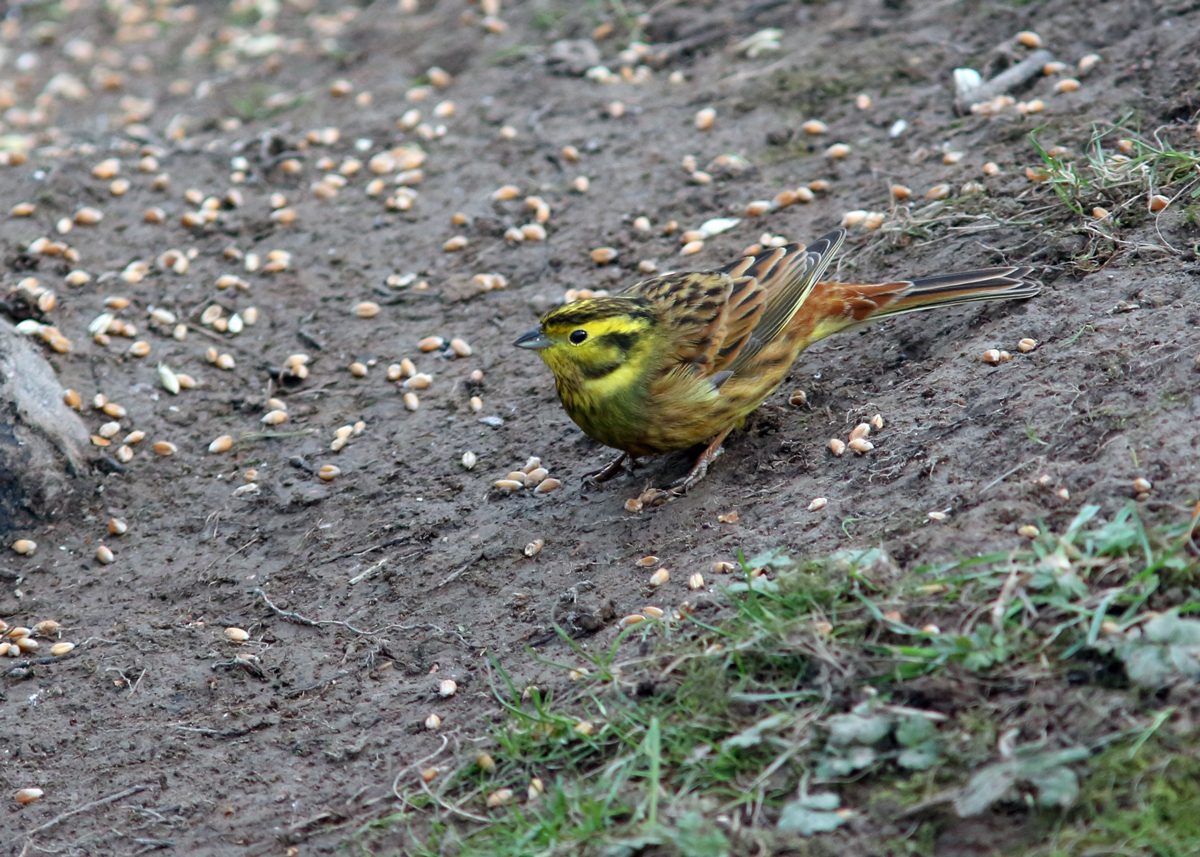
Yellowhammer with a lot of 'pine bunting' chestnut streaking below its throat. Many yellowhammers can show these marks to a greater or lesser degree.
Last night the first decent moth of 2017 came, an Acleris cristana, a scarce species up here, this is only the 13th for Northumberland.
If you are a birder living in Northumberland you should count yourself very lucky.
We may be very impoverished on the butterfly, moth and dragonfly front, but we really do quite well for birds.
As a large, east facing county with a wide range of landscapes, an equally good number of species can be found all year round, but what we do excel at is autumn migration.
From late July - late November we get excellent passage of waders, seabirds that are second to none, both breeding and on migration, with things such as flocks of Roseate Terns, decent Skua movements, hundreds of Sooty Shearwaters and even thousands of Little Auks. All four divers are a real possibility if the weather is right. Wildfowl is good with seaduck, geese and wild swans aplenty, then we have drift migrants such as Wrynecks, Barred Warblers and Red backed Shrikes, and later on we do well for Sibes such as Yellow browed, Pallas's, Dusky and Radde's Warblers. Oh yes, the northernmost English county is a good place to be at the 'back end'.
As Autumn draws to a close, another Northumberland speciality appears on a regular basis - the Waxwing. Whilst further south, a lone bird or a small party attracts a good twitching crowd, here we tend to expect larger numbers occasionally. In 2012, in the first week of November ( see these blog posts for a start) we were treated to over 100 of these lovely birds around our garden with out another birder to be seen ( well maybe one or two). Since then, I have had odd singles around the area but just to add to the already superb autumn here in 2016, this year is now turning into a Waxwing winter.
My first were on Monday when 35+ flew N past me whilst driving to work between Amble and Warkworth, then on Tuesday the game upped a little with 30+ at ASDA in Ashington followed half an hour later by 60+ at the south of the town near North Seaton Cemetery.
Today there has been masses of them around the county - maybe 350 in Ashington at three locations, three flocks along the A1 between Alnwick and Morpeth, including one of 200 birds, 200+ at Cramlington, 30+ in Morpeth and many other scattered parties.
Our spring birding may not be so good for overshoots, but would I swap? I dont think so...
Being up north in the UK, Northumberland often misses out on some of the more southern specialities. Birds such as Firecrests, Black Terns and Honey Buzzards are genuinely hard to come by up here and things like Serin are the stuff of dreams, I still haven't had one in this country making it probably the commonest bird missing from my British List.
Still, living up here in a county with a very long coastline that faces Scandinavia does have its plusses. Little Auks, Glaucous and Iceland Gulls are annual, Long tailed Duck and Purple Sandpiper are common enough winter visitors and we do get more than our fair share of Waxwings.
In a big invasion year we can get many hundreds of them, and they turn up almost anywhere. This year though seems to be a slow one for the Waxwing. Luckily I managed one on patch back in May as they were returning, but the presence of a few in Ashington where I work was worth a detour all of one mile to attend a meet and greet.
A lone bird was typically lethargic hanging around ASDA petrol station in the town, feeding on the remnants of some rowan berries. Watching this one, I believe a first winter female, I realised that they are quite comedic birds? Curtseying, gargling and raising an eyebrow at passing blackbirds gave it a strange impression, a bit Chaplin-esque!
After taking some poor pics in dreadful light conditions I left her to go to her roost in peace...lovely.
Numbers of Waxwings in our village have gone from 4 to 14 to 36, to 100+ this morning thanks to two apple trees still hanging with fruit in a neighbours garden.
In the still of the morning the calls were superb as they circled over our heads.
Here are a few photos...If I had a proper camera, I could have filled my boots here, but you'll have to make do with these I'm afraid...
If I remember rightly they are aged and sexed by wing markings and chin patterns though I havent consulted 'Svensson'. Please keep me right if I have made an error here -
I think -
Immature male ( some yellow, more and larger red tips)
Immature female ( very little yellow, and few,small red tips)
Adult male female ( bright yellow with white ladder effect, plus long red tips)