Showing posts with label Waxwing. Show all posts

Monday, November 13, 2023

Its almost over...

November. The trees are almost leafless now, the nights are dark and the area has a quiet wintry feel to it. Still, the past two weeks locally have been quite good really. There have been no rarities but a few birds have been moving through that should cheer up the most brow beaten of local patch watchers

The month opened with a dozen Bramblings under Beech trees along our lane and there were still two Pipistrelles out feeding at dusk.

On the 4th the incongruous sighting of 3 Coal Tits leaving village gardens at dawn and flying off high into the sky and out of sight was a thought provoker while a flock of 6 deep calling Redpolls flying south over head were likely Mealies.  21 Whooper Swans flew low S over our village in the afternoon, adding to the melancholy feel with their soft trumpeting calls.

We had a short visit  of 3 miles along to Boulmer on Guy Fawkes  where we had some nice viz migging and seawatching with 2 Snow Buntings S, 1 Twite S, 800 Pinkfeet S, 12 Puple Sandpipers, 27+ Bar tailed Godwits, 60+ Knot, 8 Red throated Divers N and 3 S, 1 Great Northern Diver N, 1 ad Little Gull N and a drake Pintail dropped in to the shore Wigeon flock.

The next morning at home viz mig had picked up with 44 Siskin, 11 Redpoll, 1 Twite, 2 Crossbill and 10 Whooper Swans all S. These were just the appetiser as an hour later 2ad and a juv Russian White fronted Goose flew low over our garden nicely lit by the morning sunshine. Only my 2nd record here after a few in the good year for them of 2010. In addition were 750 Pinkfeet S over head too.

Another 2 Mealy Redpoll called loudly overhead on the 7th.

A few local patch walks from home this weekend in quite nice weather, Pre Storm Debi, had 9 Crossbills, 4 Blackcaps, 1 Chiffchaff, 21 Whooper Swans, 300 Pink feet, 1 drake Goosander S, 1 f Long tailed Duck with 4 Goldeneye and 7 Common Scoter at the burn mouth and, saving best til last, 3 Waxwings, 1 with 20 Redwings behind the Cricket Hut then 2 in the Village Hall car park all too briefly before flying off SW. These are my 5th of autumn but all have been in a hurry to move on. Do they know something we dont?

Is it time to start Christmas Shopping I wonder?


Monday, November 21, 2022

Surely this is The End!

 Yesterday I met John at first light at Seaton Point to see if any migrants had been grounding in the overnight rain. The wind was a light SSE. It was dull first thing but it brightened into a nice day by mid morning.

Seaton Point from Foxton beach.

A few Thrushes were coming in with a scatter of Redwing and Fieldfare but there were more Blackbirds and Robins. In fact every bush and bracken clump or seaweed pile had Robins.

A Woodcock was flushed from the edge of the golfcourse. In this spot, 9 Redpolls and 30 Siskins flew W.

Along at the point the sea was dead today with very few signs of movement so we decided to check the shore for the two Snow Buntings I had seen on Friday. We soon located one bird feeding along the strand line but there was no sign of its colleague? As is the way with Snow Buntings, this loner fed unconcerned as dogs and their owners walked past yards away so we took the good opportunity to get some photos. While we were watching, the shore waders became anxious and began calling. This disturbed the bunting and it flew off southwards.


After some tea back at the car, the sun was shining so we checked the coast path south to Foxton Golf Club.

A couple of small settling ponds here looked good for a migrant or two but the best we could manage was a nice Kingfisher giving a close fly by before perching briefly on top of beach side brambles.

Then down to the Golf Club proper. It was here when we were checking a nice looking gully a loud call close overhead jolted us back into concentration - Waxwing! I thought it might be sat in the trees but it was just flying low overhead, and continued straight south. Waxwings are scarce but regular on our patch recorded in 8 years out of 14 but this was my first local bird since 2019. Hoping there are more to come!

A shot from a previous year but this is what it was like if I could have deployed the camera quicker! 


Tuesday, November 05, 2019

First storm of winter or last one of autumn?

The view from my Craster seawatch spot.
The North East wind last night was a roaring animal, bending trees and stripping them clean of foliage. By the time I took Peggy for her first walk this morning, the rain had stopped and the wind, whilst still strong, had dropped slightly. The sea was enormous and roaring as the rollers smashed into the rocky shore. Balls of ivory foam were blowing along the coast road and over the fields.

This was too harsh for a Cullernose seawatch so I headed down to Craster where the view point is lower but has a bit of a wind break.

I watched from 09.15 - 10.30am. The passage was unremarkable, being so late in the season, but there was enough to keep the interest going. The list went like this with all birds going North unless otherwise stated.

Wigeon 8 N 9 S
Common Scoter 207
Velvet Scoter 1 fem
Long tailed Duck 3
Goldeneye 20
Red breasted Merganser 2
Goosander 1 adult drake 1
Red throated Diver 1 N 1 S
Great Northern Diver 1
Little Auk 3

All against a light movement of Gannets, Kittiwakes and larger Auks.


A female Velver Scoter moves N.
From here I decided to check the Craster Heughs for migrants before home for lunch.

First bird, not a migrant, but a bit of a patch mega these days was a Marsh Tit [161], calling and showing well, but I couldn't get a photo, it was too quick for me. This site is a Willow Tit hotspot with up to 6 birds present recently so where this lone Marsh has appeared from is anyones guess. A totally unexpected year list addition.

Real migrants were noticeable by their absence, but a few Blackbirds high in a hawthorn over the path were scrutinised. Then I saw that in the middle of them was a lone Waxwing! This will likely be the bird Ben had in the village on Sunday, but as it is a first for 2019 I was well pleased to get it. This makes Waxwing being added to every one of my patch year lists since I moved here in 2009 and this week is a prime time to get one.

Also here 500+ Pink footed Geese flew around to the west.


Above -  Waxwing, an adult male too. It never moved from this spot where every angle was obscured by twigs.
After lunch at home, I thought I had better just pop back out for an hour to Cullernose as the wind had dropped further and it had brightened up a bit.

From 1.10 - 2.10pm I had a nice selection even though most seabird passage had dried up.

Little Auk 6
Pomarine Skua 1 juv very close in, great views.
Common Scoter 7
Dark bellied Brent Geese 6
Long tailed Duck 6
Snow Bunting 1 imm male N then seemed to drop down onto the coast path further north, a good claw back after my off-patch birds on Sunday. [162]
Raven 1 over head.

So, not a bad day in the field really with 3 patch year ticks. At this late date, I'm sure my listing additions will be coming to a close...
Edit -I have just realised I am on 162, equalling my best year ever, 2010. Can it be, dare I say it... beaten?
Edit 2 - I have just updated my spreadsheet and it puts me on 163! After going through it species by species, I am confused... It looks like the record has been broken!!

The view south from Cullernose Point, the Howick Bathing House can be seen then Longhoughton Steel behind that.

Cullernose, the great whin sill cliff.

Goldeneyes and a Red breasted Merganser.


Sunday, February 26, 2017

To Bamburgh and back.

We headed off north this morning, though not far, Bamburgh and back.

On the way, first stop at sunrise was Embleton to see if the Waxwings found by Gary Woodburn ( and present since January) were still around. After a short hunt we found two in a garden near the main road. Photographing them in the poor dawn light, was always going to be tricky, but the birds were very confiding so we were quite close. These images are only very slightly cropped to shape. We were also pointing our cameras in the vague direction of bedroom windows, so after snapping a few shots we left the residents to their privacy!


From here was had a short tea stop at Monks House Pool, Seahouses where 13 Shoveler were quite frisky alongside 20+ Teal, several Tufted Ducks, Mallard, Coot and Little Grebe. The dunes- working Exmoor Ponies came to see us, one enjoying a jammy dodger from John before continuing to munch the coarse grasses down to a reasonable level to increase the local flora.

Budle Bay was next up, with its daunting expanse of mud flats.

Spotted Redshank feeding in creek.

The wintering Spotted Redshank was racing up and down the creek feeding behind three Shovelers constantly that, I assume, were churning up edible morsels for it. Also here were masses of wildfowl including many Teal, Wigeon, Shelduck, 300 Pale bellied Brent Geese, 1000 Pink footed Geese. The waders were in equally large numbers with many Bar tailed Godwit being the highlight. A lone Little Egret looked the part fishing in the close creek.

A nearby feeding station was to be our final stop of the morning. Marsh Tits used to frequent here but, as with this species across the rest of Northumberland, this site now seems devoid of them with none reported in the hide logs since last February. Still we enjoyed nice views of Nuthatch, Treecreeper, Great spotted Woodpecker, Yellowhammer, various Tits and finches.

With the weather not being too bad either, it turned out to be a nice morning all round.


Nuthatch

Great spotted Woodpecker

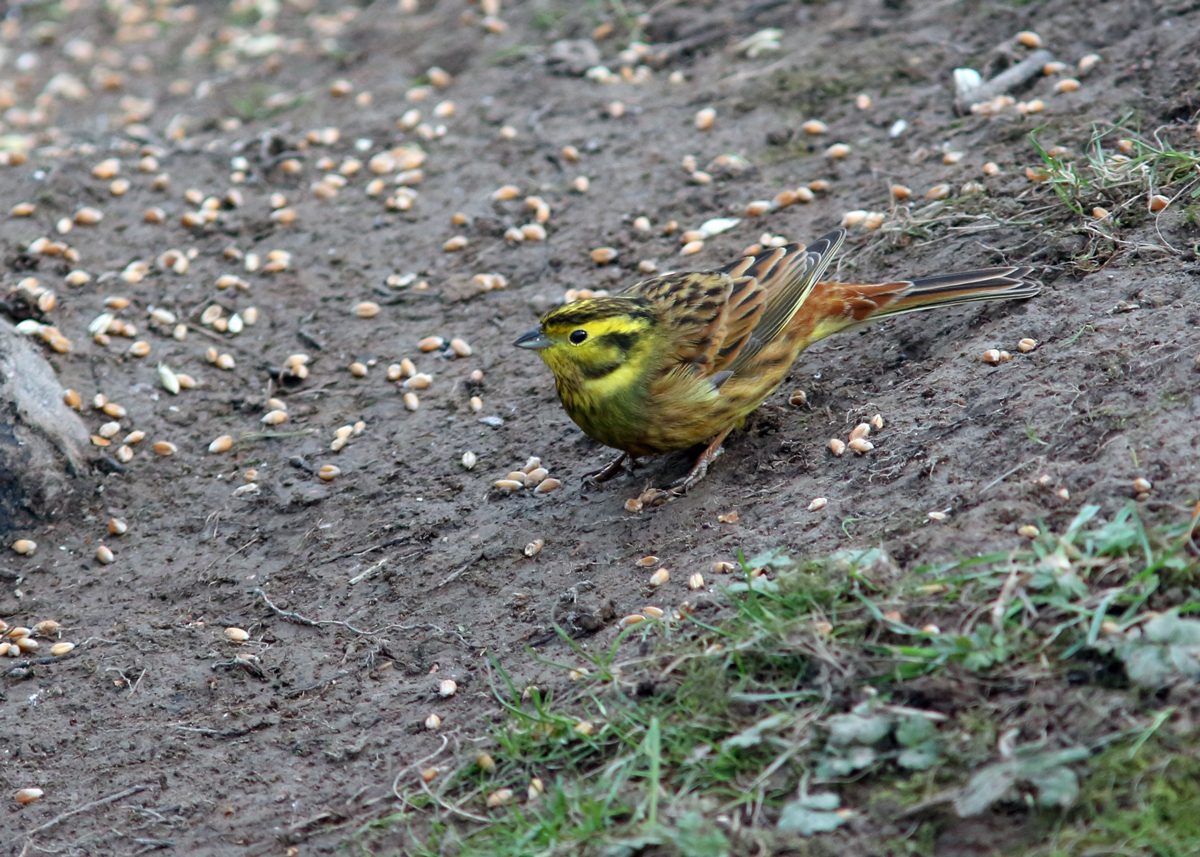
Yellowhammer with a lot of 'pine bunting' chestnut streaking below its throat. Many yellowhammers can show these marks to a greater or lesser degree. 

Last night the first decent moth of 2017 came, an Acleris cristana, a scarce species up here, this is only the 13th for Northumberland.


Acleris cristana, the 13th for Northumberland.


Wednesday, November 09, 2016

A Waxwing Winter.

If you are a birder living in Northumberland you should count yourself very lucky.

We may be very impoverished on the butterfly, moth and dragonfly front, but we really do quite well for birds.

As a large, east facing county with a wide range of landscapes, an equally good number of species can be found all year round, but what we do excel at is autumn migration.

From late July - late November we get excellent passage of waders, seabirds that are second to none, both breeding and on migration, with things such as flocks of Roseate Terns, decent Skua movements, hundreds of Sooty Shearwaters and even thousands of Little Auks. All four divers are a real possibility if the weather is right. Wildfowl is good with seaduck, geese and wild swans aplenty, then we have drift migrants such as Wrynecks, Barred Warblers and Red backed Shrikes, and later on we do well for Sibes such as Yellow browed, Pallas's, Dusky and Radde's Warblers. Oh yes, the northernmost English county is a good place to be at the 'back end'.


As Autumn draws to a close, another Northumberland speciality appears on a regular basis - the Waxwing. Whilst further south, a lone bird or a small party attracts a good twitching crowd, here we tend to expect larger numbers occasionally. In 2012, in the first week of November ( see these blog posts for a start) we were treated to over 100 of these lovely birds around our garden with out another birder to be seen ( well maybe one or two). Since then, I have had odd singles around the area but just to add to the already superb autumn here in 2016, this year is now turning into a Waxwing winter.

My first were on Monday when 35+ flew N past me whilst driving to work between Amble and Warkworth, then on Tuesday the game upped a little with 30+ at ASDA in Ashington followed half an hour later by 60+ at the south of the town near North Seaton Cemetery.

Today there has been masses of them around the county - maybe 350 in Ashington at three locations, three flocks along the A1 between Alnwick and Morpeth, including one of 200 birds, 200+ at Cramlington, 30+ in Morpeth and many other scattered parties.

Our spring birding may not be so good for overshoots, but would I swap? I dont think so...


Monday, November 30, 2015

Cartoon Birds...

Being up north in the UK, Northumberland often misses out on some of the more southern specialities. Birds such as Firecrests, Black Terns and Honey Buzzards are genuinely hard to come by up here and things like Serin are the stuff of dreams, I still haven't had one in this country making it probably the commonest bird missing from my British List.

Still, living up here in a county with a very long coastline that faces Scandinavia does have its plusses. Little Auks, Glaucous and Iceland Gulls are annual, Long tailed Duck and Purple Sandpiper are common enough winter visitors and we do get more than our fair share of Waxwings.

In a big invasion year we can get many hundreds of them, and they turn up almost anywhere. This year though seems to be a slow one for the Waxwing. Luckily I managed one on patch back in May as they were returning, but the presence of a few in Ashington where I work was worth a detour all of one mile to attend a meet and greet.

A lone bird was typically lethargic hanging around ASDA petrol station in the town, feeding on the remnants of some rowan berries. Watching this one, I believe a first winter female, I realised that they are quite comedic birds? Curtseying, gargling and raising an eyebrow at passing blackbirds gave it a strange impression, a bit Chaplin-esque!

After taking some poor pics in dreadful light conditions I left her to go to her roost in peace...lovely.


Monday, March 23, 2015

Winter is leaving....

On my way to work this morning as I crossed a bridge known as the Dry Arch, a bird flushed from the roadside and flew towards the car. All I saw was a broad pale band on the end of the tail and knew instantly what it was. I screeched into a worn laybye and looked back, with no bins or camera, to find a lone Waxwing hopping about on the verge. What on earth it was doing there fails me, but, in headless chicken mode I thought, get home for the camera. I drove back through the arch to the Howick Hall main entrance then thought better of it, I would be massively late for work, so I turned around again but this time the bird was no where to be seen? Maybe on Wednesday when I'm off...

In a winter when they have reverted back to normality after a good few years of influx, I never thought I would get one on the patch, but this one was inside the boundary by about 10 metres!

A recycled Waxwing photo from a few years ago, its been on here before, but no camera this morning.
On the return from work journey at 6pm I passed a field at Warkworth containing 120 Whooper Swans where yesterday there were only 23, so I fancied they might be on the move. Nearer home I got my eye on a flock heading north, containing about 60 birds, just outside my patch. I put my foot down hoping to get them looking back from home, but I was too late.

Inspired, I set off with Bunty in the dusk over the back field. Nothing was seen other than 2 Goldcrests in the hedge but no 'whooping' swans. We headed back. Just as we approached home, there was the distinctive bugling coming from the east. Manoeuvring into a better position I waited until 90-100 Whooper Swans flew north along the coast and out of sight at Craster. Lovely.

Not a bad non birding day then :)


101. Waxwing
102. Whooper Swan