Showing posts with label Warkworth. Show all posts

Monday, February 03, 2020

A Wet Rossicus.

The forecast didnt look promising yesterday morning when I met with John at Alnmouth Cricket Club. It was calm and cold but heavily overcast. Drizzle was just trying to get through.

We had decided to check out the Coquet Estuary as we hadn't been for ages and there had been a lot of gulls in the mornings this week, as I was passing on my way to work. You would think they knew. This morning at the weir, it was high tide so the actual weir was totally submerged and there was only a lone Black headed Gull on the shore. One. On Friday there were 300 or more assorted gulls but not today. Highlight were two Foxes chasing each other on the far bank , 6 Roe Deer, 1 Little Grebe, 15 Mallard, 2 Goldeneye and 3 Herons. A Song Thrush was in full song, my first of the year and a portent of things to come.

We moved along to the Marina. Here we fared a little better with 94+ Curlew, 36 Knot, 14 Wigeon, 4 Teal, 2 Shelduck and a Snipe.

At Amble Harbour the slow theme continued. Even the local Med Gull wasn't on its usual rock. We did have 1 Purple Sandpiper, 8 Red throated Divers, 1 fem Red breasted Merganser, 18 Eider and 10+ Turnstone though.

After a stop for some snacks in Warkworth we headed up to Birling Carrs ( you might remember the posts on here about the Arctic Redpoll a few years ago? There.) The redpoll field had been ploughed recently so there was nothing here either. Then the rain started.

We decided to check the sea, getting wet in the process... viewing was good but we didn't do better than 15 Red throated Divers and 2 male Red breasted Mergansers,

Back at the car we noticed that the field to the north was stubble with some rape plants and Groundsel growing through. A few Reed Buntings were active along the track so we decided that we couldn't get more wet and to give it a blast.

As we wandered the stubble hoping for a Lap Bunting, we had a good flock of 40 - 50 Reed Buntings, 40 Meadow Pipits, 38+ Skylarks ( with one smaller one with them that we followed around but couldn't make it into anything other than a wet Skylark.)

As I climbed over the hill I flushed a single goose that flew towards me very closely. Head on it had an orange and black bill. I shouted to John that it could be Bean Goose and we watched as it circled giving us enough on it to confirm indeed a Tundra Bean!  The upperside was generally dark brown with a grey wash on the primary coverts but no pale grey forewing shown by Pink footed. The bill was longer and the bird seemed a bit larger. It began to call as it circled. I had no idea what Bean Goose called like, but noted that it was a deep nasal double or single 'ang-ang' and 'ack'. Not Pinkfoot either. As it left, John checked the call on his phone from Xeno-canto and sure enough the voices matched. A bona fide Tundra Bean Goose at close of play. A good record here.

Near by 4 Whooper Swans and 3 Bar-headed Geese just brightened things a bit more before it was time for home...


Sunday, November 13, 2016

Back to normal...

After the birding excitement of recent weeks, today saw things slow up a little, back into the usual pace for winter birding in Northumberland.

I met John at Warkworth and as the weather was pleasant we just pottered around the area taking a few snaps and drinking tea. No change there then.

A short drop in at Druridge Bay Country Park was all but pointless, highlights being about 70 Tufted Duck and half a dozen Gadwall.

Back up the the Coquet Estuary area it remained pleasant but very slow on the bird front, until we stopped to check a herd of 24 Whooper Swans ( with 6 juvs) and were very surprised to find a flock of 64 Black tailed Godwits in the stubble alongside them! Whilst not a rare bird in the county, flocks of 10 in early autumn or spring are more usual so this large gathering was the highlight of our morning. Further over the road another 13+ Whoopers were feeding in a rape field.

Elsewhere, 1 Little Egret, 250 Golden Plovers, 11 Yellowhammers, a Brambling and a few Wigeon were all we could muster. A nice morning out though, all the same.


Little Grebe and BHG on the country park...

Coquet Estuary.

Old Water Pools, Warkworth Dunes

Black tailed Godwits at Birling


Whooper Swans in wet stubble at Birling.

Sunday, July 17, 2016

A Floral Interlude.

First of all a Starling roost update. We have a mystery. On Thursday night at about 11.30pm I was taking the dog out, when a Barn Owl came from one of the conifers where the starlings roost. It flopped onto another tree across the track, flushing one or two birds, but there were thousands in there. Later, I was woken by the dog at 3.45am, wanting me to take her out. As we walked around the corner near the trees, it was silent. Not a bird in there. And that was about it. They've not been back. I am amazed that a visit by a Barn Owl can move on 4000 Starlings so easily. Its probably for the best, but we are quite sad to see them go, their chattering calls through the night was quite reassuring.

This morning began wet breezy and cool, more like October than July.

I met John at Homebase and noted that all three plans for today were scuppered by the weather. Plan 1 was to go over the south Cumbria looking for butterflies, the weather there was too poor. Plan 2 was to go looking for Large Heath butterfly in Northumberland, but again, weather too cool. Plan 3 was to go up to Holy Island looking for Orchids with the off chance of a butterfly. Not worth it.

In the end we just pottered around our usual haunts at Warkworth. Before that, we did a quick check of the pond next to the A1 at Charlton Mires where a Green Sandpiper was the highlight.

Then down to the Coquet Estuary. Here waders are on the increase, but its just a shame that so far it is nearly all one species -Redshank. We did dig out 35 Dunlin, 5 Common Sandpipers, 1 sum plum Knot and 2 flyover sum plum Grey Plovers.

As it was getting brighter and warmer we popped along to the dunes to check out the flora. This can be lovely at this time, and today was no exception. There were various species of hawkbits, harebells, maiden pinks, ladies bedstraw, birds foot trefoil, wild thyme, meadow vetchling, restharrow and vipers bugloss all over. Attracted to the floral scene were a good range of butterflies with 4 Dark Green Fritillary ( our first at this site), 25+ Small Skippers, 3 Small Heath, 2 Common Blue, 10+ each of Ringlet and Meadow Brown. Added to a few Narrow bordered 5 spot Burnet Moths, Latticed Heath and Yellow Shell moths, the day was salvaged quite admirably I think...


Narrow bordered 5 spot Burnet Moth

Dark Green Fritillary

Latticed Heath moth

Maiden Pinks

Small Skipper on Thyme.

Wild Thyme

Floral dunes at Warkworth

Warkworth Dunes.

Tuesday, April 12, 2016

A floral interlude...

Field Pansy Viola arvensis
 While wandering the redpoll field at Birling on Sunday I noticed a few tiny flowers emerging. Many were Field Pansy but nearer the car were a few larger specimens. We wondered if they were another species? On checking the guides, I find they are indeed, they are Heartsease or Wild Pansy. Lovely.
Images taken with my phone camera.

Heartsease or Wild Pansy Viola tricolor

Sunday, April 10, 2016

The Glorious 10th...

10th April 2016.

In Northumberland, our spring passage starts in earnest today. 'Whats he on about', you ask, there have been spring migrants for the last fortnight or more, with hirundines, wheatears, chiffchaffs and others all along the coast. But all is not as it seems. Those early birds, are just that. Early. The product of southerly airflow well before its time, depositing hungry swallows in an insectless Northumberland, only for them to need to move back south a couple of hundred miles when we get some late frosts.

No, the 10th has some significance, as this is the date when in most years there is a very noticeable arrival of spring migrants. You don't need to scour the local ponds for a one off sand martin or walk five miles of headland for a wheatear, birds like this are much more widespread, and the 10th April 2016 was no exception to the rule.

I was on my way to meet John at Warkworth at 7 o'clock this morning when I noticed a raptor putting up the gulls near Hipsburn. Buzzard I thought, then as I drove the next mile, keeping it in sight, it looked a bit different so I pulled over for a quick look. Marsh Harrier! A male too, slowly moving south. I put my foot down and arrived just before it in the top car park to get it on Johns patch list before it continued on its way. How many birds do we miss like this I wonder....

A quick check of the car park scrub revealed a male Blackcap in song, our first of the year, then down past the Old Water near the estuary we had 4 Black tailed Godwits in summer plumage, 2 Sandwich Terns and half a dozen Sand Martins near the pier. We're on a roll.... Others of note were 60 Knot, a Little Egret and a few Stonechat.

A flat coated retriever rolling on a long dead grey seal provided some value too, much to the concern of the owners...

Unfortunately, none of the summer birds lingered long enough for a photo, but two Twite were more obliging...

Sandwich Tern and mates...

One of the Twite on the washed up flotsam.

A later tea stop, found us up at the Birling Redpoll field. There were no surprises today but still lots of Linnets, a few Redpolls and 25+ Meadow Pipits. Three small groups of Pinkfeet flew N overhead. Back at the car, we heard the unmistakeable 'tew tew tew' of a Greenshank but try as we may we couldnt get on to it. Still, calls count as a tick in the year list.

Back at home, I glanced out of the kitchen window and first bird I see is a year tick. A male Blackcap skulking through the roses. Nearby a Siskin pair were showing well and even singing, but my camera was still in the car. By the time I snipered out and got it, the Blackcap had continued its migration, I did manage a Siskin though.

Later as I cut the grass, 2 Lesser Redpolls joined the Goldfinches and Siskins at the niger seed. I waited in the outhouse and got a nice shot of one of the redpolls, I'm quite happy with this one. Good light and good range make all the difference.

Lesser Redpoll

Male Siskin in song. Looks a bit soft as its taken through the kitchen window...

Sunday, March 27, 2016

Easter Sunday..

After such a lovely day on Friday, today has turned out to be a bit blustery and cold, though sunny.

I met up with John at Warkworth and we covered a lot of the area on foot, but it was mainly very quiet. We had hoped for a wheatear or something but migration was at a very slow pace today.

A first walk down the north side of the Coquet Estuary to the pier did not reveal too much, with 24 Shelduck, good numbers of Dunlin, Knot and Redshank but little else. 2 pairs of Gadwall were quite approachable on the saltmarsh. Our second wander upstream from the village had 2 pairs of Goosander, 1 Sparrowhawk, 2 Goldcrests singing on territory and the first singing Chiffchaff of the year, though there are still no singers at Howick.

Yesterday Jane and myself got new phones as our old iphone 4s's were approaching 4 years old and beginning to slow up. I did a complete change and chose the new Samsung Galaxy S7 Edge, whilst Jane took the latest iphone 6s model. I tried the Samsung out today on some scenes and habitat type shots and was very pleased with the results....

Flowering Currant in the car park, a main source of nectar for newly emerged bees.


Above - Various views of Warkworth village. I've no idea why we get so many tourists here, there's nothing to see, just move on....

Gadwall on the saltmarsh

Singing Goldcrest..

Meadow Pipit.

Sunday, March 20, 2016

Longshot longspur...

Lately I have been quite pleased with some of my photos on here, a distinct improvement since the start back in 2006 when I was digiscoping with a poor quality compact camera. Today sees a return to the good old days! Not digiscoping mind you, oh no this is all DSLR with Canon lenses and all that jazz, its just that the taget was so far away and elusive, you would think the images had been taken in the fog through a carrier bag over the lens!

This morning we had a quiet wander around the Coquet Estuary seeing very little, so we decided to take a long shot and try a revisit to the Coues Arctic Redpoll. It seems that he is long gone, but there were still redpolls in the field including at least one Mealy. The weedy rank stubble was full of bird though with lots of Yellowhammers and Reed Buntings, Linnets and Skylarks with a few Grey Partridges and Brown Hares for good measure. As we walked up we herd a faint 'tickety tickety' over head and after a scan around picked out a lone Lapland Bunting circling around with other finches and buntings.

What a merry dance this bird lead us for the next hour or two, back and forward up the field sometimes missing it all together then lifting it nearby only for it to fly the length of the field and drop back down! I managed two glimpses on the deck as it ran along a wheel rut showing a nice rusty nape, but photos were an impossibility. Then, didn't it make a change from normal Lap Bunt behaviour and land up on a bramble bush next to the main track! Although way too far for pictures, we could see its nice pale form quite well in the binoculars. Well here are the delightful images I promised you. Prepare to be amazed...

'tickety tickety' and off...

Squint. Thats it in the middle. 

A much better shot. Showing rusty nape and chestnut wing panel with white underparts...
 While the views and photos are nothing to write home about, it is still a Lapland Bunting and a very nice record for John's patch. Its a while since I've seen one...

Monday, February 08, 2016

Up to the Guts....

A day off today, with a reasonable weather forecast, so we went birding...

With no planning whatsoever John and myself began at Amble Harbour and worked north.

Amble was very quiet indeed with nothing of note. Further along the river, a few ducks were worth a look, 100+ Wigeon, 1pr Gadwall, 4 Red breasted Merganser, 2 Goosander and 2 Goldeneye fed on a low tide, while a Little Egret flew over the point to the Gut  er Old Water.

At this stage we discussed the local site names for our usual birding spots. Traditionally, all bird records from most of the Coquet estuary were labelled Warkworth Gut. This name, however, is just wrong. Warkworth Gut is a small muddy creek running from the south behind Amble Marina and not the channel edged in saltmarsh and reedbed that runs to the north. This place, where most birds are found, is called Old Water. Now there are some tidal pools at the head of Old Water we have imaginatively named 'Old Water Pools'.

Just to confuse matters further, there is a small, difficult to view 'Gut' opposite the weir laybye, that could also be called Warkworth Gut, but it doesnt have a separate name, it is just known as 'the river above the weir'.

There, that's that clarified. Several Guts, but the real one rarely has birds...

Back to the birds. As we were here it would be rude not to call in to see the Coues Arctic Redpoll for the 5th time. Today the bird was running a bit late and left us standing twiddling our thumbs for half an hour before it and it's colleagues flew in to the usual fence line to allow viewing. There was some discussion about the identity of the rest of the flock. These birds get no easier. Most could feasibly be Mealies rather than the assumed Lessers. In fact only 2 birds out of 30 or so were obvious Lessers, one a very red breasted male and another browner bird, both small compared to the rest. There are definitely 3+ Mealies, the rest are just Redpolls....

Coues on its usual post....
 From Birling we headed up to Boulmer via Foxton Bends where 500+ Wigeon were unsuccessfully  scanned for yanks. At Boulmer we walked both north and south along the shore. There were lots of birds to search through, many hundreds of gulls and coastal waders with a few wildfowl too but it was a day of spectacle rather than substance. A Peregrine hunted the rocks and a Twite flew south. On the flash, a few Mallard were joined by a juv Pale bellied Brent Goose. It was the shere number of gulls and waders though that caught our attention the most. As the tide neared the high mark, the waves washed piles of seaweed around exposing tasty morsels for the birds. There were 8+ Purple Sandpipers, 50+ Turnstones, 20+ Bar tailed Godwit, 100+ Dunlin, 40+ Sanderling, 2 Grey Plovers, 200+ Curlew, 50+ Redshank on the shore. It was great to watch them swirl around and return to the beach every so often.

A sample of waders flying around.

Nearby a young Grey Seal watched us pass then went back to sleep.

Not a bad day, certainly better than being office bound that's for sure!

Grey Seal

Sunday, January 31, 2016

Redpoll...week 4.

You will all be getting sick of me chuntering on about the Coues's Arctic Redpoll at Birling / Warkworth by now, but today we managed some great views and this time I even had the camera instead of the scope.

I've jumped the gun a bit though so first things first. I met John at Warkworth at 7.30 this morning just as it was getting light. It was nice and calm for a change, overcast and cold. To start things we walked down towards the beach and along to view the salt marsh, to check the local Twite flock for the first time this year. As expected, about 15 Twite showed well, in less than good light, but with them were 2 Redpolls, one a sure fire Mealy, the other more ambiguous. I dont recall ever seeing redpolls in this habitat before...

While here, a Barn Owl hunted the car park banks and a host of waders roosted along the edge, where Bar-tailed Godwit and Little Egret were both new for the year.  

Twite in the gloaming at first light.
From here we walked back up and followed the field north along the golf course to view the redpolls. Today numbers were up to 34 birds and the Arctic was easily picked out as they came in and sat, obligingly, along the fence line.

Coues's Arctic Redpoll showing well, sticking out like a sore thumb. This shot shows its bull-head and necked appearance well.
We stood back from the fence a few yards and the birds came in every so often. Here the Arctic is showing its typical puffed up pose, complete with huge, unstreaked white rump.
In this shot, the Arctic has not had time to fluff up, giving an altogether different appearance. It appears to be a first winter male as there are odd reddish feathers in the upper chest / cheek area. 
 This is my fourth audience with exilipes and he never fails to impress. What a little cracker!
As we watched, John and I met with John Richardson and Sasha Elliott who also got some nice photo's. Pleased to meet you Sasha....

From here, we returned to the car for a refill of tea, pasty and cake ( no....) then off down to the harbour and estuary. Highlights here were a nice male Goosander, 3 Purple Sandpipers and the adult Mediterranean Gull has finally returned, albeit a little bit late....

So, a nice winter morning out with some excellent birds. If only all weekends were like this....

Mediterranean Gull with Black headed Gulls, Little Shore, Amble.


Sunday, January 10, 2016

White out....

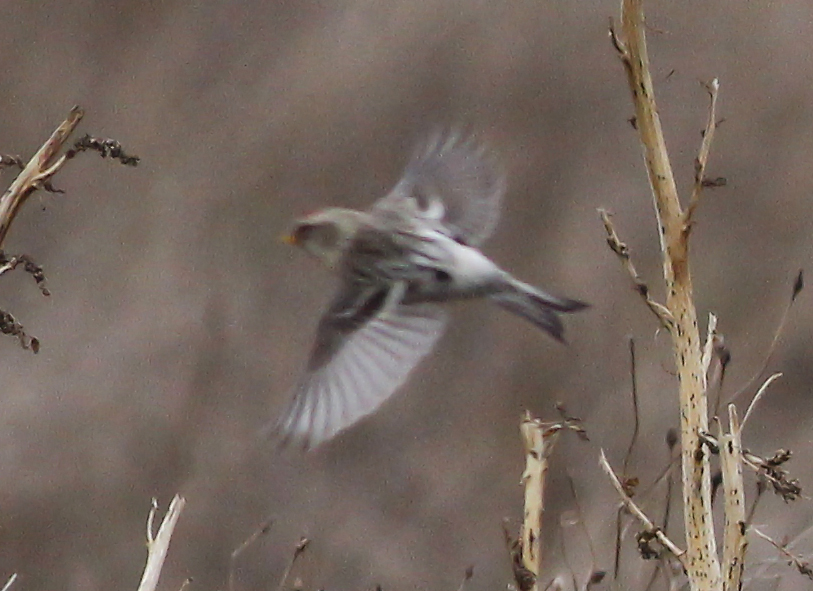
I just want to post some info on the Redpoll John found at Birling Carrs today. John had noted a redpoll flock last week and fancied he glimpsed a paler bird in with the lessers. They are feeding in a rotting game crop full of seed right next to the golf course at Warkworth.

This morning we had a wander around and sure enough the flock of about 20 birds came dancing into the tall stands of seeding crop. The birds perched for a minute then dropped to the ground and were mainly invisible. As we approached up they would go and fly off some distance only to come back 10 minutes later. This was the pattern for the next hour before we had to leave.

So what did we observe. We have posted snippets of info and two pics that John took on social media but it doesn't explain the story.

Our bird was the only pale individual in an otherwise brown flock, so no two bird theory here.

At first sight against a dull, damp, dark background a white flash of rump like a Brambling was very exciting.  Once our eye was in, the bird could even be picked out in flight against the sky let alone a dark background.

Once, it landed close to us where the distant white snowball looked very much greyer and Mealy-like, but only a back view was had before they dropped out of sight.

At long range the bird looked even better, a very whitish bird like a beacon amongst the little buff lessers.

Looking at Johns photo's below it is easy to cry Arctic, but lets be very critical first.The bird looks like a first winter with pointed tail feathers? The colour of the tail seems odd with those white streaks, this is due to the wetness of the habitat soaking the feather so maybe the tail tips are wider and rounded when dry, its hard to tell.

This wetness might be having an effect upon the extent of white rump showing too, smoothing feathers down and exposing a more pale, basal area.

The mantle is quite dark and dirty looking, but again is this a weather related illusion?

Dark solid looking ear coverts with greyish surround and large red 'poll' do fit a Mealy and lack the buffiness of Arctic ( Coues Arctic). The bill didnt appear stubby and can easily be seen  in flight.


Now this second image for me gives more info, but is a bit contradictory.

The under tail coverts first seem to have only one fine streak but look at that errant streaked feather sticking out to the side. That is quite obvious.This is a second thicker streaked undertail feather. I think.

The flanks have nice dark tramlines drawn down them but are partially obscured.

Its such a shame the face is hidden because this does look different and very creamy buff, under and around the black chin and the supercillium.

These comments still leave us hanging really. I dont think a 100% certain i.d can be made so far. The bird needs further observation and, hopefully more photos taken.

On social media quite a few comments have been made shouting Arctic, even saying definitely, but let me say, how can we be sure from these two images. I have consulted Garner's Winter Guide, and Birdling World 1996 as well as online images and nothing really helps.

Personally, I have a good Redpoll 'CV'.

Myself and John are experienced observers. I have kept them in captivity as a child, helped a Mealy captive breeder, used to be a ringer and have caught, ringed and handled a good few, I have seen lots of Mealies in Northumberland, uncountable Lessers since childhood,indeed this was the first flight call I could identify when aged about 9 or 10 yrs old. I have found and watched the nests and display of Lessers in the wild, watched Iceland Redpolls in Iceland and have found 2 Arctic Redpolls in Northumberland ( Alnmouth and Druridge Bay Country Park) accepted by BBRC.

I just want to put it out there that we kind of know what we are talking about.

So why can we not be sure of this bird after watching it in snippets for an hour, yet people online can name it from two images that took  1/600th of a second?

Lets hope its publicity gets other birders onsite to check it out and hopefully get some clinching shots. You never know it might be our third self found Arctic Redpoll!!

Sunday, December 27, 2015

Twite...

Time flies at this time of year. Its been nearly two weeks since I posted about the Chiffchaff, so here is a little update of what I have been seeing since then.

On the 19th it was a very mild 15 degrees so the moth trap was put out. I was pleased to catch my earliest ever Hebrew Character as well as a Chestnut. A Red Squirrel dashed across the road at our lane end, the first I've seen here for a little while.

The 23rd brought an early Christmas present when a nice Merlin dashed past me while I walked Bunty. It perched up on a fence a couple of hundred yards away giving good binocular views. This brings the patch year list to a round 150 species.

On 24th a hint of de ja vu came when a Peregrine over flew the exact same flight line as yesterdays Merlin. A Barn Owl hunted for half an hour outside our kitchen window and 2 Bramblings were with 100+ Chaffinches in the rectory stubble field.

No white Christmas this year though and on the big day only a lone Siskin and 8 Pink feet flying south made it into the notebook.

Last night while returning home from visiting the 24 hour long rain deluge had finally stopped leaving us with seriously flooded roads. No sooner had the rain abated the owls came out, with a nice Long eared Owl sitting on a hedge lit by the car headlights, then a Barn Owl near home sitting the same way.

Thats us up to date. Today I popped out to see John at Warkworth for a wander around the estuary area. Apart from the usual crack, it was uneventful bird-wise until a group of 19+ Twite flew in to the salt marsh. This was a regular traditional site for them some years ago but now they seem to prefer the Druridge Bay links.

Back home, 20 Siskins and a Lesser Redpoll fed in alders, while 7 Stock Doves were with other birds in the rectory stubble, but there was no trace of the Bramblings...


Twite creeping through the grass like mice...
Lesser Redpoll
150. Merlin

Sunday, November 08, 2015

Tits 'n' Tongues....

Can't beat a bit of old fashioned sitcom innuendo!

That's enough of that.

This morning I met John at Warkworth Top Car Park at 07.30. A stroll around in the half light was quiet with no thrushes or anything in the scrub. Viz migging was almost non existent too, so the morning didn't seem to be going too well. That is until we were chatting about the latest poor customer care from EE Broadband that John has been suffering from( all providers must be the same because BT is absolutely dreadful too when it comes to customer service).

In mid chat, I heard a very distinctive call across the salt marsh in the reed bed - Bearded Tit! Now Bearded Tit is a rare bird in Northumberland mainly because the habitat is very scarce too. My last were at East Chevington a good few years back so this one set the pulse racing.

We scanned the edge of the phrag without luck but the call continued, then all of a sudden John got onto it, a beautiful male sitting out in the open. What a cracking bird to brighten up the gloom. We watched it for a bout 10 minutes as it flew around even venturing across the open and doubling back at one point. A real highlight on this patch this year.

 
Male Bearded Tit, Old Water reedbed. 


After some tea, we headed down the north side towards the pier. Here a male Snow Bunting flew N low overhead, calling, while well over 600 Golden Plover were on the estuary.

On the way back through the dunes I was pleased to find lots of fungi, including three new species for me - 

Dune Waxcap, Black Earth Tongue and Rosy Bonnet. The latter is a woodland species mainly I believe, but some species occur in various old habitats.

Dune Waxcap

Black Earth Tongue Geoglossum cookeanum

Rosy Bonnet Mycena rosea Note the white tapering stem differs from Lilac Bonnet.
As the rain increased by 11.15 we decided to call it a day. I hope we get some nice fine winter days, I really hate this dark stuff...