Showing posts with label Grey Phalarope. Show all posts

Monday, October 30, 2023

A Storm is a Threatenin'

 For a nice change, the wind for the last couple of weeks has been usually from the eastern half, with quite a bit of rain too, so we have had a few interesting things to see on patch. Nothing to set the grapevines alight but enough to keep me occupied.

Before I get on the that we had a short fine interlude on the 14th where we had a good influx of butterflies into the village. The short Ivy hedge near the village hall had 105+ Red Admirals one lunchtime with 3 Comma and a Painted Lady. Each time a car passed they would lift up like the autumn leaves in a wind. In the village wood some Striated Earthstars were a new fungi for me.

Striated Earthstar like a little spaceship.

The very next day, it was cold, down to 2 degrees with a mod NW4 blowing so we spent the morning seawatching. The sun was bright so we were often blinded but a change of angle helped a bit.

From 07.15 - 11.30 we had - 

Sooty Shearwater 1, Red throated Diver 4N 6S, Great Northern Diver in summer plumage very close in N, Arctic Skua 1N, Skua sp 2N, Pink footed Geese 90, 30, 70 S, Barnacle Goose 50 N, Purple Sandpiper 2, Shelduck 3 S, Common Scoter 4N, Red breasted Merganser 1N, Long tailed Duck 1male and 1 female N, Sabines Gull 1 juv S, loitering for a short while offshore to dip feed before drifting out of sight, Arctic Tern 1ad 2 juv N and finally 2 Twite S calling.


17th Oct, 4 late Swallows, I'd not seen any for weeks, were in the village at dusk.

On Thursday 19th we were treated to a 3 day Storm Barbet with its ESE8 Gale and heavy rain.

One of the Swallows above was so tired it flew into our shed and settled on the bench just to rest.

A few Redwings and Fieldfares arrived over the garden first thing, with 3 Brambling but it was a cracking male Firecrest that graced our compost heaps for a few minutes that made the day. Still a scarce bird up here, this is a garden first, and it started quite an influx of them all along our coastline. Also around the garden were 3 Blackcap, 3 Goldcrest, 1 Chiffchaff and a Raven overhead. A Woodcock flushed from the village hall pond mid morning.

Rough field notes.....Firecrest in the garden.

On the Friday, Babet was cranking it up with 50 mph E winds causing massive seas and sea foam feet deep across the coast road and paths.

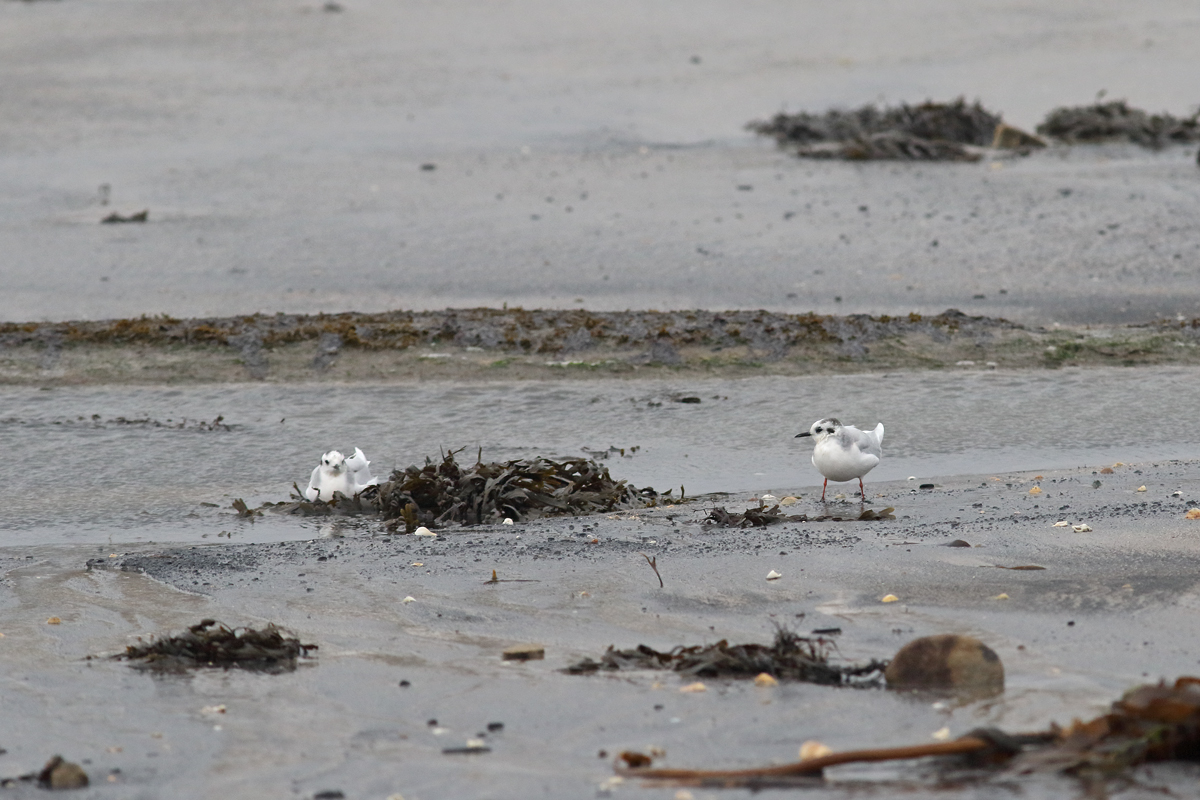
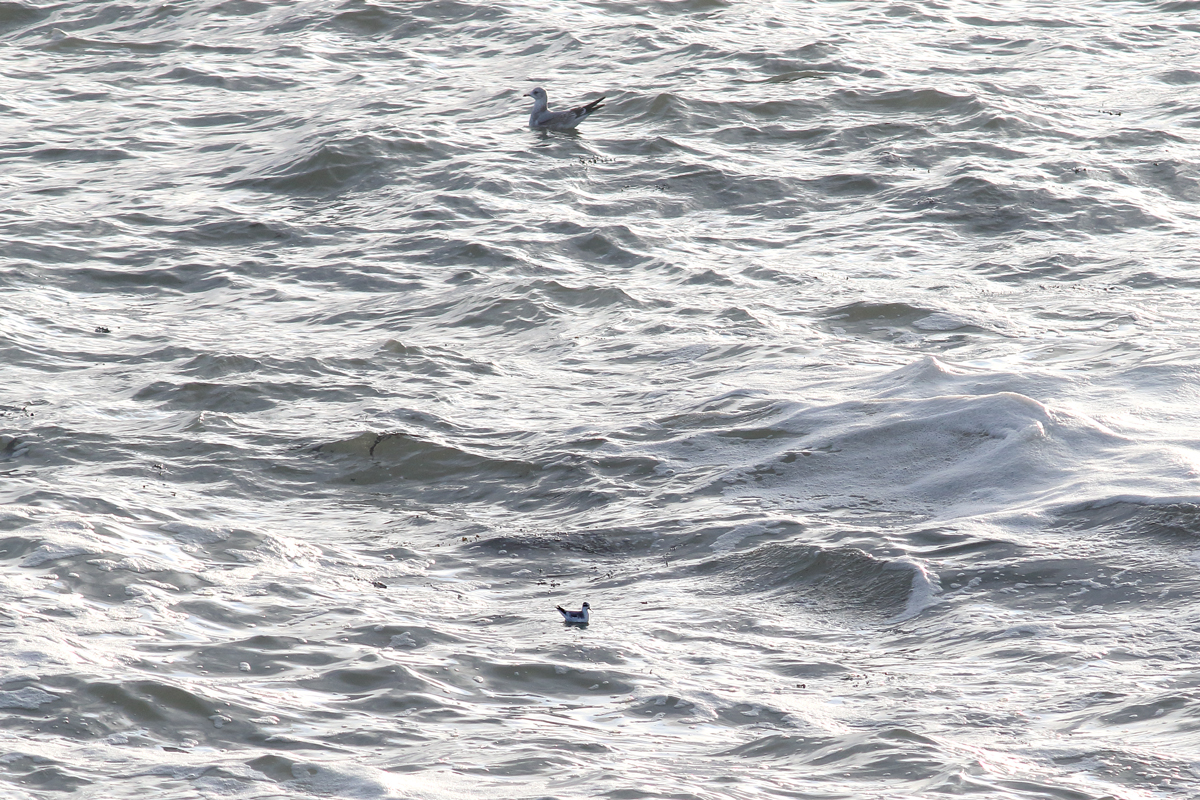
I was at work so popped down to Newbiggin where a lot of birds sheltered in the bay inc - Grey Phalarope 8  ( 6 in one scope view!), this number increased to 12 over the weekend, 60+ Little Gulls, 1 ad Mediterranean Gull, 2 Bonxie and 1 Pomarine Skua, 4 Brents N 3 Shoveler N in an hour. The Little Gulls were knackered being blown around the beach.

Outside Newbiggin Bay.

Exhausted Little Gulls, Newbiggin

Saturday 21st and Babet still raged with ENE gales, rain and huge seas, too rough to watch. At home I short watch from the car only had 5 Little Gulls and 15 Common Scoter N. A few more birds were in the village, with a beautiful tortoiseshell patterned flock of 60+ Bramblings swirling around the back field. Two came to our feeders for a while. 115+ Redwings flew W with 3 Fieldfares and 3 Blackcaps fed on apples in our garden.

When a small 'brown' shrike was reported a couple of miles along the road, at Sugar Sands, I dashed along, but the bird couldnt be relocated. The views had been frustratingly brief of a Red backed type of Shrike. Of note here were 3 Grey Phalaropes, 4 Little Gulls and a few Twite.

Sunday 22nd saw the back of Storm Babet being a fine, calm, cold, frosty morning, a total contrast to the mayhem of the previous few days. Wanting a Phalarope for the patch I wandered along to the Rumbling Kern where 2 Grey Phalaropes fed close in with Black headed Gulls, only my 2nd patch record. An adult Mediterranean Gull, 6 Purple Sandpipers, 3 Red throated Divers were also present.


Howick Haven and Grey Phalaropes

After this I took the short drive to Alnmouth for a walk with John where the highlight here were viz mig Snow Bunting, Crossbill and several Siskins.

Back home for lunch and I was surprised to find a very late Hummingbird Hawk-moth on our second flowering Red Valerian, despite the white frost earlier. Seems an odd combination seeing the hummer, Grey Phals and Snow Bunts on the same day...


Saturday, December 05, 2020

Looking Good.

 Its a few weeks now since I last had a seawatch, so with yesterdays low pressure settled over southern England giving us blustery, SE winds and rain, I thought I would try an hour today while Jane visited the hairdresser. December isn't renowned for good movements of birds at sea, but there's always a chance of something interesting like Grebe or White winged Gull to bolster the now flagging Local Patch year list.

I sat out at the usual spot on Cullernose Point. It isn't so good here late in the season being so exposed, so if the weather had been really bad, I would have sought shelter along at Craster, but the wind had dropped off to an E2 making Cullernose bearable.

After half an hour, I had added 3 Red throated Divers N, 2 Great Northern Divers S, 2 Goldeneye and a Common Scoter N but that was about it. Distantly a few tardy Gannets lingered.

What could I do to improve my lot? Cullernose Point has a short fast tide race only about 50 mtrs out with foam and pulled up seaweed flotsam that I have always thought looked good for a Phalarope. I moved to the point with my binoculars only and scanned down the cliff and into the bubbly water offshore...Although there is rarely a phone signal here, I pulled my phone from my pocket and hopelessly checked it. Interesting, a WhatsApp message had made it through. It was Ben down at Low Steads near Boulmer where he had seen a Grey Phalarope offshore that had then flown north towards Howick and was lost from view.

Great minds thank alike as I was already scanning for these little pelagic waders. With renewed effort I began another scan, and Bingo! There it was, a small Grey Phalarope bobbing and spinning like a cork in exactly the spot I have thought for years should attract a phalarope! Its not often a plan like that comes together but here I was watching a new patch bird for me, taking me to a record breaking patch total of 166 for the year.

Although a little distant for a photo, it was giving great views in the scope as it spun around icking at plankton from the surface, oblivious of the gulls hanging around and the big waves rolling in.

Fortunately the little bird lingered for over an hour allowing county year listers Dave Dack and Graham Sorrie to catch up with it having come 25 miles from Morpeth...

During a heavy hail and sleet squall, the phalarope looked even more tiny and vulnerable at sea, but it lust lay flatter and pointed its bill upwards into the deluge until it passed.


Saturday, March 31, 2018

Holy Land.


Today I joined Alan Tilmouth as his guiding assistant at Holy Island to show some visitors to the Pilgrimage to the Islands Festival some birds.

The weather was diabolical and not conducive to trailing non birders around east coast headlands looking for migrants, so we adopted the stand and wait approach. Before heading off towards the location, we met up at the Crossman Hall. As I stood at the door, a quiet call caught my attention and a bird dropped into a small tree across the road. I gazed bemused at a wet silhouette before lifting the bins, to see a Hawfinch! At that point if flew up and east, then doubled back to drop somewhere in the village near the school. Alan didnt even get on to it as he was doing the meet and greet bit!

From here was stood on the shore near the Vicars Garden, in the shelter of an old building seeing 3 Slavonian Grebes, inc 1 summer plumaged bird, 2 Red breasted Mergansers, 2 Long tailed Duck, 10 Bar tailed Godwits, 2 Grey Plover. A few migrants dropped out of the murk, 2 Song Thrushes a few Blackbirds and a Goldcrest.

After leaving the island, I called in the Low Newton Scrapes that has played host to a Grey Phalarope for the last 4 days. Today it was looking settled, feeding on the water, head into the wind bobbing up and down. These little wisps of feather winter out in the Atlantic and are as tough as old boots. We get a few in Northumberland but not often on freshwater so it was a pleasure to see this one before it continues northwards...

Sunday, November 11, 2007

Jackpot!


Above - Top. Little Auks, Longhoughton Steel by Richard Dunn.
Centre - Long tailed Duck, Longhoughton Steel by Richard Dunn.
Bottom - White billed Diver, Boulmer Steel, today. Click for bigger image.

Cold and damp this morning with a strong N6, becoming brighter and clearer later.

Well, where do I start.

This morning the tides were wrong for seawatching at Boulmer, so I thought I would just get out there and do some drawing for a change. My plan was to go to Seaton Point and sit near the beach and see what turned up. At 8am I was passing the main Boulmer car park and decided to pull in to scan the haven for grebes after the recent stormy weather. I climbed from the car and pointed the bins seaward.

What a shock I got. Before I put the bins back down from my eyes, 101 Little Auks had flown through. In about 30 seconds. Looks promising I thought, and headed to the seat north of the village for a 'quick look'. In the next 1.5 hours I had -

Little Auk 3304 N
Great Northern Diver 3 N
Red throated Diver 2 S 4 N
Gannet 6 N
Goldeneye 8 N
Common Scoter 3 N
Velvet Scoter 1 N
Puffin 5 N
Long tailed Duck 1 female N
Purple Sandpiper 4 N
Scaup 2 N
Goosander 3 N

Then things got interesting. As I was counting my three thousandth Little Auk a Diver swam into my view only yards from the rock edges at Boulmer Steel. Nice, a close Great Northern thought I, until as it slipped below the waves, I thought F*** ME thats a WHITE BILLED DIVER! I was now looking at a patch of empty water ( apart from Little Auks whizzing by that is...). Panic. Ring for help. The best way to be branded a stringer is to see a proper rarity alone and then its gone before anyone arrives.

With numb shaky fingers I gave ADMc a call down at Newbiggin and told the tale and gave assurances that a second call would follow if the bird is relocated. I was now doubting myself and expecting to relocate a Great Northern. So, scan with the bins, this bird isn't too far away and heading for a rock pool of sheltered water between a reef offshore and Boulmer Steel.

Sure enough there it was, next to some pot flags and looking the part. Long slim bill uptilted so the tip was crown level, and the tip third was nicely illuminated an ivory cream. Still disbelieveing my luck the call was made to Newbiggin and then to TAC as I figured he could get here sooner. Tom arrived after about ten minutes and I could get him straight on to the bird. Pale mottled head, stonking beak huge size Bingo! my fourth White bill in he county.

Then things got even better. While we were noting the details of the bird, it surfaced near the reef only to be nearly landed on by a GREY PHALAROPE. This is what local patching is all about. Months of slogging around hoping for the big one, but when it arrives its a great feeling. After all, this isn't Newbiggin or Whitburn...

As the tide dropped ( and as people started to head for Boulmer) the Diver took a claustrophobic turn and tried to swim out of its enclosure. This was not possible, so it took to the air and flew off strongly to the north. A good comparison could be had between this birds massive frame and the Great Northerns seen only an hour ago. But the bird was gone for good.

Just as we were talking about the best bird at Boulmer this year, a nice fw Glaucous Gull joined the other gulls briefly before flying south.

I would never have thought it. Posibly my best days birding at Boulmer taking place in November. I reckon that by the time I left for home at 11.30am some 6000+ Little Auks had gone North...What a morning....

Oh, the Farnes had 29,000. Did someone say there might be a chance of a Little Auk this weekend.

144. White billed Diver.
145. Grey Phalarope.