Happy New Year folks and thanks for the concerned comments. After my
last sickly post it still took another week or 10 days to get back up to speed
making the whole sickness thing last maybe 2 or 3 weeks.
Hence the only things in my notebook over Christmas week were 3 Primrose
plants in flower on Christmas Eve and a Kingfisher was a semi resident on the
Pond while the first Snowdrop clump was in flower on 31st. Despite
our Estate being a nationally known Snowdrop collection with literally
millions of plants, this is the first I've ever had before the New Year. So
here goes with 2025....
2025 came in like a lion with a strong W wind and rain in the
afternoon of the 1st but since then Northumberland has been ‘the place to be’
nationally when it comes to some more unusual bird sightings.
The famous
Grey headed Lapwing, first seen in the county at Low Newton in May 2023 as a first British
record, seemed to return when one arrived at East Chevington in December and
remained for a month. Due to the incredible rarity of this species, this is
likely a return of that first bird rather than being a second individual.
Where has it been since May 2023 when it was last noted on the Isle of Lewis,
Outer Hebrides is anyone’s guess.
As already mentioned, due to one thing and another, I was
late to this party, not calling in to pay my respects until 3rd
January when the bird was frequenting some damp field corner and taking
advantage of invertebrates thrown out by some industrious moles making their
soil mounds. It hung around until the final sighting on 9th
January. Will it resurface?

|
|
Figure 1: Grey headed Lapwing in Northumberland when it should be
in SE Asia!
|
On the same day, another spot in Druridge Bay held no less than 5 Short eared
Owls, male and female Hen Harriers, male and female Marsh Harriers, 3 Buzzards
and 2 Kestrels. The same site saw the efforts of Northumbria Ringing Group,
ring 9 Barn Owls along with 3 Short eareds and 2 Long eared Owls. 6 Barn Owls
were ringed on one evening alone. Amazing!
Some proper wintry weather arrived on 5th that seemed to shuffle
things up - a lot! Some snow and a strong E wind resulted in the arrival
of several very rare species.
On 8th a juvenile White billed Diver showed well
to all comers at Druridge Bay Country Park after first being seen on Cresswell
Pond the day before. This, the largest of its tribe is rare here usually being
seen flying past a headland, out to sea on its way back north. To get one on a
fresh water body is an great record. Even more so as this same site ( exactly
the same spot even) also hosted an ever rarer Pacific Diver on 21st
January 2017! The White billed remained until the rough seas abated and the
freezing temps on 11th almost completely froze the surface of the
lake.
Figure 2: Juvenile White billed Diver, DBCP.
Figure 3: White billed Diver, DBCP.
On 8th while we watched the Diver a message came
through that an adult Ross’s Gull had flown N close in past Whitburn. These
small arctic waifs always cause excitement, more so for those of a certain age
who remember when these pink gulls were basically a myth or a fairy tale even.
The Unicorn amongst seagulls. With some chattering between birders the hoped
for happened when the gull was relocated feeding in the Tyne Estuary off South
Shields Pier.
Work commitments prevented me from going for the first two
days but on Friday 10th, as soon as an update was received I was
off down to the Royal Quays Marina, North Shields where the bird was feeding
in the river with about 30 Black headed Gulls. I was a bit lucky here as after
15 minutes of observation it flew with the flock away off up river towards
Howdon and was not seen again from the North side. This is my 4th
Ross’s Gull but every one is as gripping as the last, you cant get enough of
them.
Figure 4: Ross's Gull, adult, River Tyne Estuary North Shields.
During January so far, when it
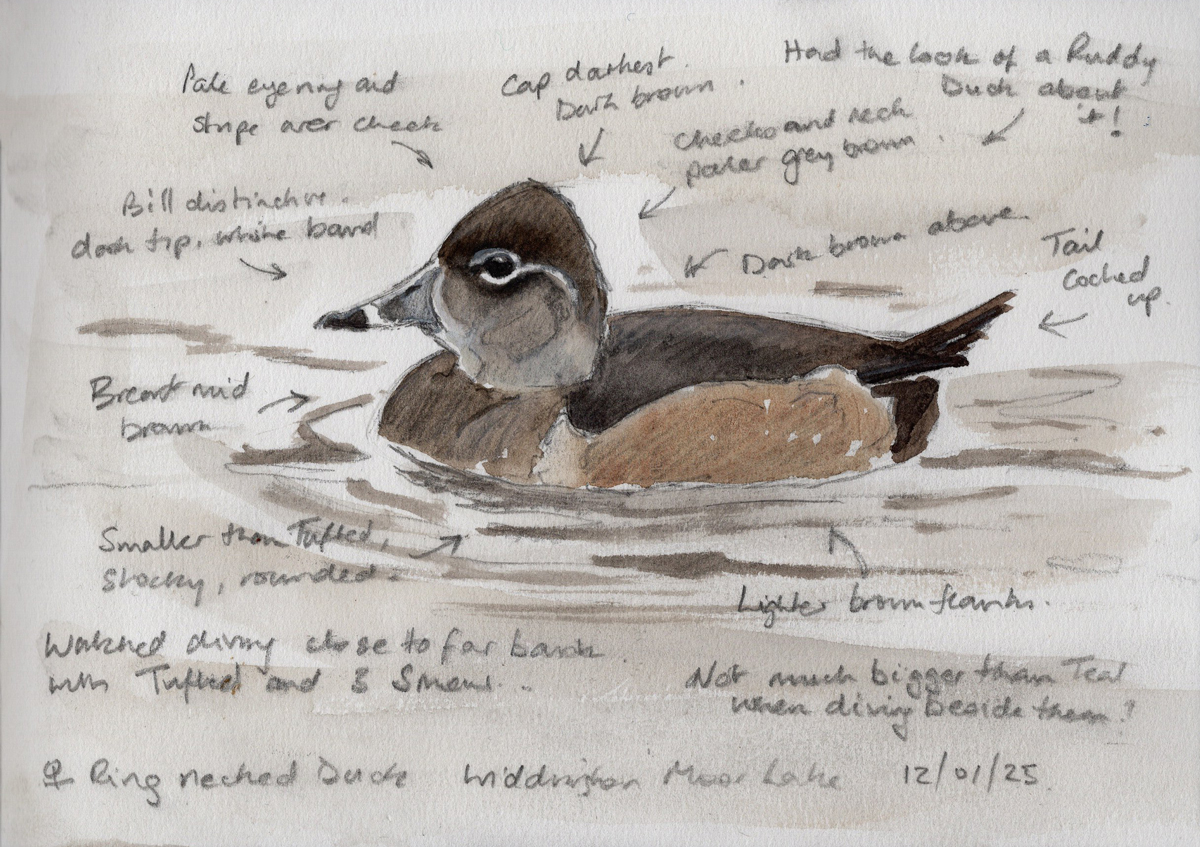
seems as if another rarity is just around the corner, on Saturday 11th
a female Ring necked Duck arrived at DBCP with the Diver briefly before
relocating to Widdrington Moor Lake as the country park froze over night. This
little brown duck from America is only the second female of its kind to arrive
in Northumberland though there have been more records of drakes.
Figure 5: Female Ring necked Duck, a rare North American wildfowl, Widdrington
Moor Lake
As if in support, an American Buff bellied Pipit was also
present at Ross back sands at the same time, an even rarer bird, being only
the second record ever for the county.
What a spell for birders this last two weeks has been. Above
are the birds I managed to catch up with, there were also others – Black
Scoter, American Wigeon, Green winged Teal, Iceland and Glaucous Gulls that I
didn’t have time to see plus Snow Buntings, Scaup, 3 Smew etc. A veritable
feast for anyone who has an interest in birds.
What has made Northumberland the centre of the birding universe I couldn’t
really say but the going has been great. No doubt normal service will be
resumed soon…