Showing posts with label Stonechat. Show all posts

Wednesday, May 01, 2024

Time and the White Hare

 Crikey where does the time go?

In late March I mentioned we had lost a close friend in sudden circumstances. What with various investigations taking place, the funeral only took place on Monday so it has been difficult trying to keep business as usual. There is nothing like this kind of shock to the system to get you thinking about mortality and life in general. Its all too easy to complain about trivia when really we should be grateful when we wake up each morning.

Since my last post, I've been out around the doors, not going too far ( I rarely do these days). In light of recent events, I would like to be able to take a more free and relaxed approach to natural history observations. There is no need to fixate on stuff, whether it is about staying local to the exclusion of all else or having to twitch the latest mega 300 miles away. None of it matters you know. Just take a breath and follow your instincts without pressure, just enjoy the time you have left and do what ever it is you want to do. Feel free to change your mind and approach at a whim, just to gain personal enjoyment on any day. We all have fixed commitments, work, family etc, but in your free time, be free!

Spring has been very slow in coming to my corner of Northumberland, as it always is. I can only think it is the close proximity to a winter retaining North Sea that removes our spring from the equation. As with most recent Aprils the wind has been a cool northerly for weeks now, blocking newly emerging nature of all sorts. Spring bird migrants have been delayed in arriving, butterflies almost non existant and the moth trap has lain redundant for weeks. Still there is no stopping the change in the air.

My first signs of a few migrants came on 21st April with ironically, early for here, Sedge Warbler and Whitethroat while Grasshopper Warbler and Redstart was more fitting.

A leucistic Brown Hare ( creamy white all over) crossed our path at that time too. I must check out the mythology around these, surely there will be some tales of ghostly white hares, no doubt bringing a curse on all who's path she crosses...

The White Hare.

A wander around the dunes at Warkworth had a nice display of just emerging Early Purple Orchids too. I must try and get back this week to see them at full opened glory.

In our garden, Holly Blues are out at the slightest hint of sun and a lovely big Hoverfly, Criorhina floccosa was easy to photograph in the chill air.  

The bee mimic hoverfly Criorhina floccosa complete with its diagnostic white flank tufts.

For such a common bird along our coast I had never seen a Stonechat's nest until the other week. While looking for a Grasshopper Warbler a small bird flushed from a clump of marram near my path. I was over the moon to find a nice small, flattened, tunnel leading to a small cup containing 5 eggs. I took one photo with my phone and left her to it.


Stonechat nest.

Whimbrel arrived on the patch on 22nd April witha single bird on the rocky shore beside us.

So with Orange Tips now on the wing and a seemingly drier break in the weather lets hope this Bank Holiday marks the start of a good spell of wether for wildlife / birding!
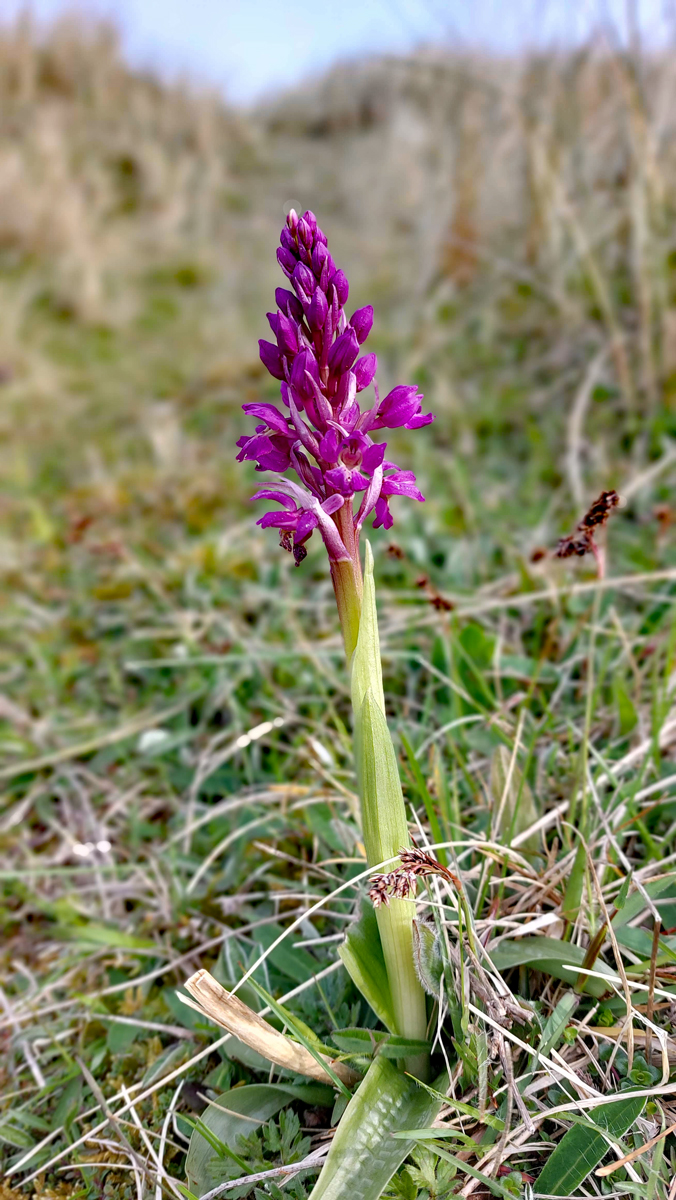
Early Purple Orchid, one of 200+ at Warkworth.

'Gropper'

Willow Warbler


Monday, April 03, 2023

It feels like spring.


Alnmouth with Coquet Island in the distance.

Sunday was a calm and pleasant day, getting brighter as it wore on and for once spring was in the air. What breeze there was, came from an ENE direction building hopes that we might come across something out of the ordinary. Unfortunately we didnt turn up anything rare but we still had a good morning seeing a few migrants.  

I met John at Alnmouth Cricket Club at 7am. A stroll down to the water works and flood meadows was filled with bird sounds. Lapwings and Redshanks displaying, Geese clattering around, a Water Rail squealed from a dense patch of phragmites and the sound of Chiffchaffs rang from every tree tall enough. 

A field near the track held some Mad March Hares, in April, with 8 or more chasing and boxing around.


Brown Hares mating.

 While watching these, a pair of Shoveler flushed from the small pond to settle again on a flash near the river.

Next we took the car down to the estuary. From here we covered the rest of the patch including the shore, bracken hill, and the estuary itself.

At this time there is an odd mix of birds of both summer and winter. There was a lone Barnacle Goose swimming up river beside a drake Red breasted Merganser, 25+ Wigeon, 20 Teal, 153 Curlew, a Goosander and 80+ Pinkfeet North while newly arrived birds included a female Wheatear, 4 Sand Martins, many Chiffchaffs, a Little Egret and 15+ Shelduck . There was no sign of the Avocet John had here mid week.

Little Egret

Incoming Sand Martin.

Stonechat on shed in the dunes.


Teal looking very smart in the sunshine.

Wheatear flew from beach and relocated in paddock on top of bracken hill.

 Later in the morning the warm sun brought out a few insects - 2 Small Tortoiseshells and a scatter of Hairy footed Flower Bees.

A small solitary bee, I'll need advice from specialists for this one...Andrena scotica. 

A male Hairy footed Flower Bee showing is feathered legs and the white blaze...

Small Tortoiseshell, the first butterfly of the year for me.

Back home at lunchtime, I was pleased to give the lawn its first cut after a wet March. Now I can let the meadow kick in. In the garden were more Hairy feet and 2 Peacock butterflies...

Peacock in the garden.


Sunday, November 01, 2020

Pied Wagtails n'that...

The weather at Boulmer this morning was mild and windy from the south, with some rain bearing cloud and odd bright sunny spells.  

We headed north along the shore where it was getting less of the annoying wind. In front of the pub, there was no sign of the Black Redstart but two 'pied' Wagtails drew my attention. One in particular looked to have an unusual head pattern with shadows of the subpersonata race of Morocco. I know very well that Pied and White Wagtails are so variable in the autumn that to claim one of the rare races would mean the bird should be a classic 'nailed on' example and be well documented with photographs, so this bird, was likely just a nicely marked Pied Wagtail Motacilla alba yarrellii .

First impressions of the alba wagtail showing a nice white supercillium and unusually blackish ear coverts with a paler patch below the eye.

A closer look at it, shows it to be a female Pied Wagtail, but even with photos I am unsure of its age?

The blackish rear half of the ear coverts are quite unusual and I can't find any images online to exactly match this bird, but, variability makes things interesting.

Showing the birds right hand side, the ear coverts are not quite as dark as on the left.

The paler mantle has a White Wagtail look about it, but the blackish rump up to the first tertial is a Pied feature. White should have paler grey much lower down towards the tail.


The grey flanks are also a Pied feature. It looks nice and fresh so I suspect its an adult female, a male would show more black above than this. But what about that chequered face pattern? Very nice.

Above - the real article...

These alba Wagtails are very tricky. Is it any wonder they usually get put down as Pied Wag, so without further ado...


This one is an adult male winter Pied Wagtail, showing nice crisp fresh plumage with a primrose yellow tint to the face. The greater coverts all look very white and uniform and the tertials nicely edged white.. 

We continued along 'the front' towards Longhoughton Steel where an errant Halloween balloon flushed a male Snow Bunting from the beach that landed distantly out on the rocks. A Woodcock, fresh in from last nights full moon, lifted from the beach edge around the corner.  Apart from that it was generally quiet though the ever present Stonechats always brighten a sunny spell even further.

Stonechat along the beach edge.

Back at the cars we set up the scopes and checked the beach. As usual the waders were getting a right kicking from dog walkers, but hopefully this might be curtailed soon as there is a new beach scheme coming into operation to protect the habitat and its inhabitants.

This morning there were 31 Sanderling, 100+ Dunlin, 40+ Turnstone, 9+ Ringed Plover, 5+ Grey Plover, 10 Bar tailed Godwit, 1 Knot and loads of Redshank and Oystercatchers. Around the headland were 200+ Lapwings and 400+ Golden Plover.

The only viz mig were a few finches, with 13 Siskin and 21 Redpolls S. 

Offshore there were plenty of Gannets and a few Auks but no passage of note.

So, with another COVID Lockdown looming this week who knows what birding will be available. I am off work from Wednesday for a few days mainly to sort the garden out for winter but with a better looking weather forecast, I might just add another species to my Howick year list to break that record for a second year running...  


Sunday, July 05, 2020

Since the COVID lockdown has been slackened, there is a definite change in vibe across the social media platforms when it comes to birding attitudes.

The new order seems to be low carbon all the way, and God forbid you should stray across the line. 

It reminds me of the early eighties when Richard Millington's book, A Twitchers Diary' was published. At that time, twitching was frowned upon by the more 'serious' birder as being frivolous and of little scientific value. The RSPB magazine even censored pictures of the book cover by blackening out the title as if it was a photo on the cover of a seedy top shelf magazine ( ask your older mates). 

Now the twitcher bashing has started again though for a very different reason. Those who don the hair shirt of local patch birding, while off setting their carbon footprint, look down upon those mile munchers who dash off at the wink of an albatross, seeing them as planet destroyers of no less stature than Thanos himself ! Apparently these 'dinosaurs' have had their day...

We will see.

Where am I going with this? I'm rambling a bit so lets get back on track. The majority of my birding time is spent in a local context, with the odd twitch and day out thrown in to spice things up a bit. Most of my ventures are within Northumberland, but that's because it is a good county for birding. I have been thinking of my last time across the county border after a bird? White winged Scoter at Musselburgh I think? This got me thinking about Steve Gale's 'uber patch'. An area that is bigger than what is deemed managable as one patch but still an area that he spends most of his time.

For me my 'Uber Patch' would be a zone stretching 10 miles North to South and 14 miles East to West with the town of Alnwick more or less in the middle - 


This is not a deliberate area, it just happens to be where most of my time is spent. To be fair  most the area is not even given a look at but it encompasses places I visit for wildlife regularly. Although it is a big area of land, I don't think I am destroying the planets resources as much as some, especially as even in this area most of my birding is done between Boulmer (the square headland to the right of Longhoughton)and Craster .

This morning was spent 3 miles from home at Boulmer. The strong winds made us choose the coast rather than inland today. It was typically 'July quiet', but enjoyable all the same. First off we walked south from the car park along the shore to get some shelter from the westerlies, to Seaton Point. Highlight here was the Cuckoo on the beach, first seen last weekend by John but still present and flighty today. 1 Bar tailed Godwit, 4 Dunlin, 23 Golden Plovers, 32+ Curlews were the start of wader passage here. Or maybe the end?
12 Swifts flew south. 3 Grey Partridges were in the fields while a Shelduck lead a creche of over 30 ducklings on foot past a roost of Herring Gulls, on to the sea. A pair of Stonechats did their best to stay upright in the wind.


Him and her Stonechats.

Curlew


Back at the car for a tea stop then we walked North to view Longhoughton Steel. Here we had 2 Red throated Divers in summer plumage, many Sandwich Terns, 1 Common Tern, 1 juv Yellow Wagtail and 1 Canada Goose South. A summer plumaged adult Mediterranean Gull flew north along the shore. On the sea loads of Gannets and Auks but nothing on the move.

Dunstanburgh Castle and on the left, the Bathing House.

The North End of Boulmer facing Low Steads.

The North End at Boulmer facing due North. 


This wind might swing into the north tomorrow, if so I'll have a seawatch. This time even closer to home...

Tuesday, April 16, 2019

Continental Stonechat? Maybe?

Tonight I had a walk down to the Howick Burn moth and back by the shore with the intent of looking for a Black Redstart on patch. A couple have been seen in the county today and these east winds might have brought some more.

As I walked from Seahouses Farm, south along the old 'tee-pee track', I flushed an odd looking Stonechat. It was a very brightly marked male, and quite unlike the few local birds we have here. It behaved differently too, being very flighty indeed, not allowing me anywhere near it whereas the local birds feed as close as garden Robins on most days.

Our locals, Saxicola torquata hibernans, are very brownish bodied with the chestnut breast reaching all the way down to the lower belly and up to the flanks. This bird showed characteristics similar to the Continental Stonechat Saxicola torquata rubicola . This form is not officially recognised on the British list, not becasue it doesnt occur here, in fact it is believed to have bred in the UK on more than one occasion, but because many authorities dont recognise them as seperate forms at all. Only the most distinctive specimens seem to stand out.  Compare my bird to these on Birding Frontiers...

Today's bird showed the following 'pro' rubicola features -

Broad extensive white collar patches, making the black head seem almost capped in appearance.
Very black upperparts.
Orange breast restricted to the upper centre, with the flanks and lower belly being white.
Upper tail coverts were white.
The white inner greater coverts were clean and extensive in flight.

Unfortunately the bird kept low so I didnt see the underwing at all.

Although there is no way to be sure, I do think this bird is at least a migrant and not a local breeder. We never get them looking like this as early as this. Its behaviour too was more migrant like, being very flighty and dashing off long distances.

Its not going to get the twitchers going but it brightened my evening, and was quite thought provoking.

I didnt find any Black Redstarts....

Possible Continental Stonechat S t rubicola. Typical view this evening. Note capped appearance, restricted orange in breast with white flanks. 
 

Two truly awful flight shots but if you squint you can see white upper tail covs that were more obvious in life.

A crop of the fist shot. Compare with a local male Stonechat St hibernans, below. See the brownish less advanced look, more extensive orange chestnut below covering all underparts except the undertail coverts. Easier to approach too.


Saturday, April 18, 2015

On the patch...

Out early this morning to try and catch up with some spring visitors on the patch. First stop was Craster where the only sounds were the birds singing against the distant thrum of a boat engine off to collect the pots. The morning was crystal clear and sunny with a chilly NE nip in the air. Around the village were 12+ Chiffchaffs, 7+ Blackcaps, 3 Willow Warbler, 3 Swallow, 4 House Martins, 2 Willow Tits and 2 Bullfinch.


Four House Martins straight in at the nest site, quite early here, but still no Sand Martin...
Next, a short run along to the Rumbling Kern to check for Sand Martins proved fruitless, but 6 Sandwich Terns flew N close inshore, 3 Canada Geese flew south and 2 male Stonechats on territory put on a great show in the morning sunlight. A female Sparrowhawk dashed south along the cliffs.

Sparrowhawk, nearly sharp too!
Later a visit down to Howick Pond had Coot, Little Grebe and Mute Swan all sitting on nests, plus several more Blackcaps and another Willow Warbler along the lane.

The willow warblers wouldnt play so who could ignore these chaps, possibly the easiest bird to photograph after the robin!


107. Willow Warbler
108. House Martin
109. Sandwich Tern 

Tuesday, November 25, 2014

Not doing the predictable...

 A long weekend this week to try and finish up the decorating business, but before that, as it was JWR's birthday, we had a full day out birding.

Whilst others did the twitching thing down at Teesside where the Isabelline Wheatear put on a show, despite looking a bit sickly in some photos, we headed up on to the moors to look for raptors.

Red Grouse
It was a lovely early winters day and despite being typically quiet on the raptor front we enjoyed the wilderness experience. Up at the Harthope Valley, the only Buzzards seen were local birds, but there were loads of Redpolls and Siskins, 6+ Crossbills and 10+ Red Grouse. At another moorland site, the hunt and its band of merry men ensured that the whole area for miles around was largely devoid of any wildlife other than a scattering of Fieldfares and a flock of 20 ish Yellowhammers.

JWR 
A late Pale Pinion in the moth trap the other day.
 Today was spent painting windows and skirtings. What a task!

I managed to get out for an hour with Bunty this morning and for a shorter time this afternoon. The female Stonechat sporting an albino throat patch showed well along the roadside. This bird has been around for the thick end of 6 weeks now.

Stonechat female with a hint of albinism...
Down the long walk a few good patch birds were seen - a pair of Gadwall and a female Shoveler on the pond, not annual here, 17 Whooper Swans and masses of Pinkfeet flew S and a Red Squirrel was chewing on some acorns for breakfast.

If that wheatear had been up at Musselburgh for example I might have gone, but down there to the smoke...no thanks, not this time, maybe I'm starting to get away from twitching rarities?