Showing posts with label Birling Carrs. Show all posts

Monday, February 13, 2023

A cornucopia...

 Out and about yesterday seemed pretty much standard fare with one or two bits of interest thrown in.

Lets begin with the moth trapping.

For the first time this year I put the small bucket trap out in the Village Wood on Saturday night. The evening was calm, overcast and quite mild at 8 degrees so despite the early date I was hopeful that a few moths would show.

On collection yesterday there were a reasonable 32 moths of 6 species - Agonopterix heracliana/ciliella 1, Acleris cristana 1, a nice form I have not seen before, Tortricodes alternella 1, Dotted Border 3, Pale brindled Beauty 8 and 18 Chestnut. As usual in early spring, this outshone the more powerful garden Robinson trap that could only muster 1 Hebrew Character and 1 Dark Chestnut.

I always feel a bit guilty entering the wood at first light as I feel I am disturbing the locals - Roe Deer. The tactic is to make a small amount of noise as I walk so as not to overly surprise them when I round a corner. On this occasion, one stood only about 10 mtrs away watching me walk past, so I kept eye contact to the ground and quickly went on my way.


Acleris cristana

 Catch counted and released by 7.45 I met John and we headed down to Birling Carrs to have a look at the sea. This is the southern boundary of John's patch and there has been a Red necked Grebe in recent weeks so it was worth a look. On route, a short pause at Lesbury for singing Dipper resulted in a blank.

At Birling the track is now closed to all traffic like a lot of places here since covid, but in some ways at least there is less disturbance on the walk. First off, 100+ Linnets looked promising on a seeded rape field but there was nothing with them, not so much as a Tree Sparrow or Reed Bunting. Only 2 Grey Partridges added variety. A few yards further on, a distinctive call stopped us. A Willow Tit was buzzing away in low brambles and flat bracken close beside the track. It soon popped out giving good views but briefly as it flew off to thicker cover to the south.

We finally took position in the caravans to scan the sea in good flat grey viewing conditions. To be honest we were a bit disappointed. Over a vast area all we had were 17 Great crested Grebes ( 15 in one flock), 4 Common Scoter and about 20+ Red throated Divers way out 'on the edge of science'.

Back at the car, a good count of 62 Whooper Swans were in the field west of the road.

From here, a short half mile journey south to twitch a plant! At least the Mistletoe was still present and showing well. A rare plant in the county and only my second sighting up here and it looked like it was doing well.


Mistletoe, maybe the first time on this blog?

Back north now, to Alnmouth where we had our tea and sausage rolls while scanning the estuary. There were a lot of birds on a falling tide - 1 Black tailed Godwit,  200+ Lapwings, 18 Ringed Plover and  a pair of  Red breasted Merganser and an adult Mediterranean Gull the highlights. The Med was colour ringed but just too far to read.

Mediterranean Gull, Aln Estuary

We took a walk along to the Golf Course Pond to check for wintering Chiffchaff maybe. As often happens, that plan failed, but a nice Water Rail showed itself at our feet before vanishing again leaving me wondering if it had been there at all! A female Bullfinch and 2 Goldcrest the only passerines of note.

Alnmouth GC Pond, just the spot for Northumberland's first Penduline Tit!

This weekend has been like a taste of spring, but I'll not be putting my big coat away just yet, there could be snow before the Swallows return...


Sunday, March 20, 2016

Longshot longspur...

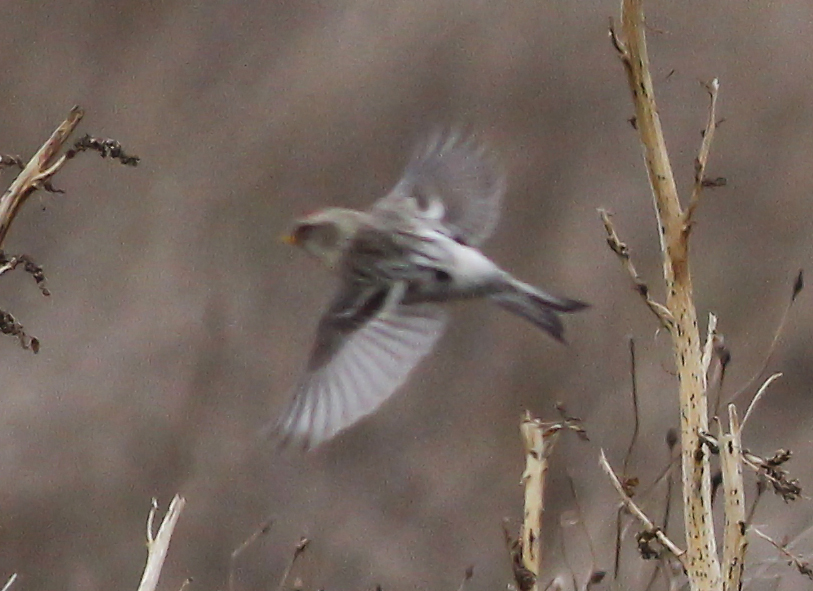
Lately I have been quite pleased with some of my photos on here, a distinct improvement since the start back in 2006 when I was digiscoping with a poor quality compact camera. Today sees a return to the good old days! Not digiscoping mind you, oh no this is all DSLR with Canon lenses and all that jazz, its just that the taget was so far away and elusive, you would think the images had been taken in the fog through a carrier bag over the lens!

This morning we had a quiet wander around the Coquet Estuary seeing very little, so we decided to take a long shot and try a revisit to the Coues Arctic Redpoll. It seems that he is long gone, but there were still redpolls in the field including at least one Mealy. The weedy rank stubble was full of bird though with lots of Yellowhammers and Reed Buntings, Linnets and Skylarks with a few Grey Partridges and Brown Hares for good measure. As we walked up we herd a faint 'tickety tickety' over head and after a scan around picked out a lone Lapland Bunting circling around with other finches and buntings.

What a merry dance this bird lead us for the next hour or two, back and forward up the field sometimes missing it all together then lifting it nearby only for it to fly the length of the field and drop back down! I managed two glimpses on the deck as it ran along a wheel rut showing a nice rusty nape, but photos were an impossibility. Then, didn't it make a change from normal Lap Bunt behaviour and land up on a bramble bush next to the main track! Although way too far for pictures, we could see its nice pale form quite well in the binoculars. Well here are the delightful images I promised you. Prepare to be amazed...

'tickety tickety' and off...

Squint. Thats it in the middle. 

A much better shot. Showing rusty nape and chestnut wing panel with white underparts...
 While the views and photos are nothing to write home about, it is still a Lapland Bunting and a very nice record for John's patch. Its a while since I've seen one...

Monday, February 08, 2016

Up to the Guts....

A day off today, with a reasonable weather forecast, so we went birding...

With no planning whatsoever John and myself began at Amble Harbour and worked north.

Amble was very quiet indeed with nothing of note. Further along the river, a few ducks were worth a look, 100+ Wigeon, 1pr Gadwall, 4 Red breasted Merganser, 2 Goosander and 2 Goldeneye fed on a low tide, while a Little Egret flew over the point to the Gut  er Old Water.

At this stage we discussed the local site names for our usual birding spots. Traditionally, all bird records from most of the Coquet estuary were labelled Warkworth Gut. This name, however, is just wrong. Warkworth Gut is a small muddy creek running from the south behind Amble Marina and not the channel edged in saltmarsh and reedbed that runs to the north. This place, where most birds are found, is called Old Water. Now there are some tidal pools at the head of Old Water we have imaginatively named 'Old Water Pools'.

Just to confuse matters further, there is a small, difficult to view 'Gut' opposite the weir laybye, that could also be called Warkworth Gut, but it doesnt have a separate name, it is just known as 'the river above the weir'.

There, that's that clarified. Several Guts, but the real one rarely has birds...

Back to the birds. As we were here it would be rude not to call in to see the Coues Arctic Redpoll for the 5th time. Today the bird was running a bit late and left us standing twiddling our thumbs for half an hour before it and it's colleagues flew in to the usual fence line to allow viewing. There was some discussion about the identity of the rest of the flock. These birds get no easier. Most could feasibly be Mealies rather than the assumed Lessers. In fact only 2 birds out of 30 or so were obvious Lessers, one a very red breasted male and another browner bird, both small compared to the rest. There are definitely 3+ Mealies, the rest are just Redpolls....

Coues on its usual post....
 From Birling we headed up to Boulmer via Foxton Bends where 500+ Wigeon were unsuccessfully  scanned for yanks. At Boulmer we walked both north and south along the shore. There were lots of birds to search through, many hundreds of gulls and coastal waders with a few wildfowl too but it was a day of spectacle rather than substance. A Peregrine hunted the rocks and a Twite flew south. On the flash, a few Mallard were joined by a juv Pale bellied Brent Goose. It was the shere number of gulls and waders though that caught our attention the most. As the tide neared the high mark, the waves washed piles of seaweed around exposing tasty morsels for the birds. There were 8+ Purple Sandpipers, 50+ Turnstones, 20+ Bar tailed Godwit, 100+ Dunlin, 40+ Sanderling, 2 Grey Plovers, 200+ Curlew, 50+ Redshank on the shore. It was great to watch them swirl around and return to the beach every so often.

A sample of waders flying around.

Nearby a young Grey Seal watched us pass then went back to sleep.

Not a bad day, certainly better than being office bound that's for sure!

Grey Seal

Monday, January 18, 2016

Redpoll update...

What a lovely weekend that was, sunny cold and crisp, just the job after weeks of clarts* and rain.

A few walks around the homelands added another 10 species to the 2016 Patch List, mainly very common stuff like Greylag, Greenfinch, Reed Bunting and Yellowhammer, but also 2 Willow Tits fighting and buzzing around at Craster soon to be joined by an equally tricky patch bird, a Treecreeper. Rock Pipits and a Shag were in Craster Harbour too, so its slowly coming along.

I might have seen more, If I hadn't been tempted back down to Johns patch at Birling to see what our Redpoll looked like in the sunshine.

After a full week of debate that had the emotions churning, at last, young Jonathan Farooqi has caught a photo, capturing the bird's very essence. Forget the Garner Redpoll Code for just a moment and wallow in this image for me.... in particular image number 8 from the top.

Now take yourself back 30 years, if you were birding then, and just think what your reaction would have been if you had found this in a hedge with a load of brown birds. All of us, to a man, would have shouted ARCTIC REDPOLL! 

I posted my own redpoll CV in the last episode, so you know that I have watched a lot of Mealy Redpolls over the years, but have never known one in the wild or in captivity to show that amount of whiteness or, more importantly, feather bulk and posture ( fluff, to you and I). Martin Garner suggests using 'jizz' before going into the minutiae. This bird, as soon as it settles, puffs itself into a round cotton wool ball, Every time. Only when coming in to feed does it take on a different persona, becoming all tight feathers and slimmer, like a fat bloke breathing in on the beach.( Not a word from you lot either).

So, on Sunday we managed some good views of the redpoll in both of its forms, both slim and fluffed, but mainly at a bit of a distance. The scope gave good views though. At one point it was on the ground scuffling for seed where it could be compared to Lesser Redpoll and Linnet.  This flock also has probably 2 Mealies in there, and one bird it associated with in particular was a big brown Mealy.

The bird still has a few problems that dont seem to fit with our current understanding of redpolls. That bill for instance gives it a Mealy look about it.  But I think thats the problem, we just dont know all there is. These birds are very difficult and may even merge in some areas though studies in Canada didn't think they interbred. Maybe Coues's Redpoll is more 'flexible' that we think....

*mud for those south of the Tyne....

Notes from yesterday done in the car after my fingers had thawed out, hence scribbled writing. Colour added later back home.

Good enough for the Handbook....


Sunday, January 10, 2016

White out....

I just want to post some info on the Redpoll John found at Birling Carrs today. John had noted a redpoll flock last week and fancied he glimpsed a paler bird in with the lessers. They are feeding in a rotting game crop full of seed right next to the golf course at Warkworth.

This morning we had a wander around and sure enough the flock of about 20 birds came dancing into the tall stands of seeding crop. The birds perched for a minute then dropped to the ground and were mainly invisible. As we approached up they would go and fly off some distance only to come back 10 minutes later. This was the pattern for the next hour before we had to leave.

So what did we observe. We have posted snippets of info and two pics that John took on social media but it doesn't explain the story.

Our bird was the only pale individual in an otherwise brown flock, so no two bird theory here.

At first sight against a dull, damp, dark background a white flash of rump like a Brambling was very exciting.  Once our eye was in, the bird could even be picked out in flight against the sky let alone a dark background.

Once, it landed close to us where the distant white snowball looked very much greyer and Mealy-like, but only a back view was had before they dropped out of sight.

At long range the bird looked even better, a very whitish bird like a beacon amongst the little buff lessers.

Looking at Johns photo's below it is easy to cry Arctic, but lets be very critical first.The bird looks like a first winter with pointed tail feathers? The colour of the tail seems odd with those white streaks, this is due to the wetness of the habitat soaking the feather so maybe the tail tips are wider and rounded when dry, its hard to tell.

This wetness might be having an effect upon the extent of white rump showing too, smoothing feathers down and exposing a more pale, basal area.

The mantle is quite dark and dirty looking, but again is this a weather related illusion?

Dark solid looking ear coverts with greyish surround and large red 'poll' do fit a Mealy and lack the buffiness of Arctic ( Coues Arctic). The bill didnt appear stubby and can easily be seen  in flight.


Now this second image for me gives more info, but is a bit contradictory.

The under tail coverts first seem to have only one fine streak but look at that errant streaked feather sticking out to the side. That is quite obvious.This is a second thicker streaked undertail feather. I think.

The flanks have nice dark tramlines drawn down them but are partially obscured.

Its such a shame the face is hidden because this does look different and very creamy buff, under and around the black chin and the supercillium.

These comments still leave us hanging really. I dont think a 100% certain i.d can be made so far. The bird needs further observation and, hopefully more photos taken.

On social media quite a few comments have been made shouting Arctic, even saying definitely, but let me say, how can we be sure from these two images. I have consulted Garner's Winter Guide, and Birdling World 1996 as well as online images and nothing really helps.

Personally, I have a good Redpoll 'CV'.

Myself and John are experienced observers. I have kept them in captivity as a child, helped a Mealy captive breeder, used to be a ringer and have caught, ringed and handled a good few, I have seen lots of Mealies in Northumberland, uncountable Lessers since childhood,indeed this was the first flight call I could identify when aged about 9 or 10 yrs old. I have found and watched the nests and display of Lessers in the wild, watched Iceland Redpolls in Iceland and have found 2 Arctic Redpolls in Northumberland ( Alnmouth and Druridge Bay Country Park) accepted by BBRC.

I just want to put it out there that we kind of know what we are talking about.

So why can we not be sure of this bird after watching it in snippets for an hour, yet people online can name it from two images that took  1/600th of a second?

Lets hope its publicity gets other birders onsite to check it out and hopefully get some clinching shots. You never know it might be our third self found Arctic Redpoll!!

Monday, October 26, 2015

Late autumn...

Sea Buckthorn
A very Scandinavian looking Blackbird newly arrived.
The day started off quite cool with a light grass frost in shady areas, but soon warmed up into a very pleasant late autumn day.

I met John at Amble Marina car park at 7.30am to give the patch a once over.

As the weather was from a light westerly direction, passerines were not going to be too inspiring so we wandered around looking for bigger game.

First off a stroll along the road path to Warkworth and back checking the river Coquet for wildfowl, grebes etc. The tide was low, encouraging 7 Little Egrets and a handful of Grey Herons to feed in the shallows. 200+ Wigeon were widespread along the route with a good few Mallard and a scattering of Teal. A couple of Rock Pipits added to the show with an very odd high flying Great Tit dropping in.

A good few Blackbirds were on various berries in the car park and John saw a Kingfisher fly upstream, while I had to make do with hearing the whistle call only.

Two Peregrines were exciting near Beal Bank, one big female moving off SW while a bright male left a kill on Helsay Farm and circled the fields for a while.

Geese were obvious around here with 100+ Pink feet and 50 each Greylags and Canadas.

You can just about see the male Peregrine here...
  Next move was along to Birling Carrs to check the sea and game crop along the coast. Small birds were all but absent in the seed field which was surprising, but 3 Goosander flew over S.

The sea was more interesting being well up by now. It was calm allowing good viewing conditions.

A scan of the bay had 20 Red throated Diver and a cracking Black throated Diver that flew from the south and dropped in with small group of Red throats quite close in allowing good views in the scope. The first water based bird I've seen for ages and certainly brightened the morning.

Black throated Diver, Birling Carrs.
Also here were 1 Great crested Grebe, 13 Common Scoter and a male Goldeneye with a few Guillemots. Out on the carr were 18+ Grey Plover, 10+ Knot and 2 Sanderling.

Bck home, a Chiffchaff was investigating the bird bath and a Tawny Owl showed sat out on a telegraph pole in the darkness at tea time.

Roll on Spring....

Sunday, August 31, 2014

In the pink...

Sedge Warbler juveniles.
Is it my imagination or are there a lot of young warblers around this year? Most spots this morning held a good selection, in particular the Warkworth Gut top car park where there were 5+ Chiffchaff, 1+ Willow Warbler, 5+ Blackcap, 3+ Whitethroat and 1 Sedge Warbler. Overhead, 2 Yellow Wagtails flew south and a Wheatear seemed to drop out of the sky from nowhere.

Over in the bay, a dark phase Arctic Skua stalked along N and a Whimbrel trilled going south.

Its years since my first ever Surf Scoter was at Birling Carrs, just to the north of Warkworth and I can count on one hand the times I have been there since, but today we gave it a look.

In a proper stubble field (one with weed seeds) we came across a large flock of small birds with maybe 500+ individuals comprising of mostly Linnets but with good numbers of Greenfinch, Goldfinch and Skylarks too. Its nice to see this again when we are old enough to remember when every cut corn field was like this, not so long ago. Later next month this might be worth checking for Lap Bunts, providing its not ploughed in by then.

By the time we got to the beach, the sun was out and things were warming up nicely. there was a large tern roost on the one flat rock that merited a closer look. In there, were 80+ Sandwich, a few Common and Arctic and 2+ Roseate Terns including a nice very pink adult. I thought this would have faded by now?
A Med Gull here looked like an adult, but might have been second winter, as I didnt get to see the primaries at all...  

A nice pink adult Roseate Tern in the flock..
...and again this time it is far left, three down from the top.
Mediterranean Gull
Birling Carrs