Showing posts with label Seahouses. Show all posts

Sunday, November 14, 2021

Not the rarity we anticipated....

 With the final throws of Autumn upon us it was with some eager anticipation this morning dawned damp and overcast with a light SE breeze.

As I stepped out of the house in the gloaming at 07.10, the sky was full of calling thrushes. Fieldfares, Redwings and Blackbirds were arriving in good numbers for the first time this season. This made me keen to get to Boulmer to see what might have pitched in. Last night on social media there was some daft chat about Rubythroats, Accentors and the like, but I was hoping for a Long eared Owl, or Black Redstart maybe.

Boulmer car park was ominously quiet with little arriving. A party of 10 Fieldfares W, was about as good as it got. John and myself  'smashed' Seaton Point grafting until our eyes bled. Well, maybe not but we did wander around looking at bushes and listening for calls for a couple of hours. Another 2 Fieldfares, a Redwing, 20+ Dunnocks were as near as got to migrants, but 2 Great Northern Divers flew North over our heads and a third North out to sea.

Not to be thwarted in our search for something, we retired to the car for sustenance that was made  up of a Greggs Cheese Pasty, a Chocolate Eclair and a mug of tea. That got us going a bit so we planned to head North now searching the rocky shore on the way with thoughts of a rare wheatear. Unfortunately, this plan was rapidly changed as we passed the Village front and a very unusual What'sApp message came through -  Walrus at Seahouses.

Could this be the return of professional dinghy sinker 'Wally' who wreaked havoc all down the west coast from Wales to Scilly to Spain and Ireland in the summer? Whatever, this is a very rare occurrence indeed so, it may not be a Rubythroat but we were soon in the car and off to Seahouses to see for ourselves.

Quite a crowd was already watching the Walrus, hauled out on a breakwater in the harbour. It looked like a huge, ginger sofa or maybe a fly-tipped carpet and didn't seem to be in a hurry to get off. We could watch it down to about 30 yards without it being in the least bit concerned.

The Marine Mammal Medics were on site to monitor the animals welfare. It seems to be a female called Freya who was last seen sleeping on a Dutch Submarine in late October. Comparison of the marks on its flippers seem to agree with this theory. See this link to an article in the Guardian.

Occasionally Freya would wake up and stretch, have a look around at its new admirers before going back to sleep. Never has an animal looked so comfortable on such an uncomfortable bed. After the Humpback in January, now Walrus is another arctic marine mammal to be added to the Pan species List. If she lingers it is well worth a visit. What a beast...

Walrus can just be seen on the granite breakwater near the end in front of the observers.

She sleeps on oblivious of the attention .


Occasionally Freya the Walrus would wake up, have a look around then go straight back to sleep. She has a sore looking abrasion on her flipper though this is a regular normal feature apparently?


Monday, January 19, 2015

Black necked Grebes.

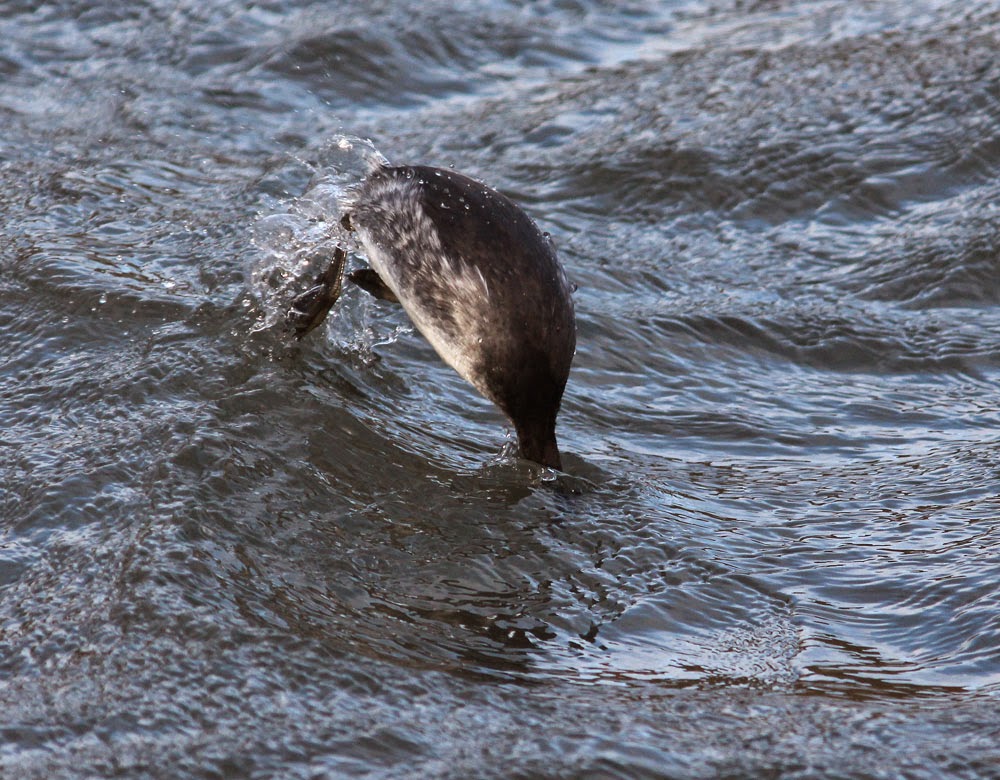
Over recent weeks two Black-necked Grebes have been living in Seahouses harbour, so today I thought I would meet up with Gary for a chat and maybe get a chance of a photo or two of them. One of the birds legged it out of the harbour pretty much as soon as I arrived, but the other continued to feed between the walls and boats. It led us a merry dance though, often over on the opposite side to where we were, but after some 'Benny Hill' style chasing around between lobster pots and rope piles, we managed some pleasing pics.

What a great little bird, it was even heard calling to its buddy who was making itself scarce on the open sea.It was scared when a large bull Grey Seal popped its head up next to it right inside the inner harbour.

Black-necked Grebes used to be a good breeding bird in Northumberland, with one inland water holding up to 16 pairs plus non breeders. The sight of 40 Black-necked Grebes in breeding plumage swimming between the flowers of amphibious bistort and water lillies was a annual spring highlight up here. One year when I went, there was a summer plumaged Slavonian Grebe in with the Black-neckeds! What a picture that would have made...    


Back at home, a flock of 200 Pink footed Geese and 30+ Greylags flew south, while the birds feeding in the coast path pasture continues to increase - 100+ Redwings, 3 Fieldfares, 12+ Mistle Thrushes, 50+ Golden Plovers and 40+ Lapwings.

76. Greylag Goose.

Sunday, February 23, 2014

Another lesson learned, a day at the harbour.

 Another day, another lens borrowed. This time a kindly loan from Gary Woodburn of his Canon 300mm f4 with 1.4x extender, saw me and John down at Seahouses Harbour giving it the once over.

The light today was pretty useless when we were out, being overcast and quite windy, so the results aren't directly comparable to yesterdays photos, but here are a selection...


Eiders running up the ramp, thinking we had chips.
Is there a finer duck than this? I think not...
Calling and bubbling to females.


Various gulls got the paparazzi treatment.

   
Turnstone

Never has a Skemmie been so photographed! Lets call it a Rock Dove...
A Collared Dove, on a dull day on the north side of some pines with ISO1600.
John took this one of a Rock Pipit admiring its own reflection.

Very good results I think. Take into consideration that it is a new lens to me, the light was poor and these results are after an hour in the field.

So how do I decide what is best for me? Lets go through the pros and cons of each lens, not that there are many cons for either of them. Both are tremendous, and after being used to compact and bridge cameras, I would be very happy to use either of them to the exclusion of all else!

The 400...

Pros.
Compact and lighter than the 300 set up.
A single optic, with very bright images and fast focusing.
Cheaper, slightly, as it doesn't need an extender.
Only one item to buy so its easier to get hold of.

Cons.
My friend Roger has one. He says that he often leaves it at home during the winter as the lack of image stabilising needs better light than a Northumberland winter can provide.
3.5 mtr min focus distance, is ok for birds and mammals but not so good for butterflies etc.


The 300...

Pros.
IS. A boon in dull Northumberland winter light, means faster shutter speeds can be obtained.
Focus down to 1.5 mtrs tested today would enable insect photography.
Extender ups the 'mag' to 430mm.

Cons.
Quite long and heavy with IS and an extender.
Two pieces to buy makes it more expensive.

Summary.
These 'cons' above are nit picking really, but its difficult to choose which one to fork out cash on.
I want a lens to carry in the field when birding, but it has to be used all year round. Despite what people think, I didnt notice any appreciable reduction in quality when using an extender. Certainly not enough to detract from blog photos which is my main use after all.

I think I'll go for the......er.......mmmmmm, now hang on a minute.....

oh shite.

[Many thanks to Gary, Alan, Richard, Roger, John, Ian, Tom and everyone on t'internet for their help and advice.]