Monday, October 23, 2023

Fall...chat

 On Saturday 7th October the weather was awful. For most people that is. For the birder, heavy rain for 24 hours with a light ENE wind can only mean one thing - migrants!

I stepped out of the door at 08.30 to the swirling sounds of hundreds upon hundreds of thrushes teaming out of the sky. Most years recently have only seen a small trickle of thrush migrants as early as this with most not coming in until late October or even early November. Especially Fieldfares.

During an hour standing around the village getting soaked, a minimum of 2700 Redwings, 50 Fieldfares and a few Blackbirds and Song Thrushes arrived. The back field behind us was carpeted in birds. 

It was while getting some respite from the rain indoors while scoping the thrush carpet from our kitchen window ( I wish I had taken a blog photo of that), a smaller bird flitted into view, dropping onto the plough between the larger birds. It was very dull and raining leaving the birds more soggy than I was so initially I couldn't work out what the small visitor was. It was sat hunched, facing me, reminding me a bit of a Dester Wheatear but it wasn't quite right.

It was only when it  flew a short way and began feeding by hopping, and flying from clods of earth that it dawned on me. It was a  Stonechat. A Siberian Stonechat. From inside our kitchen. 

These days I don't keep up as much with the very latest taxonomy but to begin with the bird looked more dark orange that most peachy Sibechats I've seen so wondered about it being Amur or Stejnegers Stonechat? A further 10 minutes watching through the scope, showed that its apparent dark tone was nothing more than the grim light and damp feathering causing it. As the rain eased a bit the bird became more perky and looked paler. It was quite the shape shifter though, changing tone and even pattern according to its angle.

After scribbling some notes I decided to go out to try and photograph it with the camera. My phonescoped shots are dire, as I'm sure you will agree.  

The best plans though don't always work out and as I approached the field a wave of thrushes headed west and there was no futher sign of the chat. It seems it was travelling with them and moved on.

Back home after checking some literature, I don't think I could attempt a specific id on this bird but its going down as Eastern Stonechat and its still a total garden mega so I'm having it.

By lunchtime, most of the thrushes had moved on west leaving the place quiet as if nothing had happened.


Above, Eastern Stonechat, apologies for the photos.

Wednesday, October 18, 2023

Red breasted Goose etc.

 So, September ended with a big dip. Oh well, its one of those things. How would October fare...

Sunday 1st October was a lovely fine autumn day here. Dawning quite cool but warming up later on.

John and myself took a trip up to Elwick on the Lindisfarne Reserve to look for the Red breasted Goose that has been hanging around with the large geese flocks for a few days.

We wandered up the track knowing from experience that the geese here are usually quite mobile and as we arrived at the end, this was certainly the case. Flock after flock of Barnacle Geese were leaving a distant field to our right and flying across our vision to land, unseen in a field, two to our left. Each flock was scrutinised in nice morning light as they passed, without luck. 

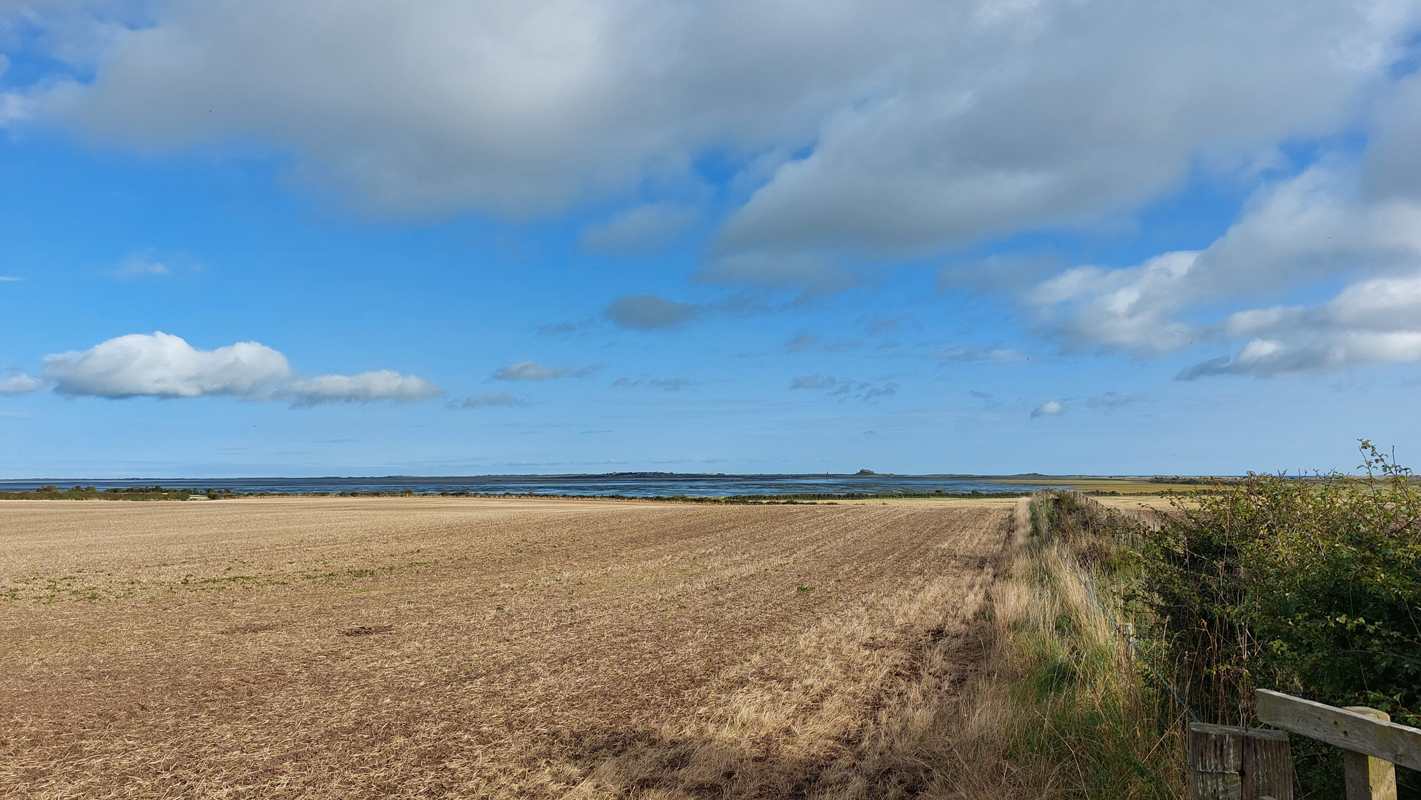
The view we had as geese flocks flew left at the end of this field. Holy Island lies beyond the flats.

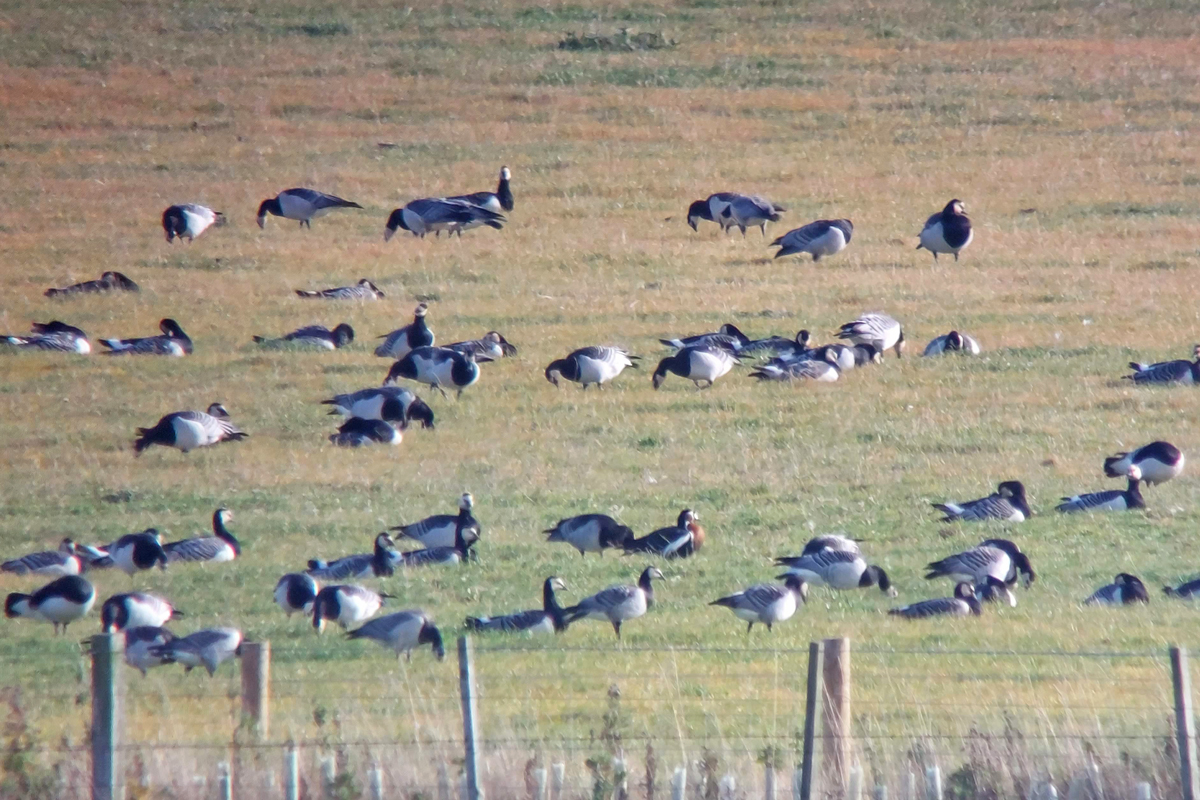
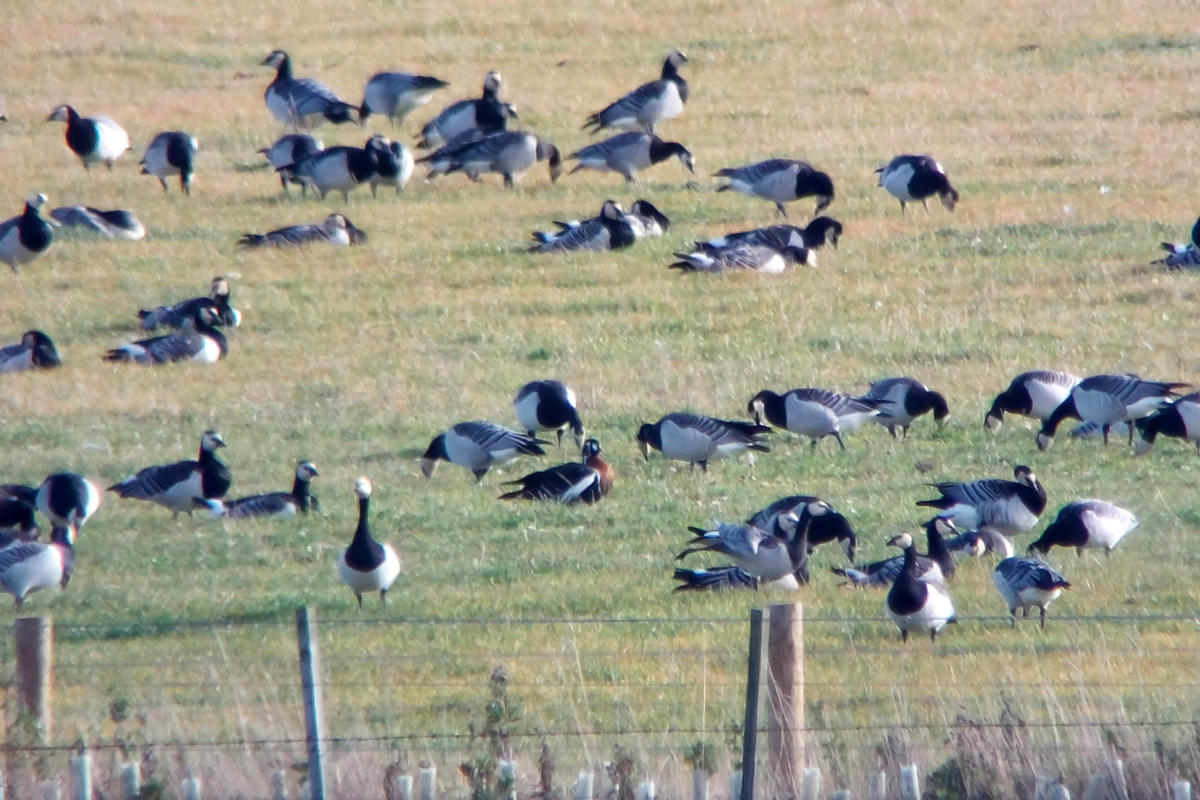
We decided to try to get a view of the geese over to the left so we stalked close to the hedge, into a dip, to peer into the next field. The ground was wallpapered in Black and White. A 'magic-eye' illusion of Barnacle Geese greeted us with birds still arriving. The problem was, we were too close. We stopped, scarcely daring to breathe and quietly scanned through. No joy. We waited. In the distance from Holy Island causeway I saw another few hundred geese strung out in the air heading our way. As they whiffled down to the ground we had another scan. There, only about 100 mrs away, right on the front in full sunshine a stunning adult Red breasted Goose, probably the first with good credentials since the 1800s in Northumberland. It had arrived with a small flock of Brents from high to the east originally before moving in with the Barnacle Geese to feed. What a belter, and I had left my camera in the car thinking the geese would be too far off.

As it happened, that was irrelevant. No sooner had we seen the target, a farmer on a quad drove straight into the field putting 3000+ geese to flight right over our heads. The sound was incredible. I've seen lots of goose flocks into many many thousands across the UK but have never experienced such noise from wings and voice only 50 feet above me. It was truly awesome.

As we watched the mass head back to the fields they originally came from, we scanned and scanned but couldn't pick up the Red breast. It was here a twist occurred. As we looked, I noticed an Egret coming off the flats towards us mobbed by crows. I couldn't say I'd seen that before, so I just put the scope on them. The Egret had a bright crocus yellow carrot pushed into its mush - it was a Cattle Egret! This was only my 2nd in the county and my first self found. These may be tame fare on the Avalon Marshes but up here they're still hens teeth.  We watched as the Cattle Egret lowered its undercarriage and glided over a hedge appearing to land unseen. We went to investigate.

From our new vantage point, we never did see the Egret again but we could see the geese. It took about half a dozen scans before the Red breasted Goose was picked out. Now at comfortable distance we could scope it feeding with Barnacles and showing how such a colourful harlequin could be camouflaged in the monochrome sea of wildfowl.


Two great county birds UTB by breakfast, excellent.

A stop at Budle Bay for our tea and snacks had a lot of birds but just the usuals. Highlight was probably 35 Shovelers.

On to Monk's House Pool of Ennion fame where there had been an American Golden Plover. Unfortunately most of the flock had departed leaving only 115 Eurasian Goldies to scan through.

Still not a bad day, RBG is no 363 on my county list and only my 2nd ever. 

Cattle Egret field notes.

Red breasted Goose field Notes

A worked up version of the Red breasted Goose back home.


Friday, October 13, 2023

Suffolk...

 I was going to do a better holiday blog, but things are backing up on me a bit so this will be brief, just for completeness. While we were away for 2 weeks there were very few noteworthy bird reports from Suffolk but my Northumberland Birds WhatsApp group was niggling away at me with almost daily reports of the goodies back home. Most galling was a tremendous juvenile Red footed Falcon on one of our local moorland patches. I even recognised the telegraph pole it was perched on in the photos! After about 10 days of daily gripping frame fillers, we were on our way home. Bird still present at 10.30am. Looking good. After 360 miles with a sickly clutch I decided to get up there first thing next morning. Yes you've guessed it. That 10.30 am sighting while I was on the A1 near Stamford, was the last. It had gone.

Back to the Suffolk report. The only good bird ( for us) was a very close Dartford Warbler in the dunes at Sizewell. We went for a brace of Glossy Ibis at Aldburgh but dipped those. Im starting to sound like Unlucky Alf here...


So, I'll just end with some snaps from the week...


Peggy enjoyed her trips out and pub lunches...

Southwold, always a pleasure.

Aldeburgh Food Festival at Snape Maltings.

Crabbing at Walberswick.


Above, Shingle Street. What a place.

Sunset from the house

Wood Mouse watching the moth trap action...


Tuesday, October 03, 2023

Holiday Moths

 Well that's our two weeks holiday in Suffolk over and we are back to work.

We spent the fortnight, as usual, in Westleton, a village only a mile or so from RSPB Minsmere, a place we have visited twelve times since 2002, staying in eight different houses! Its probably enough to say that we like it there.

From a wildlife perspective, I never seem to do very well with the birding, but for insects and other taxa, there is plenty to keep my interest up over multiple visits. Who knows, one day I might even jam in on a good bird !

For this post I just want to get the mothing out of the way. Over two weeks I trapped on 6 nights, missing others due to overnight wind or showers.

There were 9 new species for me, most interestingly were a good few migrants.

Best of all was this Diasemiopsis ramburialis, the Vagrant China Mark. This is a vagrant with only 8 previous Suffolk records.

I think this Pediasia contaminella is new for me? Not found at home.

This Carnation Tortrix Cacoecimorpha pronubana was nice even showing its orange hindwing.

One of my most wanted migrants, Palpita vitrealis came on the final night trapping. What a stunner, smaller than imagined.

This Mallow was quite distinctive when compared to the Shaded Broad Bar which is common at home.


Above, this Hoary Footman was tricky to separate from Scarce Footman but both were caught.

Scarce Footman with the bright darker yellow full length costa.

Feathered Brindle was a nice surprise and off my radar, only the one caught.


Geography sorts out this Deep Brown Dart from our own Northern Deep Brown Dart. Caught a few of these. Back home NDBD is barely annual in small numbers.

Apart from those new to me species, there was also some I am pleased to get on my visits to Suffolk - 

Convolvulus Hawk-moth, three taken on the first two nights, none thereafter. These two in the trap together.


I have only seen one Delicate before, but caught them every time trapping here up to 5 a night,


Scarce Bordered Straw visited 3 times, both pale and dark forms seen.

Neocochylis molliculana Ive had on a previous visit.

As above, Webb's Wainscot has graced the holiday trap before.

So, its always good to take the moth trap on holiday, there is always going to be something of interest in there...


Monday, September 11, 2023

Club Tropicana....

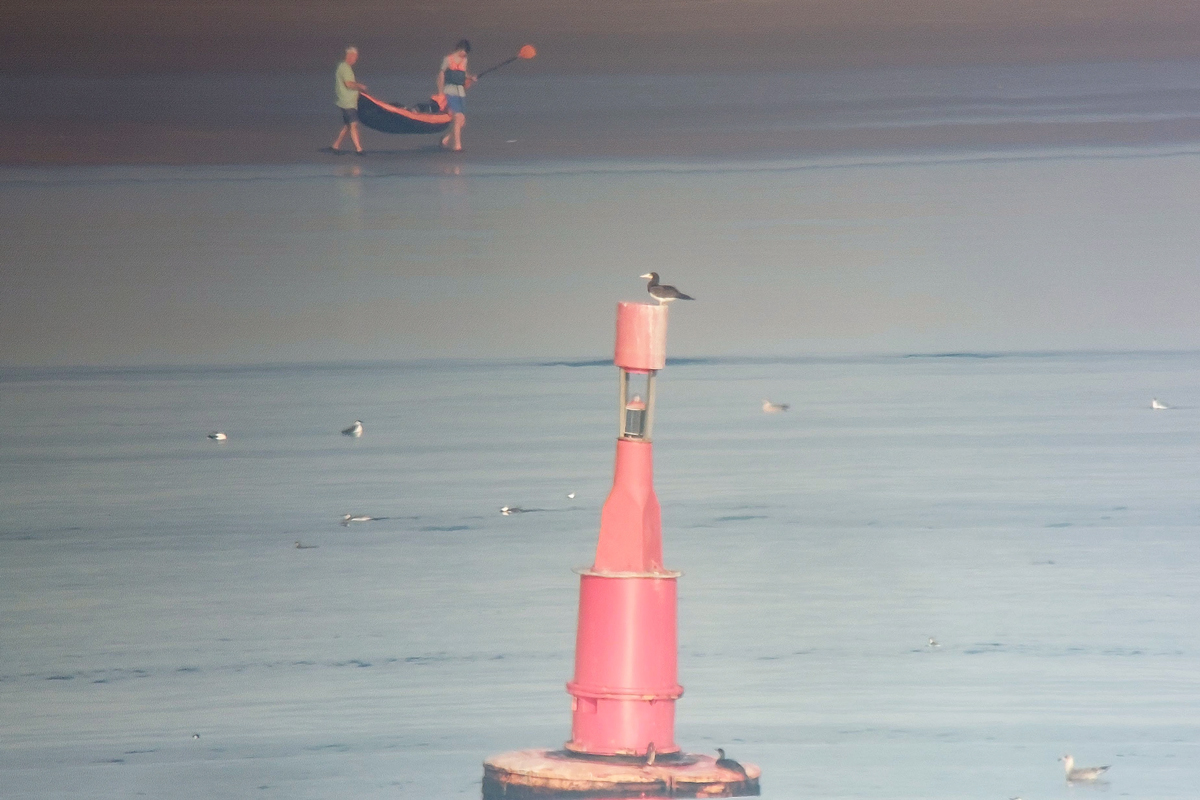
The bird was on that Red Buoy.

 After the run around on Wednesday, I was pleased to find that the Teesside Brown Booby was still hanging on down at South Gare, Redcar. To put this to bed once and for all I carried out that most heinous  of birding crimes and twitched it. In my car! How very dare.... but the 160 miles round trip was worth it and it turned out to be one of the easiest twitches I've done.

I met John at Alnwick Homebase at 6am and we headed on a traffic free A1 down to J60 at Sedgefield then a short run eastwards to arrive at our destination at 7.30am. The car was parked in a road side pull -in and as we got out and opened the boot to get the gear out, John said ' In the bag, let's away!' Eh?

'Aye its sitting over there' so I scanned with the bins and sure enough, at range the angular shape of the Booby could be seen sat atop the tall red buoy in the river mouth. Target ticked by 7.35am!

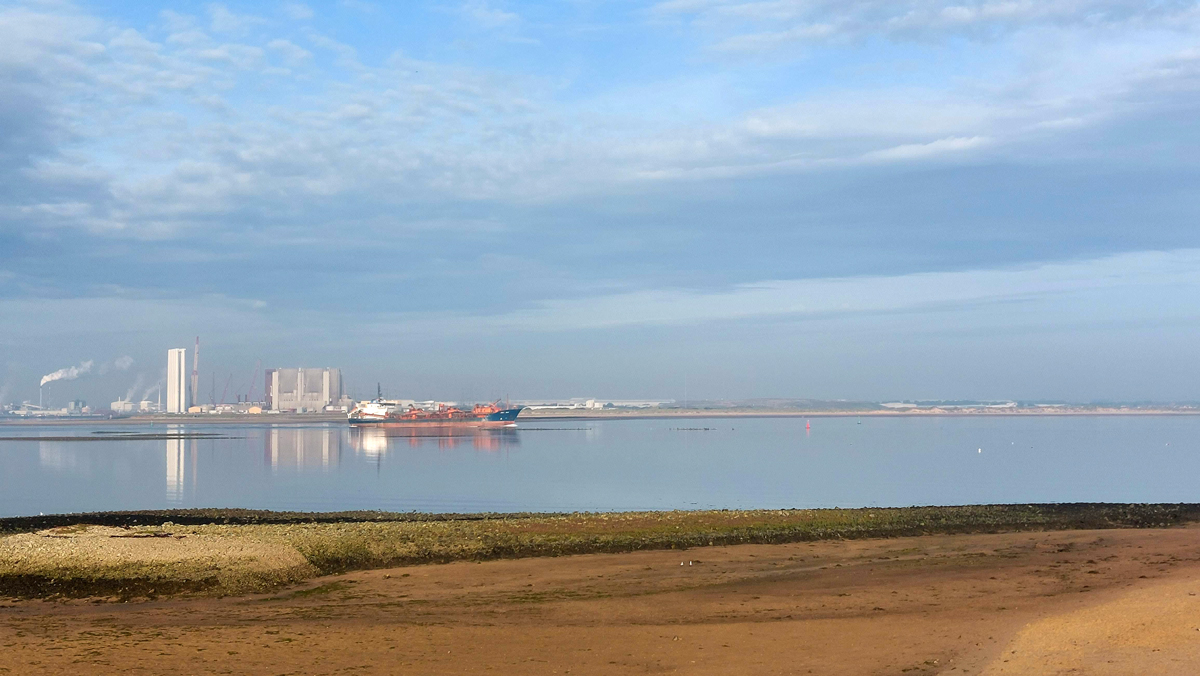
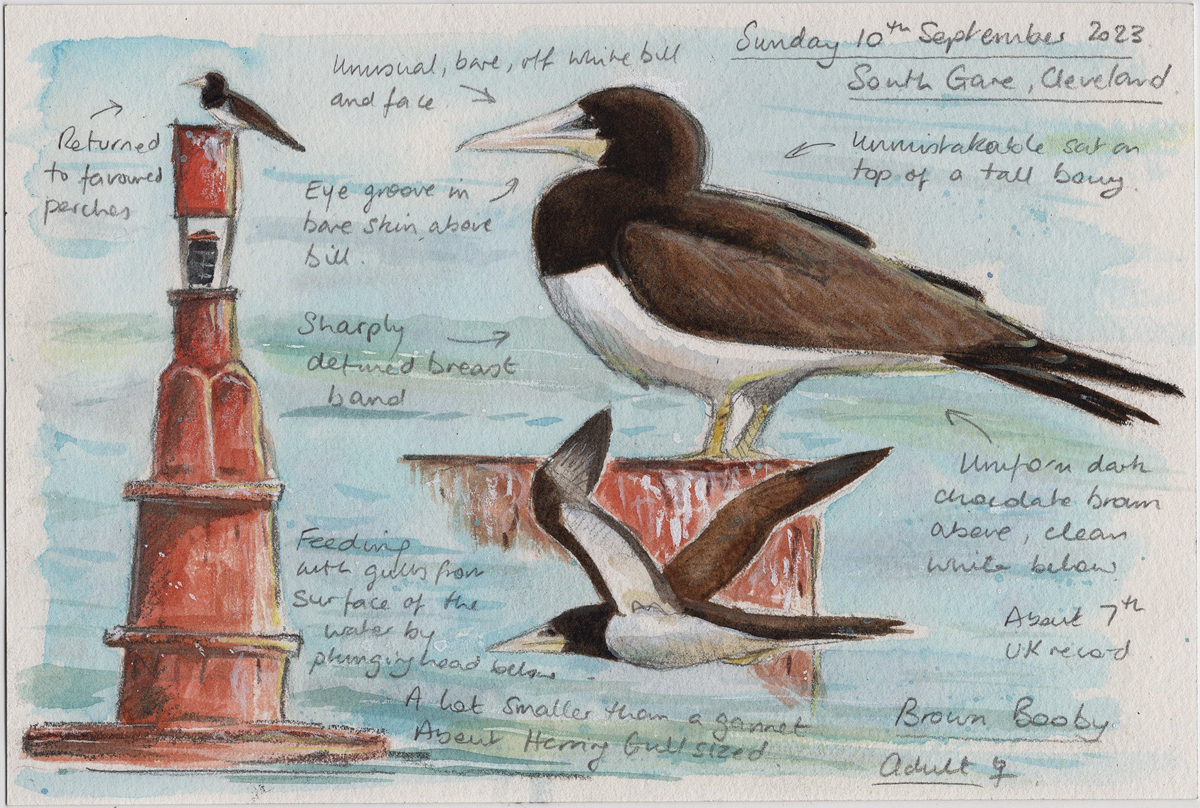
A short wander across the road with the scopes and an hour observation gave nice, if a little distant, views. The bird preened a while before being shook from its perch by the wake of a large ship passing by. It then flew around, chased by a few gulls where its small size could be seen. It then joined a gull / auk feeding frenzy to feed. The method was quite unexpected. I imagined it would plummet in like a Gannet but no, it sat on the calm surface and dipped its head down like a dabbling duck or maybe a pelican, before lifting up with a mouthful of fry.   

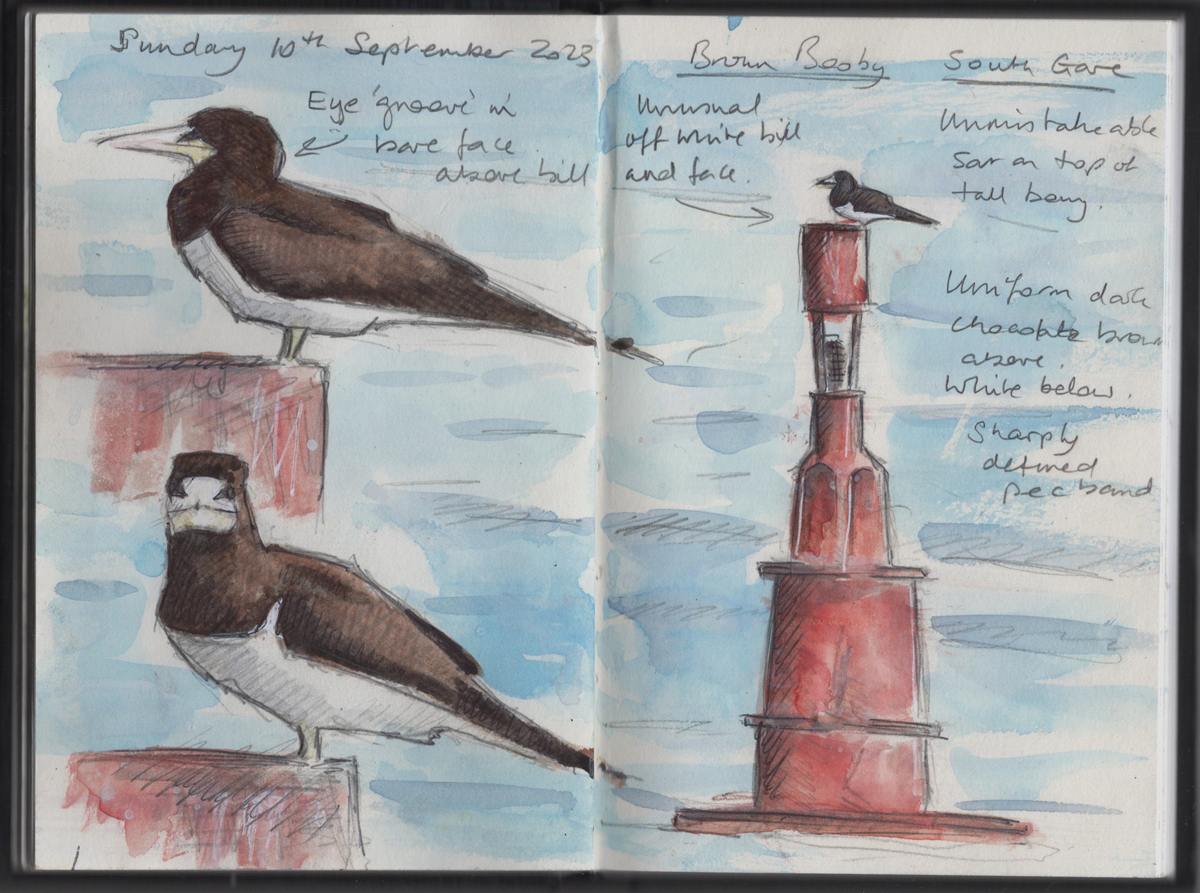
Some field sketches were put in the book and a few digi phone scoped shots for later. 

A few other birds passed the time too with a nice morning lit Peregrine low over, 2 Arctic Skuas, 1 Yellow Wagtails S and 1 Redpoll S. 

We left at 9.30am arriving back home at 11am. Excellent timing as we both had family commitments in the afternoon.

Brown Booby #428 BOU.


Field sketches, coloured when back home.

Worked up sketch for my neater notes.


Wednesday, September 06, 2023

Boobycarnage!

 This morning before leaving work to go into the office a local WhatsApp message popped up - 

Brown Booby, North, Long Nab, Scarborough.

This is a message that causes a basic life pause, just for a second while the info is mentally processed.

Then its reported very close in past Cowbar in Cleveland.

Clearly this is the bird that has spent a couple of days off Filey, so, what chance that it is actually on the move and not just circling around in the sea haa looking for a nice feeding frenzy to join in with?

Just in case, you understand, not that the chance would arise, and yes I am remaining cool, it might be worth checking timescales.

Long Nab to Cowbar took 1 hr 15 mins for 36 miles.

Cowbar to Newbiggin in Northumberland, only 2 miles from my office is 75 miles. By counting fingers and toes I can deduce from this that the tropical Sula could be due in around 11.30am.  

No, I'm still not too bothered, chances are it will be back in Filey before I get in to work.

Fast forward and I am in the office at 10am and logged on.

A message banner pops up on my phone. Brown Booby past Hartlepool Headland, very close in...

Shit is getting real, this could be on the cards.

A humorous and hasty conversation with colleagues and manager about 'weh hey' Brown Boobies ( insert emoji) and I cant hold on much longer, I'm off to Newbiggin arriving at 10.50am.

Already there are 20 people eagerly concentrating and grilling the rolling calm waves into the mist. The good thing about these type of twitches is that we can meet up with good friends we don't see so often, so its always going to be a win. 

The tension is palpable. Each juv Gannet gets a sigh as it passes. The concentration is broken briefly when a Black Guillemot flies through my scope and on to several peoples county and year lists.

'Cullercoats Brown Booby North towards Seaton Sluice'.

That is almost in sight! Come on...

After a few minutes there begins to be some coughing and fidgeting in the now 35 strong crowd. The rumour mill is grinding. Word has it, that it has not been seen at Whitburn a seawatching mecca. But there are close in immature Gannets. Then one observer says that the sighting at Hartlepool was believed by some ( always a good one) to be a Gannet too.

The observers at Cullercoats chip in that it might not have been a Booby?

It turns out there are NO confirmed sightings North of Cleveland.

Ah well its been a pleasant two hours and I am back in the office at 12.45.

Things should have ended there, but no, life is never that easy, is it.

Gary Woodburn calls. After all the earlier confusion, conspiracy and string, the real deal has just gone past Whitburn! Could you believe it. Right, one last ditch attempt sees me back at Newbiggin for 1pm but I need to be back by 2pm.

I needn't have worried, as I got out of the car Gary messaged to say 'Stand Down, the Whitburn sighting is erroneous too!'

Whats going on here. Looks like another young Gannet is responsible.

While standing discussing this with those who about turned back to the point, we had a close in very dark Balearic Shearwater, a Bonxie and a few Manx and Red throated Divers.

Balearic Shearwater courtesy of Paul Weddle.


30 minutes passes, time to call it a day. While there had been several Boobies this morning there was no Brown Booby for Stew.

As we left, a photo came through of the cracking adult Sula leucogaster now loitering off South Gare. Looks like it has never passed Cleveland after all...


Of his Time....

 I'm not sure what is going on lately, but things have been a little bit ... well  'meh' or 'pfff' so to speak.

Motivation has been as elusive as a good bird around these parts, but here are a few bits and pieces from over the last two weeks or so.

Maybe my highlight of this period is finally getting around to reading all of Steve Gale's short 1970's memoir of his early birding experiences 'Of my Time'. Steve is a great writer and his diary had me nostalgic for those better times. The anecdotes about his formative birding years around London, Dungeness and the south of England, had me gripped!  

Only one grumble, Steve  - get on with the 80s!

Hedgely North Pit despite looking good for waders on all of the pits, we heard that the farmer drives around the very margins on a Quad each morning to check his stock, thus chasing off any grounded birds!

On Sunday 27th we headed inland to Hedgely and Branton Pits to avoid Bank Holiday on the coast. While we had a pleasant wander in good weather there was little of note other than 9 Little Grebes, 300+ Lesser black backed Gulls inc 2 'intermedius' types with very dark upperparts and long wings. This big flock of gulls were put up by two Marsh Harriers, a female and an imm male who soon drifted off south. Single Greenshank, Wigeon and Kingfisher, a few families of Redpolls, 2 Ravens and a Spotted Flycatcher were the best of the rest. Until I got back home that is....

Mid afternoon I was on our drive when the local Swallows began mobbing something. A scan over the back field revealed a small, spiky, Hobby casually flying away from the hirundines off to the North. Through the bins it looked very grey and was likely an adult or near adult male. Its long swept back wings really did match the 'swift-like' cliche.  


On Bank Holiday Monday we mostly remained around the garden and village where 2 Ravens in the back field, an adult Mediterranean Gull in plough at Cullernose and 2 garden Holly Blues were the highlight, narrowly taking the prize from an off patch Peregrine over the road on our way home from Sainsbury's.

A mid week seawatch for an hour had 26 Manx Shearwaters, 54 Shag, 3 Sandwich, 3 Common and 1 Arctic Tern, 1 Common Scoter and 400 Gannets per hour all N. 

As the forecast was for warm sunshine yesterday we went on a dragonfly search inland at Corby Woods. The first two hours were cool and quiet with not much seen other than for a dozen Crossbills.
flitting around.

Once the sun came out so did the insects with 4+ Common Hawker, 4+ Black Darter and a dozen Emerald Damselflies. The the pine plantation were full of post breeding bird flocks with many Chiffchaffs and Goldcrests seasoned with 1 Treecreeper, 1+ Redstart and 2+ Spotted Flycatchers.

Larch Ladybird, Lesser Willow Sawfly larvae and Spotted Toughshank fungi were all new species for me. Hopefully the autumn will have a word with itself and kick in soon...


Black Darter


Common Hawker


Larch Ladybird