Thursday, November 25, 2021

Expectations, Hope and the Lottery...


Most birders, certainly coastal observers, spend a lot of time watching weather forecasts and trying to predict how it will impact on the bird life in their area. Often we raise our expectations too highly, more in hope than good judgement, but occasionally a good weather pattern forms that makes us think, surely this will do something. To be specific, that means it will bring rare or scarce birds to us.

The map above is of the wind forecast for this weekend. Today it is swinging around to the north and continuing from that direction until Sunday, peaking with 50+ mph gales on Saturday. 'Damaging' according to Carol Kirkwood. 

The chart shows the source of the 'breeze' to be from the Arctic Ocean, via the Greenland Sea, North East Greenland, Svalbard, Jan Mayen Island, Norwegian Sea and the Faroe Islands bumping into Northumberland nicely in time for Sunday morning.  


A quick Google of this area's birds shows that it is home to many seawatcher's palpitation inducing species like Brunnich's Guillemot, Ross's and Ivory Gulls, King Eider, Snowy Owl etc plus scarce stuff like Little Auks, Glaucous and Iceland Gulls, Grey Phalarope, White billed Diver and Leach's Petrel.  Any one of that lot would make for a good  local patch day.

But realistically what are the chances of pulling it off? Well who can say? It is getting late now and most of those birds rarely leave the pack ice let alone fly down a thousand miles of sea. There will be some Little Auks surely and maybe a white winged gull or phalarope somewhere but it is hope that will have us out in the teeth of a gale with fingers crossed. You need to be in it to win it...watch this space...


Monday, November 22, 2021

Winter


The weather forecast looked promising for a seawatch this morning. The wind was curling over the north of Scotland and down into the north sea, giving us a force 5 NW'erly. There was also a 30% chance of some precipitation too, but we didn't realise that seemed to translate into torrential sleet for a third of the time we were out.

We arrived at Boulmer at first light but had to wait in the car for the first of the squalls to subside before deciding what to do. Eventually it faired up enough to walk out south down towards Seaton Point. By the time we arrived, the sky was darkening again and curtains of sleet were heading our way. This is when we took advantage of the winter caravan site being empty and stood in the lea of this cabin. Strictly speaking we should not have been there, but the place was deserted and apart from this blog we left with no one being any wiser of our presence.

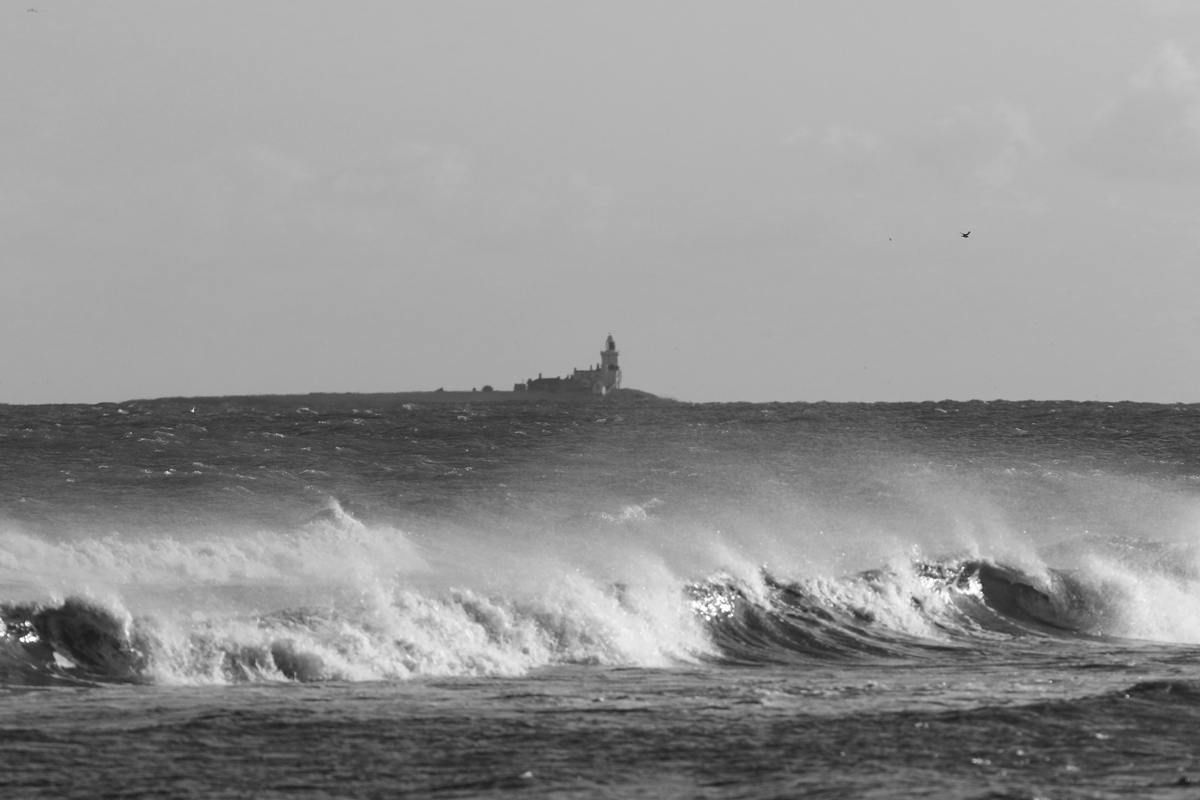
With the tide on the ebb, viewing wasn't ideal but the close sea south east of the point was sheltered by the land mass and a lot flatter than the wider sea slightly to the north and east. This meant birds were taking advantage of this and skirting just beyond the rocks and inside that line of breakers you can see in the photo above giving us good views in decent light. As further squalls arrived we just took a step backward under the porch canopy until it passed then we would pop back out again.

For this late, totals were as expected. From 9am - 11.30am we noted - 

Sooty Shearwater 1N

Little Auk 3 singles, 2 of which landed and bobbed around in floating weed for a bit before continuing north.

Long tailed Duck 2 fine drakes N.

Puffin, 15, a lot for the winter.

Red throated Diver  6+ 

Black throated Diver 1 north, close in then landed where it was seen breifly on the sea then lost in wave troughs.

Great Northern Diver 1N

Goldeneye 2N 1S

Velver Scoter 1 N over the rocks.

Pale bellied Brent 3N

Purple Sandpiper 3 on the shore and 1 N

Brambling, 1 calling in-off.

No Fulmars seen, Gannets, Kittiwakes, Gulls and larger auks not counted, but a steady movement throughout. Odd Common Scoters, Eiders, Mallard and Wigeon milling around too.  

So far so good. It was time to head back between storms. Peering out, the north sky looked blue and clear so off we went. Its about 1 km back to the car and as you expects, yes, we didnt make it. After only a third of the way, the black clouds raced over and hit us with driving sleet, right in the mush!

Back at the car, I was soaking with water running off my gear into the boot. Definitely time for home to get warmed and dried, still that was maybe the best local morning we have had for a few weeks...

Here it comes...

Nearly at the car park, sun and driving stinging sleet.


Thursday, November 18, 2021

The Lane.

 This is going off on a tangent with no current news here but I have been contemplating, as you do at the back end of the year, about next years patch projects. So far, I haven't come up with anything, but I was out with the dog the other day along our lane and it got me thinking.

Lots of people I follow on blogs and social media watch a local patch in some way or other. Some diligently, others more casually, but within your patch do you have small micro patches that draws you in more often than other areas? I'd imagine we all do.

Here, on my doorstep the village entrance is via a straight lane that stretches for 279 mtrs, according to Google Maps.

The Lane.

   As you can see its not East Bank, Hoddy Cows, or the Narrow Neck. Just an absolutely random bit of road that can be found duplicated right around the country. In its favour it is located 3 fields away from the North Sea, but its not on a headland or anything.

Habitat wise, its a tarmac, one vehicle wide, road and path with a low yield corn crop, this means there are some weedy seedy remnants in the stubble after harvest, on the East side and on the West is Village Wood, part of the estate with scrub and weedy areas. The whole length of the East edge has a deep ditch along it and a wide overgrown field margin, enjoyed by Barn Owls and Yellowhammers alike.

On the West, the ditch starts half way along and runs to the south end where they go under the main road.    

Facing North from the main road at the South end in May.

Same view in different weather.

I walk and drive this stretch almost everyday at some point, often several times when out with Peggy on her walks. Times of day and weather conditions vary but its flat and dry underfoot and always worth a stroll . Summer evenings at 11pm or fine early mornings are great but dark winter days with rain are also covered without bias.

November. Facing the other direction.


Beast from the East

No birder would ever visit. Its not a destination spot but for a local walk it is a route to other sites further south. The thing is, I have gone over my patch list to see what I have seen on this road over the last decade and it is quite surprising. In no particular order - 

Water Rail almost annually in the ditches during winter. Easier to see in hard weather.

Woodcock annually.

Little Egret 1 amazing record of a bird sat in the ditch then on top of the dead roadside tree.

Kingfisher a few records fishing over the ditches in winter.

Brambling, several times in with other finches in stubble and drinking from the ditch.

Mealy Redpoll a small flock one January included one very white bird feeding in alders on the west side.

Yellow Browed Warbler, a few records located by calling birds.

Grasshopper Warbler, once in the ditch reeling and seen down to 10 feet.

Peregrine a few records hunting over head.

Cuckoo 2 together autumn 2020.

Raven a few records, in the harsh winter of 2010 a pair roosted in the wood on the west side.

Crossbill annual in varying numbers

Tree Sparrow. Daily all year round.

Willow Tit. Rare only a couple of records usually late summer breeding dispersal.

Marsh Tit. Used to be regular now a very rare visitor.

Spotted Flycatcher, rare, 2 birds in 2020.

Waxwing, rare one sighting of 3 eating rosehips on the west side.

Hooded Crow 1 last year, 'our hoodie'.

Short eared Owl 1 in off, once.

Barn Owl regular along both sides in winter.

Osprey 1 a couple of years ago flew low right down the length of the road at tree top height.

Grey Partridge. Occasional.

This is not an exhaustive list, because I don't have one, but it shows how interest can be found in the most mundane spots by carrying out regular observation.   Quite a reward for watching a short stretch of road, I wonder what could be next?.


You can just make out a Woodcock on the road, quite regular here.

Sunday, November 14, 2021

Not the rarity we anticipated....

 With the final throws of Autumn upon us it was with some eager anticipation this morning dawned damp and overcast with a light SE breeze.

As I stepped out of the house in the gloaming at 07.10, the sky was full of calling thrushes. Fieldfares, Redwings and Blackbirds were arriving in good numbers for the first time this season. This made me keen to get to Boulmer to see what might have pitched in. Last night on social media there was some daft chat about Rubythroats, Accentors and the like, but I was hoping for a Long eared Owl, or Black Redstart maybe.

Boulmer car park was ominously quiet with little arriving. A party of 10 Fieldfares W, was about as good as it got. John and myself  'smashed' Seaton Point grafting until our eyes bled. Well, maybe not but we did wander around looking at bushes and listening for calls for a couple of hours. Another 2 Fieldfares, a Redwing, 20+ Dunnocks were as near as got to migrants, but 2 Great Northern Divers flew North over our heads and a third North out to sea.

Not to be thwarted in our search for something, we retired to the car for sustenance that was made  up of a Greggs Cheese Pasty, a Chocolate Eclair and a mug of tea. That got us going a bit so we planned to head North now searching the rocky shore on the way with thoughts of a rare wheatear. Unfortunately, this plan was rapidly changed as we passed the Village front and a very unusual What'sApp message came through -  Walrus at Seahouses.

Could this be the return of professional dinghy sinker 'Wally' who wreaked havoc all down the west coast from Wales to Scilly to Spain and Ireland in the summer? Whatever, this is a very rare occurrence indeed so, it may not be a Rubythroat but we were soon in the car and off to Seahouses to see for ourselves.

Quite a crowd was already watching the Walrus, hauled out on a breakwater in the harbour. It looked like a huge, ginger sofa or maybe a fly-tipped carpet and didn't seem to be in a hurry to get off. We could watch it down to about 30 yards without it being in the least bit concerned.

The Marine Mammal Medics were on site to monitor the animals welfare. It seems to be a female called Freya who was last seen sleeping on a Dutch Submarine in late October. Comparison of the marks on its flippers seem to agree with this theory. See this link to an article in the Guardian.

Occasionally Freya would wake up and stretch, have a look around at its new admirers before going back to sleep. Never has an animal looked so comfortable on such an uncomfortable bed. After the Humpback in January, now Walrus is another arctic marine mammal to be added to the Pan species List. If she lingers it is well worth a visit. What a beast...

Walrus can just be seen on the granite breakwater near the end in front of the observers.

She sleeps on oblivious of the attention .


Occasionally Freya the Walrus would wake up, have a look around then go straight back to sleep. She has a sore looking abrasion on her flipper though this is a regular normal feature apparently?


Monday, November 08, 2021

Work? I don't think so...

Somewhere in an alternate universe there are people who have this grandiose idea that when they go birding, they are actually grafting real, sweat-breaking, toil. Can you imagine?

A recent online article has described the 'retina burning' 'thigh aching' disappointment and shattered dreams of a 'holiday' to Shetland where the authors actually failed to find a first for Britain. Oh no, really! They had set their sights on a Baikal Bush-Warbler ( a what?) or a Yellow- rumped  Flycatcher maybe. 

Now I may be a pessimist but neither of these species has occurred here in the last 200 years so why one would arrived in their 10 day window remains to be seen. Shetland is home to some of the UK's top bird finders who, I'd hazard to guess' may be better positioned to turn up a real mega, simply due to the time in = birds out method.

As it happened, no mega rare birds were found only multiple Little Buntings, a Rosefinch ( by using a thermal imaging camera), 3 species of Flycatcher and a few Yellow broweds. They could have battled through the pain barrier and seen Arctic Redpolls, White billed Diver, Bonelli's Warbler, Woodchat etc too. 

This left the observers broken. Lads, lads, lads, get a grip. Birders with this outlook really do need a reality check. If its you, its time to have a word with yourself!

If I had spent the thick end of a grand for a holiday my main concern would not be the disappointment of not finding rare birds ( they are rare after all, the clue is in the name), it would be coming back with the attitude that I deserved those megas, and all else was an abject failure. 

I am so pleased these birds don't perform on cue...

So that's what one looks like...

One I have seen, a spring Yellow rumped Flycatcher...

In other news, I was saddened to learn yesterday that the great DIM Wallace had died aged 88. 

Ian Wallace was my birding hero. His books and articles are things to be kept and re-read over and over where each time they give inspiration, excitement and joy. Scarcely a month passes where I don't refer to a Wallace writing in some way. Usually for solace, after reading the 'disappointment papers' maybe and as said above, real inspiration. Sitting here writing this I can reach out to seven books and three ring binders full of cuttings connected to him.  

It is a regret that our paths never crossed. I've thought about this for many years and often considered writing to him but could never muster the courage. What could I say to this great man, the founding father of modern birding? In recent years I pondered that Ian was getting older and would not be around for ever so I should take the plunge but never did.

What would he have made of the 'disappointment' piece? Wallace was never disappointed, how could he be, he laid the path we birders tread today. He mingled with historical greats like HG Alexander, Kenneth Williamson, Eric Ennion, Guy Mountfort, Eric Hosking and even Meinertzhagen briefly to name but a few. 

He always had a plan, always seeking out new places and new things to learn, right to the end and it is with this attitude we should learn from and move forward. 

The thermal imaging and rare smelling graft can wait...we should strive to be worthy of tying DIMW's shoelaces.  

Rest in Peace Ian...


Wednesday, November 03, 2021

Gone off with a bang...


08/11/21 Note - Please click on the comments at the bottom of this post. A resident of Newstead has contacted to complain of obstructions and dangerous parking. Please ensure you park safely and legally without obstruction well away from the farm and its entrances. Thanks. 


 At the very tail end of autumn, November can still be a good month for rare and scarce in Northumberland. No sooner had October fizzled out like a damp banger, November came raging in with a raft of good birds, all in the far north of the county.

Due to work I didn't have time to visit the Richards Pipit at Low Newton, or the Great Shearwater, Bonaparte's Gull, 4 Grey Phalaropes and Black Guillemot at Stag Rocks, but I did manage to clock off early on Monday for a 12 mile dash up the A1 for my 3rd Wilson's Phalarope at Newstead Flash.

What a delightful bird it was too, as are all phalaropes, it made us dizzy with its constant spinning like a Waltzer on the choppy surface of the pond. Distant for photos, it was good in the scope where it could be seen snatching insects from the surface. 

I had never heard of this water feature before this morning so Mike Hodgson did well in passing it then finding a great little bird like this on it. It made me think, along with that stunning Eye browed Thrush in the highlands, how many good birds drop in to anonymous spots and are never seen? Must be a few, but its just a lottery finding one. Literally a 'needle in a haystack' scenario, but its things like this that should keep diligent patch workers spirits up.


Tuesday, October 26, 2021

Days Off...


Coquet Island from Seaton Point

I like to keep a few days leave back for autumn just in case we get some 'weather' but this year its all staying pretty much 'as you were' . At least this allows me to just take some odd random days to see what is happening. This week my days off were Thursday and Friday making a nice long weekend. 

Before we get on to that, however, the early part of the week turned up some bits and pieces too.

Monday was a bit interesting despite there being a mild southerly breeze. First thing when I took Peggy for her morning walk, our village was ringing to the sound of Redwing calls for the first time this autumn. Several small flocks of up to a dozen birds left garden cover and moved west.

Later on more seemed to arrive. We did another coast path walk in the afternoon where we soon counted 150 Redwings and a few Blackbirds in-off. One tired individual barely made it, dropping into the long grass of the Bathing House only a few yards from the waves. As we approached the sycamores near the road a small bird scuffling along the track side caught Peggy's attention. A smart male Brambling, again looking knackered after its crossing. Back home another Brambling looked similar on our drive and another dozen Blackbirds and Song Thrushes were in the wood. How many of these birds are lost to the sea isnt known but it will be a big toll I'm sure.

On Tuesday morning, the coast path Brambling was now along the main road verge, looking no better. A few more were picked up on call as they flew west overhead. One Starling, like yesterdays Blackbird struggled in from low over the sea, alone, but it didn't stop, it just steadily kept on course, low west.  

By Wednesday the immigrant passage had dried up, leaving two groups of Whooper Swans, 20 and 25 birds, to keep me looking up. 

There was a nice moth surprise on Wedesday night, again on a Peggy walk. I routinely shone my headlamp along some flowing Ivy beside our lane to see if any moths were present. The first thing I saw was only my 3rd ever Pearly Underwing, fresh conditioned individual alongside 6 Angle Shades and a couple of Silver Ys.

Pearly Underwing, a rare migrant here.

With the working week now done, the wind began to increase from a North westerly direction and with it so did my hopes of some seabird action.

I was in position on Cullernose by 8.15 eagerly awaiting birds to pass. To cut a long story short, by 10.15 a few birds were in the notebook but not enough to merit sitting it out. I decided to cut my losses and try again later on.

Birds seen included 5 Red throated Divers, 48 Wigeon, 3 Common Scoter, 600+ Pinkfeet, 20 Barnacle Geese, 2 Pale bellied Brents and 1 Arctic Skua. Best of all were 2 each of Twite and Snow Bunting south over head.

I gave it another two hours from 2pm, this time at Seaton Point, Boulmer. There were masses of birds feeding along the very high tide line with thousands of Black headed Gulls, Wildfowl and Waders including 17 Grey Plover, 74 Curlew, 35 Bar tailed Godwit, 4 Purple Sandpipers 1 Goosander 56 Mallard and 8 Wigeon. Another 2 Pale bellied Brents flew N and a Swallow over the caravans was my first for 2 weeks. It could well be my last until April. 

Masses of birds along the shore.

Pale bellied Brent Geese

Ever present Eiders

Juvenile Grey Plover

Pinks South

There were hundred of Turnstones with odd Purps.

Wigeon

On Friday we had a nice walk around Longhoughton Steel to Sugar Sands. There had been a Shorelark around but we didnt see it. A bit of viz mig was evident though with 1 Snow Bunting, 5 Whooper Swans, 15 Siskins, 1 Grey Wagtail, 75 Pinkfeet south and 2 Red throated Divers North

We narrowly averted disaster when a freak wave rushed up previously dry shore ( the tide was going out too) and caught us unaware. Jane and myself ended up nearly knee deep in water while Peggy floated around us! Luckily we kept our footing and made it up to dry ground with nothing worse to endure than a slosh back to the car with boots full of briny.

A postcard from Northumberland.

On Sunday, for a change John and myself headed to our inland areas for a change from the sea. Despite the forecast, the sun shone and it was quite pleasant. A great contrast from the coast in only a short drive.

Not expecting many birds, I only took my macro lens to look for fungi and other small stuff. As it happened, we didn't find many fungi but we did get some good birds. 

Highlight was a cracking male Goshawk sparring with a Raven. What a size they are and even the Raven made sure it stayed higher up than the Gos. In flight Gos have a much longer wing than the much smaller Sparrowhawk, to my mind, giving more of a ring tailed Harrier impression. They immediately look different. The two put on a great show for about 15 minutes with one taking advantage of the other in turns, the Raven uttering a short 'gruk' of panic when Gos flipped over to retaliate. Lovely. The things you see when you don't have your gun....

We also had a nice female Merlin low overhead, another Raven, 1 male Crossbill song flighting and another 7 over, 4+ Brambling, 7+ Jays, 1 female Sparrowhawk, 1 Kestrel, 1 Buzzard, 10+ Meadow Pipits and a Stonechat. A nice suite of upland birds for the time of year.

The only fungi we had were - 

Dusky Puffball Lycoperdon nigrescens

Raspberry Slime Mould Tubulifera arachnoidea


Monday, October 18, 2021

Stick with it, be positive.

 Last night I was thumbing through my current big notebook, the one I write up my scribbled field notes into, mainly just to see what the coming weeks gave us last year when I found a recurring theme. In a lot of entries for Boulmer they begin something like this...


It seems that most local patch days are 'generally quiet'. But is that true? Quiet days are all relative to where we watch I suppose. For example on the 25th October 2020 the rest of the page shows...


 For many birders who watch an inland or urban areas to walk out in a morning and get Black Redstart, Brent Goose, Purple Sandpipers, Grey Plover, Grey Partridge, Crossbills and Willow Tit would be a very decent patch visit. To be honest its not so bad here too, so its time to be a bit more positive. Whilst we do get some great birds locally, they are the exceptions rather than the rule and most days do get a few good birds of the calibre above. Enough to keep us going. 

I digress. Keeping the above in mind, getting back to this week. 

A moderate NW wind on Tuesday was enough to get me on to Cullernose Point for an hour and a half seawatching. It was steady going with Great Northern Diver, Bonxie, 9 Barnacle Geese, 3 late Arctic Terns, 3 Velvet Scoters inc 2 lovely smart drakes, Manx Shearwater and Goldeneye amongst others.

Yesterday morning it was back to Boulmer as per. As above, incoming passerine migrants were in short supply, but the sea always helps out. On this occasion we had 26 Whooper Swans S, 1 juv Peregrine, 1 ad winter Little Gull, very smart too, 2 Arctic Skuas, 1 Bonxie, 7 Red throated Divers and a few Common Scoter. On the shore were 21 Ringed Plover, 100 Lapwing, 8 Bar tailed Godwits and 4+ Grey Plovers but we didn't get in to counting them really. 

The bushes were 'shivvering' with Dunnocks, up to 6 at a time, something I enjoy seeing in October. High flying Dunnocks are always unusual but we only saw a single Chiffchaff.

Hopefully there will be more seawatching weather later in the week. Thursday seems canny...

The male Grey Partridge made short work of keeping female Pheasants away from the 'conservation measures'...

Lapwings pushed by a rising tide.


Tuesday, October 12, 2021

Busy...

 12th October and no blog posts. Anyone would think it has been a busy bird filled autumn but no, the first part is correct 'busy' but bird filled, no. I just haven't had much time to blog so here is a potted catch up.

Rather than birds keeping the Adrenalin flowing in October it has been invertebrates that have provided several lifers over the last few days.

To start with, an arachnid came as a surprise. When the Wild Guides 'Britains Spiders' book came out I was intrigued by a small spider that was almost only found on the smooth grey trunks of old Beech trees. We have a few good candidates in the arboretum beside us so thought I would look sometime. That project slipped my mind until 29th Sept when walking Peggy after work. We came down a steep woodland bank ending up face to trunk with a massive tree. As I looked at the bulk of the timber, a small creature ran across. A spider! Could it be the one from the book? By now I had forgotten its name and didnt have my camera so tried to see any marks on the long legged money spider. It had an obvious white band on the abdomen and thin striped legs. As described there were strands of web across the trunk too.

Sure enough back home a browse of the internet and check of the book showed the spider to be Invisible Spider Drapetisca socialis. Since then I have checked and found another couple on different trees, so it must be quite widespread.

Invisible Spider.

Several visits to Boulmer have been slow for birds but a colour ringed Bar tailed Godwit in a flock of 29 was a male bird of the year ringed in Norway.

On 5th October a Northerly storm rattled some torrential rain along the coast. I walked the north end at Boulmer hoping to find grounded migrants but returned to the car with rain running down my armpits under my clothes and a single Wheatear in the notebook. The following day the morning had a good passage of wildfowl with 2,139 Wigeon, 5 Pintail, 2 Shoveler all heading North.

On 7th a warm plume of air from the Azores bathed us in an unseasonal 20 degrees, and also dropped some migrant moths in our village. A Gem was only the second here after one in 2010 plus Dark Sword-grass, Rush Veneer, Silver Y and Diamond back. Our neighbour along at the farm did even better and caught a  , only the 15th for Northumberland.

The Delicate

The Gem

  
Rhigognostis incarnatella 

Another new species for me was a Diamond back look-a-like Rhigognostis incarnatella. The moth fest wasn't over just yet however. There was a bigger surprise waiting. Overnight on 10th it was cooler and there didnt seem much activity around the lamp. The next morning it only took a few minutes to identify and count the 20 moths of 16 species in the egg trays. That is until I noticed a single moth lying in the bottom of the trap. A long looking, Setaceous Hebrew Character shaped 'flame shoulder'?

Straight away I sort of knew what was instore here. The moth was soon processed, photographed and discussed with Tom Tams. We agreed it was Northumberlands first and most unlikely Radford's Flame Shoulder, a rare migrant of the south coast and around 400 miles north of its main known range!
Tom had it confirmed by Steve Nash and I was commented on by Dave Grundy and Les Evans-Hill.
What an amazing record! 

Radford's Flame Shoulder, centre, with a Flame Shoulder from the summer on the right to compare. 

Check out the distribution. We are at the top line, 5 squares above the Isle of Wight.


 Now, all was not lost on the bird front either. On Friday 8th a visitor to Holy Island found Northumberland's 3rd and only twitchable Red eyed Vireo along the Straight Lonnen. The previous two were only seen by the finders so all county birders were interested in this one. I can remember being in awe of the first in 1988 and again racing to the scene in 2014 to no avail. However this latest blood shot yank was much more polite and is still present on day 5.

I went up on Saturday morning and managed a lot of short glimpses in thick cover then two longer more open views. We went back on Sunday for another look but the breeze made it impossible so we left empty handed. Not to worry I was please to update Bubo with my 357th county bird.


Above - Red eyed Vireo, Holy Island.