Showing posts with label Northumberland. Show all posts

Wednesday, January 15, 2025

A Feast before the famine....

 Happy New Year folks and thanks for the concerned comments. After my last sickly post it still took another week or 10 days to get back up to speed making the whole sickness thing last maybe 2 or 3 weeks.

Hence the only things in my notebook over Christmas week were 3 Primrose plants in flower on Christmas Eve and a Kingfisher was a semi resident on the Pond while the first Snowdrop clump was in flower on 31st. Despite our Estate being a nationally known Snowdrop collection with literally millions of plants, this is the first I've ever had before the New Year. So here goes with 2025....

 2025 came in like a lion with a strong W wind and rain in the afternoon of the 1st but since then Northumberland has been ‘the place to be’ nationally when it comes to some more unusual bird sightings.

 The famous Grey headed Lapwing, first seen in the county at Low Newton in May 2023 as a first British record, seemed to return when one arrived at East Chevington in December and remained for a month. Due to the incredible rarity of this species, this is likely a return of that first bird rather than being a second individual. Where has it been since May 2023 when it was last noted on the Isle of Lewis, Outer Hebrides is anyone’s guess.

 As already mentioned, due to one thing and another, I was late to this party, not calling in to pay my respects until 3rd January when the bird was frequenting some damp field corner and taking advantage of invertebrates thrown out by some industrious moles making their soil mounds. It hung around until the final sighting on 9th January. Will it resurface?

Figure 1: Grey headed Lapwing in Northumberland when it should be in SE Asia!


On the same day, another spot in Druridge Bay held no less than 5 Short eared Owls, male and female Hen Harriers, male and female Marsh Harriers, 3 Buzzards and 2 Kestrels. The same site saw the efforts of Northumbria Ringing Group, ring 9 Barn Owls along with 3 Short eareds and 2 Long eared Owls. 6 Barn Owls were ringed on one evening alone. Amazing!

Some proper wintry weather arrived on 5th that seemed to shuffle things up -  a lot! Some snow and a strong E wind resulted in the arrival of several very rare species.

 On 8th a juvenile White billed Diver showed well to all comers at Druridge Bay Country Park after first being seen on Cresswell Pond the day before. This, the largest of its tribe is rare here usually being seen flying past a headland, out to sea on its way back north. To get one on a fresh water body is an great record. Even more so as this same site ( exactly the same spot even) also hosted an ever rarer Pacific Diver on 21st January 2017! The White billed remained until the rough seas abated and the freezing temps on 11th almost completely froze the surface of the lake.  


Figure 2: Juvenile White billed Diver, DBCP.


Figure 3: White billed Diver, DBCP.

 On 8th while we watched the Diver a message came through that an adult Ross’s Gull had flown N close in past Whitburn. These small arctic waifs always cause excitement, more so for those of a certain age who remember when these pink gulls were basically a myth or a fairy tale even. The Unicorn amongst seagulls. With some chattering between birders the hoped for happened when the gull was relocated feeding in the Tyne Estuary off South Shields Pier.

 Work commitments prevented me from going for the first two days but on Friday 10th, as soon as an update was received I was off down to the Royal Quays Marina, North Shields where the bird was feeding in the river with about 30 Black headed Gulls. I was a bit lucky here as after 15 minutes of observation it flew with the flock away off up river towards Howdon and was not seen again from the North side. This is my 4th Ross’s Gull but every one is as gripping as the last, you cant get enough of them.


Figure 4: Ross's Gull, adult, River Tyne Estuary North Shields.

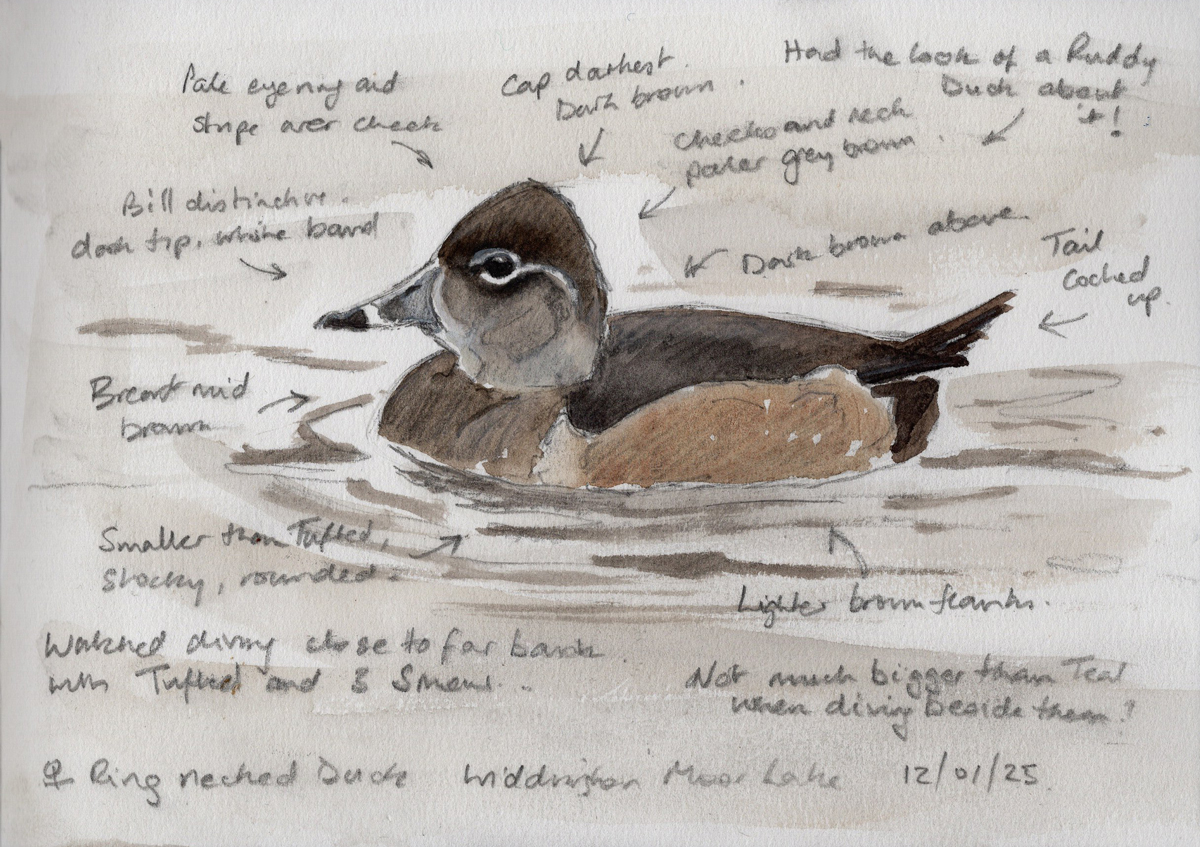
 During January so far, when it seems as if another rarity is just around the corner, on Saturday 11th a female Ring necked Duck arrived at DBCP with the Diver briefly before relocating to Widdrington Moor Lake as the country park froze over night. This little brown duck from America is only the second female of its kind to arrive in Northumberland though there have been more records of drakes.


Figure 5: Female Ring necked Duck, a rare North American wildfowl, Widdrington Moor Lake

 As if in support, an American Buff bellied Pipit was also present at Ross back sands at the same time, an even rarer bird, being only the second record ever for the county.

 What a spell for birders this last two weeks has been. Above are the birds I managed to catch up with, there were also others – Black Scoter, American Wigeon, Green winged Teal, Iceland and Glaucous Gulls that I didn’t have time to see plus Snow Buntings, Scaup, 3 Smew etc. A veritable feast for anyone who has an interest in birds.

What has made Northumberland the centre of the birding universe I couldn’t really say but the going has been great. No doubt normal service will be resumed soon…


Wednesday, November 06, 2024

Edge of Winter

 November starts in autumn and ends in winter. Our old county winter atlas surveys began on 13th of the month, so I tend to think of that period as the beginning of winter, though autumn bird migration can continue into December. By mid month, the majority of our winter visitors will be in situ, and our summer birds long gone. 

This week is make or break for one iconic winter visitor in Northumberland. This will not relate to more southern counties but it is very accurate up here. Waxwings. If it is to be a Waxwing Winter, Northumberland will have a decent arrival before bonfire night.  In 2023, I had seen 5 Waxings on patch by now, and a flock of 45 was in residence by the 20th. Overall by 31st December exactly 100 Waxwings had presented before me. Come 1st January I didn't see another! So, 2024 / 25? not a report of a single bird yet here, so I'll go all out to say, no Waxing Winter this time...shame.

The first week of November has been quite good on the local patches of Howick and Boulmer. No real rarities but a good variety of species to keep up the interest.

To summarise - 

1st Nov - 

High pressure  with mild calm dull days has been the flavour this month, so far. What is it they say? In like a Lamb out like a Lion?

5 Whooper Swans flew west over the garden, while 66 Curlew, a Stonechat and 7 Grey Partridges enlivened a quite early morning dog walk around the village.

2nd - 

Unusually, Peggy was asking to be out at 0530 so off we tootled into the darkness for no more than 5 or 10 mins. We were met with bird calls all around. Redwings and Blackbirds at the rate of about 10 cals per minute. We also almost stood on a Woodcock beside our neighbours corner too.

A couple of hours later I was up at first light to see if any of these birds were grounded.

In an hour I had 32 Redwings, 94 Fieldfares, 35 Blackbirds, 1 Chiffchaff, 3 or 4 calling Brambling, 1 Sinipe in off, 1 Whooper Swan over, Golden Plover S, 12+ Chaffinch and 400+ Starlings.

A stand around on the drive for an hour mid afternoon added 1 Raven N, 23 and 7 Whooper Swans S, 1 Brambling beside the garden, 5 Long tailed Tits and 3 Mistle Thrushes.


3rd - 

Met John at Boulmer where we did an ebird full count of our walk. The route was only three miles around by Longhoughton Steel but the bird range was excellent with 69 sp recorded. Not on the list, below, was a huge falcon bearing a red breeders ring, on the rocks with prey. Unsure of its parentage but Id say Peregine x Lanner or Saker... the Xs below are birds present in good numbers but we didnt bother counting them.


Apologies for the poor digiscoped phone shots...

As we enter the dark days of a Trump administration across the pond, who will say what disasters will befall us at the hands of the orange manbaby...


Monday, February 06, 2023

Cateran Hole

 What a perfect day for a walk on Sunday morning. It was calm, sunny and cold on the fingers when we headed up to the moors north of Eglingham via the North Charlton road from the A1 North of Alnwick.

For sometime we have been going to check out a unobtrusive cave hidden in the heather called Cateran Hole, on the north slope of Cateran Hill. This gash down into the moor is steeped in folklore with tales of Smugglers and Faeries. Rather than plagiarise bits of others research, check out this link for more pics and the tales...

Not that we were hoping to add to the myth, we were looking for any wildlife that might lurk within...


To begin with, above are two maps of the location. Its quite a remote spot as you can see below.

Park the car at this finger post and walk across the moor for about 10 minutes until...

...you see this post with arrows on, in the distance. Its there honest. At this point turn left.

A small stone in the middle of the path is carved, pointing left again just off track to the cave,

And there in a small depression is the hole. There are carved stone steps down into it. A torch or headlamp is a must. Its about 40 feet of narrow passage through the rock.


The way in..


Once in, water drips through and glistens on the walls covered in green algae. Signs of visitors date from 1700s, right to the present day. We hoped to find Cave Spider and a small Bryophyte called Tunbridge Filmy Fern, but we couldnt find either.

Only one spider was found - 

Metellina merianae 

A selection of unfamiliar mosses and spleenworts adorned the step walls, I'll try and get id's later...


Common Feather Moss

Hart's Tongue Thyme Moss


Waved Silk Moss
Once back into the light we checked out the view from the top of Cateran Hill, to see if any birds were to be had. Red Grouse called unseen hidden in a multitude of Red legged Partridges and Pheasants ( there were even 2 Japanese Green Pheasant types) . 2 Buzzards and 2 Ravens hung around while a few Skylarks were newly back on territory.


Back at the car for tea, I scanned North and saw a raptor flying steadily across the moor. It immediately looked different and  I called John to look. By now, closer and lower down it was obviously a smart male Goshawk! It soon perched up on the side of a tall larch where I could get the scope on it. A belter. 
After a minute or two it was gone, flushing pigeons to the four winds as it went.

Male Gos, perched.

Back along the road, another 2 Ravens gave closer views gathering nesting material and harassing a Buzzard.

And with that it was time to leave, a very pleasant morning, we could almost kid ourselves it was spring...    

Friday, October 14, 2022

Mint.


For a change a post about a moth. And what a moth it is too. This is the Merveille du Jour Griposia aprilina, with two individuals posted above, the top one being slightly fresher and darker than the bottom. 

When flipping through the field guide, the bright sharp cool mint green and black patterning jumps off the page, making you filled with desire. I remember catching my first in 2009. I couldnt believe it. What a panic to pot it up as it flew around the light on an October night. Since then I have caught it on 34 occasions, mainly singletons but occasionally up to 4 at a time.

It is specifically an moth of cooler autumn nights and tends to associate around oak trees of which we have a young one in the garden.

This year I am very pleased to meet with Merv, as these are my first since the 11th Oct 19. Two blank years in succession is unprecentented here though 2016 was also a miss. The best year here was 11 caught in 2018.

I'm not sure if some autumn species are cyclical as I've also checked Frosted Orange and Flounced Chestnut for garden stats. In 2010 I had 93 and 39 respectively but in 2022 I have 2 and 0 !   Lets hope things improve next year...

Thursday, July 28, 2022

Three Shears.

 Mid July signifies the start of one of my favourite pastimes on the coast - seawatching. 

In recent years we have had some great birds from the sea on the local patch in July. In 2019 it was the surreal appearance of a Giant Petrel from Southern Oceans, followed in 2020 by a more twitchable mega, a Sooty Tern for a day or two and as if that duo wasn't enough, 2021 was not going to be outdone as another UK first opened July with a close, nicely breast banded Soft-plumaged Petrel moving North offshore.

Is it any wonder I like the hypnotic draw of the waves?

Last week we had the first light north winds of the season, so an hour intro on Wednesday was quiet but pleasant with Little Tern, a dozen Manx Shearwaters, a handful of Puffins with ever present Sandwich and Arctic Terns making up the tally. That was until a very close pod of Bottle nosed Dolphins slashed into the bay, soon followed by a Minke Whale that dived just in time to avoid the Life Boat bombing over its head. An adult summer Mediterranean Gull  passed North as I was preparing to leave. Not a bad start.

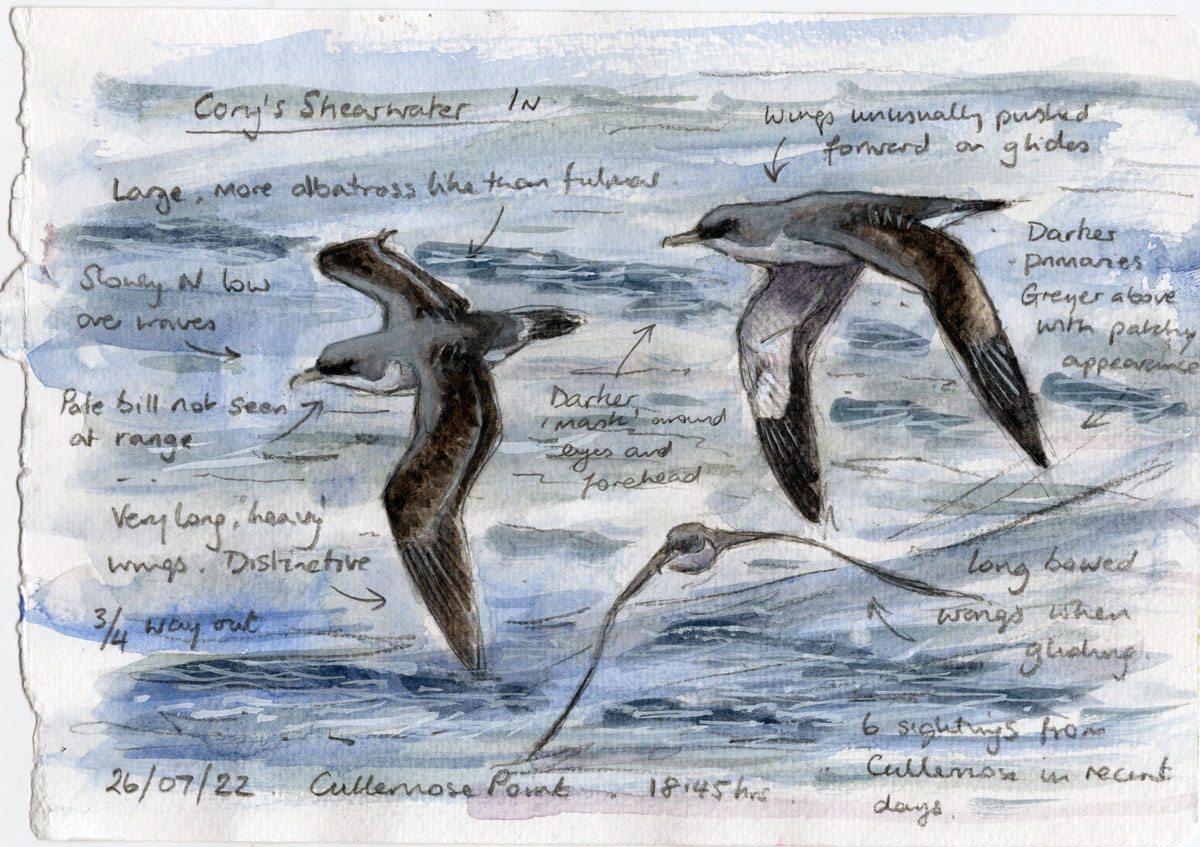
On Monday as a large high pressure system moved in to the west of Ireland bringing with it masses of Cory's Shearwaters into the western approaches, hopes were high that we might get in on the action. Cory's is a very difficult bird to catch up with in Northumberland, Ive only seen one, at Newbiggin around 1999 I think.

On Monday I was out on Cullernose alone from 16.45 - 18.00. Although there was a fresh breeze from the North, few birds were moving. 86 Arctic Terns, 21 Sandwich Terns, 4 Whimbrel, 3 Manx, 9 Puffins a few waders and an in off juvvy Med Gull were all I could muster. A single Wheatear was quick off the marks here, a taste of what is to come hopefully.

Tuesday turned out to be a different kettle of fish. Early doors, Dan Langston had a Cory's slowly past our village and sitting on the sea while I was walking the dog within viewing distance if Id had my scope. I dashed back down with the scope after dropping the dog off at home but the light was dreadful and nothing of note was seen. Gutted, a great patch tick gets away.

After work saw me keen to get back on to the point, and by 16:30 I was in position.

Manx Shearwaters were the main passage birds on show with 583 N in 3 hrs, a good total for here. 5 Goosanders flew south as did a distant Bonxie, while an Arctic Skua chased terns overhead. 2 Little Terns were good to get too.

Soon, I was joined by Dan, Alan, Ian and Keith ( and a bit later by Mark). After about half an hour Dan called the bird. CORY'S! It was way to the south and distant but as it progressed the distance shortened and it gave reasonable views hugging the surface with long bowed wings occasionally tipping over to reveal the underside. It took around 8 minutes to get past us, but even though we called directions, pot flags and range, Ian and Keith just couldn't get on to it. Whilst three of us were elated, it still takes the edge off things.

We sat another hour hoping for another chance, but only 3 Sooty Shearwaters were added to the total before most of us left*.

Cory's Shearwater, a great addition to the patch list for me and a full new species for the site.

Cory's Shearwater, Cullernose Point 26/07/22. 


*Mark Eaton stayed on after we left. As dusk came, Ben Steel at home in Longhoughton a mile inland, was looking at the sea from his bedroom when he picked out another Cory's coming past Longhoughton Steel [ garden tick!]. Mark managed to get it close in as it passed Cullernose . Finally last night Tom Cadwallender was on the point alone not seeing much at all until a group of 4 Sooties passed, followed a minute later by the 5th Cory's of the week. Unprecedented.


Thursday, July 14, 2022

Post Trap Punditry

 I don't post many moth lists on here these days but on this occasion a notable catch deserves some post trap analysis.. 

The night of the 11th July was overcast and very warm, no cooler than 18 degrees at 5am. Experience tells me there would be quite a few moths, but I had not expected such a diversity of species. When I looked into the trap it was a sea of micro moths and geometers rather than the expected Large Yellow Underwings.

I have highlighted some notable garden records. This lot is all in a single 125w MV Robinson Trap on our drive. To do before work!

Total finally at 518 moths of 112 species. Not my biggest catch but up there for species.


Taxa

  Common Rustic agg. (Mesapamea secalis agg.)  1

  Marbled Minor agg. (Oligia strigilis agg.)  3

03.003  Map-winged Swift (Korscheltellus fusconebulosa)  4

03.005  Ghost Moth (Hepialus humuli)  1

16.001  Bird-cherry Ermine (Yponomeuta evonymella)  3

16.020  a moth (Paraswammerdamia nebulella)  1

28.010  Brown House-moth (Hofmannophila pseudospretella)  1

34.004  a moth (Limnaecia phragmitella)  4 usually only singles occur.

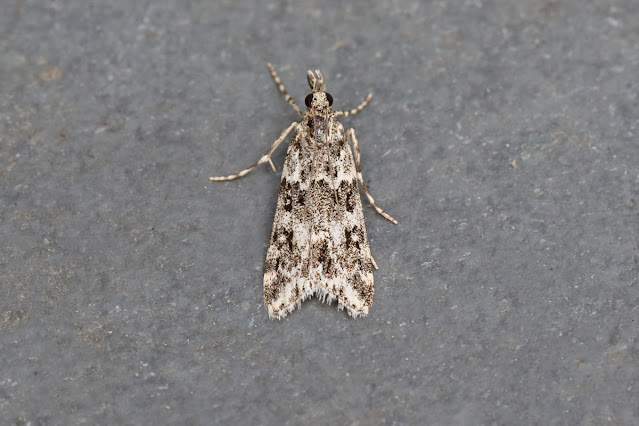
35.159  a moth (Exoteleia dodecella)  1 a totally new species for me.

38.039  a moth (Elachista maculicerusella)  1 new for the garden but a bit battered after I struggled to get it out of the egg tray.

39.001  a moth (Blastodacna hellerella)  1

40.002  a moth (Mompha ochraceella)  1

41.002  a moth (Blastobasis adustella)  3

45.008  Yarrow Plume (Gillmeria pallidactyla)  1

49.025  Barred Fruit-tree Tortrix (Pandemis cerasana)  3

49.038  a moth (Clepsis consimilana)  2

49.050  Grey Tortrix (Cnephasia stephensiana)  1

49.051  Flax Tortrix (Cnephasia asseclana)  1

49.109  a moth (Agapeta hamana)  26 a record count here the previous highest being 20. Only 6 times out of 191 occurrences have numbers been in double figures.

49.127  a moth (Aethes cnicana)  2

49.128  a moth (Aethes rubigana)  1

49.166  a moth (Celypha lacunana)  4

49.183  a moth (Lobesia abscisana)  1

49.193  a moth (Endothenia quadrimaculana)  1 the 5th garden record

49.194  a moth (Bactra lancealana)  1

49.252  a moth (Epinotia tedella)  1 the 3rd garden record

49.265  a moth (Eucosma cana)  6

49.266  a moth (Eucosma hohenwartiana)  1

49.298  a moth (Notocelia trimaculana)  1

49.367  a moth (Pammene fasciana)  1

49.375  a moth (Pammene regiana)  2

62.001  Bee Moth (Aphomia sociella)  2

63.025  Small Magpie (Anania hortulata)  3

63.037  a moth (Udea olivalis)  2

63.038  Mother of Pearl (Patania ruralis)  8

63.057  Garden Pebble (Evergestis forficalis)  2

63.064  a moth (Scoparia ambigualis)  3

63.066  a moth (Scoparia pyralella)  1

63.067  a moth (Eudonia lacustrata)  9

63.071  a moth (Eudonia lineola)  1 a scarce species getting more regular. the 9th since the first in 2018.

63.080  Garden Grass-veneer (Chrysoteuchia culmella)  101

63.089  a moth (Agriphila tristella)  2

63.093  a moth (Agriphila straminella)  6

63.102  a moth (Catoptria falsella)  3

65.009  Buff Arches (Habrosyne pyritoides)  5

66.010  Drinker (Euthrix potatoria)  1

69.003  Poplar Hawk-moth (Laothoe populi)  2

69.016  Elephant Hawk-moth (Deilephila elpenor)  3

70.011  Single-dotted Wave (Idaea dimidiata)  7

70.013  Small Fan-footed Wave (Idaea biselata)  9

70.016  Riband Wave [non-banded form] (Idaea aversata ab. remutata)  6

70.029  Blood-Vein (Timandra comae)  1

70.045  Shaded Broad-bar (Scotopteryx chenopodiata)  3

70.049  Garden Carpet (Xanthorhoe fluctuata)  2

70.055  Large Twin-spot Carpet (Xanthorhoe quadrifasiata)  2

70.061  Common Carpet (Epirrhoe alternata)  1

70.069  Dark Spinach (Pelurga comitata)  1

70.074  July Highflyer (Hydriomena furcata)  2

70.089  Phoenix (Eulithis prunata)  1

70.093  Barred Straw (Gandaritis pyraliata)  16

70.100  Green Carpet (Colostygia pectinataria)  1

70.132  Rivulet (Perizoma affinitata)  3

70.133  Small Rivulet (Perizoma alchemillata)  7

70.138  Sandy Carpet (Perizoma flavofasciata)  18 a good number.

70.144  Green Pug (Pasiphila rectangulata)  1

70.169  Ash Pug (Eupithecia innotata f. fraxinata)  1

70.173  Lime-speck Pug (Eupithecia centaureata)  1

70.207  Clouded Border (Lomaspilis marginata)  1

70.218  Latticed Heath (Chiasmia clathrata)  2

70.226  Brimstone Moth (Opisthograptis luteolata)  1

70.237  Early Thorn (Selenia dentaria)  4

70.243  Swallow-tailed Moth (Ourapteryx sambucaria)  2

70.252  Peppered Moth (Biston betularia)  1

70.258  Willow Beauty (Peribatodes rhomboidaria)  3

70.265  Mottled Beauty (Alcis repandata)  4

70.278  Common Wave (Cabera exanthemata)  1

70.283  Light Emerald (Campaea margaritaria)  3

70.297  Grass Emerald (Pseudoterpna pruinata atropunctaria)  3 a record number, usually singles.

71.025  Buff-tip (Phalera bucephala)  1

72.002  Straw Dot (Rivula sericealis)  17

72.003  Snout (Hypena proboscidalis)  12

72.026  Garden Tiger (Arctia caja)  2

72.045  Common Footman (Eilema lurideola)  7

72.053  Fan-foot (Herminia tarsipennalis)  3

72.061  Pinion-streaked Snout (Schrankia costaestrigalis)  4 a record count never more than 2 previously.

73.001  Spectacle (Abrostola tripartita)  3

73.012  Burnished Brass (Diachrysia chrysitis)  4

73.015  Silver Y (Autographa gamma)  2

73.016  Beautiful Golden Y (Autographa pulchrina)  1

73.017  Plain Golden Y (Autographa jota)  1

73.084  Marbled Beauty (Bryophila domestica)  6

73.092  Mottled Rustic (Caradrina morpheus)  1

73.096  Uncertain (Hoplodrina octogenaria)  2

73.113  Angle Shades (Phlogophora meticulosa)  1

73.147  Small Dotted Buff (Photedes minima)  2

73.154  Dusky Brocade (Apamea remissa)  1

73.162  Dark Arches (Apamea monoglypha)  3

73.254  Antler Moth (Cerapteryx graminis)  1

73.267  Bright-line Brown-eye (Lacanobia oleracea)  5

73.291  Common Wainscot (Mythimna pallens)  8

73.293  Smoky Wainscot (Mythimna impura)  17

73.298  Clay (Mythimna ferrago)  1

73.317  Heart and Dart (Agrotis exclamationis)  11

73.328  Flame (Axylia putris)  11

73.332  Purple Clay (Diarsia brunnea)  1

73.334  Small Square-spot (Diarsia rubi)  5

73.338  True Lover's Knot (Lycophotia porphyrea)  3

73.342  Large Yellow Underwing (Noctua pronuba)  23

73.345  Lesser Yellow Underwing (Noctua comes)  1

73.353  Dotted Clay (Xestia baja)  3

73.359  Setaceous Hebrew Character (Xestia c-nigrum)  6

73.361  Double Square-spot (Xestia triangulum)  16

49.128  Aethes rubigana

49.193  Endothenia quadrimaculana

49.252  Epinotia tedella

63.071  Eudonia lineola

35.159  Exoteleia dodecella
49.367  Pammene fasciana


70.297  Grass Emerald Pseudoterpna pruinata atropunctaria

72.061  Pinion-streaked Snout Schrankia costaestrigalis


Tuesday, April 19, 2022

Bobby Dazzler

 While the rest of the country basked in a mini heatwave, up here we had our own version. 12 degrees with a light onshore breeze and a moderate haze just to make sure we didn't get carrier away and think it was summer. Monday was better as the wind had gone west making it a little bit milder.

Despite the cool, more spring migrants arrived with  2 or 3 Swallows back in the village from 1.30pm on Saturday followed by 3 nice male Wheatears on Cullernose on Sunday. To those in the south or on headlands this might seem a bit duff, but these are my first of the year and might even be the only ones of spring on my patch where it is not a common bird.

Willow Warblers and Blackcap numbers seemed to increase too but the highlight of the weekend had to be a bright, tortoiseshell patterned, summer plumaged male Brambling at the bird table yesterday. April is the best month to get one on the feeders here and it was only 2 days later than last years singing male. Being on the north east coast we don't get many winterers, sometimes we get single figure parties, but they are easiest to find in October and April as they come and go.

Anyway, here is the stunner...images through kitchen window. 


Monday, March 07, 2022

County Tick...

Seems a bit frivolous in light of the state of the world right now, but it's good to get out into the fresh air to clear an anxious mind.

 For a change the wind had dropped right off giving us a lovely spring-like day. John wanted to check out new bins at 'In-Focus' who had an open day at Hauxley reserve so this seemed as good an opportunity as any to try for an elusive, but now resident, county tick.

The ever skulking, impossible Cetti's Warbler has been a reasonably new resident in Northumberland with records dotted all along the coast over the past decade, but the stronghold for them here are the large reedbeds of East Chevington. I have heard singing birds there several times over the years but none have shown. We even twitched one that had been at Low Newton for a period recently to no avail. In addition they can be found at Big Waters and occasionally in other spots too so it was always going to be a list addition, one to keep in the back pocket, so to speak. 

A lot of people are happy with adding a bird to a list on call alone, something that I do for the local patch year list, but whenever its a county or UK first, I like to have a sight record, just for completeness.

The weather and timing were good for a chance of seeing these ginger, swamp dwellers and we had planned an early spring visit for a few years but just hadn't gotten around to it. There is always something else happening. Having seen Cetti's in various places further south and abroad, there was never any great push to get one up here, but is was always in the back of my mind.

We parked up at the south end of the North Pool and headed up to the South East corner hide, a good place for them. As we arrived at the track to the hide, the machine gun rattle of a male Cetti's could be heard in the tall reeds about 100 mtrs away. The sun shone and it was calm on this side of the reeds so hopefully one might appear.  

After about 15 mins the song came again, much closer this time, in a wedge shaped island of reeds between two cut channels. Surely we had this one in the bag now, its right outside the hide and it has to venture into the open to move around. Then after a few minutes, a small brown bird flew like a bullet out of the reed base across the water and it was gone. Seen, but not quite what we had in mind.

As we waited, a Water Rail flew across the same channel, squealing as it did so. It then landed, did a funny jig around before vanishing into cover.

Then, Cetti's song came from behind the hide at our backs in some hawthorns.

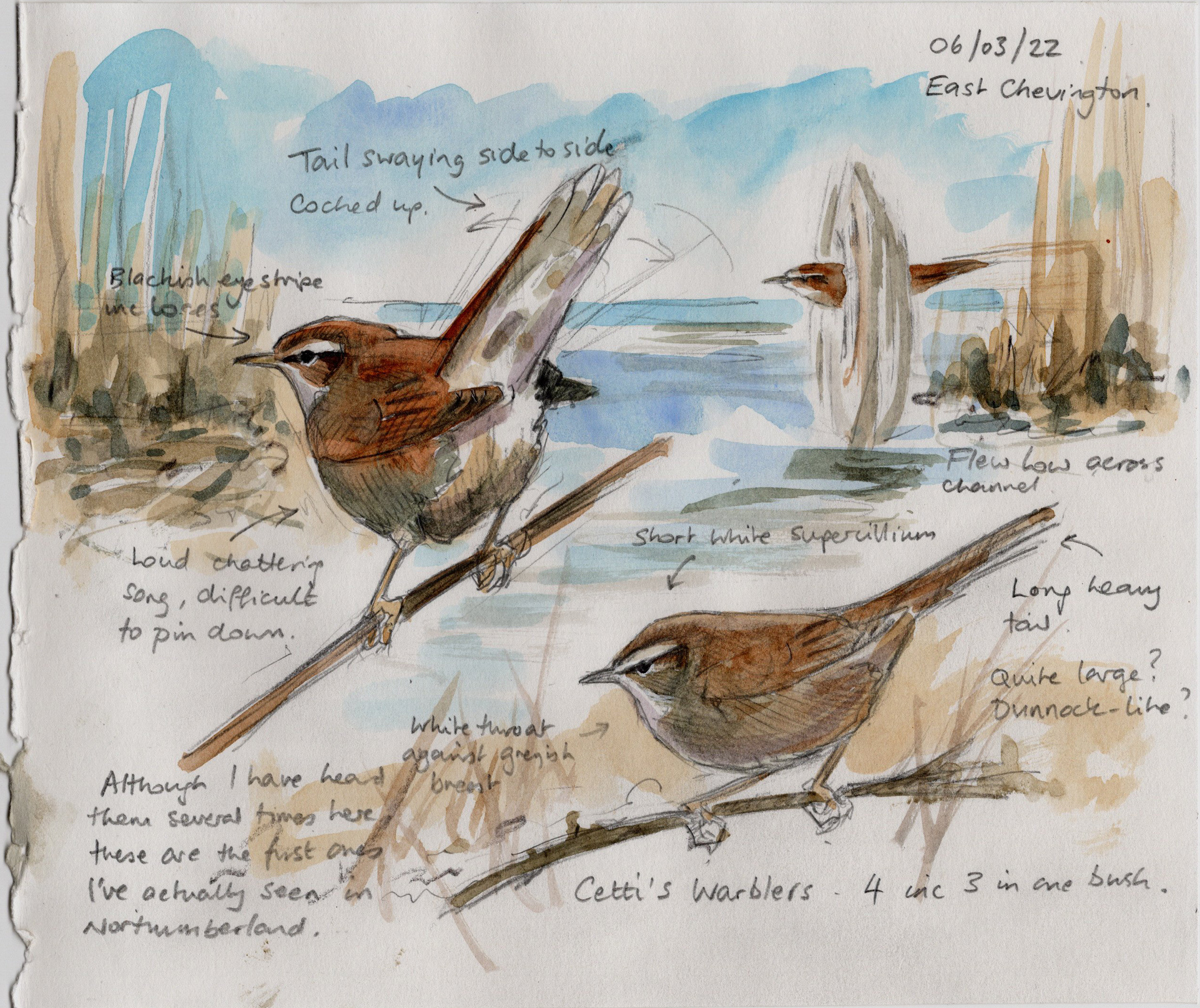
We left the hide and moved along the track. Here some sparse small bushes grow from the long grass, and there at the far left was a movement. Through the bins it was calling, tail swinging Cettis Warbler. It looked a bit agitated, then it was soon joined by a second bird just as jittery as the first. They chased around tails waving and calling as they went. Then a third bird appeared that we took to be a female, as it remained quite calm and quiet as the other two ran around the bush for a while before breaking away into thicker cover.

Not bad, 4 sightings of at least 3 birds far exceeded our expectations, leaving my Northumberland List on a nice rounded 360 sp.


 After that we headed up to Hauxley where Willow Tit and a few hundred Pink feet were the highlight ( after the superb Swarovski NL Pures of course).

Back home this afternoon in the warming sun, my fist Bumblebee and Peacock Butterfly of the year were both on the wing.


Sunday, November 14, 2021

Not the rarity we anticipated....

 With the final throws of Autumn upon us it was with some eager anticipation this morning dawned damp and overcast with a light SE breeze.

As I stepped out of the house in the gloaming at 07.10, the sky was full of calling thrushes. Fieldfares, Redwings and Blackbirds were arriving in good numbers for the first time this season. This made me keen to get to Boulmer to see what might have pitched in. Last night on social media there was some daft chat about Rubythroats, Accentors and the like, but I was hoping for a Long eared Owl, or Black Redstart maybe.

Boulmer car park was ominously quiet with little arriving. A party of 10 Fieldfares W, was about as good as it got. John and myself  'smashed' Seaton Point grafting until our eyes bled. Well, maybe not but we did wander around looking at bushes and listening for calls for a couple of hours. Another 2 Fieldfares, a Redwing, 20+ Dunnocks were as near as got to migrants, but 2 Great Northern Divers flew North over our heads and a third North out to sea.

Not to be thwarted in our search for something, we retired to the car for sustenance that was made  up of a Greggs Cheese Pasty, a Chocolate Eclair and a mug of tea. That got us going a bit so we planned to head North now searching the rocky shore on the way with thoughts of a rare wheatear. Unfortunately, this plan was rapidly changed as we passed the Village front and a very unusual What'sApp message came through -  Walrus at Seahouses.

Could this be the return of professional dinghy sinker 'Wally' who wreaked havoc all down the west coast from Wales to Scilly to Spain and Ireland in the summer? Whatever, this is a very rare occurrence indeed so, it may not be a Rubythroat but we were soon in the car and off to Seahouses to see for ourselves.

Quite a crowd was already watching the Walrus, hauled out on a breakwater in the harbour. It looked like a huge, ginger sofa or maybe a fly-tipped carpet and didn't seem to be in a hurry to get off. We could watch it down to about 30 yards without it being in the least bit concerned.

The Marine Mammal Medics were on site to monitor the animals welfare. It seems to be a female called Freya who was last seen sleeping on a Dutch Submarine in late October. Comparison of the marks on its flippers seem to agree with this theory. See this link to an article in the Guardian.

Occasionally Freya would wake up and stretch, have a look around at its new admirers before going back to sleep. Never has an animal looked so comfortable on such an uncomfortable bed. After the Humpback in January, now Walrus is another arctic marine mammal to be added to the Pan species List. If she lingers it is well worth a visit. What a beast...

Walrus can just be seen on the granite breakwater near the end in front of the observers.

She sleeps on oblivious of the attention .


Occasionally Freya the Walrus would wake up, have a look around then go straight back to sleep. She has a sore looking abrasion on her flipper though this is a regular normal feature apparently?


Tuesday, October 26, 2021

Days Off...


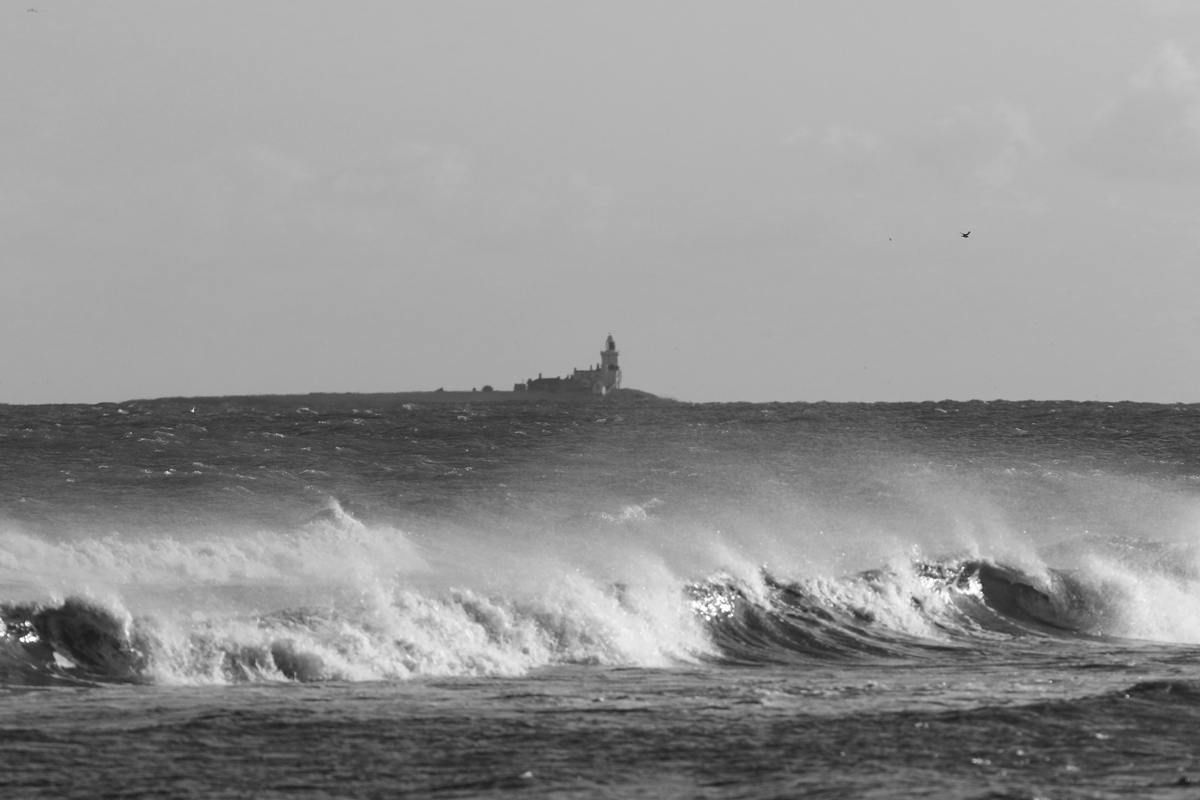
Coquet Island from Seaton Point

I like to keep a few days leave back for autumn just in case we get some 'weather' but this year its all staying pretty much 'as you were' . At least this allows me to just take some odd random days to see what is happening. This week my days off were Thursday and Friday making a nice long weekend. 

Before we get on to that, however, the early part of the week turned up some bits and pieces too.

Monday was a bit interesting despite there being a mild southerly breeze. First thing when I took Peggy for her morning walk, our village was ringing to the sound of Redwing calls for the first time this autumn. Several small flocks of up to a dozen birds left garden cover and moved west.

Later on more seemed to arrive. We did another coast path walk in the afternoon where we soon counted 150 Redwings and a few Blackbirds in-off. One tired individual barely made it, dropping into the long grass of the Bathing House only a few yards from the waves. As we approached the sycamores near the road a small bird scuffling along the track side caught Peggy's attention. A smart male Brambling, again looking knackered after its crossing. Back home another Brambling looked similar on our drive and another dozen Blackbirds and Song Thrushes were in the wood. How many of these birds are lost to the sea isnt known but it will be a big toll I'm sure.

On Tuesday morning, the coast path Brambling was now along the main road verge, looking no better. A few more were picked up on call as they flew west overhead. One Starling, like yesterdays Blackbird struggled in from low over the sea, alone, but it didn't stop, it just steadily kept on course, low west.  

By Wednesday the immigrant passage had dried up, leaving two groups of Whooper Swans, 20 and 25 birds, to keep me looking up. 

There was a nice moth surprise on Wedesday night, again on a Peggy walk. I routinely shone my headlamp along some flowing Ivy beside our lane to see if any moths were present. The first thing I saw was only my 3rd ever Pearly Underwing, fresh conditioned individual alongside 6 Angle Shades and a couple of Silver Ys.

Pearly Underwing, a rare migrant here.

With the working week now done, the wind began to increase from a North westerly direction and with it so did my hopes of some seabird action.

I was in position on Cullernose by 8.15 eagerly awaiting birds to pass. To cut a long story short, by 10.15 a few birds were in the notebook but not enough to merit sitting it out. I decided to cut my losses and try again later on.

Birds seen included 5 Red throated Divers, 48 Wigeon, 3 Common Scoter, 600+ Pinkfeet, 20 Barnacle Geese, 2 Pale bellied Brents and 1 Arctic Skua. Best of all were 2 each of Twite and Snow Bunting south over head.

I gave it another two hours from 2pm, this time at Seaton Point, Boulmer. There were masses of birds feeding along the very high tide line with thousands of Black headed Gulls, Wildfowl and Waders including 17 Grey Plover, 74 Curlew, 35 Bar tailed Godwit, 4 Purple Sandpipers 1 Goosander 56 Mallard and 8 Wigeon. Another 2 Pale bellied Brents flew N and a Swallow over the caravans was my first for 2 weeks. It could well be my last until April. 

Masses of birds along the shore.

Pale bellied Brent Geese

Ever present Eiders

Juvenile Grey Plover

Pinks South

There were hundred of Turnstones with odd Purps.

Wigeon

On Friday we had a nice walk around Longhoughton Steel to Sugar Sands. There had been a Shorelark around but we didnt see it. A bit of viz mig was evident though with 1 Snow Bunting, 5 Whooper Swans, 15 Siskins, 1 Grey Wagtail, 75 Pinkfeet south and 2 Red throated Divers North

We narrowly averted disaster when a freak wave rushed up previously dry shore ( the tide was going out too) and caught us unaware. Jane and myself ended up nearly knee deep in water while Peggy floated around us! Luckily we kept our footing and made it up to dry ground with nothing worse to endure than a slosh back to the car with boots full of briny.

A postcard from Northumberland.

On Sunday, for a change John and myself headed to our inland areas for a change from the sea. Despite the forecast, the sun shone and it was quite pleasant. A great contrast from the coast in only a short drive.

Not expecting many birds, I only took my macro lens to look for fungi and other small stuff. As it happened, we didn't find many fungi but we did get some good birds. 

Highlight was a cracking male Goshawk sparring with a Raven. What a size they are and even the Raven made sure it stayed higher up than the Gos. In flight Gos have a much longer wing than the much smaller Sparrowhawk, to my mind, giving more of a ring tailed Harrier impression. They immediately look different. The two put on a great show for about 15 minutes with one taking advantage of the other in turns, the Raven uttering a short 'gruk' of panic when Gos flipped over to retaliate. Lovely. The things you see when you don't have your gun....

We also had a nice female Merlin low overhead, another Raven, 1 male Crossbill song flighting and another 7 over, 4+ Brambling, 7+ Jays, 1 female Sparrowhawk, 1 Kestrel, 1 Buzzard, 10+ Meadow Pipits and a Stonechat. A nice suite of upland birds for the time of year.

The only fungi we had were - 

Dusky Puffball Lycoperdon nigrescens

Raspberry Slime Mould Tubulifera arachnoidea