Showing posts with label County Listing. Show all posts

Monday, July 29, 2024

A County First!

 Sitting at the computer in our small bedroom on Wednesday lunchtime last week, it was a busy work day. There were so many emails and calls that I rarely came up for air, so I hadn't checked my WhatsApp messages for a while when I finally picked the phone up. 

A short message seemed a bit confused followed with equally confused responses about a Lesser / Mongolian / Tibetan/ Siberian Sand Plover on the stony beach at Lynemouth with Ringed Plovers. Any of those would be a British tick for me and new for Northumberland but these had been followed with a single photo, that to me, initially, showed a longer bill, that would indicate Great Sand Plover. Not a new bird for me, but a County First all the same.

Now, had I been in the office, I would have been 10 minutes away, but from home its 40 mins and the bird had flown south.

Still the work came through apace so my intended early 3pm finish dragged on til after 5pm. 

By then the bird, now reidentified as a Greater Sand Plover had been relocated around the next headland at Beacon Point, Newbiggin, a pattern it would repeat going forward.

Visions of a lot of birders and toggers booting the plover up and down the coast made me decide not to go on Wednesday evening but just leave it, keeping my fingers crossed for the Thursday when I would be based just around the corner in Ashington. Hopefully it would linger, it is 'autumn' after all...

Thursday, early doors I see from my phone that the Greater Sand Plover was still present  but has again flown from its roost on Lynemouth beach towards Beacon Point again where it was being looked for. 

That would be my first port of call. The car was left on a nearby housing estate as near as possible to the site where a short march across the golf course put me with a group of a dozen or so hopefuls.

Soon enough, the bird was found on the rocky shore where it would do a pop up act by appearing then vanishing in equal measure. I gave it half an hour and decided to have a better look at high tide after work.

4pm found me at Lynemouth Power Station where a walk of about half a mile over a brownfield area got me to the blast beach where the birds were roosting. The industrial landscape here is more like Teesside than Northumberland but its a good spot for migrants and other wildlife too. 

At the spot there were only about 6 of us at the beginning and by the time I left I was alone. I was able to watch the bird well and at a nice distance, enough to stop them being anxious and close enough for good scope views. A few notes and sketches were made and some phone scoped photos taken as a record of the bird. 

Later on at home a scan of some literature showed a minefield of taxonomic issues with the Sand Plover complex but comparing my notes with details it looked to be of the Central Asian race 'scythicus' all the way froTurkmenistan through S Kazakhstan and Afghanistan wintering in SE Africa

An older paper in BB refers to the 'crassirostris' race ( now changed in name only to 'scythicus' )...

 Bill - As nominate, but on average somewhat longer and thinner.   ( It was slim and quite long)

Upperparts - Paler grey-brown, usually lacking rufous-cinnamon tinge, but may show narrow rufous feather margins. (It was heavily abraded so no rufous finging)

Face Mask - Wider and complete, with white forehead patch small or absent .( It was only a few small dots in a line)

 Breast Band -  Broader, less sharply demarcated and generally paler, but with narrow centre  and rufous often extending obscurely to flanks .

Border to Breast Band - Sometimes present as thin black line; often absent.  ( It had a faint black line along the edge to the throat).

So there you have it, my 2nd UK GSP after one at Aberlady in June 1999, takes my county list to 364 until the Redpolls go!

Note - 30/07/24 I see Bird Guides are putting this out as the Eastern race 'leschenaultii' so I've looked again to see where I'm going wrong. Ive coloured positives in green and negatives in red.

Bill - Strong, with curved nail and obvious, angled gonys ( Bill didnt seem strong or have a gonys?)

Upperparts - Usually ‘clean’ grey-brown, often lacking cinnamon tinge, and thus similar to Lesser Sand Plover, but may show narrow rufous margins. ( Yes like this)

Mask - Variable, but occasionally fully black ( Fits)

Breast Band - Narrow at centre and deeper rufous, hardly extending to lower breast or onto flanks; also more sharply demarcated ( Doesnt look sharply demarcated to me or particularly deeper rufous)

Border to breast band - Normally lacking ( Definitely had a fine line bordering)

As with all of these complex species, the descriptions or parts are fluid and extremely variable. No doubt the BirdGuides Team have access to more expert up to date info than myself...Every day is a school day!


Wednesday, October 18, 2023

Red breasted Goose etc.

 So, September ended with a big dip. Oh well, its one of those things. How would October fare...

Sunday 1st October was a lovely fine autumn day here. Dawning quite cool but warming up later on.

John and myself took a trip up to Elwick on the Lindisfarne Reserve to look for the Red breasted Goose that has been hanging around with the large geese flocks for a few days.

We wandered up the track knowing from experience that the geese here are usually quite mobile and as we arrived at the end, this was certainly the case. Flock after flock of Barnacle Geese were leaving a distant field to our right and flying across our vision to land, unseen in a field, two to our left. Each flock was scrutinised in nice morning light as they passed, without luck. 

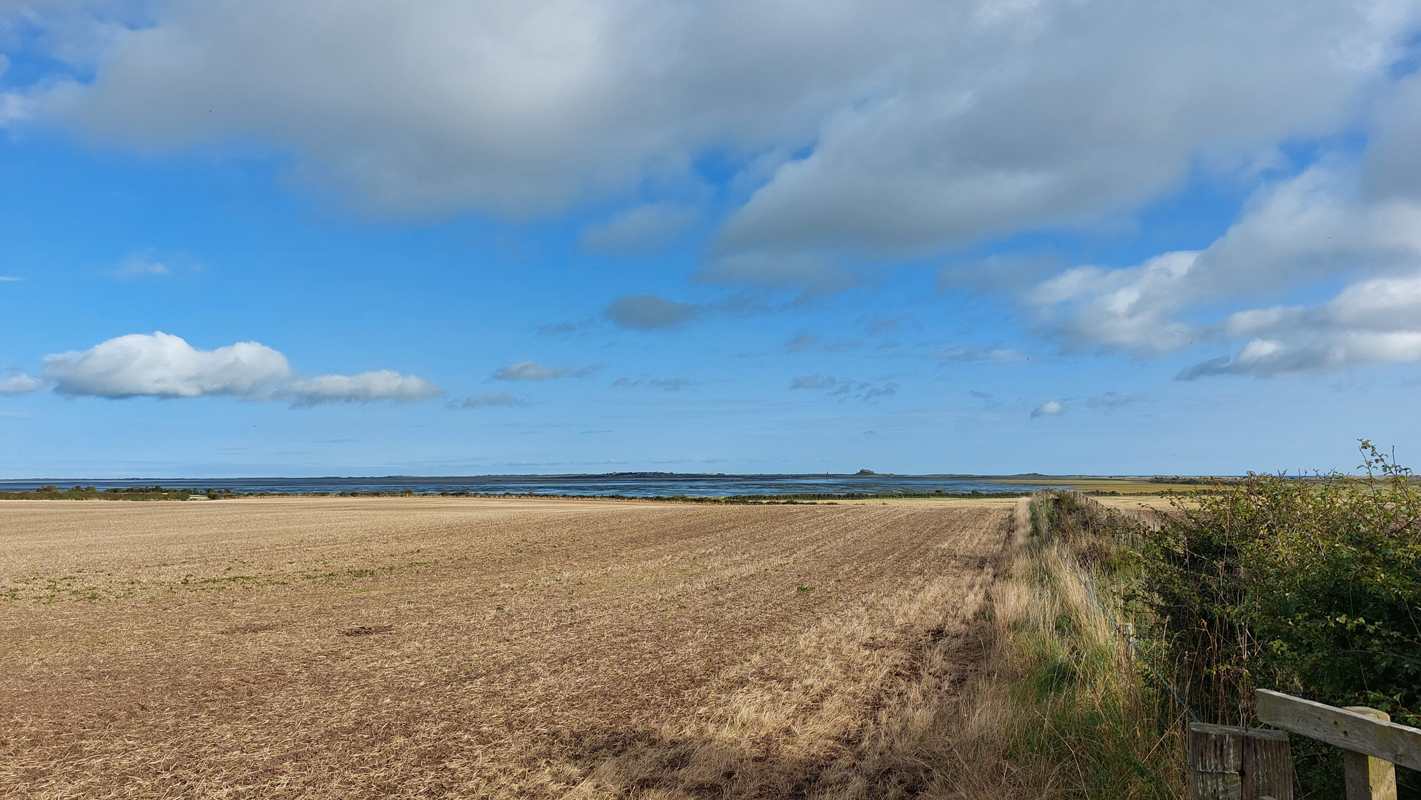
The view we had as geese flocks flew left at the end of this field. Holy Island lies beyond the flats.

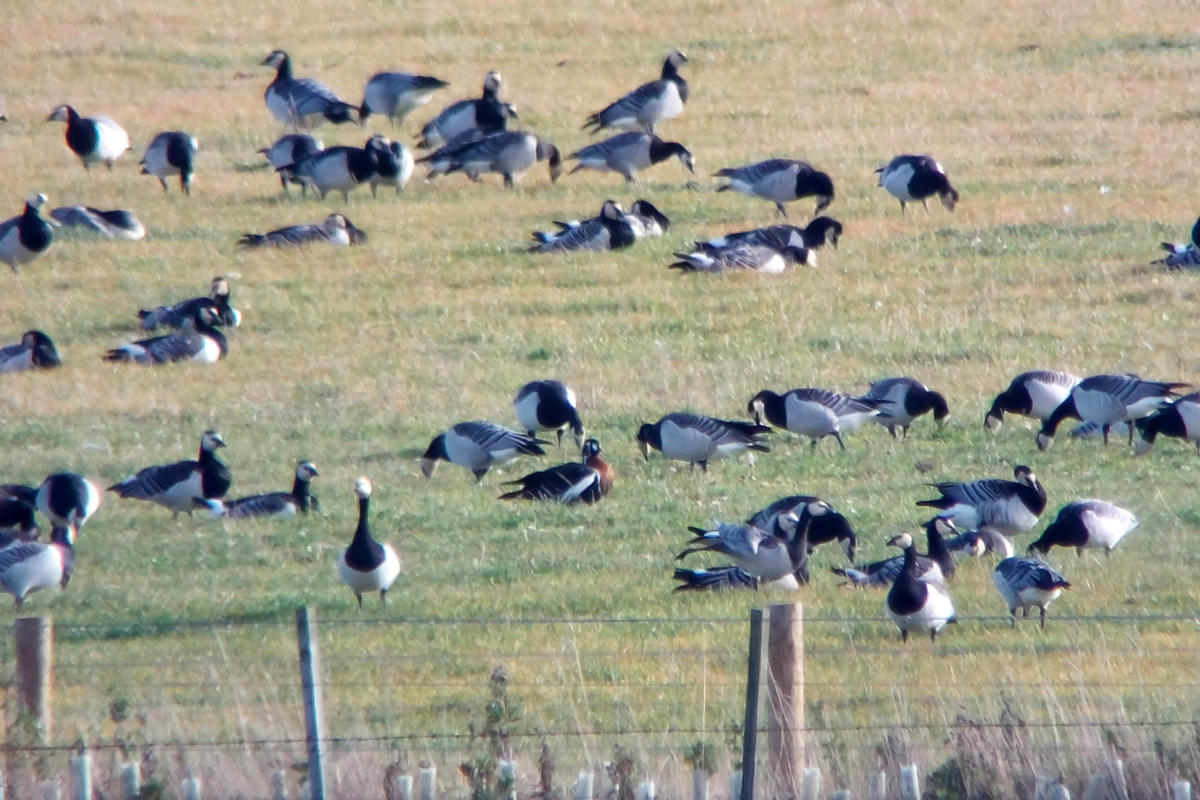
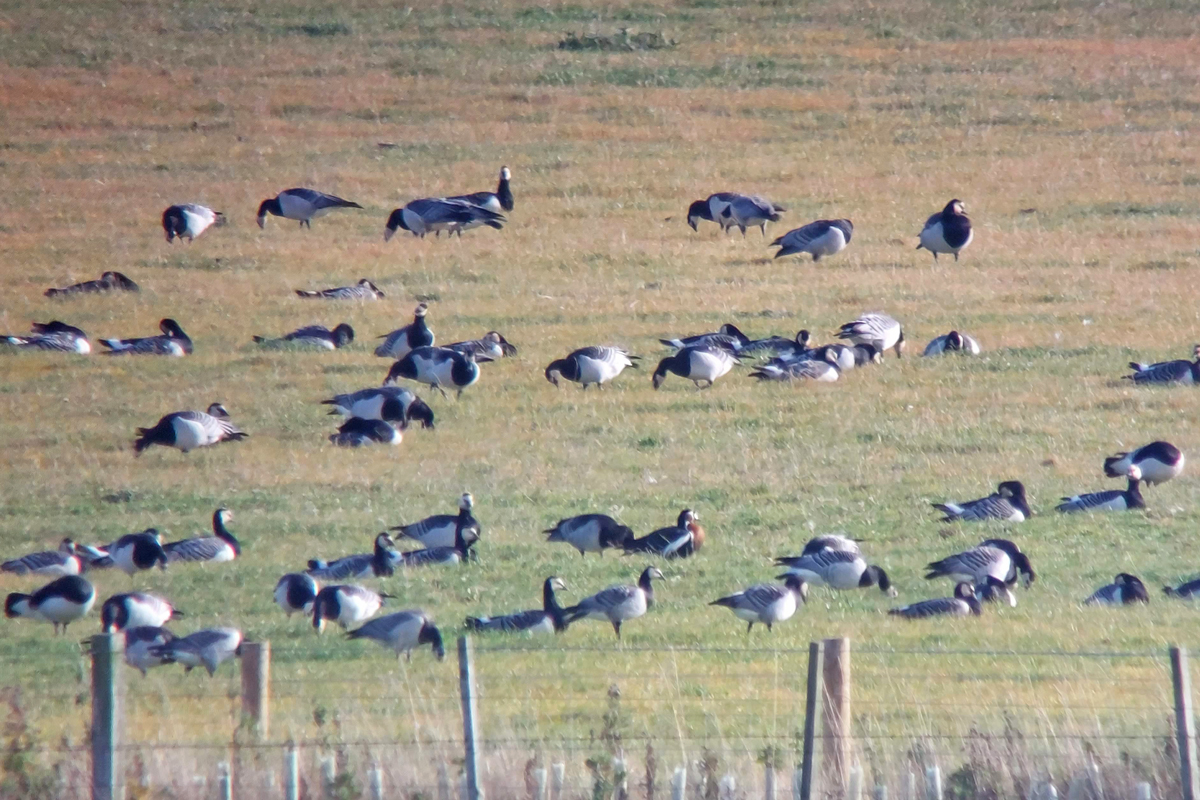
We decided to try to get a view of the geese over to the left so we stalked close to the hedge, into a dip, to peer into the next field. The ground was wallpapered in Black and White. A 'magic-eye' illusion of Barnacle Geese greeted us with birds still arriving. The problem was, we were too close. We stopped, scarcely daring to breathe and quietly scanned through. No joy. We waited. In the distance from Holy Island causeway I saw another few hundred geese strung out in the air heading our way. As they whiffled down to the ground we had another scan. There, only about 100 mrs away, right on the front in full sunshine a stunning adult Red breasted Goose, probably the first with good credentials since the 1800s in Northumberland. It had arrived with a small flock of Brents from high to the east originally before moving in with the Barnacle Geese to feed. What a belter, and I had left my camera in the car thinking the geese would be too far off.

As it happened, that was irrelevant. No sooner had we seen the target, a farmer on a quad drove straight into the field putting 3000+ geese to flight right over our heads. The sound was incredible. I've seen lots of goose flocks into many many thousands across the UK but have never experienced such noise from wings and voice only 50 feet above me. It was truly awesome.

As we watched the mass head back to the fields they originally came from, we scanned and scanned but couldn't pick up the Red breast. It was here a twist occurred. As we looked, I noticed an Egret coming off the flats towards us mobbed by crows. I couldn't say I'd seen that before, so I just put the scope on them. The Egret had a bright crocus yellow carrot pushed into its mush - it was a Cattle Egret! This was only my 2nd in the county and my first self found. These may be tame fare on the Avalon Marshes but up here they're still hens teeth.  We watched as the Cattle Egret lowered its undercarriage and glided over a hedge appearing to land unseen. We went to investigate.
From our new vantage point, we never did see the Egret again but we could see the geese. It took about half a dozen scans before the Red breasted Goose was picked out. Now at comfortable distance we could scope it feeding with Barnacles and showing how such a colourful harlequin could be camouflaged in the monochrome sea of wildfowl.


Two great county birds UTB by breakfast, excellent.

A stop at Budle Bay for our tea and snacks had a lot of birds but just the usuals. Highlight was probably 35 Shovelers.

On to Monk's House Pool of Ennion fame where there had been an American Golden Plover. Unfortunately most of the flock had departed leaving only 115 Eurasian Goldies to scan through.

Still not a bad day, RBG is no 363 on my county list and only my 2nd ever. 

Cattle Egret field notes.

Red breasted Goose field Notes

A worked up version of the Red breasted Goose back home.


Monday, March 07, 2022

County Tick...

Seems a bit frivolous in light of the state of the world right now, but it's good to get out into the fresh air to clear an anxious mind.

 For a change the wind had dropped right off giving us a lovely spring-like day. John wanted to check out new bins at 'In-Focus' who had an open day at Hauxley reserve so this seemed as good an opportunity as any to try for an elusive, but now resident, county tick.

The ever skulking, impossible Cetti's Warbler has been a reasonably new resident in Northumberland with records dotted all along the coast over the past decade, but the stronghold for them here are the large reedbeds of East Chevington. I have heard singing birds there several times over the years but none have shown. We even twitched one that had been at Low Newton for a period recently to no avail. In addition they can be found at Big Waters and occasionally in other spots too so it was always going to be a list addition, one to keep in the back pocket, so to speak. 

A lot of people are happy with adding a bird to a list on call alone, something that I do for the local patch year list, but whenever its a county or UK first, I like to have a sight record, just for completeness.

The weather and timing were good for a chance of seeing these ginger, swamp dwellers and we had planned an early spring visit for a few years but just hadn't gotten around to it. There is always something else happening. Having seen Cetti's in various places further south and abroad, there was never any great push to get one up here, but is was always in the back of my mind.

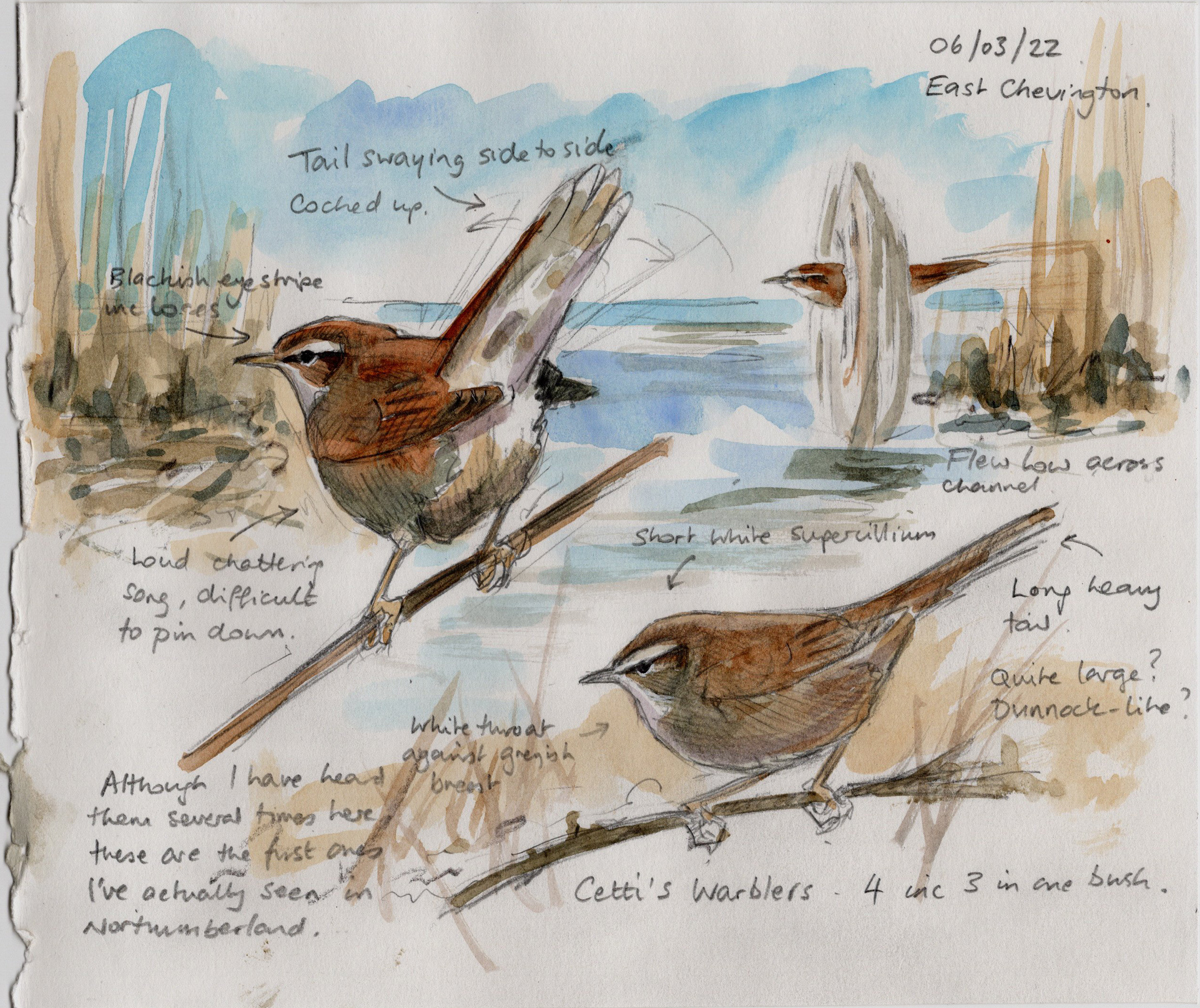
We parked up at the south end of the North Pool and headed up to the South East corner hide, a good place for them. As we arrived at the track to the hide, the machine gun rattle of a male Cetti's could be heard in the tall reeds about 100 mtrs away. The sun shone and it was calm on this side of the reeds so hopefully one might appear.  

After about 15 mins the song came again, much closer this time, in a wedge shaped island of reeds between two cut channels. Surely we had this one in the bag now, its right outside the hide and it has to venture into the open to move around. Then after a few minutes, a small brown bird flew like a bullet out of the reed base across the water and it was gone. Seen, but not quite what we had in mind.

As we waited, a Water Rail flew across the same channel, squealing as it did so. It then landed, did a funny jig around before vanishing into cover.

Then, Cetti's song came from behind the hide at our backs in some hawthorns.

We left the hide and moved along the track. Here some sparse small bushes grow from the long grass, and there at the far left was a movement. Through the bins it was calling, tail swinging Cettis Warbler. It looked a bit agitated, then it was soon joined by a second bird just as jittery as the first. They chased around tails waving and calling as they went. Then a third bird appeared that we took to be a female, as it remained quite calm and quiet as the other two ran around the bush for a while before breaking away into thicker cover.

Not bad, 4 sightings of at least 3 birds far exceeded our expectations, leaving my Northumberland List on a nice rounded 360 sp.


 After that we headed up to Hauxley where Willow Tit and a few hundred Pink feet were the highlight ( after the superb Swarovski NL Pures of course).

Back home this afternoon in the warming sun, my fist Bumblebee and Peacock Butterfly of the year were both on the wing.


Tuesday, October 12, 2021

Busy...

 12th October and no blog posts. Anyone would think it has been a busy bird filled autumn but no, the first part is correct 'busy' but bird filled, no. I just haven't had much time to blog so here is a potted catch up.

Rather than birds keeping the Adrenalin flowing in October it has been invertebrates that have provided several lifers over the last few days.

To start with, an arachnid came as a surprise. When the Wild Guides 'Britains Spiders' book came out I was intrigued by a small spider that was almost only found on the smooth grey trunks of old Beech trees. We have a few good candidates in the arboretum beside us so thought I would look sometime. That project slipped my mind until 29th Sept when walking Peggy after work. We came down a steep woodland bank ending up face to trunk with a massive tree. As I looked at the bulk of the timber, a small creature ran across. A spider! Could it be the one from the book? By now I had forgotten its name and didnt have my camera so tried to see any marks on the long legged money spider. It had an obvious white band on the abdomen and thin striped legs. As described there were strands of web across the trunk too.

Sure enough back home a browse of the internet and check of the book showed the spider to be Invisible Spider Drapetisca socialis. Since then I have checked and found another couple on different trees, so it must be quite widespread.

Invisible Spider.

Several visits to Boulmer have been slow for birds but a colour ringed Bar tailed Godwit in a flock of 29 was a male bird of the year ringed in Norway.

On 5th October a Northerly storm rattled some torrential rain along the coast. I walked the north end at Boulmer hoping to find grounded migrants but returned to the car with rain running down my armpits under my clothes and a single Wheatear in the notebook. The following day the morning had a good passage of wildfowl with 2,139 Wigeon, 5 Pintail, 2 Shoveler all heading North.

On 7th a warm plume of air from the Azores bathed us in an unseasonal 20 degrees, and also dropped some migrant moths in our village. A Gem was only the second here after one in 2010 plus Dark Sword-grass, Rush Veneer, Silver Y and Diamond back. Our neighbour along at the farm did even better and caught a  , only the 15th for Northumberland.

The Delicate

The Gem

  
Rhigognostis incarnatella 

Another new species for me was a Diamond back look-a-like Rhigognostis incarnatella. The moth fest wasn't over just yet however. There was a bigger surprise waiting. Overnight on 10th it was cooler and there didnt seem much activity around the lamp. The next morning it only took a few minutes to identify and count the 20 moths of 16 species in the egg trays. That is until I noticed a single moth lying in the bottom of the trap. A long looking, Setaceous Hebrew Character shaped 'flame shoulder'?

Straight away I sort of knew what was instore here. The moth was soon processed, photographed and discussed with Tom Tams. We agreed it was Northumberlands first and most unlikely Radford's Flame Shoulder, a rare migrant of the south coast and around 400 miles north of its main known range!
Tom had it confirmed by Steve Nash and I was commented on by Dave Grundy and Les Evans-Hill.
What an amazing record! 

Radford's Flame Shoulder, centre, with a Flame Shoulder from the summer on the right to compare. 

Check out the distribution. We are at the top line, 5 squares above the Isle of Wight.


 Now, all was not lost on the bird front either. On Friday 8th a visitor to Holy Island found Northumberland's 3rd and only twitchable Red eyed Vireo along the Straight Lonnen. The previous two were only seen by the finders so all county birders were interested in this one. I can remember being in awe of the first in 1988 and again racing to the scene in 2014 to no avail. However this latest blood shot yank was much more polite and is still present on day 5.

I went up on Saturday morning and managed a lot of short glimpses in thick cover then two longer more open views. We went back on Sunday for another look but the breeze made it impossible so we left empty handed. Not to worry I was please to update Bubo with my 357th county bird.


Above - Red eyed Vireo, Holy Island. 


Monday, June 14, 2021

Pacific Heights.


For some reason I couldn't sleep on Saturday so got up early to do the moth trap. Numbers still aren't up to usual standards but 97 moths of 36 species is enough to keep the interest going. After the catch was processed and photographs taken, it was time to up date our local moth page on FB.

It was while sat at the desk editing images that the Northumberland WhatsApp Rare Birds group came to life. A photo was uploaded, taken by Dave Elliott showing the departure of a Swift with a white rump low over water at East Chevington reserve. Even the rear-on image looked to me that it was not an abberant Common Swift. The bird was banking over showing a very slim pointed wing vertical to the water. Knowing the extreme transient nature of 'Apus' the image was taken at 7.30am and there was no further news by 9am. As the day warms, insects would rise on thermals and so will the swifts. It was currently cool and cloudy.

Then at around 9.30 information was released saying that the bird was still present, with no identification as yet.

With fixed plans for the afternoon, if I was going to have a look I better go now, so thats what happened. Arriving at a queue of cars parked along the lane side at Chev, the news was that it had not been seen for 20 minutes, however when I saw Tom Cadwallender he told me the bird was still here but away up at the far north of the reserve near Druridge Bay Country Park.

The car was given a 10 point turn and I headed up to the park, parking the car right beside the north entrance to the reserve coast track. As I made my way south, three birders were stopped on the track around 100 mtrs away looking towards the lake. I assumed they were watching the bird, but no sooner had I built my hopes up, they all just carried on wandering down to the west facing hide.

By now I was almost at their spot. Looking toward the hide, a birder was watching through his bins but he was facing directly north, an area above some trees to my right, so I stopped and scanned. With the naked eye, nothing. The bird could be more distant so a scan with the bins was similarly empty, then all of a sudden one bird came into my field of view and it had a huge wrap around white rump! It came very close giving excellent views against the trees. Immediately it could be seen not to be a Common Swift, its shape was all wrong with a narrow waist and slim more pointed wings it scythed around with Common Swifts  and to me, was all day long a Pacific Swift!

After a couple of minutes it flew back down to the water so I headed to the hide where around 20 birders stood around outside. Someone asked 'Well, what is it?'  'Its a Pacific isnt it!' was my excited response only to be doused by a 'Is it though?' by very experienced birders. White-rumped Swift was not eliminated. This was a bird I have no experience of but I have seen Pacific Swift in China. If only we had a field guide because given these brilliant views, there isn't really a danger of confusion. We commented on the slimmer structural build, the pale scalloped under parts and the size. Some felt it should be bigger than Common Swift, but guide measurements show them to be the same.

By now it was a big twitch with lots of people taking photographs so no doubt its identification would be confirmed soon.

I left after an hour, not believing what had just happened. After last weeks stint, now this! Northumberland is getting some great birds again this year.

By the time I was home, the information services were posting images of the now identified Pacific Swift and everyone was getting good views. I could get on with today's plans quite happy...

Northumberland List 356  British List 423


Friday, May 07, 2021

Anything. Anywhere.

Birding, as we know, can throw us some unexpected curved balls at times but today really takes the biscuit.

I am recycling a post I have just done on Facebook albeit for a more savvy blogger audience so please bear with me.

Back in February at the height of lockdown, a Northern Mockingbird arrived in a garden in Exmouth in Devon. This slim, blackbird sized bundle of feathers will have been bred in the USA and by some miraculous feat of migration ended up on the other side of the pond in a palm tree in Devon.

As it was only the 3rd for Britain and the first to be actually twitchable, birders across the land were devastated that there were travel restrictions in place stopping them making the pilgrimage. Some disregarded the COVID rules and went anyway, resulting in on-line vilification by the more sedentary law abiding citizens of ornithology. Some twitchers were believed to have been fined for going, but felt that it was worthwhile to see such a rare bird. After all, they would have paid for a flight to Shetland if it had been there.

Then, at the beginning of April, typically as restrictions lifted, the Mockingbird left its Exmouth garden and vanished only for it to reappear as if by magic 150 miles east along the south coast at Pulborough in Sussex the very next day.

What chance refinding a small grey bird after its gone 150 miles in a night? Pretty slim I reckon. Anyway, it spent one day in a garden there, where birders, who didn't go to Devon, managed to catch up with it, but there was no trace the next day.

And there the trail goes cold, everyone assumed it had gone for good.

Until yesterday. A month, 400 miles and a massive fluke later.

A family in a small new build house in Newbiggin by the Sea saw an unusual bird in their garden. Wondering what it was, they sent a video to the Bird Guides Information services to find out. News was released that there was a Mockingbird somewhere in Newbiggin but the location was withheld.

Most of us were disbelievers, surely not...

After some super sleuthing and discussions with the resident, our friend Alan Tilmouth managed to negotiate access and permission to release news of the location.

So this morning, anxious birders were poised ready to go. At 11.20am the location was released and a Wacky Races style movement of camo clad, binocular wearing, camera toting fans descended on the town...to see this Yank who had turned up after a jaunt the length of the UK.

After such a wild card, you have to think... where next?

Northern Mockingbird UK 422 Northumberland 355

Northern Mockingbird, Newbiggin by the Sea.


Sunday, April 25, 2021

Seeing Red...

Act I.

On Friday the weather continued in a similar vein as recently with a high pressure giving a cool, clear and sunny morning at 2 degrees first thing.

The first dog walk of the day resulted in a new one for the year list as a Sedge Warbler sang from blackthorn on the coast path.

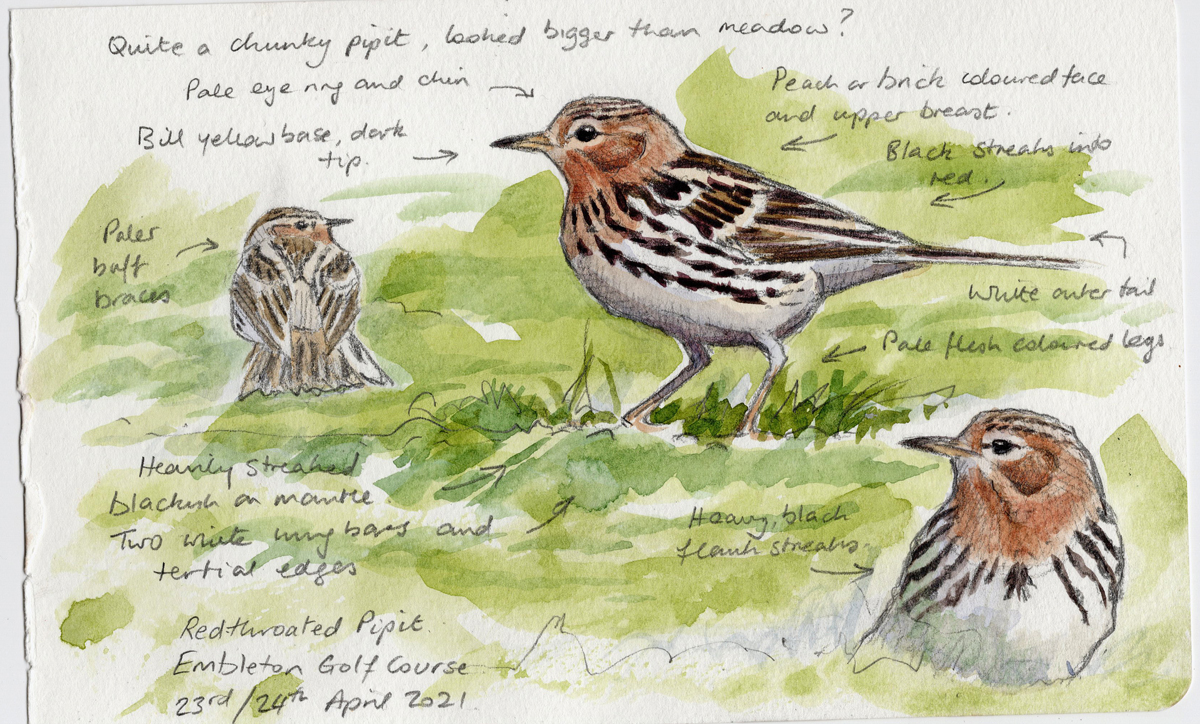
I was working at the computer in the bedroom when a WhatsApp from Gary Woodburn came through telling of a Red throated Pipit he had just found at Newton Pool.

Now, Red throated Pipit is possibly my commonest full lifer outstanding from my list. Other birds I have seen abroad but I cant think of anything on the British List more regular that I have not seen anywhere, so my ears perked up at this message.

In Northumberland there has not been a properly twitchable one for about 30 years so I wasn't holding out much hope for this early bird. I fully expected it to have flown off high, North, calling within 10 minutes, so a direct message to Gary asking for a Sit Rep ( Line of Duty there) was quickly dispatched. Surprisingly the reply was positive though mixed. The bird was still present on Embleton Golf Course but the greens were filling up rapidly with Pringle sweaters. Would they scupper my chances?

As the bird was only 5 miles from home, I quickly clocked off work and headed off up the road. I arrived after a road block stoppage, to find only 4 birders present and the bird not seen for 20 minutes having last been watched about 300 yards away on the other side of the course. 

The heat haze was building and the golfers were buzzing here and there when miles away a small bird in short grass looked different. At 50x zoom in the Swaro, it looked 'warmer' than the other pipits dotted around. We sat in expectation waiting for the golfers to flush the flock when one of two things would happen. They would fly closer and land, or they would do a bunk altogether. Unbelievably the first option won, with the 6+ Meadow Pipits, 1 Yellow Wagtail and 2 Yellowhammers plus the 'bird' all lifted and flew at least 50% closer onto the nearer fairway. We soon picked it out, still very distant but now confirmed as my lifer Red throated Pipit!

This was the pattern for the next hour but generally the bird stayed a bit too far to be called a good observation. Tickable views but hardly satisfying.


Above, Top, the Golf Club house where I parked.Bottom the view just off the golf course to Dunstanburgh Castle.


Thats it above the gorse...

Act 2.

 Saturday was another glorious cold morning. I was up at 5.50am to collect my Bucket Moth Trap from out Village Wood. When I got back, Gary rang me in error from his coat pocket. From the garbled voices I knew he was back on the golf course. Maybe the bird was still there? All of a sudden Gary messaged me saying if I wanted a second view the Pipit was showing very well on the green with no golfers yet.

This was too good a chance to miss, so off I went for a look. On arrival from the south end this time, our rusty faced Anthus was back in the same place as yesterday, out on the edge of science, miles off!

Ah well, I'll give it a chance , at least I had already seen it.

As we waited a Barn Owl, one of two here, winged along the far edge of the course lifting the small birds and they flew, again half way out. Today the haze was much less so even this was a good view in the scope, When the first round of Arnold Palmers arrived they helped coax the bird even closer now on the nearest fairway giving nice views. All of a sudden they lifted again and landed right out from us on the nearest green! We manged a few shots here, but missed a great opportunity when the Pipit landed only 12 feet from Gary. As we fumbled in panic, the bird lifted again and headed North towards the main pool ending our audience for the morning.

Still it was a much better performance than on Friday and some record shots were a bonus.

Red throated Pipit UK List 421 , Northumberland List 354 .


Above -  Red throated Pipit, Embleton Golf Course 24/04/21


Sunday, November 29, 2020

Dip dip dipper.

 We are now in to the quiet dark days of winter sure enough. After a lovely sharp sunny frosty day yesterday, today was just dull, in more ways than one. Before I get on to today, a quick note about yesterday.

My garden view point.

Saturday was the #GardenBirdRace day on Twitter. Just like the spring lockdown version, a lot of people entered. At first I couldn't really be arsed and now I regret that a bit as conditions were ideal all morning with no wind, nice sunshine and  a sharp white frost. You could hear a pin drop a field away. As I fed the birds first thing, a Woodcock flushed from below our bird table. Its always good to get on actually in the garden rather than over it. While topping up the feeders, a pair of Grey Partridges flew along the back field, but that was about it. I had other things to do.

By early afternoon, some cloud cover had removed the brightness and all jobs were finished so I took myself outside onto the drive for a couple of hours. Here I soon racked up a straight 40 species without much trouble. The highlights were a total of 5 Woodcock, 2 Grey Partridges, 2 Sparrowhawks, Kestrel, a Brambling, 2 Yellowhammers, some Oystercatchers, our Tree Sparrows and the local Barn Owl.

Biggest misses were Magpie, Great black backed Gull, Meadow Pipit, Redwing and Song Thrush.

Some talk of county listing on Twitter the other day with my fellow Northumberland Birders, sent me on a twitch up the road this morning. Cetti's Warbler is a relatively new bird in our county and one I have only heard singing here in the past. For a British or County tick I like to see the first one, so there have been recent sightings only 6 miles north of us at Newton Pool that had us loitering around there this morning. To cut a long story short we didn't see much at all and Cetti's is still a gap on my list...but it gives me a target to claw back over the quiet weeks ahead, and one my peers already have so it would bump me up a notch...


A gloomy Kestrel this morning.

Thursday, November 19, 2020

American Pipit...

 Yesterday Clive Saunders, a local birder, was pleased to find a Water Pipit near where he lives, on the beach. That was until he posted it on Twitter and comments said the bird was actually a Buff-bellied Pipit! You'll get a Water Pipit there one day Clive!

Unfortunately work Zoom meetings prevented me from leaving the back bedroom cell yesterday, but when the bird was relocated this morning I put my plan into action. It wasn't much of a plan really, clock off, drive 12 miles, see bird, drive back and clock on. Give or take, that just about sums it up. It was a bit like one of the Lord of the Rings trilogy except I wan't attacked on route and it went much more smoothly.

On the beach opposite Links Avenue, Amble a small crowd of independent visitors all happened to be exercising in one place whilst keeping a mostly socially acceptable distance apart. It just so happened that the Buff bellied Pipit was also present.

A first for Northumberland, it was not even on my radar, though with records on the rise, maybe it should have been. It was quite a subtly distinctive bird, being easily picked out from the neighbouring petrosus and littoralis Rock Pipits and one or two Meadow Pipits along the strand line. As with all pipits it was giving those to who field craft is an unknown entity, the run around. I was pleased with my scope views in nice sunshine and even managed a few record shots...  


Another excellent bird, only 12 miles from home, it was my 5th new Northumberland bird this year. 

Tuesday, June 16, 2020

Nana na na...


Yesterday morning Richard Drew found a skulking sylvia warbler on the Snook, Holy Island but could not place it. He assumed a female type Subalpine Warbler of sorts but he couldn't relocate it.

At 1pm Mike Carr, keen to check for a Mark Toni's Warbler, or whatever its called, hunted the area the bird was last seen. Now Mike isn't a birder like me. He is a pro. He scoured this area on and off for the next, wait for it, 7 hours to no avail. A period when most birders would have been away home for a bath and their tea long ago. But not Mike.

At 8pm, by now dragging his feet, he spied a movement in a lone bush in the marrams and a drab little bird popped out briefly. A few photos were rattled off and the bird dropped from view. In his words, his 'heart missed a beat as I saw a drab sylvia with... a yellow eye!'

He checked the camera to be sure and there it was a mega of the highest order, an ASIAN DESERT WARBLER! A first for Northumberland and only around the 13th for the UK.

As they say, the rest is history. A few of the fastest off the grid connected before dark last night but I had sipped a couple of sherries so made plans for the morrow...

Up bright and early this morning around 3.30am, gear packed, breakfast eaten and the half hour drive to Holy Island done saw me parking up at 5am on the Snook. I was worried, thinking if it took Mike 7 hours, how on earth would we find this? I needn't have worried, Sylvia nana was in full song to a small, socially distanced, appreciative crowd of 20 or so.

Over the next 3 hours we managed some good views but the warbler was a skulker of the highest order at times, slowly creeping into the middle of thickly foliaged bushes and just sitting still for 20 minutes.

I got some pics, they aren't the best but they'll do to commemorate the event .

Mid summer can be great for rarities in Northumberland. Just look at last years Baikal Teal and Baillon's Crake for example. Not to mention two massive ( literally and metaphorically) southern hemisphere seabirds that passed in July 2019. When we go on holiday in June is it any wonder it is done with some trepidation.

At least this year my cancellation has had one good feature...

This puts me on 352 for Northumberland, although Bubo says 349 for the purist, it misses off Fea's Petrel, Ruddy Shelduck and of course last years Giant Petrel sp. You can never predict the next one to fall but Andy Mould has just had an Alpine Swift fly over the Snook tonight, that would do!
 [Late Edit - BBRC has classed the Baikal Teal as Cat E, Escape, so I have removed it from my lists. Shame it looked canny too. One step forward, two steps back...]

Some written notes taken on site but sketched at home with help from my poor photos below...