Showing posts with label White billed Diver. Show all posts

Wednesday, February 25, 2026

WBD2


Yesterday, Les Hall, found another White Billed Diver or Loon or whatever in Blyth South Harbour. This is almost 30 years to the week since another great banana bill graced the estuary, that one was found by the late Tim Cleeves and the resulting phone call found me 20 minutes later standing on the Seven Stars Jetty still in my slippers, alone with the monster. 

This bird showed very well in the  calm water of the marina area, albeit still a bit of a distance out, but the scope views were fantastic. In the hour I was there it loafed around in typical lethargic manner, only getting active when it appeared to try and dislodge something from its throat? Counting back I think this is my 7th in Northumberland, with 3 of those coming in the last 13 months.

Part of a recent influx of birds into the north east UK, this is the 5th in a week in Northumberland with another dozen or so in the Firth of Forth . It appears there has never been a better time to add the rare arctic visitor to your self found list. ( two for me, one at Boulmer, one at Hauxley back when they were really rare).

Joking aside, these are magnificent birds to see and, lately, almost passing Black throated Diver in accessibility. So when the chance arises, go out an meet one, you never know when the next will come along though at the current pace, it might not be too long...


Monday, February 23, 2026

HMS White billed Diver

 On Saturday we went for a pub lunch at Warkworth. On the way back as we called in to the CO-OP a message came through saying Ben Steele had a White billed Diver on the sea close in at Seaton Point, about 2 miles away. What was there to do but to head straight there.

A quick yomp south from Boulmer on a rising tide and there it was, a battleship of a bird floating in a weed filled rock channel about 100 mtrs off the beach. The bird gave great views in the scope as it loafed around between dives but when it went under, creating a big bow wave, it was down for ages and would appear well away from where you first saw it.

White billed Divers are getting about as easy to see here as Black throated Divers these days. In fact Ive had two White billed since my last Black throated sighting! This bird was a second year, showing some white spots on the wing coverts.


Back home, a flock of 200 Geese headed low towards our house so I dashed in for the bins. Sure enough the first birds I got on to were 3 Russian White fronted Geese in with the Pink feet. They were too low and quick for details searching for others.

The moth trap was dusted off on Saturday night for its 2026 debut. It was a good success too with 34 moths of 9 sp, inc 3 Satellite, 13 Chestnut, 3 Dark Chestnut etc.

On a lovely fine sunny Sunday morning John and myself went back to Boulmer to see if the diver was around, but, as expected, the tide has been out and in again since Saturday taking with it the banana bill to who knows where. 4 Purple Sands, 21 Bar tailed Godwits and 37 Pink feet S were the best.

As it was sunny we headed a couple of miles to one of our off coast sites. We did a full eBird count with some good resluts. We had 2 Stock Dove, 2 Woodcock, 1 Willow Tit and a singing Dipper, 13 Crossbills inc a nice red male perched in hazel catkins and 12 Yellowhammers. Best though was a fluke while John was elsewhere. Awaiting his return I scanned the rise over the fields to increase the Buzzard count to three . A large rapter flying steadily south attracted attention. It looked to have a longer tail than a Buzzard, then a crow came up to head it off, After some panicking from both birds, the raptor flipped around and headed back north where I could see it was a nice adult Goshawk! White below, with long flappy wings, the hand narrower but the secondaries carried a large curved trailing edge. The tail had some darker banding. When flying a hint of display was noticed with deep butterfly wing beats. I could also see it was a size bigger than the crow too.

What a bird, this is my first Gos east of the A1 up here. Maybe the storm flattened forests since Arwen in 2021 have dispersed birds out into other bits of countryside?


A rewilded field that held a few birds of up to 42 species.

Wednesday, January 15, 2025

A Feast before the famine....

 Happy New Year folks and thanks for the concerned comments. After my last sickly post it still took another week or 10 days to get back up to speed making the whole sickness thing last maybe 2 or 3 weeks.

Hence the only things in my notebook over Christmas week were 3 Primrose plants in flower on Christmas Eve and a Kingfisher was a semi resident on the Pond while the first Snowdrop clump was in flower on 31st. Despite our Estate being a nationally known Snowdrop collection with literally millions of plants, this is the first I've ever had before the New Year. So here goes with 2025....

 2025 came in like a lion with a strong W wind and rain in the afternoon of the 1st but since then Northumberland has been ‘the place to be’ nationally when it comes to some more unusual bird sightings.

 The famous Grey headed Lapwing, first seen in the county at Low Newton in May 2023 as a first British record, seemed to return when one arrived at East Chevington in December and remained for a month. Due to the incredible rarity of this species, this is likely a return of that first bird rather than being a second individual. Where has it been since May 2023 when it was last noted on the Isle of Lewis, Outer Hebrides is anyone’s guess.

 As already mentioned, due to one thing and another, I was late to this party, not calling in to pay my respects until 3rd January when the bird was frequenting some damp field corner and taking advantage of invertebrates thrown out by some industrious moles making their soil mounds. It hung around until the final sighting on 9th January. Will it resurface?

Figure 1: Grey headed Lapwing in Northumberland when it should be in SE Asia!


On the same day, another spot in Druridge Bay held no less than 5 Short eared Owls, male and female Hen Harriers, male and female Marsh Harriers, 3 Buzzards and 2 Kestrels. The same site saw the efforts of Northumbria Ringing Group, ring 9 Barn Owls along with 3 Short eareds and 2 Long eared Owls. 6 Barn Owls were ringed on one evening alone. Amazing!

Some proper wintry weather arrived on 5th that seemed to shuffle things up -  a lot! Some snow and a strong E wind resulted in the arrival of several very rare species.

 On 8th a juvenile White billed Diver showed well to all comers at Druridge Bay Country Park after first being seen on Cresswell Pond the day before. This, the largest of its tribe is rare here usually being seen flying past a headland, out to sea on its way back north. To get one on a fresh water body is an great record. Even more so as this same site ( exactly the same spot even) also hosted an ever rarer Pacific Diver on 21st January 2017! The White billed remained until the rough seas abated and the freezing temps on 11th almost completely froze the surface of the lake.  


Figure 2: Juvenile White billed Diver, DBCP.


Figure 3: White billed Diver, DBCP.

 On 8th while we watched the Diver a message came through that an adult Ross’s Gull had flown N close in past Whitburn. These small arctic waifs always cause excitement, more so for those of a certain age who remember when these pink gulls were basically a myth or a fairy tale even. The Unicorn amongst seagulls. With some chattering between birders the hoped for happened when the gull was relocated feeding in the Tyne Estuary off South Shields Pier.

 Work commitments prevented me from going for the first two days but on Friday 10th, as soon as an update was received I was off down to the Royal Quays Marina, North Shields where the bird was feeding in the river with about 30 Black headed Gulls. I was a bit lucky here as after 15 minutes of observation it flew with the flock away off up river towards Howdon and was not seen again from the North side. This is my 4th Ross’s Gull but every one is as gripping as the last, you cant get enough of them.


Figure 4: Ross's Gull, adult, River Tyne Estuary North Shields.

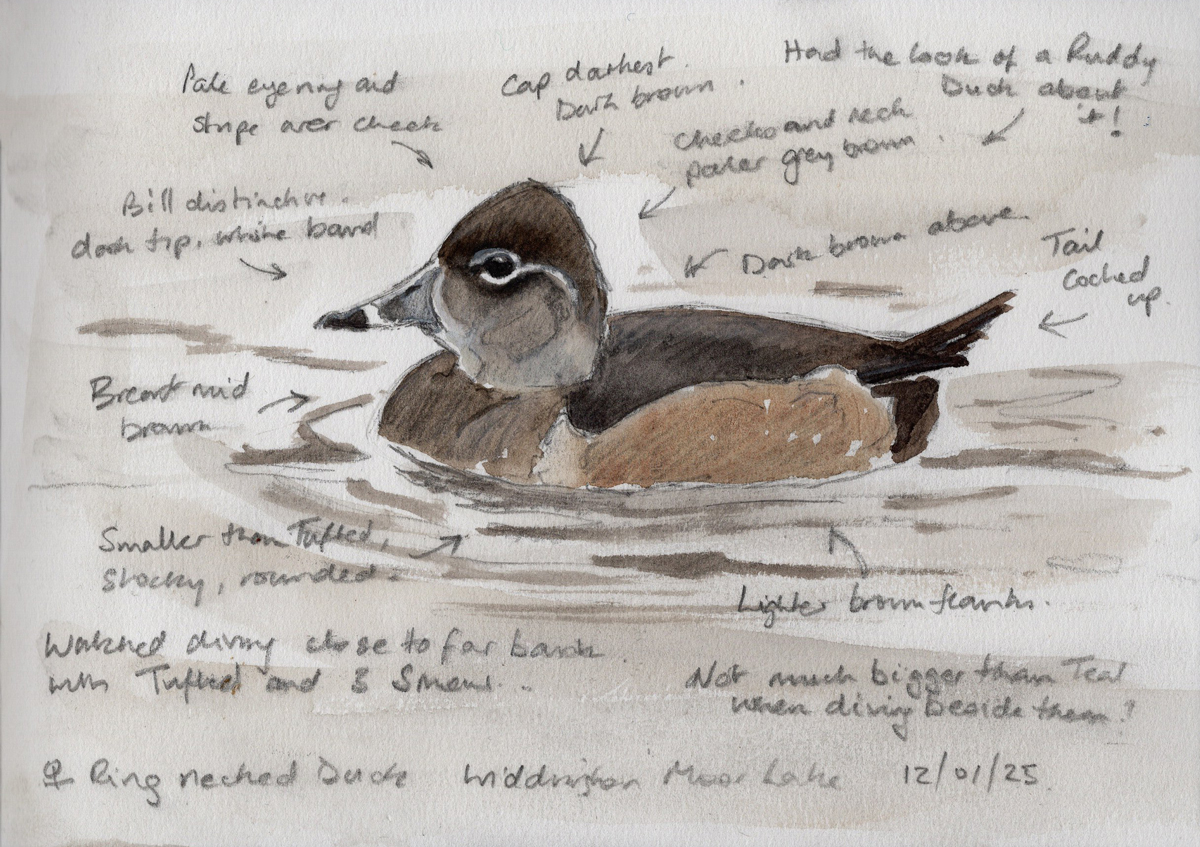
 During January so far, when it seems as if another rarity is just around the corner, on Saturday 11th a female Ring necked Duck arrived at DBCP with the Diver briefly before relocating to Widdrington Moor Lake as the country park froze over night. This little brown duck from America is only the second female of its kind to arrive in Northumberland though there have been more records of drakes.


Figure 5: Female Ring necked Duck, a rare North American wildfowl, Widdrington Moor Lake

 As if in support, an American Buff bellied Pipit was also present at Ross back sands at the same time, an even rarer bird, being only the second record ever for the county.

 What a spell for birders this last two weeks has been. Above are the birds I managed to catch up with, there were also others – Black Scoter, American Wigeon, Green winged Teal, Iceland and Glaucous Gulls that I didn’t have time to see plus Snow Buntings, Scaup, 3 Smew etc. A veritable feast for anyone who has an interest in birds.

What has made Northumberland the centre of the birding universe I couldn’t really say but the going has been great. No doubt normal service will be resumed soon…


Sunday, December 02, 2018

Boney's and the rest....

The original forecast for today was for drizzle throughout, so it was pleasing to find the morning had dawned dull and quiet but fair.

I met with John at the usual Homebase rendezvous in Alnwick to drive up to Bamburgh in the hope that the Bonaparte's Gull found earlier in the week would still be around. At this quiet, dark time of year it seemed the best option, and little did we know how good it would be.

A few miles up the A1 John ordered a sharp right turn for a very brief detour to a concrete culvert ( a road really) under the main road to look for hibernating moths. It proved a good call with a single Herald roosting high on the roof right in the middle of the tunnel at its darkes spot.

Back on to the trunk road North and we were soon at the very scenic tourist village of Bamburgh. At all times, Bamburgh is still besieged by hordes more modern than the original vikings, so it was good to get there early doors before most were out.


At first there were very few gulls to be seen on the shore but as the tide began to rise a few started to drop in. Eventually when we had added 120+ Purple Sandpipers and 130+ Shag to the notebook, our American target arrived with about 20 black headed gulls. Its a while since Ive seen a Bonaparte's Gull so it was good to get this lovely, dove grey and white adult in winter plumage. These are the Nearctic version of our common Black headed gull but seem so much daintier despite looking very similar.

Stag Rocks and lighthouse.


Bonaparte's Gull with Black headed Gulls

After giving it a good look at, we moved a few hundred yards up to the golf club entrance for a cuppa. While drinking tea we could view the flat calm water for seafowl in relative comfort.
Things didnt look promising with only a few Common Scoter and Eiders dotted around, then a winter plumaged Puffin was a bit unusual at this time, diving at mid range.

It was about now that John glimpsed a diver in front of the lighthouse and said 'Get a look at this'. As I looked in his scope I saw a split second before it submerged. It wasn't a red throated thats all I could see.

After a long time, when it seemed to have succumbed to the depths, it emerged several hundred yards further offshore, for a minute then down again. This time I commented that it was a large diver and the head posture was up tilted like a White billed, but it had gone.

Another five minutes passed when it resurfaced, again too far out to tell. We grilled it and it stood up, flapped then dived. The bill seemed a bit scruffy and the nape looked very dark so we left it as a Great Northern. Then the phone rang.

Jonathan Farooqi and his dad were at the lighthouse, maybe 2 or 300 yards closer to the bird. They were sure it was White billed Diver but it remained distant even for them. We hastily downed the tea dregs and walked down the slope to join them.

No sooner had we arrived, Jonathan offered me a look in his scope. There, a lot closer and heading our way was a big hefty White billed Diver! Get in!

Not a bad day, twitching a Bonaparte's Gull then dipping in on a big banana bill, cant be bad.


White billed Diver, adult winter.
As the diver swam much closer we could see all of the required features well, the long ivory coloured bill tilted up from horizontal and even the white spotting on the mantle and coverts. To put the icing on the cake, after half an hour it was joined by a Great Northern Diver in the same scope view for an ideal comparison. The WBD surfaced with some sizeable flatfish to eat then resumed its diving. I'm sure these have evolved from fish, spending as much time below the surface as on it....


Sunday, November 11, 2007

Jackpot!


Above - Top. Little Auks, Longhoughton Steel by Richard Dunn.
Centre - Long tailed Duck, Longhoughton Steel by Richard Dunn.
Bottom - White billed Diver, Boulmer Steel, today. Click for bigger image.

Cold and damp this morning with a strong N6, becoming brighter and clearer later.

Well, where do I start.

This morning the tides were wrong for seawatching at Boulmer, so I thought I would just get out there and do some drawing for a change. My plan was to go to Seaton Point and sit near the beach and see what turned up. At 8am I was passing the main Boulmer car park and decided to pull in to scan the haven for grebes after the recent stormy weather. I climbed from the car and pointed the bins seaward.

What a shock I got. Before I put the bins back down from my eyes, 101 Little Auks had flown through. In about 30 seconds. Looks promising I thought, and headed to the seat north of the village for a 'quick look'. In the next 1.5 hours I had -

Little Auk 3304 N
Great Northern Diver 3 N
Red throated Diver 2 S 4 N
Gannet 6 N
Goldeneye 8 N
Common Scoter 3 N
Velvet Scoter 1 N
Puffin 5 N
Long tailed Duck 1 female N
Purple Sandpiper 4 N
Scaup 2 N
Goosander 3 N

Then things got interesting. As I was counting my three thousandth Little Auk a Diver swam into my view only yards from the rock edges at Boulmer Steel. Nice, a close Great Northern thought I, until as it slipped below the waves, I thought F*** ME thats a WHITE BILLED DIVER! I was now looking at a patch of empty water ( apart from Little Auks whizzing by that is...). Panic. Ring for help. The best way to be branded a stringer is to see a proper rarity alone and then its gone before anyone arrives.

With numb shaky fingers I gave ADMc a call down at Newbiggin and told the tale and gave assurances that a second call would follow if the bird is relocated. I was now doubting myself and expecting to relocate a Great Northern. So, scan with the bins, this bird isn't too far away and heading for a rock pool of sheltered water between a reef offshore and Boulmer Steel.

Sure enough there it was, next to some pot flags and looking the part. Long slim bill uptilted so the tip was crown level, and the tip third was nicely illuminated an ivory cream. Still disbelieveing my luck the call was made to Newbiggin and then to TAC as I figured he could get here sooner. Tom arrived after about ten minutes and I could get him straight on to the bird. Pale mottled head, stonking beak huge size Bingo! my fourth White bill in he county.

Then things got even better. While we were noting the details of the bird, it surfaced near the reef only to be nearly landed on by a GREY PHALAROPE. This is what local patching is all about. Months of slogging around hoping for the big one, but when it arrives its a great feeling. After all, this isn't Newbiggin or Whitburn...

As the tide dropped ( and as people started to head for Boulmer) the Diver took a claustrophobic turn and tried to swim out of its enclosure. This was not possible, so it took to the air and flew off strongly to the north. A good comparison could be had between this birds massive frame and the Great Northerns seen only an hour ago. But the bird was gone for good.

Just as we were talking about the best bird at Boulmer this year, a nice fw Glaucous Gull joined the other gulls briefly before flying south.

I would never have thought it. Posibly my best days birding at Boulmer taking place in November. I reckon that by the time I left for home at 11.30am some 6000+ Little Auks had gone North...What a morning....

Oh, the Farnes had 29,000. Did someone say there might be a chance of a Little Auk this weekend.

144. White billed Diver.
145. Grey Phalarope.