Showing posts with label Local Patch. Show all posts

Tuesday, December 30, 2025

Local Patch End of Year 2025

 As the end of 2025 approaches we always like to appraise how the birding has gone and for me that means, in particular, my local patch. As I have mentioned on more than one occasion, my patch is not a nature reserve. It has no large areas of fresh water, estuaries or scrapes. There is not a hide to be had. Other observers are thin on the ground, so combining this with working full time, a lot of the birds are self found on my daily dog walks. I miss a bit too when I am at work.

This year I have been using eBird to keep a list and in doing so I have input quite a few records for my 3 sq km area, see Map -


Whilst 2025 was just about average in the number of species recorded at 154, over the last 16 years on site ( record is 166 in 2019, lowest 136 in 2014) . Here are the rarity highlights with comments - 

White fronted Geese  - 6 stayed for a month Jan - Feb. Only the 3rd occurrence after birds in 2011 and 2023.


Great Crested Grebe 1 on the sea in August, like the geese only the 3rd occurrence after birds in 2011 and 2016. 9 years since I last recorded one here.

Red necked Grebe 1 on 26th October on a seawatch another 3rd record after birds in 2010 and 2019. Equals Great Crested Grebe in regularity here.

Glaucous Gull 1 2nd Winter in February seen twice. Yet another 3rd after singles in 2015 and 2018.


Osprey 1 flew N past our house early on 24th April, the 4th here. 

Bee-eater 1 south on 31st May a patch first at last. Pity it didnt linger for photos, it was seen twice in half an hour as it moved south.


Garden Warbler. This is what makes patch watching interesting. Despite being on the east coast these birds are hard to catch up with here. This one singing on the coast path and seen in spring was the first for 9 years. They were more or less annual for the first few years after we came here in 2009. Getting rarer.

Common Rosefinch. My second garden record, but not as good as the first one in 2010. In fact this one was a heard singing only record that departed before I could get eyes on it. 27th May.

Other notable species for the patch were Gadwall, Pintail, Long tailed Duck, Cuckoo, Water Rail, Grey Plover, Knot, Bar tailed Godwit,  Greenshank, Mediterranean Gull, Little Gull, Little Tern, Roseate Tern, Pomarine Skua, Long tailed Skua ( all 4 skuas), Little Egret, Marsh Harrier, Short eared Owl, Willow Tit, Yellow browed Warbler, Grasshopper Warbler, Spotted Flycatcher, Twite. 

Biggest misses include Sanderling, Common Sandpiper, Redstart, Red legged Partridge, Little Auk and Waxwing both the latter near annual. Its 5 years since my last Whinchat here though they have been seen by others occasionally.

So, here's to 2026, lets hope it brings something interesting...


Wednesday, June 04, 2025

I see a Rainbow Rising....

 Whats going on? My local patch is getting some good birds. After last weeks post anyone would think I had peaked for the year but no, that was just an apperitif. Things were going to take an upward turn...

Saturday 31st May. 

Jane is off to Newcastle with friends, so me and Peggy are left at a loose end back at home. I could have gone birding, but no, I am out on Sunday so I thought I might use my free time productively for the good of the village.


Our Village Hall has a small wildlife pond less than 100 mtrs from our house and it needed a bit more of a tidy up after starting it last month. Then, with the help of a few Coast Care Volunteers, we removed some choking vegetation to create more open water for amphibians. This was done successfully and in no time we had Toads, Smooth and Palmate Newts back where they belong.

We stacked a large mound of chopped soft vegetation on the decking where it was up to me to mulch around shrubs with it at a later date. Today was the day.

Armed with a wheelbarrow of tools I pottered off down to the pond. While I am here, it looked like it could do with a top up so the hose was deployed and left to run into the shallows as I worked. After a few barrow loads of rotten rushes and iris leaves had been removed a movement over the water caught my attention. It was a female Broad bodied Chaser and she was egg laying. She delicately dipped up and down to the surface, touching the water with her abdomen each time. She is the first Broad bodied Chaser I have seen on the patch so I was very pleased.

An old shot of a female Broad bodied Chaser. I didnt have my camera with me for the sighting above.

At 4pm I had finished the donkey work and was now using the hose to wash off the decking to tidy the site.

As I did this, in a trance really, a quiet soft call made me pause. Now it couldnt be. Surely not? Could it?.

Not really expecting anything at all, I stopped hosing and glanced beyond the pond to the Old Rectory paddock opposite to see a BEE-EATER gliding around! ( In the top image the bird was half way out to that Shepherds hut.) The funny thing is I was quite relaxed about it. I stood and watched it flap and glide when it called again , then moved off behind some tall sycamore trees and off south.

It was time to put the word out incase it might be picked up by birders south of me, so I walked back home collected my Bins, Camera and the dog and headed back out, hoping the bird might be sitting on some wires for me to get a photograph.

We walked back through the village where there was no sight or sound  (de-ja-vu Rosefinch) and out along the lane. Three quarters of the way along I stopped to scan east with the bins. It was now 4.15 and I expected the bird to be away south by now when all of a sudden, there it was. It was distant as it arced up over the rise in the fields. It was feeding beside Seahouses Farm where cattle would attract some flies. This is two fields from my current position so off we strode with purpose.

Arriving at the spot there was no sign of the Bee-eater. only a few Swifts were hawking around. I gave it 10 minutes then left to knock up some notes while the sighting was fresh in my mind.


I see today that it was seen yesterday at Spurn and this morning along the Lincs coast.

What a bird for my village. I have hoped for one for years and each summer on a daily basis day dream as I scan the phone wires across the fields. Despite not seeing it perched up, my sighting was good enough for me, and it wont be beaten this year thats for sure...


Monday, February 10, 2025

Local Patches with cake.

 I've mentioned before my new found use of the eBird app and site online. If nothing else it is a good way to focus the mind, particularly on quieter periods and in a local context.

Now that I am getting more used to it, I try to plan the month ahead, loosely, using the app to do more recording and list management. Here at Howick the plan is to get a full list of species counted maybe once a week, while adding extra species as needed on other days. This will ensure common species aren't overlooked in the quest for the cherry on the top which can often happen, and get records in at the same time. Its a win / win really.   

After taking advice from Ipin at Druridge, yesterday I've used one feature to set up local patches by linking known recorded sites within the patch.  This is a doddle and looks good. For example my own patch consists of 4 spots with in it - Craster, Cullernose Point, Howick Village and Coast, Howick Hall Gardens while the Boulmer patch is made up of Boulmer, Seaton Point and Foxton Golf Course. Both areas under 3.5 miles from home at the furthest point away.

 The majority of recording time is spent in these coastal areas with a lesser period, in better weather, at spots inland from here on moorland or forestry sites. I might even set up an 'Uber Patch' on eBird at sometime to see what all spots are like when linked.

As I am blabbing about Local Patches and Apps, the newly popular Bluesky platform, Twitter replacement app, has a feed called #Lowcarbonbirding that fits quite well with my latest fad. There are some interesting posts on there, often about local patching that had me thinking. It is surprising how many birders take on lengthy hikes in pursuit of ornithological goals. Distances of 15 km plus are quite regularly posted, on foot from home. I read these with mixed emotions varying from Wow! through Guilt to F. That! depending on mood. 15 km is a canny trek with birding gear too, that is time consuming if you add in stopping and watching slots. My walks are no more than about 5 km usually and that still takes a morning. Yesterday morning's amble was around Boulmer and up to Longhoughton Steel and back, a distance of 4.11 km. Sometimes we might double that on a good day.

My friend Alan, seems to know me a bit too well...so I felt the need to reply...


 So far February has not been too productive on the art front, something I must try to address...

Since my last post there have been some pleasant seasonal changes. From 5th Song Thrushes began singing here on fine mornings, always a good harbinger of spring, that one. Skylarks began on the same day. Lovely.

Song Thrush

Our 6 Russian Whitefronts were still hanging on til yesterday when a farm worker and dog went through the field flushing them off. What might have been them were seen flying S at Hauxley, down the coast at lunchtime. I will check to see a bit later.

A pair of Gadwall on the pond were the first of the year coinciding with the end of the shooting season disturbances. Its not just the actual killing and lead shot that causes wildlife problems, the noise from a score of people beating and blasting shotguns through the countryside does nothing to help things. A Kingfisher was almost a daily sighting here last week.

A Woodcock flighting out to feed was nice one evening and at the same time the back field Barn Owls could be heard hissing, though they remain elusive. Some reasonable numbers of birds in the village fields included 37 Curlew, 45 Oystercatcher and 14 Yellowhammers. Best though was a Little Egret flying low, south, from our drive, a rare bird here.

Buzzard

Gadwall

Kingfisher


Russian White fronted Geese

Yesterday our wander around Boulmer was in full overcast, cold and breezy conditions so there wasn't a great deal going on. An adult Mediterranean Gull was a highlight, plus another or the same Little Egret as above, 200+ Curlew, 11 Grey Plover, 14 purple Sandpipers, 50 Linnets, 2 Fieldfares and the first Gannets of the year with 10 birds moving N.

 I will end with some stats off eBird - 

My usual Howick - Craster Patch - 

YL- 80   Feb - 71

My village small area within the above, about 1.5 sq km - 

YL - 75    Feb - 59 

Boulmer with much less coverage -

YL- 64    Feb - 54


Monday, February 03, 2025

Russians arrive...

 Been keeping local recently after the flurry of county twitches earlier in the year.

As you can imagine, it has quietened off somewhat but there is still a few bits and pieces to keep the interest up. I'm also trying to use ebird for my patch birds as a way to keep up with a year list and to provide records that I might not otherwise have.

On the plus side, apart from an odd hurricane force storm, the weather seems to be better than last year too. By late Jan 2024 we were already up to Storm Isha ( they are named alphabetically) but at the same time in 2025 we only have Storm Eowyn...

So what has been seen....

Around the village, coast and pond, keeping a count of commoner species is a good thing to do. In this 1 sq km ( maybe 1.5 sq km) a flock of small birds in stubble comprised of 25 Yellowhammers approx, its hard to get them to sit still long enough, with 5 Reed Buntings and 65 Chaffinches, but no Bramblings this winter. Tree Sparrow numbers have declined too with usually only up to a dozen present. 55+ Linnets left the coast blackthorn roost this morning but arent feeding in with the stubble flock? and up to 12 Goldfinches present too.

A male Kingfisher is usually at the pond on days with better weather, sitting up along the back edge, fishing for sticklebacks.

An Alnwick Wildlife Group guided walk on the 18th added Fieldfare, Rock Pipits, Ringed Plover, up to 300+ Lapwings and 400+ Golden Plover while 7 Goldeneye were on the sea.

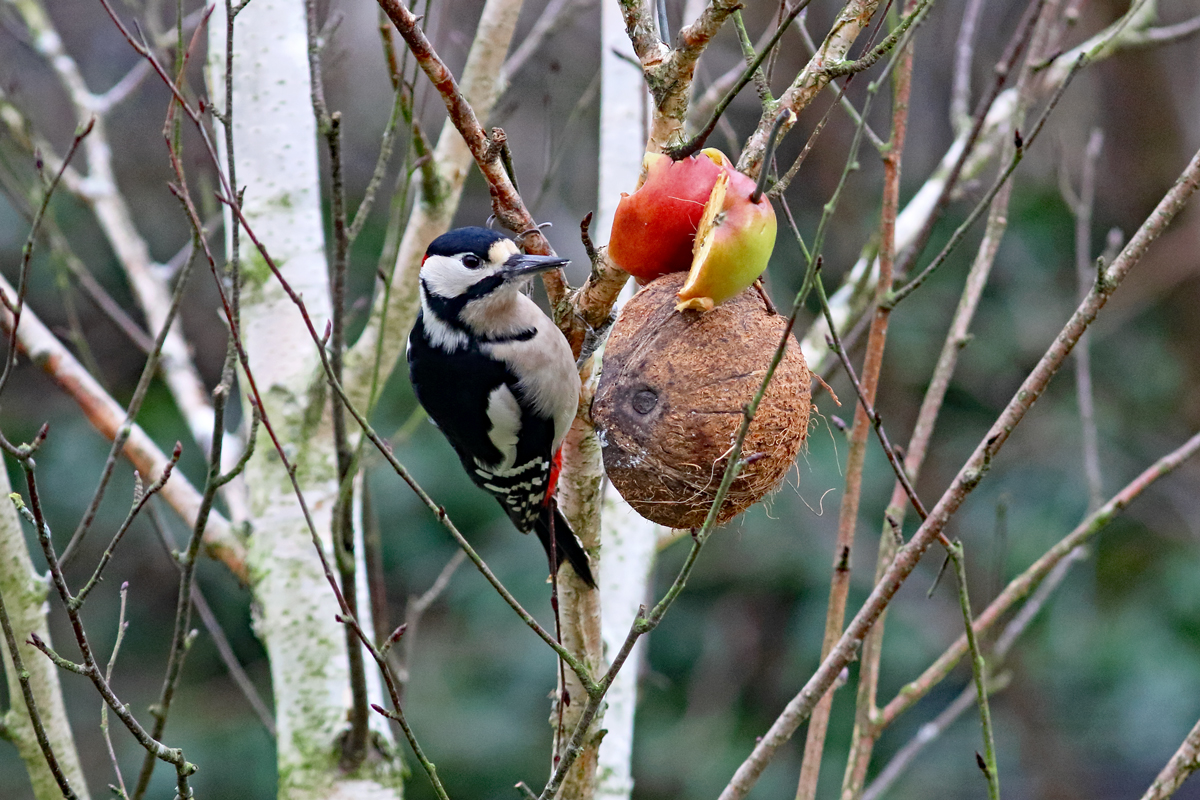
3 drumming Great spotted Woodpeckers were in the wood on 20th with a couple of Nuthatch and Treecreeper.

Short visits have been made to Boulmer and Craster over the last couple of weeks too where up to 18 Purple Sandpipers and 2 ad Mediterranean Gulls plus the resident hybrid Falcon still causing mayhem.

Without a doubt though, the highlight over the past week has been the presence of 6 Russian White fronted Geese in the field behind the Bathing House. A rare bird on my patch with only 3 previous records in 15 years and these are my first ones to be actually on the deck! Such a smart grey goose these are, well camouflaged in a field filled with molehills, they were all present and correct still this morning.


Wednesday, November 06, 2024

Edge of Winter

 November starts in autumn and ends in winter. Our old county winter atlas surveys began on 13th of the month, so I tend to think of that period as the beginning of winter, though autumn bird migration can continue into December. By mid month, the majority of our winter visitors will be in situ, and our summer birds long gone. 

This week is make or break for one iconic winter visitor in Northumberland. This will not relate to more southern counties but it is very accurate up here. Waxwings. If it is to be a Waxwing Winter, Northumberland will have a decent arrival before bonfire night.  In 2023, I had seen 5 Waxings on patch by now, and a flock of 45 was in residence by the 20th. Overall by 31st December exactly 100 Waxwings had presented before me. Come 1st January I didn't see another! So, 2024 / 25? not a report of a single bird yet here, so I'll go all out to say, no Waxing Winter this time...shame.

The first week of November has been quite good on the local patches of Howick and Boulmer. No real rarities but a good variety of species to keep up the interest.

To summarise - 

1st Nov - 

High pressure  with mild calm dull days has been the flavour this month, so far. What is it they say? In like a Lamb out like a Lion?

5 Whooper Swans flew west over the garden, while 66 Curlew, a Stonechat and 7 Grey Partridges enlivened a quite early morning dog walk around the village.

2nd - 

Unusually, Peggy was asking to be out at 0530 so off we tootled into the darkness for no more than 5 or 10 mins. We were met with bird calls all around. Redwings and Blackbirds at the rate of about 10 cals per minute. We also almost stood on a Woodcock beside our neighbours corner too.

A couple of hours later I was up at first light to see if any of these birds were grounded.

In an hour I had 32 Redwings, 94 Fieldfares, 35 Blackbirds, 1 Chiffchaff, 3 or 4 calling Brambling, 1 Sinipe in off, 1 Whooper Swan over, Golden Plover S, 12+ Chaffinch and 400+ Starlings.

A stand around on the drive for an hour mid afternoon added 1 Raven N, 23 and 7 Whooper Swans S, 1 Brambling beside the garden, 5 Long tailed Tits and 3 Mistle Thrushes.


3rd - 

Met John at Boulmer where we did an ebird full count of our walk. The route was only three miles around by Longhoughton Steel but the bird range was excellent with 69 sp recorded. Not on the list, below, was a huge falcon bearing a red breeders ring, on the rocks with prey. Unsure of its parentage but Id say Peregine x Lanner or Saker... the Xs below are birds present in good numbers but we didnt bother counting them.


Apologies for the poor digiscoped phone shots...

As we enter the dark days of a Trump administration across the pond, who will say what disasters will befall us at the hands of the orange manbaby...


Wednesday, August 14, 2024

Surfie Seconds...

 On Monday night after work, I couldnt resist popping along the road to see if I could get the Surf Scoter while I was actually on patch, rather than just watching the bird on the patch from beyond. After a spell without any sign, tonight the sea had a bigger swell with some quite large waves rolling in making viewing more tricky. Then all of a sudden up it popped. This time it was only half the range of yesterdays views and was well lit in the evening sun. All of its features could be appreciated, including that daft 'zoom lolly' of a bill... 

To be fair, I am well pleased with this. Sea Ducks are not in large numbers on my patch so to get one of these actually on the sea rather than a fly by was never expected....

Pity I forgot to take my phone, I might have improved on the phone scoped efforts... I took notes instead and worked them up later...


  The only other things of note seen were 3 Common Sandpipers together pushed by the tide onto one rock and a Painted Lady butterfly, only my second this year. Speaking of butterflies reminds me, the first Autumn Holly Blue was out in our garden yesterday...

Wednesday, February 01, 2023

A new month...

 So, January finished with my patch list standing at 87. This is about average or maybe a bit under.

The best bird so far was the Great Northern Diver last week, annual here but always a nice one to get. Other, better, species have remained elusive. No Kingfisher, Raven or Med Gull and most years gives an oddity for January like Firecrest, Little Gull, Marsh Harrier, Little Egret etc but not this time. Even our local Barn Owls seem to have moved elsewhere. For a bird that used to be a daily occurrence, that is a bit worrying.

At least the days will now lengthen a bit more noticeably and it wont be long before the birds start to sing. So far only a Coal Tit has graced my ears, but I'm sure Great Tit, Song Thrush and Chaffinch wont be far behind.

Recently I have had pop ups on social media regarding the weather, with a few sources reporting the possibility of a Beast from the East, the UK covered in 4" of snow and prolonged freezing temperatures yet I cant see anything at all like that in the forecast. Last year we had a lot of named storms over the winter with Arwen, Eunice etc but I've not noticed any names so far this year ( thank God)? At least the Snowdrops, Winter Aconites and Winter Heliotrope are all in flower to remind us that the dark days are almost over...

Another type of patch list, if you like, is underway here . The Spiders in the Bathroom List 2023. I bet there's not an option for that on Bubo. Here are the additions so far and to be fair the only wildlife pics I've taken this year with my camera. This project reduces the need for Hoovering....

I began this post with an idea of something to write, but it has slipped my mind? 

Theridion species likely melanurum


Amaurobius ferox

Amaurobius similis

Erategena sp likely juv Giant House Spider

Monday, January 23, 2023

Noddy...

As mentioned last Sunday, this week we would give my local patch a once over on Sunday morning to add a few species to the list.

The morning was darkly overcast and cold with a brief icy shower around 9am. 

I met up with JWR at our Village Hall  and headed down the road to Seahouses Farm. Th eplan was to get in position over looking the sea and rocks at Rumbling Kern shortly after first light. The plans were curtailed a bit as John had forgotten his bins, resulting in a cross country dash to his house to pick them up. As it happens, there was nothing lost because it was scarcely light by the time we returned.

Down on the Rumbling Kern we were soon joined by Daniel who obviously had a similar plan to us.

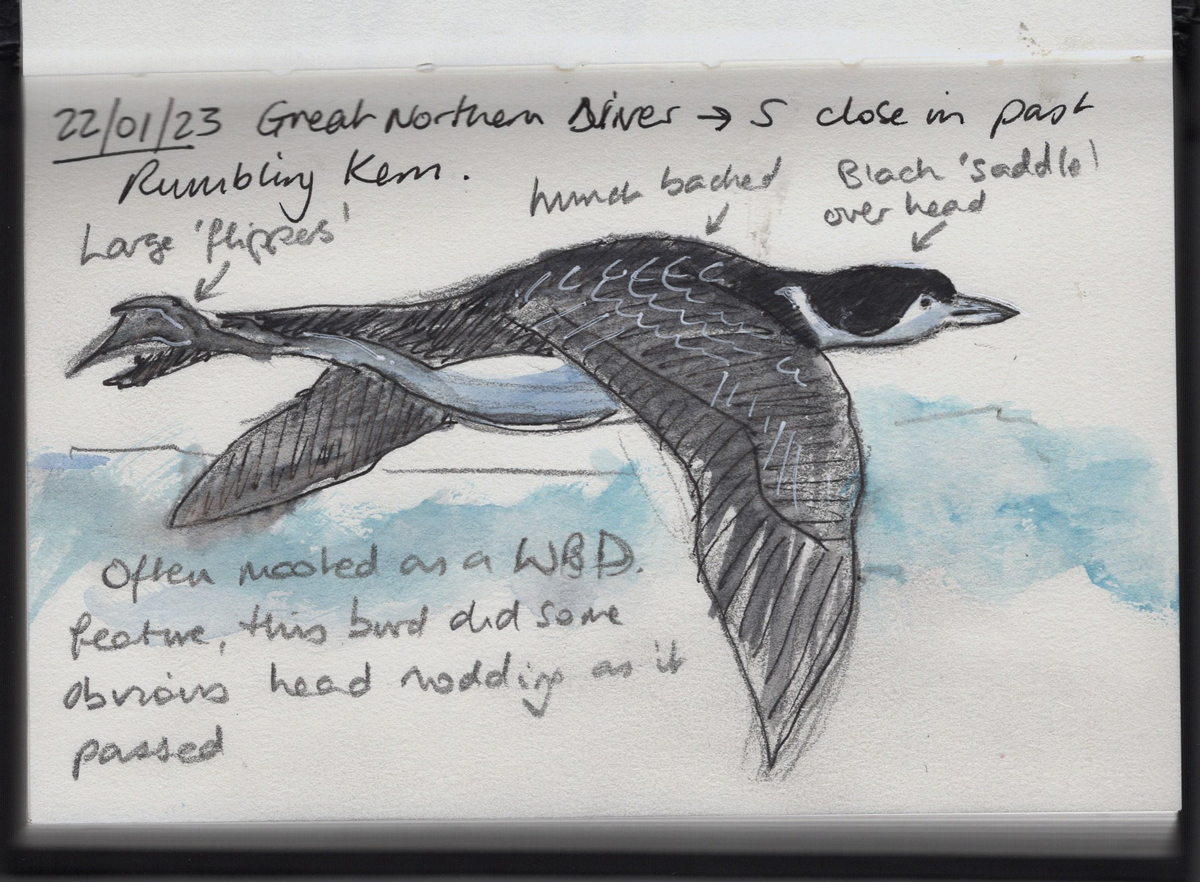
The sea was quiet but the few birds we did meet were mostly new for 2023 - Red throated Diver 4 on the sea, 1 south followed by a close in Great Northern Diver S giving a nice view as it passed. One notable thing about this sighting was that the GND was nodding its head all the way past. This is an oft mooted White billed Diver feature so beware, it does little to split the two.


 Also, 2 Razorbills close in and a light passage of Herring Gulls, though they may be just leaving a roost on the sea.

Down at the Howick Burn mouth statistically the  best patch bird of the day here was on the beach, a Ringed Plover! Just about annual but never easy on this rocky coast line, so a grounded one this early was very welcome. Surprisingly the same or another was seen along at Craster later on too.

A pile of rotting weed at the burn attracted a few passerines with 4 Rock Pipit, 2 Meadow Pipit, 5 Robins, 2 Pied Wagtail and a Blackbird, while 2 Grey Plovers and 4 Lapwings were down the shore. 

We walked back by the Teepee track seeing very little so we drove along to Craster for tea and cheese rolls.

Around Craster were 8 Purple Sandpipers, 1 Goldcrest, 3 Bullfinch, 2 Treecreeper and 2 Greenfinches.

That was the morning about done with 6 patch year ticks added - RTD, GND, Razorbill, Purple Sandpiper, Greenfinch and Ringed Plover. Total 86 sp.

For the first time, I even charged the camera but t was a bt dull for photography really. Still, here's a Great spot from the window in the afternoon...


Sunday, January 15, 2023

Patchin'


Last week we agreed that today we would have a morning on John's patch at Alnmouth, to give the 2023 list a kick up the backside. 

The morning dawned very pleasantly especially after last nights gales. We expected things to be quite disagreeable today but as you can see, we had a cool fine morning with a light SW3 breeze.

We began with a short seawatch from the beach shelter as it was high tide. 

4 Red throated Divers flew S and one N, 8 Great crested Grebes were in the bay and 2 drakes and one duck Red breasted Merganser chased back and forward close in. A few Rock Pipits all seemed to be grey streaky littoralis birds, a pair of Stonechats and a Pied Wagtail were all we could find on a beach stroll.

We headed a short way around the corner for a brew while scanning the Aln estuary. Small groups of Wigeon and Teal were dotted around with roosting gatherings of Curlew, Oystercatcher and Redshank. A lone Whooper Swan glided in to land near us for a while before taking off again and heading south to locate its wintering group.

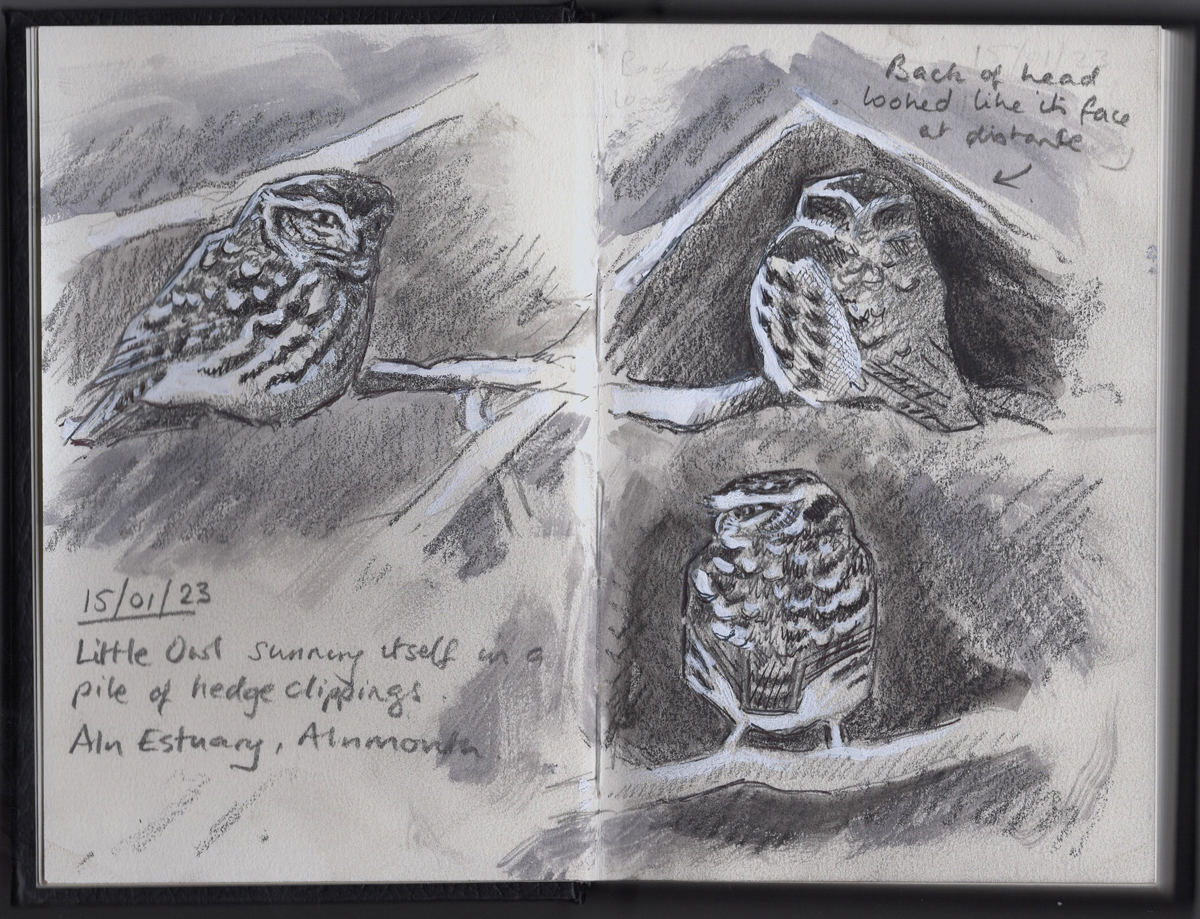
While scanning with the bins I noticed a bird on the far side saltmarsh behaving oddly. It looked like a thrush with a snail but also a wader? A quick scopeful saw that it was only a Redshank wiping some prey on the grass maybe to clean it before consumption. At the same time I noticed this bird, another round creature was sitting in a dead hedge behind it. I never thought much about it really until John said 'that's a Little Owl!' Well I never, sure enough a spotty greyish ball catching the first sunshine was indeed a nice Little Owl. Neither of us have seen one in VC68 fr a few years now. They used to crop up occasionally most years but not recently, so this bird was all the more enjoyable.

It fluttered and hopped around and through the twiggy mass until we eventually left it to its roost. A nice unexpected year addition for John.


Next stop was a brief scan of the geese at Foxton. Apart from 2 dead bird flu candidates the main interest out of the local Canadas and Greylags were 2 Barnacle Geese. A drake Goldeneye and a Little Grebe were on the river too.

Goldcrest was the only yearlist addition in Lesbury with the river being too high for Dipper, Goosander and Grey Wagtail so it was off further upstream to Greenrigg for a look along the banks.

It was passerines here that were worth a look. A close Willow Tit showed well, then a mixed flock in some weedy stubble held Reed Buntings, Yellowhammer, Linnets, Chaffinches and one female Brambling.

So not a bad morning, John secured 16 new additions. I hope I can do half as well next Sunday when my patch will get the once over. You never know, I might even take the camera....


Monday, October 31, 2022

Swifts

 While the southern half of the country is awash with rare subtropical migrant moths things are more sedate up in the far north east of England. Still, I have had a Scarce Bordered Straw and a Pearly Underwing so cant complain. I had hopes of a Crimson Speckled but now I see that not only are they very rare ( still) they are even rarer in a moth trap, with most sightings being out in the field. At Dungeness, moth-ers have taken to dragging a washing line between two of them, lightly over short vegetation in an attempt to lift one up. Ah well...

Back in the real world, on Saturday afternoon I had arranged to meet Sally, a mycologist ( fungi observer) on our estate where I hoped she could identify some of the tricky ones for me. As it turned out our wires became crossed and the meeting didn't happen, but while I was sauntering around the cricket pitch, eyes to the deck looking for fungi, I was aware of thrushes flushing ahead of me.

The bushes here are decked with berries and good numbers of Blackbirds, Redwings and Song Thrushes were stocking up. While I watched a good sized party of Redwings head skywards, my eye rested on some other birds low down just above shrub height . SWIFTS!

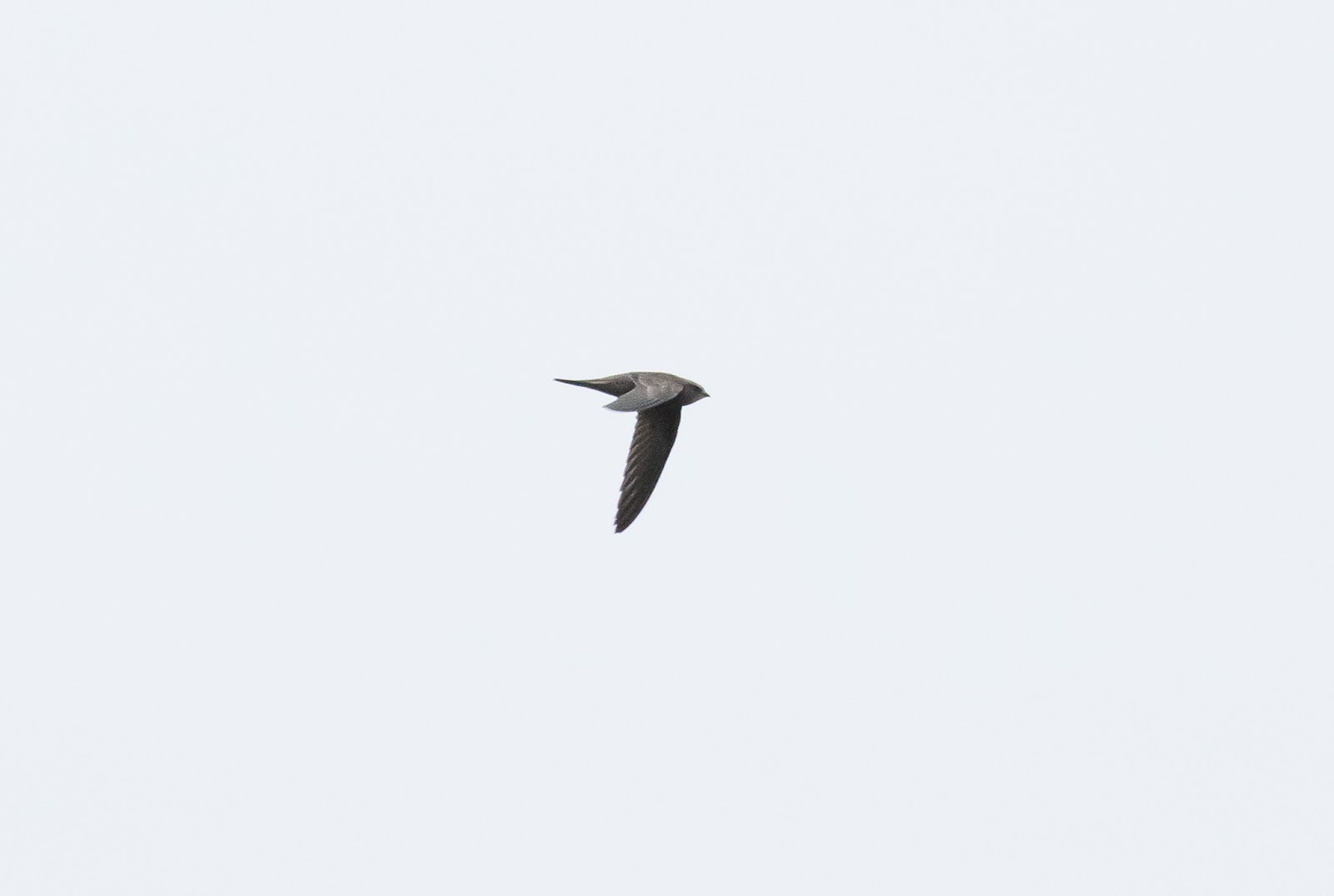
Swifts? three of them to be precise. Now I've not even seen a hirundine here since September and not a Swift since late August, so this was a bit of a shock. I was also aware that NW Europe was having a Pallid Swift invasion.

 As I watched these birds with the naked eye ( I had left my bins at home, you don't need them for mushrooms! What a muppet). The birds seemed to be feeding and not just passing through, so I put the word out on WhatsApp of 3 Swift sp present. 

Straight away Dan Langston replied, 'On my way'. Thank goodness, Dan only lives a mile or so away and is well up on these things having already found two Pallids earlier this year. Better still he would be bearing optical gear.

Within minutes Dan arrived and we had the next half an hour watching the birds drifting back and forward across the sky over the pitch.  At some angles they remained dark 'Swifts' as in sp, but when closer, in better light, it could be seen these were all Pallid Swifts. I've only ever seen two before, some years ago, so to have a multiple occurrence on patch was nothing short of amazing.

Dan rattled off some images, that showed enough to be sure, and at that, they slowly drifted north and out of sight.

Later Gary Woodburn had a single at Embleton Quarry that could have been one of ours and next morning three birds were over Amble and Warkworth for most of the day. With 4 up at St Abbs and dear knows how many in Yorkshire, its still worth keeping an eye on the sky.

 Just make sure to have bins and camera with you!


Tuesday, September 06, 2022

A local Easterly...

 Busy, busy, busy now that Autumn is in full swing and the wind has been from the eastern half over the past week. There is never enough time to do everything.

On 31st August I managed a couple of short seawatches at The Bathing House. An hour in the morning resulted in some decent birds with 1 ad Pomarine Skua, 1 close in juv Long tailed Skua, that bonked one of 25 Arctic Skuas on the head forcing it to land before moving away north. A great comparison of size and structure could be had during the interaction. 1 drake Velvet Scoter was a surprise  along with small numbers of Common Scoter, Wigeon and Teal.  It really is that time of year. 80 Manx Shearwaters completed the show.

It felt good so after work I popped down to Cullernose, but an hour and a half showed that most passage was now over. Still, 2 Long tailed Skuas, 14 Arctic Skua, 1 poss Pom but too distant and 30 Manx made it still worth while.

On Saturday 3rd September rain and easterlies looked good for an arrival of migrants to off we went to check the coast path area. Up at Holy Island and the Isle of May birds were falling in with plenty of scarcities too, but a random bit of mainland isnt really like that. We just hope for scraps really...in this case, I didnt even get those. No migrants at all, not so much as a Chiffchaff. Some compensation was had on the way back when I flushed a lovely Convolvulous Hawk-moth from the verge. It was soon pocketed and taken home for photos then released after dark.


Convolvulous Hawk-moth, one of our largest moths. 

Sunday 4th dawned foggy and mild with a light south easterly breeze. I met John at Boulmer where we were filled with hope of what the morning might uncover, after all this is a big headland into the North Sea.

The final tally is less than inspiring so here are the highlights - Curlew Sandpiper 1 juv on the beach with Dunlin, 3 Black and 1 Bar tailed Godwit flew S, 9 Brent Geese N at sea. The only passerine that got us going was an 'educational unstreaked acro' in a ditch near the car park. Doesnt that phrase make your heart sink? All I wanted was a Wryneck, not of this educational nonsense ( a phrase used to try and get some meagre enjoyment from stringing a common species). The acro turned out to be  Reed Warbler no matter how hard we tried. It is still a decent bird on this patch really, Ive only ever seen maybe 4 or 5 in the area.


Above -  Reed Warbler, top 2 mine, bottom one is by JWR a much nicer shot than my efforts. 


As the wind was set firmly from the east,a couple of days annual leave were booked for Monday and Tuesday.

On Monday a half hour sea scan had 8 Red throated Divers and 3 Arctic Skuas S with 1 Arctic N, but the glare from the sea was appalling so I gave up and went along to check Craster. On route back, a juv Peregrine went over N and a Whimbrel S .This is the north end of my patch and its not been visited much this year.

A good yomp around Craster Village fuelled with numerous juicy Brambles at last had a few birds.

Pied Flycatcher 2, Lesser Whitethroat 2, Blackcap 2, Calling phylloscs 12, non seen but 1 Willow Tit showed well. More insect migrants included 6 Red Admirals and a Hummingbird Hawk-moth.

The moth trap has produced some good stuff this week too but thats for another post...


Monday, May 23, 2022

Not so wild fowl...

 Caught up in the Bluethroat moment I forgot to blog about some other good patch birds seen recently.  When I say 'good' before I go on, remember its all relative. No wonder I forgot about them...

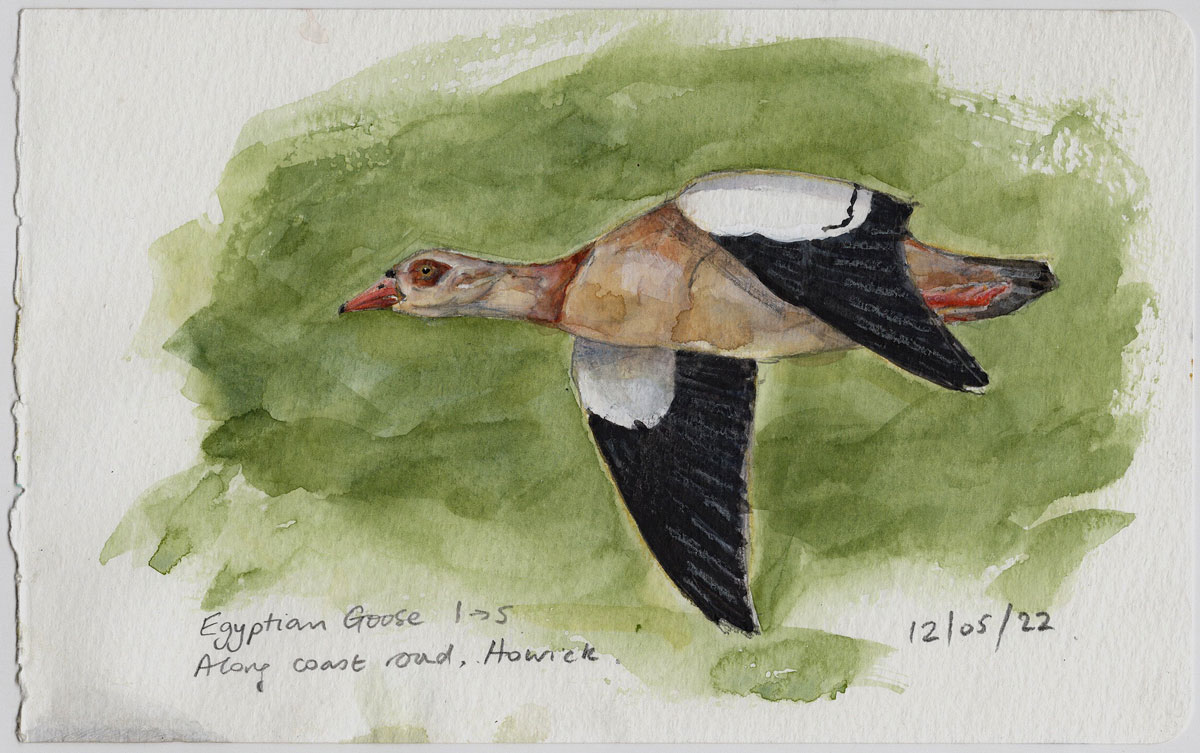
Lets get this one out of the way first as it is as rare as the Bluethroat on patch. A full new species in fact. On the 12th I was walking Peggy along the coast road first thing when I noticed a 'Greylag' coming low towards me from the north. Meh.... I'm not sure what made me raise the bins, maybe it was the white looking leading edge to the wings, I don't know, but a genuine frisson of excitement came when I saw that this was no Greylag goose.

It was NU2517's first Egyptian Goose.  It is many years since an Egyptian Goose received such a long gaze as this one from me as it called and eyeballed me on the way past...

I'm not sure when one of these will grace the pages of my sketchbook again, but it is a full patch tick so...

A pale headed male Yellow Wagtail flying around a little further on could have been a 'Channel' Wagtail but it soon flew north. 

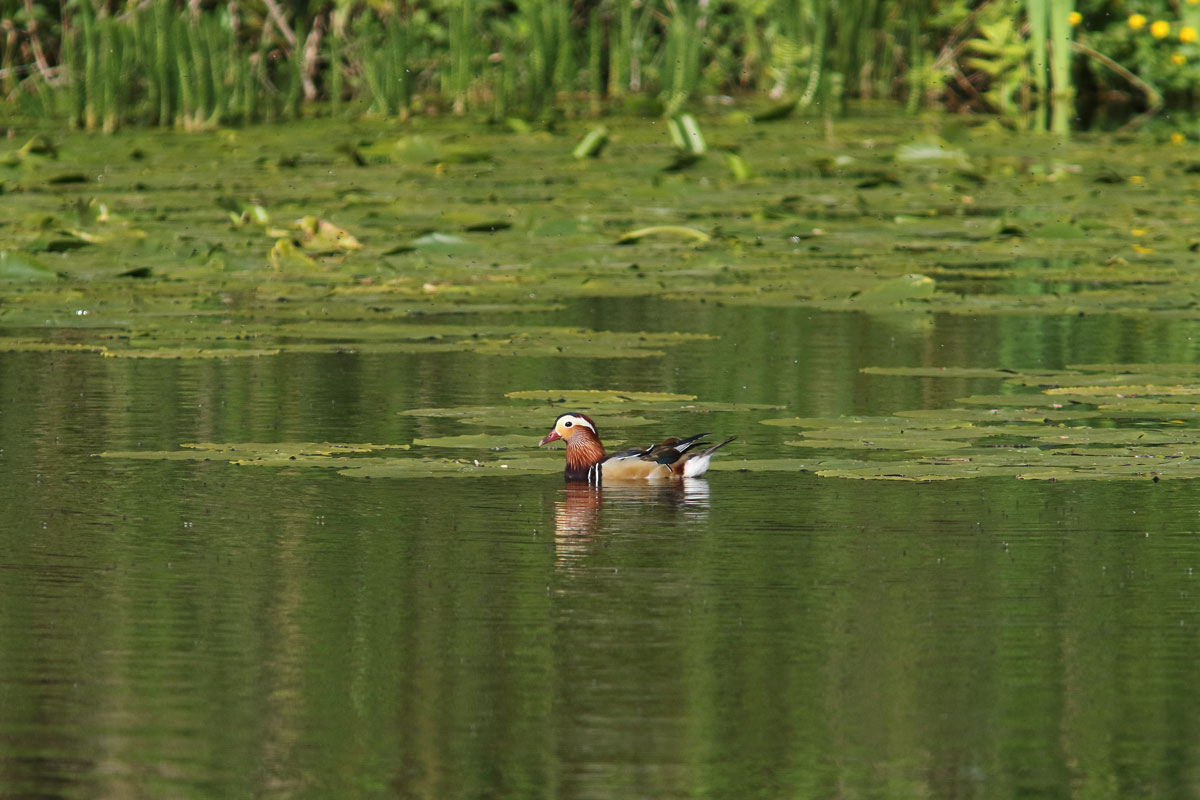
The tropical flavour was still with us last Wednesday when a drake Mandarin spent a couple of days on the pond. This is the third here in recent years, so still in the Rare category for the patch. The only individual I've managed to get a photo of on site too...

Mandarin.

Blog reader numbers have dropped a bit recently, and those two might be the nail in the coffin, but come on, they all count as natives. With this run of good luck what next, Ring necked Parakeet ?

Other than these, a calling Cuckoo a few times just west of us remains elusive though I did hear it from the garden the other morning. 

Still not quite caught up, but Sundays walk will get a new post later...  


Thursday, May 19, 2022

Blue!

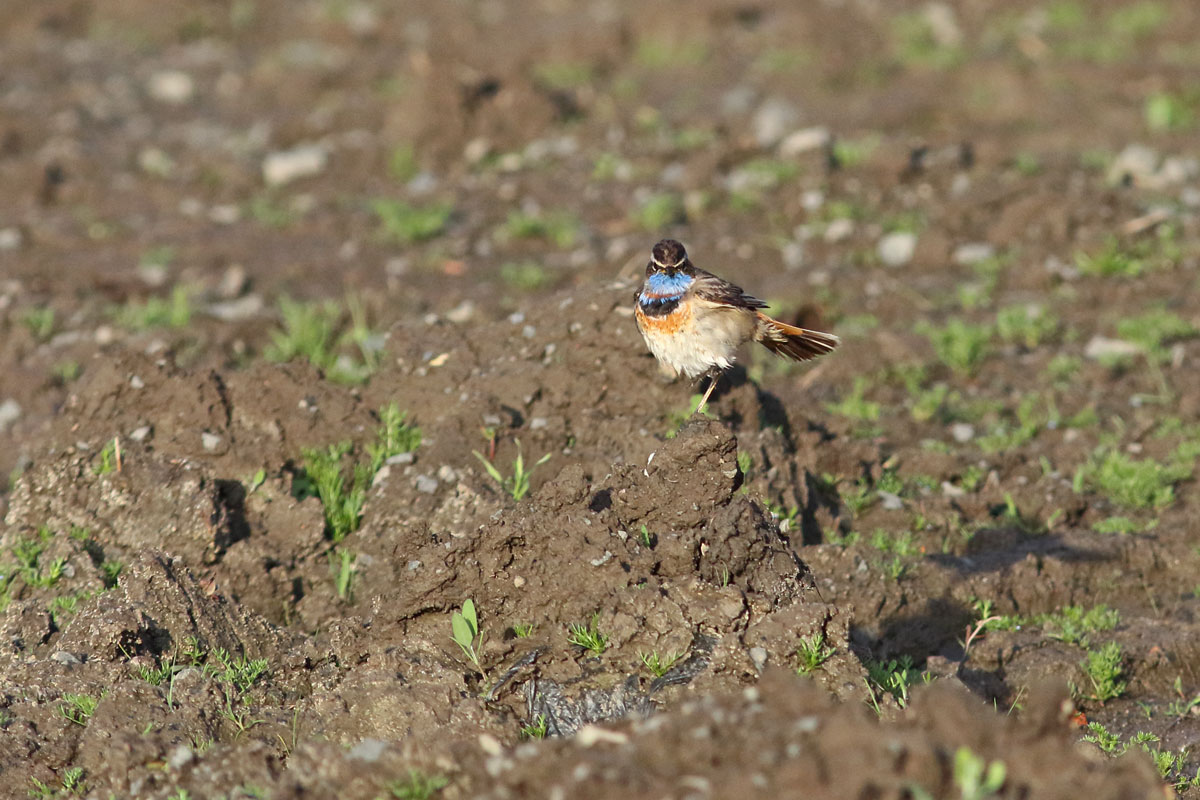
All through Sunday night into Monday we had heavy rain and a steady easterly wind on our stretch of coast. This weather pattern is not common during the third week of May and as a result, all down the East coast birders are fired up hoping that it may deliver some scarce and rare birds that have drifted off their normal migration routes, but one in particular epitomises this week above all others - the Bluethroat. 

Bluethroats in spring have a quite narrow window of migration to the sub arctic Scandinavian taiga, and if we are to see one, we need this type of weather to occur between around 10th to the 20th May. Outside of this period in spring a Bluethroat is very unlikely to be seen.

On Monday the rain was steady until around 3pm, then the wind dropped and the sun emerged from behind the clouds. What would it reveal? In the 80's and early 90's we would sometimes see big Bluethroat arrivals but this has not happened for many years now.

No sooner had I finished working at home around 4.15pm than a Facebook message arrived from my neighbour along the road, Mandy. The conversation went a bit like this.

M - 'OMG'

And nothing else? I was just about to reply with 'Eh?' when a second message arrived. It was a close up of a bright male Bluethroat but there was no location. 

Now, Mandy works as a tern warden up at the Long Nanny ( of American Black Tern fame in my previous post) so I assumed this is where the bird had been found. The Nanny has a bit of a good history for Bluethroats in past years. So I advised - 

'Ho ho, get the news out on Whats App' 'Nanny?'

then...

M - 'but its in my garden!'

This was a total game changer. Mandy lives about one field away from me. I picked my jaw up, and went into panic mode, a Bluethroat on our patch!! Grabbing my bins and camera I jumped into the car (speed if of the essence ) and drove the 400 mtrs along the road to the farm. I was there in about 3 minutes flat from getting the message.

The bird had unfortunately flown from Mandy's garden along towards the farm yard and disappeared.

The sight every East coast birder wants to see in mid May...

I quietly quartered the damp puddle edges with my bins and soon there he was, quite distantly in the centre of the paddock before flying off towards some silage bales and farm trailers.

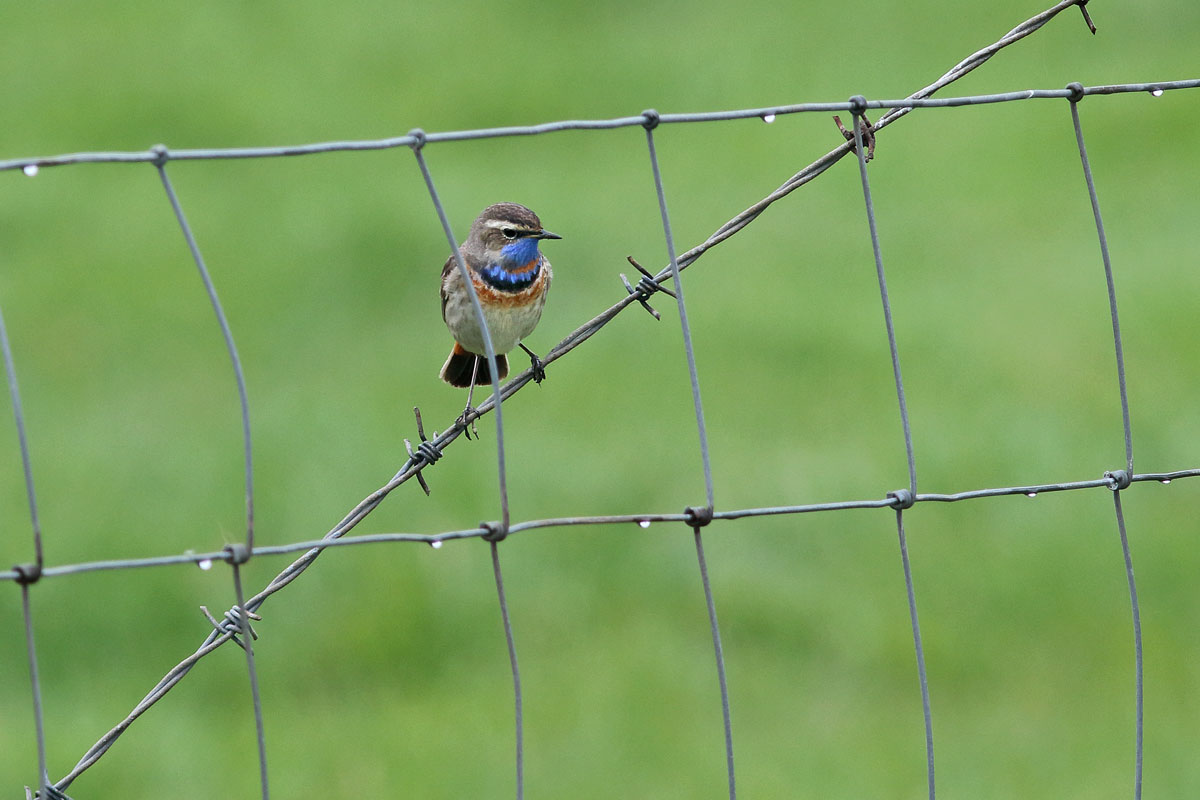
Around the other side from the bridle path a better view could be had but there was no bird? Just then a smashing male Greenland Wheatear hopped up onto the wall not far from me. I took a couple of snaps, then all of a sudden in came the Bluethroat, full of bull, not wanting this Wheatear in 'his' farm yard at all. The Bluethroat landed on the public path sign finger board and belted out a lovely melodic loud song before coming towards me down the wire fence.


My blue car next to a blue van behind the Bluethroat. Incoming...


I rattled off some shots that were almost all blurred due to wrong settings on the camera and the Bluethroat chased off after the Wheatear, to the south behind a muck heap. I left the bird in peace until I popped back home and took the dog out. Returning later on, the bird had settled into a convenient routine back in the paddock area feeding in nice evening sunshine coming quite close to us. At one stage it had a bath in a puddle and sat preening on a clod of earth for a while where we could get better shots than before.

A small group of about five of us enjoyed the bird until the light faded when it seemed to look at an old trailer to roost under. 


Red spotted Bluethroat. 2nd calendar year Male. Male.

The only sour note to the whole thing came the following morning when the farmer had decided now was a good time to move tons of farm machinery to exactly the spot the Bluethroat was using. It was not seen again.

What a great bird for the patch list and many thanks to Mandy for her prompt action in getting the news out. It was much appreciated.


Tuesday, April 19, 2022

Bobby Dazzler

 While the rest of the country basked in a mini heatwave, up here we had our own version. 12 degrees with a light onshore breeze and a moderate haze just to make sure we didn't get carrier away and think it was summer. Monday was better as the wind had gone west making it a little bit milder.

Despite the cool, more spring migrants arrived with  2 or 3 Swallows back in the village from 1.30pm on Saturday followed by 3 nice male Wheatears on Cullernose on Sunday. To those in the south or on headlands this might seem a bit duff, but these are my first of the year and might even be the only ones of spring on my patch where it is not a common bird.

Willow Warblers and Blackcap numbers seemed to increase too but the highlight of the weekend had to be a bright, tortoiseshell patterned, summer plumaged male Brambling at the bird table yesterday. April is the best month to get one on the feeders here and it was only 2 days later than last years singing male. Being on the north east coast we don't get many winterers, sometimes we get single figure parties, but they are easiest to find in October and April as they come and go.

Anyway, here is the stunner...images through kitchen window.