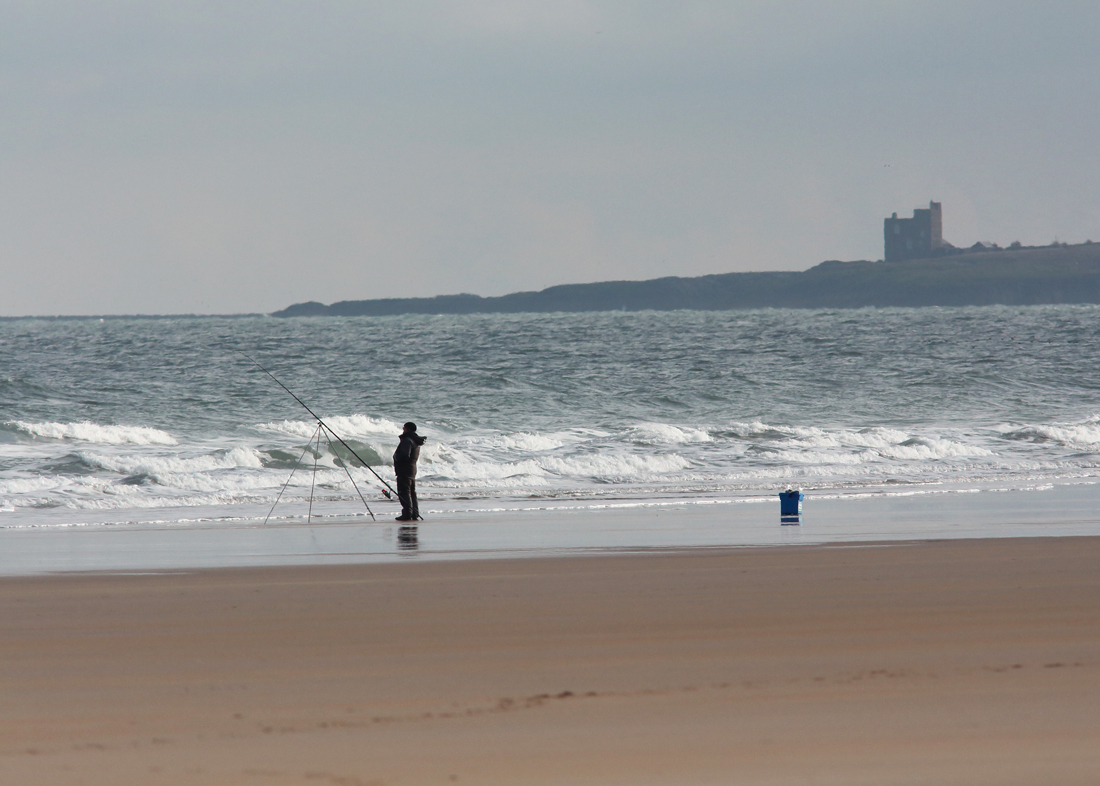
When there is a cold, north wind in February we are often at a bit of a loose end. Its too early to look for spring migrants, too cold and windy to head inland so what can we do? There is only one thing for it really, stay on patch and look at my only decent 'wetland' - the sea.
Seawatching at this time of year is a world away from the watching from July to December. In spring there is usually little to see, but it is sure to throw up one or two new birds for the local patch year list, so that is how we spent Sunday morning, and for February, we were pleasantly surprised.

So, what was on offer.
As is the way, quite a few birds were too far off to do much with, though a
steady northerly movement of Kittiwakes with a few Gannets were the start to my
list additions. Soon, a few more things of interest appeared with both Great
Northern and Red throated Divers, a nice drake Velvet Scoter, a few parties of
Common Scoter and a very early Manx Shearwater.
Great Northern Diver 2N 1 S
Red throated Diver 16N 7S
Common Scoter 23N 12S
Velvet Scoter 1N
Shelduck 3N
Razorbill only 8 identified out of 100s of auks.
Manx Shearwater 1
Purple Sandpiper 1
Gannet 40+N
Kittiwakes 100+ per hour N
Guillemots Several hundred going all directions offshore.
Shag, a few.
Harbour Porpoise 1, a while since I've seen one. Since the Bottle nosed
Dolphins became regular the poor Porpoises seem to have taken a beating.
Also in the vicinity were 18 Meadow Pipits N, 1 Rock Pipit in full display
song flight, an adult male Sparrowhawk along the shore and a few 'argentatus'
Herring Gulls. We had hoped there would be more Gulls to give us a chance of a
white winger but there were very few around.

|
| Common Scoters |

|
| Immature Red throated Diver |

|
| Shag |

|
| Shelducks above a Guillemot. |

|
| The same Shelducks now above a Red throated Diver. |
Back in the village, this young Sparrowhawk is terrorising my Tree Sparrows by
spending his days lounging below the bird feeders. It is quite obliging, behaving more like a predatory chicken that a dashing raptor. There
is a cracking adult male too, probably the bird seen while seawatching, but he
wont sit for a photo.
After adding a few of this lot, my 2023 Local Patch List is now standing at 96. Still
plenty to look out for...there must be a Stock Dove out there somewhere.

|
| Sparrowhawk watching for a meal. Pic through Kitchen window. |