Showing posts with label Field Notes. Show all posts

Wednesday, January 04, 2023

The Notebook Challenge.

 Happy New Year all. I have been watching with interest that a lot of birders are entering the Patchwork Challenge for 2023 after its revival. Back in November I was going to give it a go too but after more thought I decided against it. I'm not really a competitive person so it seemed a bit too much hassle to keep adding up various points for particular species, self finds, scarce, rare etc, so once again I will be keeping my own 3km local patch list going in a casual manner, just like last year. 

This is my 15th year on this patch, so I have a good idea of what, where and when to expect things now. Lets hope there are some surprises yet to meet me on my travels.

Instead of being wholly list focussed, the good people on Twitter have given me an idea on something I can try to improve on over the year. My Notebooks.

As a keen Notebook user, this is no biggie, but we can all have some self improvement.

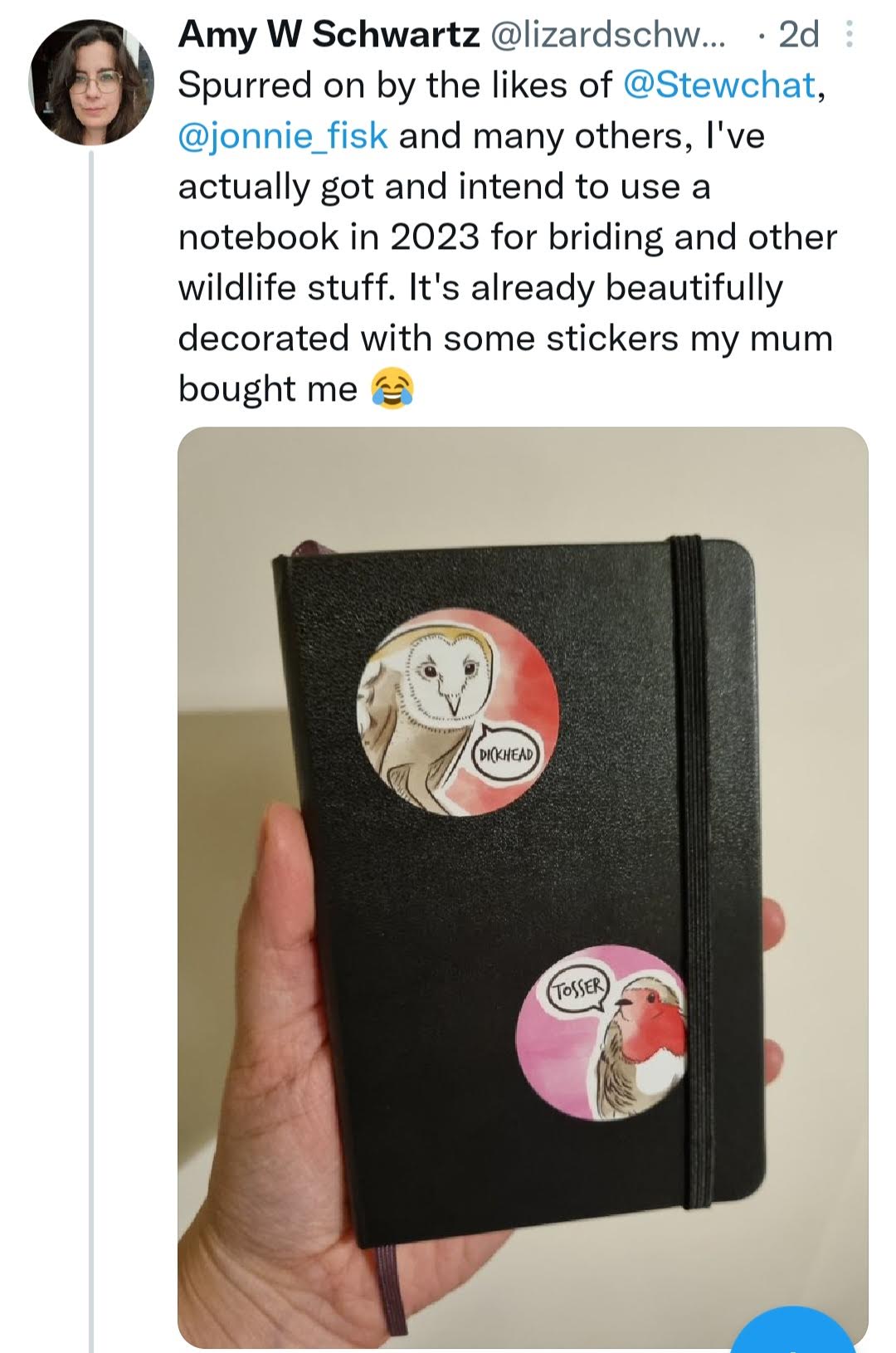
Between Christmas and New Year I was tagged in to a tweet from Amy Schwartz that set me thinking. She was going to begin using a Notebook in 2023 after a couple of false starts. In echo to this I tweeted- 


The response to this was excellent. There were over 71k 'impressions', what ever that means and over 700 people 'liked' the post. That in itself isn't important, but I'd like to assume its not the post they like but the sentiment behind it, ie, keeping a Notebook. This started off a thread of comments and posts from others about the topic of Note taking. Some top birders took the time to reply, posting pictures of shelves full of their own written word. 

It is from these I am taking some ideas on how to improve.

Here are a few - 

Look at those fab shelves! I must get mine into some order like this.

Phil is a well known brilliant bird artist. What a resource here.

Paul says his books arent really sketchbooks. Could have fooled me! These are fantastic too.

Great point made by Andy here. No one has a memory so good that they can remember details from a life of Notetaking.

Another very valid point, you cant always get a photo of every bird ( though some do very well). Its worth getting it into the notebook straight away.

James is another author and artist . His Tweet says it in a nutshell.

Well known artist Richard gives great tips here.

Craig is a great birder who is now back on track with his Notes

I'd love to get stuck into these and the others books! Mick has a great method here. 

 
Amy's tweet that started it off...


But I think it is Jonnie who has given a different outlook on Amy's tweet.


Jonnie's books are full of not just lists of birds but humour, interest, tales and the stuff that makes our birding and wildlife trips so enjoyable. These are done now, in the present, for himself in the future. Is there anything better than that!

Some birders have either given up notetaking or have never started. The alternative seems to be Birdtrack, eBird, Spreadsheets, Databases, Phone notes and Photography. 

My take on it is that we Naturalists are entering a world of different species to ourselves. There is so much beauty and bizarre interest here that one lifetime can't take it all in. In writing and sketching we are reinforcing what we have just seen or done. It is a great learning tool as well as memory storage.

To end, I want to thank all of the inspiring people above whose tweets I've stolen without permission ( I will edit and remove any if I've over stepped the mark!). 

Hopefully you might be as inspired as I am to either improve or to get started in 2023. 

Good Luck! There might be a future post on here with some thoughts and tips for beginners to note taking.

Cheers Stewart  

Monday, October 18, 2021

Stick with it, be positive.

 Last night I was thumbing through my current big notebook, the one I write up my scribbled field notes into, mainly just to see what the coming weeks gave us last year when I found a recurring theme. In a lot of entries for Boulmer they begin something like this...


It seems that most local patch days are 'generally quiet'. But is that true? Quiet days are all relative to where we watch I suppose. For example on the 25th October 2020 the rest of the page shows...


 For many birders who watch an inland or urban areas to walk out in a morning and get Black Redstart, Brent Goose, Purple Sandpipers, Grey Plover, Grey Partridge, Crossbills and Willow Tit would be a very decent patch visit. To be honest its not so bad here too, so its time to be a bit more positive. Whilst we do get some great birds locally, they are the exceptions rather than the rule and most days do get a few good birds of the calibre above. Enough to keep us going. 

I digress. Keeping the above in mind, getting back to this week. 

A moderate NW wind on Tuesday was enough to get me on to Cullernose Point for an hour and a half seawatching. It was steady going with Great Northern Diver, Bonxie, 9 Barnacle Geese, 3 late Arctic Terns, 3 Velvet Scoters inc 2 lovely smart drakes, Manx Shearwater and Goldeneye amongst others.

Yesterday morning it was back to Boulmer as per. As above, incoming passerine migrants were in short supply, but the sea always helps out. On this occasion we had 26 Whooper Swans S, 1 juv Peregrine, 1 ad winter Little Gull, very smart too, 2 Arctic Skuas, 1 Bonxie, 7 Red throated Divers and a few Common Scoter. On the shore were 21 Ringed Plover, 100 Lapwing, 8 Bar tailed Godwits and 4+ Grey Plovers but we didn't get in to counting them really. 

The bushes were 'shivvering' with Dunnocks, up to 6 at a time, something I enjoy seeing in October. High flying Dunnocks are always unusual but we only saw a single Chiffchaff.

Hopefully there will be more seawatching weather later in the week. Thursday seems canny...

The male Grey Partridge made short work of keeping female Pheasants away from the 'conservation measures'...

Lapwings pushed by a rising tide.


Thursday, June 11, 2020

'Our' Barn Owls are still showing though a little less regularly. Last night at 10pm I took Peggy for her stroll and was pleased to see the male owl coming towards us, my notebook page tells that tale, if you can read the writing...


When ever I start a new book I feel a bit anxious. I couldn't say why really its not as if anyone can see it, unless I post it of course, but the feeling is there. Once started, I just rattle away and it all works out. The books are the small A6 'Moderno' soft back books from WHSmith. I like the ivory tone and fine ruling so much I bought a dozen online for a reduced price. They are quite tactile being soft and smooth in the hand. The paper, though thin, seems to hold up ok to my small watercolours as long as I don't flood the page.  One book usually lasts around 12 months, but since lockdown my most recent only did 8 months due to scribbling observations on a daily basis while working from home.

Back in the day, I used to write everything up into either a big book or a loose leaf file, but now I don't bother, I just keep it in the original form and hope for the best.

The Notebook habit of naturalists is now all but extinct, largely due to accessible technological advances, but I have an affinity with the older ways so my notes will continue until such a time they are all flung into a skip somewhere.

Monday, February 03, 2020

A Wet Rossicus.

The forecast didnt look promising yesterday morning when I met with John at Alnmouth Cricket Club. It was calm and cold but heavily overcast. Drizzle was just trying to get through.

We had decided to check out the Coquet Estuary as we hadn't been for ages and there had been a lot of gulls in the mornings this week, as I was passing on my way to work. You would think they knew. This morning at the weir, it was high tide so the actual weir was totally submerged and there was only a lone Black headed Gull on the shore. One. On Friday there were 300 or more assorted gulls but not today. Highlight were two Foxes chasing each other on the far bank , 6 Roe Deer, 1 Little Grebe, 15 Mallard, 2 Goldeneye and 3 Herons. A Song Thrush was in full song, my first of the year and a portent of things to come.

We moved along to the Marina. Here we fared a little better with 94+ Curlew, 36 Knot, 14 Wigeon, 4 Teal, 2 Shelduck and a Snipe.

At Amble Harbour the slow theme continued. Even the local Med Gull wasn't on its usual rock. We did have 1 Purple Sandpiper, 8 Red throated Divers, 1 fem Red breasted Merganser, 18 Eider and 10+ Turnstone though.

After a stop for some snacks in Warkworth we headed up to Birling Carrs ( you might remember the posts on here about the Arctic Redpoll a few years ago? There.) The redpoll field had been ploughed recently so there was nothing here either. Then the rain started.

We decided to check the sea, getting wet in the process... viewing was good but we didn't do better than 15 Red throated Divers and 2 male Red breasted Mergansers,

Back at the car we noticed that the field to the north was stubble with some rape plants and Groundsel growing through. A few Reed Buntings were active along the track so we decided that we couldn't get more wet and to give it a blast.

As we wandered the stubble hoping for a Lap Bunting, we had a good flock of 40 - 50 Reed Buntings, 40 Meadow Pipits, 38+ Skylarks ( with one smaller one with them that we followed around but couldn't make it into anything other than a wet Skylark.)

As I climbed over the hill I flushed a single goose that flew towards me very closely. Head on it had an orange and black bill. I shouted to John that it could be Bean Goose and we watched as it circled giving us enough on it to confirm indeed a Tundra Bean!  The upperside was generally dark brown with a grey wash on the primary coverts but no pale grey forewing shown by Pink footed. The bill was longer and the bird seemed a bit larger. It began to call as it circled. I had no idea what Bean Goose called like, but noted that it was a deep nasal double or single 'ang-ang' and 'ack'. Not Pinkfoot either. As it left, John checked the call on his phone from Xeno-canto and sure enough the voices matched. A bona fide Tundra Bean Goose at close of play. A good record here.

Near by 4 Whooper Swans and 3 Bar-headed Geese just brightened things a bit more before it was time for home...


Tuesday, October 23, 2018

Spotless.

On Sunday JWR and myself went over to see the Gull billed Terns as he was unable to get away earlier. They arrived from the south east bang on cue at 8am and continued their routine the rest of the time we were there. The dull flat light gave even better views than on Friday. Also on the pits were 16 Barnacle Geese, 4 Whooper Swans, 4 Pochard and 1 female Goldeneye.

As we were in SW Northumberland we decided to go the whole hog and venture over the border into the hinterlands of Mordor where a juvvy Spotted Sandpiper was showing well on a creek in Jarrow, South Tyneside. Initially it remained quite distant but as the tide began to rise, this little teetering wader came close up allowing good views and evena few photographs.

This is my, er, 4th Spotted Sand but my first without spots!

Watching this bird brought the morning, and maybe the birding autumn, to a close. Unless this pending northerly produces some seawatching at the weekend...


After the weather...

As I have commented earlier on 'the big one travels alone' a comment by the late and great Tim Cleeves, Thursday 18th October produced news of probably the most unusual and best county record of the autumn. Way inland at an unknown spot called Haughton Strother Gravel Pits, Ross Ahmed stumbled upon the unbelievable. Not the one biggie but two - GULL-BILLED TERNS!

He got the news out early evening on the Thursday only to be met with an even bigger bombshell that these two first winter birds had been here since the 4th of the month! Two full weeks for a massive county blocker to be kept hidden away from prying eyes. Now, each to their own, I am the first to say that we dont have a god given right to bird news, but these two are viewable at a safe distance from a wide public bridlepath, so whats with the secrecy? I can only think it was due to the lack of parking out on the main access road which was pretty hair raising.

Anyway on Friday I took my kit to work, a full 38 miles from the site and awaited news. I had only been at work an hour when word came that the duo were still present and in a pattern of rest on the pits then flying out to feed in newly planted corn fields, so off I went to begin a 4 hour lunch break.

The road nearby was like a version of the Nurbergring, with lorries and luton vans speeding over blind summits and around corners, so it was disconcerting when I had to park the car in a layby, about a mile away, and walk along its pathless edge.

After dicing with death, the viewing spot was quite open and raised above the pits and the birds were easily seen. What a relief after missing one at Bothal Pond a few years ago and further back missing a pair that were tracked along the coast north from Whitburn.They sat and preened ona small gravel island beside a few black headed and common gulls then flew out to the fields and dip fed onto the ground, probably for worms. We aren't used to terns land feeding here in Northumberland...

These were my third British lifer of 2018 and my second county tick, taking the list to 416 and 344 respectively. I wonder if this autumn has any other surprises up its sleeve?


Wednesday, October 03, 2018

Scotering along the wall...

Autumn 2018 is looking like becoming a classic for all the wrong reasons. You would have to look back 13 years since we had a September in Northumberland without a Yellow browed Warbler, but here we are into October with the clock still ticking or should that be, the west wind still blowing.

That would have been tolerable had there been an early autumn fall or two with Redstarts, Pied Flycatchers and Garden Warblers mixed with an odd Wryneck, Barred Warbler and Red backed Shrike, but even these have been relegated to rarity status this year. On my patch I've not had a single one. The best I could manage when it comes to drift migrants is a lone Whinchat in early August.

With all of this creating an atmosphere of futility, it was time to totally rethink our birding. Even the mothing is dying down for the season so no succour to be found here, so there was only on thing to do - go twitching. Hopefully that will give us the fix we are looking for.

On Sunday, with a mega seaduck and a couple of scarce southern padders an hour or two to the north, I met JWR at Homebase for a pre-dawn drive up the A1. Starting off at Barns Ness where both Woodchat Shrike and Rose coloured Starling had been present and showing well for a week or more and even up until 3pm on Saturday our hopes were high for a good day.

Soon, the best laid plans and all that began to shine through. The long stayers had only done an overnight bunk. The only thing of note seen in a couple of hours searching was a Merlin dashing over the headland.

The wind was increasing, so after breakfast at the car, we headed off on the 30 miles to Musselburgh sea wall for our headline act.

Success here was much more straight forward thanks to a huddle of twitchers a few hundred yards away hunched up over scopes all pointing in the same direction. This site is easy going, a long wide flat track behind a sea wall facing north onto good numbers of northern sea fowl. Today we had 70+ Velvet Scoter, 6+ Slavonian and 1 Great crested Grebe and a few Eiders, over flown by a Bonxie and 4 Sandwich Terns.

Our cryptic target lurking amongst the basically similar Velvets was an American White-winged Scoter. Fortunately it was one of the closest birds to the wall where all of the seperating features could be seen. This is maybe only the 4th UK record of the bird, recently given specific status rather than being a race of Velvet Scoter and very nice it was too with its lolly pink bill tip and white war paint eye makeup.

We were so pleased with the line up here, our previous dipping stop was all but forgotten. As for this Autumn? Well....


Sunday, May 07, 2017

Join the Dots...

Before I get on to this weekend, a little catch up from midweek. On Wednesday as I came back home from Bunty's walk before work, I noticed a large bird slowly heading towards us along the lane, coming from the direction of the pond field. At first, heron springs to mind, but the bowed wing shape just wasnt there even though the wing span was quite similar. Its angular appearance rang bells and I could see it was heading low across our village where a neighbour was waiting with her son for the school bus. I shouted, 'Lynsey!' 'OSPREY!' and pointed above her as it languidly travelled straight over her head. Although I have never heard her talk about natural history, she did seem interested in the large raptor continuing its migration...This is the 4th I have had in the area since 2009 and its my second garden record.

Right, back to this weekend.

Saturday started very early at 4am, when I got up to go and lead a Dawn Chorus walk at Howick Hall, just up the road. At first it seemed quiet outside then a Blackbird began proceedings, followed from our garden by Skylark, Grasshopper Warbler and Wren, while a Barn Owl carried prey over the back field to a nearby nest.

The walk started at 5am continuing until 7am. It was ticket 'do' with breakfast included for the 30 or so attendees. The walk was sold out I'm glad to say, as we limit it to this number. Any more would detract from the very reason people turn up at that time in the morning. 44 sp were recorded during the time and guests even managed a bonus Red Squirrel from feeders at the tea room as they ate breakfast. Bird highlights included Lesser Whitethroat, Gadwall and Tawny owl, all new for these, now annual, early wanders.

I spent the day in tired daze despite having a couple of hours dozing when I got home.

At 7pm, I was just about to leave home to collect Jane from the train station, when news came through of three Dotterel just down the road at Boulmer, so I carried out my taxi duty and off we went to see if these harlequin plovers were still there.

Luckily they were, in the same field as those Shorelarks from the other week, and we were well pleased to see that all three were lovely bright females. Dotterels carry out role and plumage reversal during breeding. Like phalaropes, it is the male who is dull and carries out all domestic duties while the female is brightly flamboyant. Unfortunately they were too distant for anything other than a record photo, but they really brightened up the field as they periodically ran around, punctuated by prolonged rests down in the barley. I dont think I have seen adult Dotterel in the county before but have seen several juveniles. Its a long while since my last one...


Dotterel in the gloom...
Today the North wind strength has increased making it more like March than May ( we say that every year) resulting in the need for two coats early on.

A return to Boulmer this morning for better pics of the Dotterel failed as they had departed overnight. Some compensation was had by the presence of a male Whinchat and 4 Wheatears, while 145 and 70 Barnacle Geese flew N along the shore. One male Wheatear struggled with a beetle, possibly a vine weevil, that had become entangles in some sheep wool...


Wheatear with beetle seen here in the sheeps wool...


Some of the migrating Barnacle Geese today.
After being frozen on exposed Boulmer Steel. we headed off to Low Newton to see if there were any more migrants there.

Really the wind had us defeated, but we tried, coming up with Grasshopper, Sedge and Willow Warblers, Chiffchaff Whitethroat and Lesser Whitethroat. A female Wheatear was on the pond edge while a female Brambling was held up on her way north by this awful wind.

A fw fem Brambling, looking tired near the Long Nanny car park.

And while northern birds are still migrating, this juvenile Song Thrush shows an already successful breeding season for its parents...

Monday, February 06, 2017

Prestwick Carr.

Often we see the names of places or birding sites reported time and again, but they don't really register with us.

Prestwick Carr is one such place for me, sited between Newcastle Airport and Ponteland, this unusual historical boggy upland-in-the-lowlands spot is a real piece of wilderness right on the edge of urban Tyneside. Indeed, this morning after my visit, I drove for 20 minutes along to the Metro Centre, one of the larges malls in Europe, but when standing on the track north through the Carr, you could be a million miles away. This was the site of breeding Wood Sandpiper way back in 1853, so, it really does have history!

The Shrike was on those tiny bushes in the field.

Here they are from a different angle, over to the right hand side.

The site consists of lowland bog with huge rushy fields and flat flooded areas that look great for waders. There are scattered birches and hawthorns and a wood full of Scots Pine. An ideal spot for a wintering Great Grey Shrike you might say.

And so my visit today was to catch up with Exubitor that has been here since late autumn, favouring the northern end of the track. I found the bird quite easily today, sitting out in the bright sunshine on small stunted hawthorns. Quite distant, as is the way of Great Grey Shrikes, but good scope views were had in nice light.

The bird perched up on top, waving its tail from side to side scanning the ground for a vole or wren to pounce on. It seemed to have a larder low in a small thorn bush where it kept vanishing too from time to time.


Above, Great Grey Shrike, doing what shrikes do...

Living in the north of the county, Prestwick Carr is not somewhere I visit, I think I've only been once, maybe 20 years ago to see, another Great Grey! Its quite nice here though so I might come back. Before the next 20 years anyway....

Also today here were 3 Willow Tits, 40 Golden Plover, 3 Snipe, 2 Buzzard, 2 Kestrel and a Fieldfare.