Showing posts with label Newbiggin. Show all posts

Monday, July 29, 2024

A County First!

 Sitting at the computer in our small bedroom on Wednesday lunchtime last week, it was a busy work day. There were so many emails and calls that I rarely came up for air, so I hadn't checked my WhatsApp messages for a while when I finally picked the phone up. 

A short message seemed a bit confused followed with equally confused responses about a Lesser / Mongolian / Tibetan/ Siberian Sand Plover on the stony beach at Lynemouth with Ringed Plovers. Any of those would be a British tick for me and new for Northumberland but these had been followed with a single photo, that to me, initially, showed a longer bill, that would indicate Great Sand Plover. Not a new bird for me, but a County First all the same.

Now, had I been in the office, I would have been 10 minutes away, but from home its 40 mins and the bird had flown south.

Still the work came through apace so my intended early 3pm finish dragged on til after 5pm. 

By then the bird, now reidentified as a Greater Sand Plover had been relocated around the next headland at Beacon Point, Newbiggin, a pattern it would repeat going forward.

Visions of a lot of birders and toggers booting the plover up and down the coast made me decide not to go on Wednesday evening but just leave it, keeping my fingers crossed for the Thursday when I would be based just around the corner in Ashington. Hopefully it would linger, it is 'autumn' after all...

Thursday, early doors I see from my phone that the Greater Sand Plover was still present  but has again flown from its roost on Lynemouth beach towards Beacon Point again where it was being looked for. 

That would be my first port of call. The car was left on a nearby housing estate as near as possible to the site where a short march across the golf course put me with a group of a dozen or so hopefuls.

Soon enough, the bird was found on the rocky shore where it would do a pop up act by appearing then vanishing in equal measure. I gave it half an hour and decided to have a better look at high tide after work.

4pm found me at Lynemouth Power Station where a walk of about half a mile over a brownfield area got me to the blast beach where the birds were roosting. The industrial landscape here is more like Teesside than Northumberland but its a good spot for migrants and other wildlife too. 

At the spot there were only about 6 of us at the beginning and by the time I left I was alone. I was able to watch the bird well and at a nice distance, enough to stop them being anxious and close enough for good scope views. A few notes and sketches were made and some phone scoped photos taken as a record of the bird. 

Later on at home a scan of some literature showed a minefield of taxonomic issues with the Sand Plover complex but comparing my notes with details it looked to be of the Central Asian race 'scythicus' all the way froTurkmenistan through S Kazakhstan and Afghanistan wintering in SE Africa

An older paper in BB refers to the 'crassirostris' race ( now changed in name only to 'scythicus' )...

 Bill - As nominate, but on average somewhat longer and thinner.   ( It was slim and quite long)

Upperparts - Paler grey-brown, usually lacking rufous-cinnamon tinge, but may show narrow rufous feather margins. (It was heavily abraded so no rufous finging)

Face Mask - Wider and complete, with white forehead patch small or absent .( It was only a few small dots in a line)

 Breast Band -  Broader, less sharply demarcated and generally paler, but with narrow centre  and rufous often extending obscurely to flanks .

Border to Breast Band - Sometimes present as thin black line; often absent.  ( It had a faint black line along the edge to the throat).

So there you have it, my 2nd UK GSP after one at Aberlady in June 1999, takes my county list to 364 until the Redpolls go!

Note - 30/07/24 I see Bird Guides are putting this out as the Eastern race 'leschenaultii' so I've looked again to see where I'm going wrong. Ive coloured positives in green and negatives in red.

Bill - Strong, with curved nail and obvious, angled gonys ( Bill didnt seem strong or have a gonys?)

Upperparts - Usually ‘clean’ grey-brown, often lacking cinnamon tinge, and thus similar to Lesser Sand Plover, but may show narrow rufous margins. ( Yes like this)

Mask - Variable, but occasionally fully black ( Fits)

Breast Band - Narrow at centre and deeper rufous, hardly extending to lower breast or onto flanks; also more sharply demarcated ( Doesnt look sharply demarcated to me or particularly deeper rufous)

Border to breast band - Normally lacking ( Definitely had a fine line bordering)

As with all of these complex species, the descriptions or parts are fluid and extremely variable. No doubt the BirdGuides Team have access to more expert up to date info than myself...Every day is a school day!


Monday, October 30, 2023

A Storm is a Threatenin'

 For a nice change, the wind for the last couple of weeks has been usually from the eastern half, with quite a bit of rain too, so we have had a few interesting things to see on patch. Nothing to set the grapevines alight but enough to keep me occupied.

Before I get on the that we had a short fine interlude on the 14th where we had a good influx of butterflies into the village. The short Ivy hedge near the village hall had 105+ Red Admirals one lunchtime with 3 Comma and a Painted Lady. Each time a car passed they would lift up like the autumn leaves in a wind. In the village wood some Striated Earthstars were a new fungi for me.

Striated Earthstar like a little spaceship.

The very next day, it was cold, down to 2 degrees with a mod NW4 blowing so we spent the morning seawatching. The sun was bright so we were often blinded but a change of angle helped a bit.

From 07.15 - 11.30 we had - 

Sooty Shearwater 1, Red throated Diver 4N 6S, Great Northern Diver in summer plumage very close in N, Arctic Skua 1N, Skua sp 2N, Pink footed Geese 90, 30, 70 S, Barnacle Goose 50 N, Purple Sandpiper 2, Shelduck 3 S, Common Scoter 4N, Red breasted Merganser 1N, Long tailed Duck 1male and 1 female N, Sabines Gull 1 juv S, loitering for a short while offshore to dip feed before drifting out of sight, Arctic Tern 1ad 2 juv N and finally 2 Twite S calling.


17th Oct, 4 late Swallows, I'd not seen any for weeks, were in the village at dusk.

On Thursday 19th we were treated to a 3 day Storm Barbet with its ESE8 Gale and heavy rain.

One of the Swallows above was so tired it flew into our shed and settled on the bench just to rest.

A few Redwings and Fieldfares arrived over the garden first thing, with 3 Brambling but it was a cracking male Firecrest that graced our compost heaps for a few minutes that made the day. Still a scarce bird up here, this is a garden first, and it started quite an influx of them all along our coastline. Also around the garden were 3 Blackcap, 3 Goldcrest, 1 Chiffchaff and a Raven overhead. A Woodcock flushed from the village hall pond mid morning.

Rough field notes.....Firecrest in the garden.

On the Friday, Babet was cranking it up with 50 mph E winds causing massive seas and sea foam feet deep across the coast road and paths.

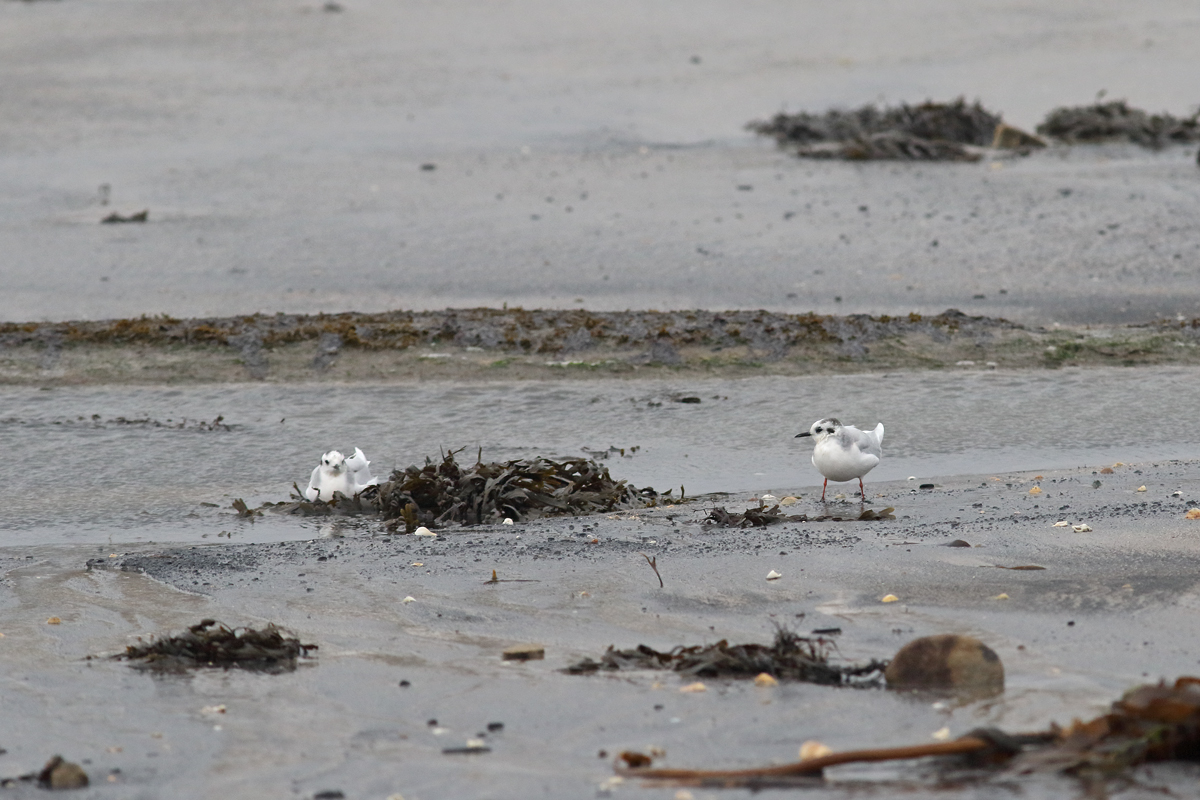
I was at work so popped down to Newbiggin where a lot of birds sheltered in the bay inc - Grey Phalarope 8  ( 6 in one scope view!), this number increased to 12 over the weekend, 60+ Little Gulls, 1 ad Mediterranean Gull, 2 Bonxie and 1 Pomarine Skua, 4 Brents N 3 Shoveler N in an hour. The Little Gulls were knackered being blown around the beach.

Outside Newbiggin Bay.

Exhausted Little Gulls, Newbiggin

Saturday 21st and Babet still raged with ENE gales, rain and huge seas, too rough to watch. At home I short watch from the car only had 5 Little Gulls and 15 Common Scoter N. A few more birds were in the village, with a beautiful tortoiseshell patterned flock of 60+ Bramblings swirling around the back field. Two came to our feeders for a while. 115+ Redwings flew W with 3 Fieldfares and 3 Blackcaps fed on apples in our garden.

When a small 'brown' shrike was reported a couple of miles along the road, at Sugar Sands, I dashed along, but the bird couldnt be relocated. The views had been frustratingly brief of a Red backed type of Shrike. Of note here were 3 Grey Phalaropes, 4 Little Gulls and a few Twite.

Sunday 22nd saw the back of Storm Babet being a fine, calm, cold, frosty morning, a total contrast to the mayhem of the previous few days. Wanting a Phalarope for the patch I wandered along to the Rumbling Kern where 2 Grey Phalaropes fed close in with Black headed Gulls, only my 2nd patch record. An adult Mediterranean Gull, 6 Purple Sandpipers, 3 Red throated Divers were also present.


Howick Haven and Grey Phalaropes

After this I took the short drive to Alnmouth for a walk with John where the highlight here were viz mig Snow Bunting, Crossbill and several Siskins.

Back home for lunch and I was surprised to find a very late Hummingbird Hawk-moth on our second flowering Red Valerian, despite the white frost earlier. Seems an odd combination seeing the hummer, Grey Phals and Snow Bunts on the same day...


Wednesday, September 06, 2023

Boobycarnage!

 This morning before leaving work to go into the office a local WhatsApp message popped up - 

Brown Booby, North, Long Nab, Scarborough.

This is a message that causes a basic life pause, just for a second while the info is mentally processed.

Then its reported very close in past Cowbar in Cleveland.

Clearly this is the bird that has spent a couple of days off Filey, so, what chance that it is actually on the move and not just circling around in the sea haa looking for a nice feeding frenzy to join in with?

Just in case, you understand, not that the chance would arise, and yes I am remaining cool, it might be worth checking timescales.

Long Nab to Cowbar took 1 hr 15 mins for 36 miles.

Cowbar to Newbiggin in Northumberland, only 2 miles from my office is 75 miles. By counting fingers and toes I can deduce from this that the tropical Sula could be due in around 11.30am.  

No, I'm still not too bothered, chances are it will be back in Filey before I get in to work.

Fast forward and I am in the office at 10am and logged on.

A message banner pops up on my phone. Brown Booby past Hartlepool Headland, very close in...

Shit is getting real, this could be on the cards.

A humorous and hasty conversation with colleagues and manager about 'weh hey' Brown Boobies ( insert emoji) and I cant hold on much longer, I'm off to Newbiggin arriving at 10.50am.

Already there are 20 people eagerly concentrating and grilling the rolling calm waves into the mist. The good thing about these type of twitches is that we can meet up with good friends we don't see so often, so its always going to be a win. 

The tension is palpable. Each juv Gannet gets a sigh as it passes. The concentration is broken briefly when a Black Guillemot flies through my scope and on to several peoples county and year lists.

'Cullercoats Brown Booby North towards Seaton Sluice'.

That is almost in sight! Come on...

After a few minutes there begins to be some coughing and fidgeting in the now 35 strong crowd. The rumour mill is grinding. Word has it, that it has not been seen at Whitburn a seawatching mecca. But there are close in immature Gannets. Then one observer says that the sighting at Hartlepool was believed by some ( always a good one) to be a Gannet too.

The observers at Cullercoats chip in that it might not have been a Booby?

It turns out there are NO confirmed sightings North of Cleveland.

Ah well its been a pleasant two hours and I am back in the office at 12.45.

Things should have ended there, but no, life is never that easy, is it.

Gary Woodburn calls. After all the earlier confusion, conspiracy and string, the real deal has just gone past Whitburn! Could you believe it. Right, one last ditch attempt sees me back at Newbiggin for 1pm but I need to be back by 2pm.

I needn't have worried, as I got out of the car Gary messaged to say 'Stand Down, the Whitburn sighting is erroneous too!'

Whats going on here. Looks like another young Gannet is responsible.

While standing discussing this with those who about turned back to the point, we had a close in very dark Balearic Shearwater, a Bonxie and a few Manx and Red throated Divers.

Balearic Shearwater courtesy of Paul Weddle.


30 minutes passes, time to call it a day. While there had been several Boobies this morning there was no Brown Booby for Stew.

As we left, a photo came through of the cracking adult Sula leucogaster now loitering off South Gare. Looks like it has never passed Cleveland after all...


Friday, May 07, 2021

Anything. Anywhere.

Birding, as we know, can throw us some unexpected curved balls at times but today really takes the biscuit.

I am recycling a post I have just done on Facebook albeit for a more savvy blogger audience so please bear with me.

Back in February at the height of lockdown, a Northern Mockingbird arrived in a garden in Exmouth in Devon. This slim, blackbird sized bundle of feathers will have been bred in the USA and by some miraculous feat of migration ended up on the other side of the pond in a palm tree in Devon.

As it was only the 3rd for Britain and the first to be actually twitchable, birders across the land were devastated that there were travel restrictions in place stopping them making the pilgrimage. Some disregarded the COVID rules and went anyway, resulting in on-line vilification by the more sedentary law abiding citizens of ornithology. Some twitchers were believed to have been fined for going, but felt that it was worthwhile to see such a rare bird. After all, they would have paid for a flight to Shetland if it had been there.

Then, at the beginning of April, typically as restrictions lifted, the Mockingbird left its Exmouth garden and vanished only for it to reappear as if by magic 150 miles east along the south coast at Pulborough in Sussex the very next day.

What chance refinding a small grey bird after its gone 150 miles in a night? Pretty slim I reckon. Anyway, it spent one day in a garden there, where birders, who didn't go to Devon, managed to catch up with it, but there was no trace the next day.

And there the trail goes cold, everyone assumed it had gone for good.

Until yesterday. A month, 400 miles and a massive fluke later.

A family in a small new build house in Newbiggin by the Sea saw an unusual bird in their garden. Wondering what it was, they sent a video to the Bird Guides Information services to find out. News was released that there was a Mockingbird somewhere in Newbiggin but the location was withheld.

Most of us were disbelievers, surely not...

After some super sleuthing and discussions with the resident, our friend Alan Tilmouth managed to negotiate access and permission to release news of the location.

So this morning, anxious birders were poised ready to go. At 11.20am the location was released and a Wacky Races style movement of camo clad, binocular wearing, camera toting fans descended on the town...to see this Yank who had turned up after a jaunt the length of the UK.

After such a wild card, you have to think... where next?

Northern Mockingbird UK 422 Northumberland 355

Northern Mockingbird, Newbiggin by the Sea.


Thursday, December 06, 2018

Small shrike...


While we were watching the Bonaparte's Gull on Sunday, new came through of a non -grey shrike at Newbiggin down on the beach behind Church Point caravan site ( exactly the same spot as the White spotted Bluethroat in the spring).

Tongues wagged metaphorically over the social media hoping against hope that at this very late time of year it might be a Brown Shrike. Alas, it was not to be, the finder Alan Priest, had it nailed with photos as a juvenile Red-backed Shrike. Stand down, panic over. Still, an amazing record, the latest ever in the county though I do remember one in December at Hunstanton some years ago.

Monday morning at work, I happened to have an appointment at Newbiggin ( well I would wouldnt I) so dropped in for 10 minutes to see the bird. I havent seen a Red backed Shrike for ages, so it was areall pleasure to watch this little chunky predator fly catching from weeds on the land slipped eroded parts just behind the beach.

They are much smaller that you you remember and this one was hunched up with wings drooped looking very sorry for itself. Food at this time is very hard to come by for a bird like this so the local Robin had better watch out.

As the sun shone, the shrike looked golden and blended perfectly with the golden leaves of reedmace and willowherb. Lets hope its soon back on the proper route south before winter really kicks in... 

Dire phone scoped image...

Sunday, April 01, 2018

A day of two parts...

Part 1...

The only bit of the April issue of British Birds I have read so far is the paper on the carbon footprint of birders. It goes on to say that twitching and foreign holidays are not good for the planet, but the recent upsurge in Local Patch birding is the best way forward in terms of helping with global warming, pollution and use of resources etc.

I light of this I changed my early plans to visit Holy Island again ( a 60 mile round trip in a diesel car) and stayed at my newly shrunk local patch. When I did the Patchwork Challenge I made the boundaries fit the 3 sq km criteria that can be seen in the map in the side bar on the right.
In reality, most of that is visited very infrequently, so I have cropped the area down to under 1 sq km -


You can see this is a very small area with only a few fields a short stretch of rocky coast and a bit of parkland with a small pond. This is a real patch to me, one that I walk around daily with the dog and a good percentage can even be seen from home.

Now, some might wonder about this, but having a patch is not just about accumulating as much of the British List as possible by stretching boundaries into every conceivable habitat just so you can get a Nuthatch or see a Gannet 5 miles away from a high point inland. For me, it is very simple in that no matter the area, its about seeing what occurs there by regular observation. Whether it is a car park or the Serengetti, just see what you can get. One man's Pied Wagtail is another man's Siberian Thrush. Certainly in a patch context anyway, and this doesnt stop you venturing away to see good birds elsewhere, it just means you will learn your patch wildlife very well indeed.

So, back to today. My target, after the easterlies and rain yesterday, was Black Redstart.

Northumberland is sinking under the weight of the bloody things, so I scoured my perfect Black Red habitat along the coastal cliffs and found.... None.  I found, 3 pairs of displaying Rock Pipits, 2 singing Reed Buntings and 2 migrant Goldcrests, and that was about it. Nothing earth shattering there, but breeding Rock Pipits are good, Reed Bunts are scarce on patch and Goldcrests migrating are a pleasure to see, and thats what local patch birding should be about.

Two Goldcrests were on a barbed wire fence with not a pine in sight...

Singing male Reed Bunting.


Part 2...

Having donned a hair shirt this morning and put in the time where no one else would, it was time for some excitement and fossil fuel usage ( sorry).

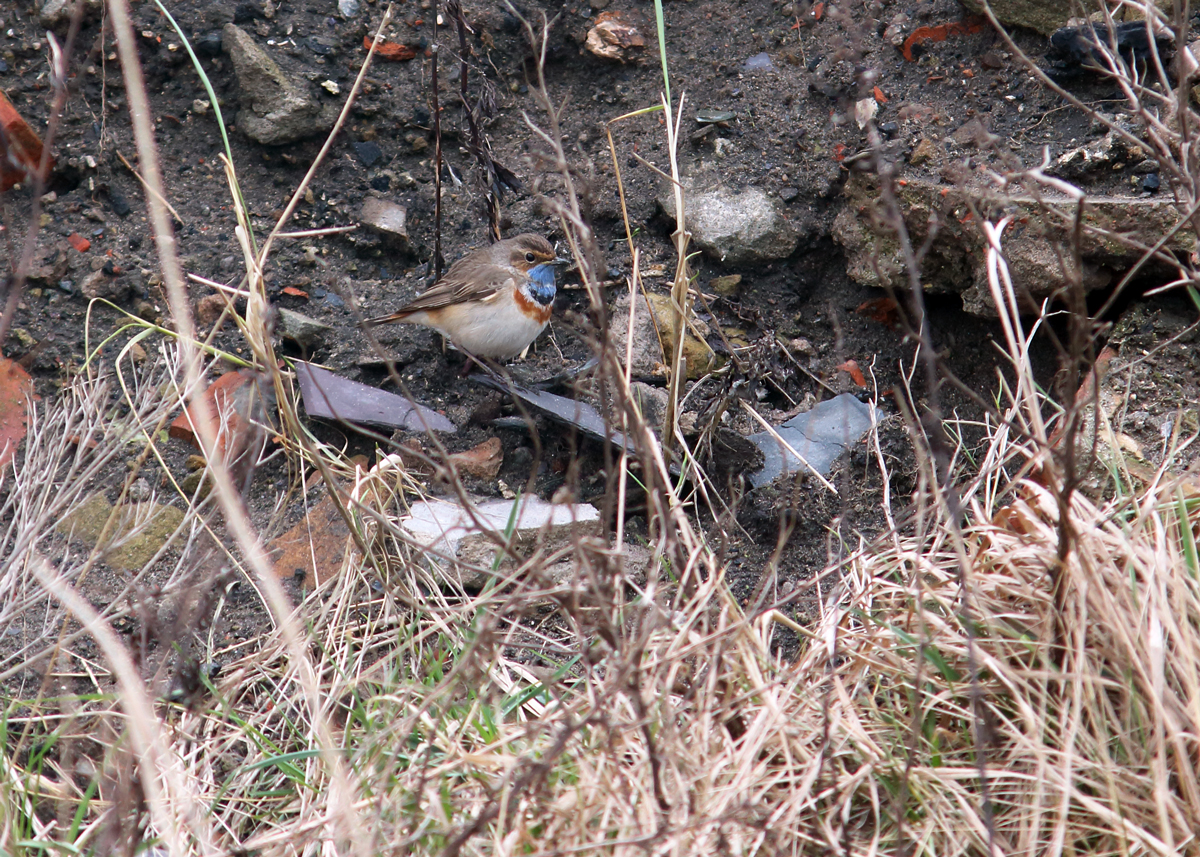
20 miles away, Gary Storey had found a male White spotted Bluethroat on the beach at Newbiggin (oh why couldn't it be me!) so I decided to give it a look. I have only seen one White spot in the county before and this bird has some history for me, having read, with awe, about the one Ennion found near Beadnell in the 50's, so the adrenaline was pumping. We used to get regular Red spotted Bluethroats when the wind turned East in May, but not for many years now. The Reds have a narrow window of occurrence from about 12th - 20th May usually so any Bluethroat in April will be a White spot.

I arrived at 2.30pm with the tide well up the beach pushing birders closer to the bird's favoured spot in turn making it quite flighty. It finally moved north a bit where the wider beach gave more breathing space, and some decent views were had, a stunning little chat, you can never get enough of these...

With snow forecast for tomorrow, I am glad to have seen some sunshine and good birds this weekend... Happy Easter!