Showing posts with label Cory's Shearwater. Show all posts

Monday, September 09, 2024

The Sea Saves the Week...

 Lately we have been getting some canny birds around our local patches. Most years we expect this to increase with the onset of September into October, but often we are disappointed. Things rarely turn out as planned.

This last week has been, let me say, mixed. The wind has been from the East or North East for about 5 days and this is sure to produce the goods. Well, it did, and it didnt. 50 / 50.

When the wind is in the east we hope for drift migrants from the continent. Classic birds in these conditions are typically Wryneck, Red backed Shrike, Barred Warbler and Red breasted Flycatcher. 

We saw none of those here. In fact, for instance, yesterday was the quietest day we've seen on the coast for some time. There were none of these rarities but more concerning, there were no common migrants either. A full stomp around the headland of Seaton Point checking all bushes produced a heard only Chiffchaff and a locally bred juvvy Common Whitethroat. I get more in the garden.

Some places did get these good birds though, Holy Island, Low Newton and Newbiggin had them just not here. Spurn was positively sinking under the weight of good birds.

What is the upside of this you might be wondering? For us it was the sea. 

Last Sunday 1st Sept at Boulmer we had 18 Arctic Skua, 2 Long tailed Skua and 2 Bonxie, 43 Manx and 10 Sooty Shearwaters, 2 Red throated Divers, 22 Common Scoter, 1 Red breasted Merganser, 4 Goosander. Then as we were drinking tea at the car park nearly at close of play, we got a message that an adult summer plumaged Sabine's Gull had been seen at St Mary's, Newbiggin, Snab Point and Hauxley very close in, and it was heading our way.

There was no time to walk out to either North or South headlands so we just went to the flag pole seat beside the Lifeboat hut and waited.

The view here was a little bit more distant than the points but we could easily identify terns and kittiwakes in good light as they passed.

We formulated a strategy. In these situations you dont want one birder to see the bird and the other one not be able to get on it, so we focussed our scopes on the sea just south of the haven marker post. That way if one of us saw it, the other could get onto the post and the observer would say, at the post NOW! Ten minutes or so later and thats exactly what happened. I called up first when a small black hooded gull came into view. Luckily, John had seen it simultaneously. As it flew north it came a bit closer giving us great views as it passed, then as quick as it arrived it was gone to the north. Thats Seawatching for you...


During the working week a couple more short seawatch sessions were much quieter though on 4th Sept, I had nice views of 2 Minke Whales feeding offshore from our village for an hour. Its been a canny year for them up here.

On Thursday 5th, it was looking good for migrants so I took a day annual leave. What a waste. There were no small migrants and even worse the drizzle and fog so thick you could hardly see the sea! A couple of short watches had 13 Sooty Shearwaters, 1 likley Balearic Shearwater, 21 Manx Shearwaters, 1 Arctic Skua, 1 Little Gull and a Roseate Tern. Not too bad in the gloom but I just knew there were more birds out there hiding in the fog...

Next day, Friday I was back in the office. What a mistake that was as every one was now seeing masses of good seabirds now the gloom had lifted. So I managed to get finished and head off up to Seaton Point where me and John were sat in position by 4.30. Tide was up and birds were streaming by. Excellent.

In the next two hours we enjoyed - 

Manx Shearwaters 102 N

Sooty Shearwater 4 N

Bonxie 2 N

Arctic Skua 2 N

Long tailed Skua 1 N

Roseate Tern 1ad N

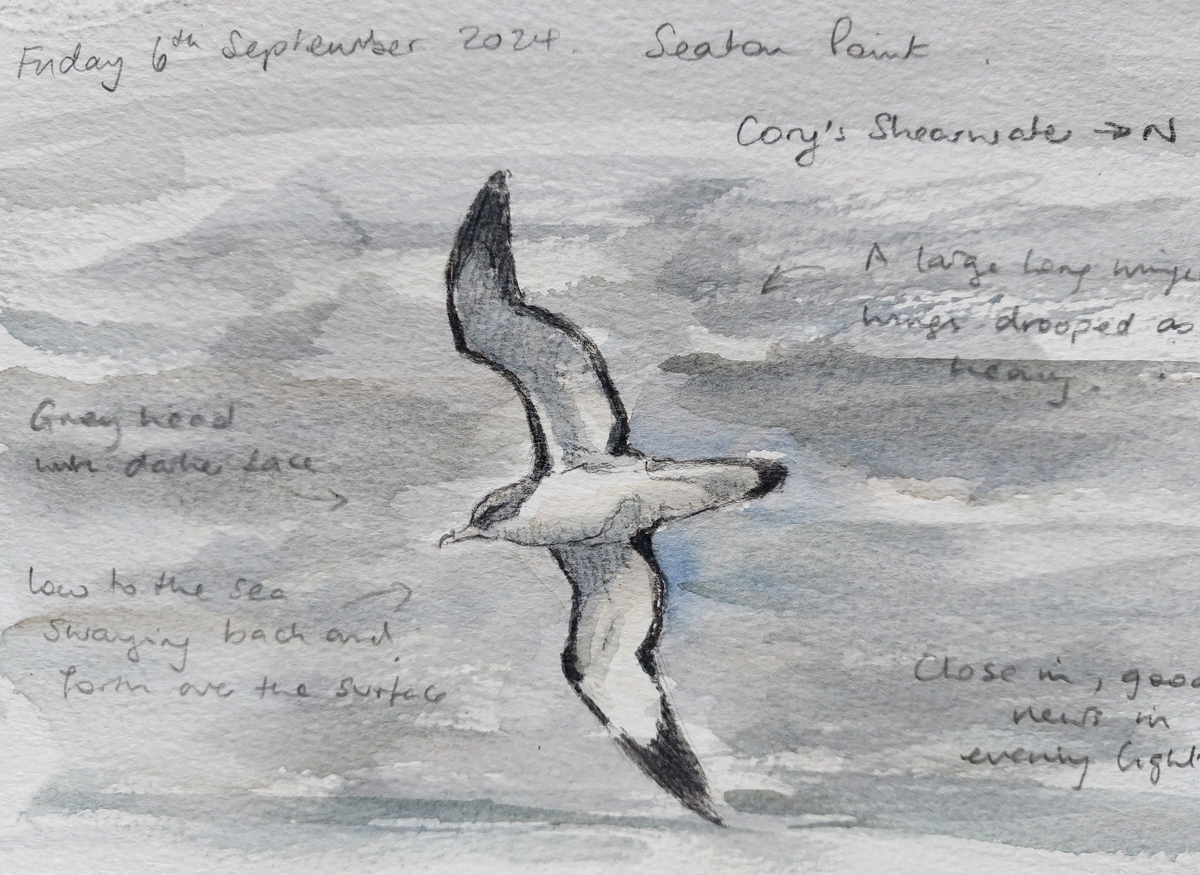
then as with the Sabine's Gull, we got wind that heading our way was a very close in Cory's Shearwater, a rare bird in the North East from the Med and more southern areas.

We had all but given up, as these birds can do anything on route such as land on the sea or go offshore etc. When, out of a trough behind a big rolling breaker it emerged and I called to John, Cory's Shearwater! Less than half way out   and showing well. This is where the fun began. As I touched on with the Sabine's, John could not get his eye on the bird as it slowly wavered its unusual flight north. I called a constant commentary, calling every bird, wave and flag that came into my view, but to no avail.

I could sense a quietness about John then he said, I'm going to miss this...

There is nothing worse than the walk back to the car when only one of us has seen something! Time to up the anti.

I could tell the slow moving bird was close and really he shouldnt miss it, he was looking too far out and to the north. I stood up and scanned with my bins rather than the scope. I soon got its bearings. A bouy and  a  long white topped breaker. I called John to look exactly there. Dropping back to my scope, there were 2 juv Kittiwakes going through. John had those. Then, close behind was the Cory's I'm not sure who was most relieved when he said 'Got it!'. Phew. It was still on view for a good spell after that so it was a result. The first Cory's we've had at Boulmer and a good view too...

I was almost hoarse from shouting directions the Shearwater will have heard me!


This week the weather is set to be a bit colder than recently with strong northerlies. 

You can guess what we will be doing later on...


Thursday, July 28, 2022

Three Shears.

 Mid July signifies the start of one of my favourite pastimes on the coast - seawatching. 

In recent years we have had some great birds from the sea on the local patch in July. In 2019 it was the surreal appearance of a Giant Petrel from Southern Oceans, followed in 2020 by a more twitchable mega, a Sooty Tern for a day or two and as if that duo wasn't enough, 2021 was not going to be outdone as another UK first opened July with a close, nicely breast banded Soft-plumaged Petrel moving North offshore.

Is it any wonder I like the hypnotic draw of the waves?

Last week we had the first light north winds of the season, so an hour intro on Wednesday was quiet but pleasant with Little Tern, a dozen Manx Shearwaters, a handful of Puffins with ever present Sandwich and Arctic Terns making up the tally. That was until a very close pod of Bottle nosed Dolphins slashed into the bay, soon followed by a Minke Whale that dived just in time to avoid the Life Boat bombing over its head. An adult summer Mediterranean Gull  passed North as I was preparing to leave. Not a bad start.

On Monday as a large high pressure system moved in to the west of Ireland bringing with it masses of Cory's Shearwaters into the western approaches, hopes were high that we might get in on the action. Cory's is a very difficult bird to catch up with in Northumberland, Ive only seen one, at Newbiggin around 1999 I think.

On Monday I was out on Cullernose alone from 16.45 - 18.00. Although there was a fresh breeze from the North, few birds were moving. 86 Arctic Terns, 21 Sandwich Terns, 4 Whimbrel, 3 Manx, 9 Puffins a few waders and an in off juvvy Med Gull were all I could muster. A single Wheatear was quick off the marks here, a taste of what is to come hopefully.

Tuesday turned out to be a different kettle of fish. Early doors, Dan Langston had a Cory's slowly past our village and sitting on the sea while I was walking the dog within viewing distance if Id had my scope. I dashed back down with the scope after dropping the dog off at home but the light was dreadful and nothing of note was seen. Gutted, a great patch tick gets away.

After work saw me keen to get back on to the point, and by 16:30 I was in position.

Manx Shearwaters were the main passage birds on show with 583 N in 3 hrs, a good total for here. 5 Goosanders flew south as did a distant Bonxie, while an Arctic Skua chased terns overhead. 2 Little Terns were good to get too.

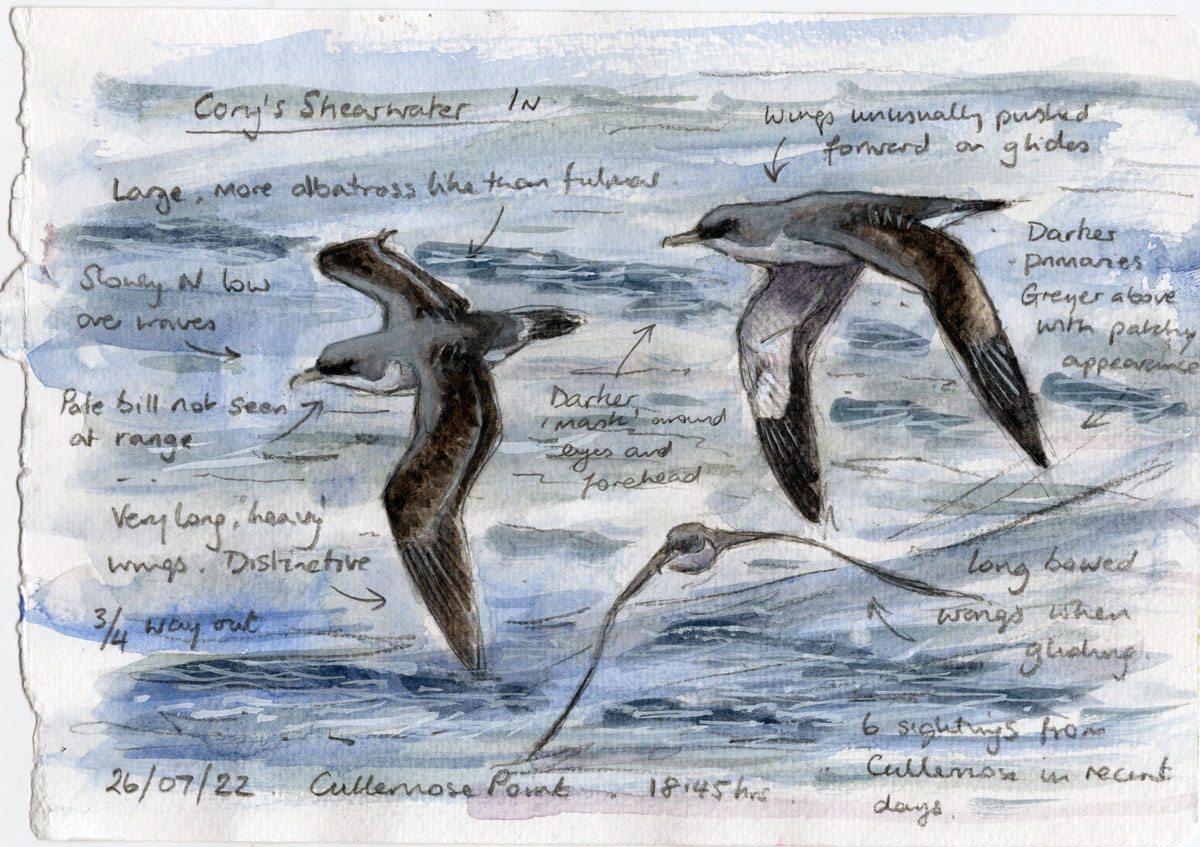
Soon, I was joined by Dan, Alan, Ian and Keith ( and a bit later by Mark). After about half an hour Dan called the bird. CORY'S! It was way to the south and distant but as it progressed the distance shortened and it gave reasonable views hugging the surface with long bowed wings occasionally tipping over to reveal the underside. It took around 8 minutes to get past us, but even though we called directions, pot flags and range, Ian and Keith just couldn't get on to it. Whilst three of us were elated, it still takes the edge off things.

We sat another hour hoping for another chance, but only 3 Sooty Shearwaters were added to the total before most of us left*.

Cory's Shearwater, a great addition to the patch list for me and a full new species for the site.

Cory's Shearwater, Cullernose Point 26/07/22. 


*Mark Eaton stayed on after we left. As dusk came, Ben Steel at home in Longhoughton a mile inland, was looking at the sea from his bedroom when he picked out another Cory's coming past Longhoughton Steel [ garden tick!]. Mark managed to get it close in as it passed Cullernose . Finally last night Tom Cadwallender was on the point alone not seeing much at all until a group of 4 Sooties passed, followed a minute later by the 5th Cory's of the week. Unprecedented.


Friday, July 10, 2020

A seawatching twitch...


In recent years a new phenomena has occurred in line with new technology and new methods of communication. That is twitching seawatch birds.

Gone are the days of Millington's idea that seawatching was the only way to get a 'non suppressive grip-off' on your mates. By that he meant that you could justifiably get a rare species and when your mates missed it, as they invariably did, unless they were sat next to you at the time, you could gloat. No need to keep a cheeky one under that hat, no, you could get a Cory's Shearwater, run to the phone box, ring the grapevine and by the time you got back the bird was two miles further along the coast with zero chance of anyone else seeing it.

Nowadays, with the invent of What'sApp groups these birds are as twitchable as any scrub hugging warbler. All you need to do is get the news, work out some flight speeds and times of arrival, in fact there is even a bird timetable going around our group now so that you can see in an instant expected arrivals times of everything from White billed Diver to Black browed Albatross according to the headland you watch from. Then get to your spot and wait. In some places with 20 other people. Many gazing at their phones to see whether the next person along the coast has seen the bird.

It doesn't always work out well though. Seabirds can't read a WhatsApp timetable and are probably not inclined to follow its guidance if they could. On many occasions I have sat it out waiting for Little or Great Shearwaters for very little in return, but on occasion it does go well, look at last years Giant Petrel for example and before that my only Fea's Petrel was more punctual than our local Arriva buses.

Yesterday we got a message that not one but two Cory's Shearwaters had passed North Yorkshire, two hours apart and were heading our way. ETA for me was about 5.30pm as the Cory's flies on a tail wind. This instruction saw me on my local headland, Cullernose Point, at 4pm already beaten to it by one other observer , our County Recorder no less, dressed like he had just gotten off the plane from Malaga. Myself and John, carried our kit along and got comfortable. I was only wearing one light fleece under my thick coat. You can tell its summer.

As a regular seawatcher, from the off, I could see that this wasn't going to be a 'notebook' event.

For a start it was sunny with blue sky. This makes a deep blue sea where it is difficult to pick up distant birds with it as a backdrop. Plus, there were only the local Auks, Kittiwakes and Terns moving around with very few Gannets and Fulmars.

This lack of action means reduced concentration all round as we were constantly distracted by anglers drinking Monster, kids with 'beans on toast' lockdown hair cuts and day trippers wondering what we were doing. Still, we did our best. An hour in, the first of 7 Manx Shearwaters passed by, closely followed by a Whimbrel. Meanwhile the Lesser black backed Gull sat sentinel hoping one of the kids with the Harpo Marx do would slip to their demise and provide more carrion than that dished out by the anglers.

After that it turned cooler and even local birds dissipated. It was the arrival of a few new ASBO anglers carrying drink, that broke the camels back for me.

On the plus side, both Cory's didn't even make it beyond Cleveland, so we didn't dip alone. I have only seen one Cory's Shearwater in the UK, on 22nd July 1999 close in past Newbiggin.

I hope the next one is self found...

A Newbiggin Cory's, 21 years ago...