August can be a good month in Northumberland, and especially in a local patch context where its not just rare birds that get the pulse going. At this time there is a post breeding dispersal of commoner species that might not occur on a given patch or in a bit of habitat. So, get out there as often as possible and watch the daily changing tide of birds as they head out to pastures new...
On 24th July, a hint of autumn was already happening. A Grey Plover flew S over our house calling strongly, a garden first. Nearby were an adult and a 2nd summer Mediterranean Gull but, on the patch the best bird was commoner than both of these, a Dunlin [135] flew over calling twice in the darkness. My fully rocky coast doesnt get mud puddlers like this so fly by's are the best I can hope for...
On 28th July warblers were on the move with Whitethroats, Blackcaps, Willow Warblers and Chiffchaffs all showing in tall hogweed and bushes on the coast. The now famous influx of Painted Lady butterflies had begun when we had 70 in and around our garden alone.
On 1st August a short seawatch from Cullernose Point had an adult Little Gull and more expected at this time, 1 ad and 1 juv Roseate Tern [136]. These are rare birds on most patches and well sought after but in Northumberland they are found all along the coast in August as the young fledge and roam widely.
With perfect timing, a Hobby [137] flashed past our garden on 4th only a day later than the 2018 sighting. Still rare in Northumberland but sightings are increasing...
A few days later on 8th, a blue, male, Merlin [138] flew over the village mobbed by swallows. In contrast to the previous raptor, Merlin sightings on the coast are decreasing. 20 years ago they were a day bird anywhere on the coast from late July to December, but now I only get one or two sightings per year.
Most days at the beginning of August had showers or even heavy downpours, but even this failed to ground any scarce migrants.
A party of 4 juv Knot [139] on 17th were my first here since 2011, and only my second record ever. This is the value of patch birding as Knot is not scarce along the muddier reaches of the Northumberland coast and even on the rocky skeers, the fingers that jut out into the sea. Unfortunately here, our rocks are more 'bunched up' so most waders give them a miss.
And finally, last night a nice walk down the Teepee track to Howick Burn mouth turned up 5 Wheatears and a juv Whinchat [140], both good sightings here.
First thing in the mornings now, hirundines are moving south in tight flocks and Golden Plovers gather on the shore...It'll soon be real autumn. Lets hope the weather changes from this bland southerly pattern...
Showing posts with label Patch Watching. Show all posts
Wednesday, August 21, 2019
Sunday, July 21, 2019
Patch List Catch up...
I haven't done a patch birding update since May, so here goes so far...
After the excitement of Baikal Teal and Baillons Crake in the county, it was back to patch watching in earnest. We always start the year full of vim and vigour but this often deteriorates as the summer arrivals peter out. On a North east coastal patch however, as mid summer beds in, things are only just starting to warm up. We are full of hopes and aspirations of what the return migrations season will be like. Willw e get any fall conditions? Will there be any rare birds? Will the sea watching be classic year? Or, will it all just be a damp squib...that remains to be seen, but a few decent species have been added to the local list since spring...
126. Quail. On 9th June as I stepped out onto our drive, the distinctive 'Whit, whit whit' call sounded only 30 yards into the field but could easily have been in the next field such is the skill in voice throwing that these birds exhibit. It remained until 22nd June when we came back from our Suffolk holiday.
127. In the quiet doldrums of mid summer living near the coast can have its advantages...see here for details on what happened next.
128. On the same crazy seawatch Arctic Tern was added...
129...and Common Sandpipers had already began moving to the coast on 2nd July after breeding.
130. Arctic Skua. After packing up on another seawatch on 7th July a dark phase adult came so close it was almost touchable just over our heads and away north.
131. Later in the afternoon on 7th July, I walked down to the coast patch just to scan for terns and waders and was pleased to see two birds not far out moving north. As I locked on to them one was a Whimbrel and the other, scarcer here, a Bar-tailed Godwit....
132 / 133. The sea is the way to lift the flagging list from now onwards and the hour spent on the 14th July was no different with Little Gull and Common Tern added. The Little Gulls were two birds, one a lovely sooty underwinged adult and a more typical first summer.
134. The most difficult of the breeding terns here, 4 Little Terns flew south just offshore this afternoon as I walked Peggy...
So, 9 year ticks and one a lifer who says mid summer is quiet for birding! With real autumn just around the corner, I am sure there is time to slot in a few more missing common species...a Dunlin or Sanderling wouldnt go amiss...
Labels:
Howick,
Local Patch,
Patch Challenge,
Patch Watching,
seawatching
Thursday, November 01, 2018
I'm late, I'm late....but not too late for some Patchwork.
Every morning before work I have a bit of a routine to follow, as do most of us. Mine involves getting up, coffee, dog walk #1, shower, breakfast, feed the garden birds dog walk#2 and then off...
Yesterday morning I was up to stage 6 above, when I heard the unmistakable 'kuuk' of a Raven, and it sounded close. I peered over the back field as a lone Raven flew very low to the ground past me before lifting up, over the village hall and away S. I was watching where it went, when I heard another Raven call, quite softly behind me. I turned to look at the sky above the copse next to our garden anticipating a fly over, when it appeared. First behind some bare branches then, it only pitched up on top of the large Ash tree next to the garden! It sent the Jackdaws and a few Rooks into panic mode. The Raven saw me, coupled by other corvids alarm and mobbing calls, and it flew off. This only angered the other crows even more who went in pursuit until they harried the larger bird out of sight.
What great bird they are, especially when they can be seen from the garden.
Now it was time for stage 7. Peggy's second walk of the morning is usually just a quick dash out before I go. Today we were on the top coast road a few minutes from home when I caught the sound of a Waxwing trilling call. I couldnt see anything and thought I had misheard, when no, there it was again. I stared high up and picked up two birds heading south but decending too. A pair of Waxwings! They dropped straight into our village after their long flight. I could just about see them perched on a tall willow in a garden in the village and saw them drop off at a 45 degree angle.
There was only one place that would pull them down like that - Davey's apple tree. Pegs and me turned ( she had been far enough anyway) and strode back home, passing the apple tree. Its very thick and hanging with fruit so I couldnt see anything. I swapped the dog at home for bins and camera and went back out. Its only 50 yards to Daveys from home, and sure enough right in the centre in the worst viewing place possible were the Waxers, getting stuck in to their apple breakfast.
I watched for a few minutes and grabbed a few record shots before they flew off, stopping briefly and then continuing west.
As I pondered them and wondered about getting back for work, more calls over head dawned on me, this time Crossbills, lots of them. First a low flock of 13 went south, quickly follwed by 5 and then 9 more accompanied by 3 Brambling. A good movement of Crossbills for here.
Now it was really getting time to be off. I could have stood viz migging much longer to see if more Crossbills would follow but time was against me so it was not to be. Still, it was a great half hour around the 'obs' before work....
![]() |
| Some record shots of the waxwings. Pity I couldnt get two in one photo. Hopefully more will arrive over the coming week or two.. |
Labels:
Crossbill,
Local Patch,
Patch Watching,
Raven,
Waxwings
Monday, October 29, 2018
Local Patch Listing
![]() |
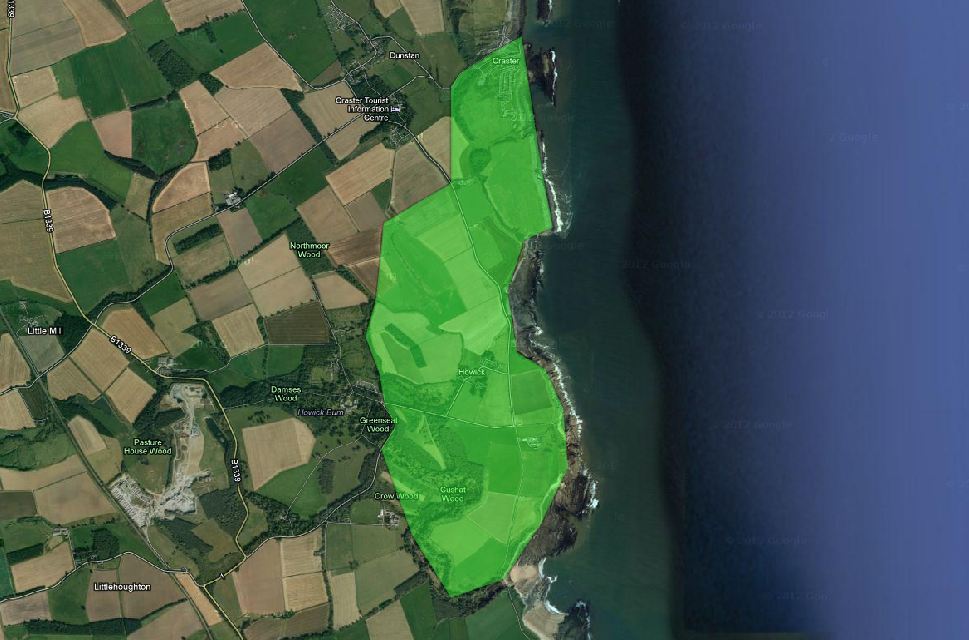
| The Howick - Craster Patch. |
Its a funny thing to ask, but I see loads of people on social media the length and breadth of the country who's local patch is Spurn, Bardsey, Cley or where ever their county hotspot is. Most people have a nature reserve or a large inland water body, or a migration place where many sets of eyes scour it every weekend for the latest 'rare' but I only see a few people with a random place that very few birders visit. Steve Gale at ND&B has one such place here.
My patch is another. Before I lived here, I used to call in to the area occasionally, but only once did I come here to see a good bird - a juv Red backed Shrike found by Julie Roper about 12 years ago. Even the coast line facing east to the North Sea is quite mundane. It is a rocky shore with no areas for gatherings of birds. The landward side is just as bad, intensively worked, mixed farmland. It is scenic but not too bird friendly really.
It is this that makes it quite a task to keep to the patch when half an hour drive North takes me to Holy Island and another half an hour South takes in the ponds and wetlands of Druridge Bay or Newbiggin. But, I live here, so technically I can visit every single day, even if its just watching out of the window, so over the past 9 years I have stuck with it.
Maybe once a year, if I am lucky, is there a period of weather that makes even this place worth a look, and most often that involves Seawatching. Its the sort of activity that can put you on a level with some other places, at last. This weekend, proved to be my 2018 window of opportunity to add a few good species to the year list.
On Saturday and Sunday I spent 6.5 hrs, alone, glued to my scope and bins enjoying the conveyor belt of birds rattling through my mediocre patch. For once I felt like a contender!
My list looks like this -
All moving North unless otherwise stated.
Pale bellied Brent 3
Shelduck 32
Wigeon 760
Mallard 12
Teal 100
Shoveler 6 attached to scoter flocks of all things.
Pintail 3 a scarce patch bird
Long tailed Duck 51 best count ever on patch.
Goldeneye 22
Scaup 3 only 3rd record.
Tufted Duck 1
Common Scoter 1034
Velvet Scoter 33
Eider 50
Red breasted Merganser 13
Red throated Diver 50
Black throated Diver 2 a rare visitor.
Great Northern Diver 8
Slavonian Grebe 1 second patch record
Manx Shearwater 11
Fulmar 50
Little Auk 9
Bonxie 1
Pomarine Skua 1 distant but carrying the full spoons.
Purple Sandpiper 9
Glaucous Gull 1 fw right over our heads N.
Plus uncountable Gannets, Kittiwakes and Auks and a Short eared Owl and a few Starlings in-off right past me. Further south observers had Leaches Petrel ( one even on Howick patch per Ben Steele but I missed it along at Craster) double figures of Little Auks and Poms, but when sitting watching by yourself its easy to miss out.
I am not too concerned, after all I had a right old hatful of decent patch birds to boost the total but its high time some quality passerine action came my way. Fingers crossed.
Labels:
Local Patch,
Patch List,
Patch Watching,
seawatching
Sunday, October 07, 2018
A Patchy post...
Its been a while since I did a full on local patch type post so Saturday and today were spent doing just that, with maybe a step just a fraction outside the 'official' boundary, which I am quite happy to do. Its no good being precious about these things. Either way all sites visited today can be walked from home and are mostly within the map in the side bar.
On Saturday morning a walk around the coast path and Rumbling Kern with Peggy had - 4 adult winter Mediterranean Gulls, together, in the cow field just north of Seahouses Farm. Two weeks ago there were two adults here, the first time I have had a multiple occurrence on the patch, so to see four in one binocular field of view was excellent. A pair of Stonechats were in scrub by the Rumbling Kern. A five minute seawatch here with bins only had 1 dark Arctic Skua S very close in, 1 ad Common Tern and 2 juv Arctic Terns N along the rock edges. Further off were 5 Red throated Divers on the sea and another two going S.
A bit of viz migging had 11 Siskins S, 7 Coal Tits coasting S and 9 Skylarks S.
A few butterflies were in the garden- 1 Small White, 8+ Red Admirals, 4 Speckled Wood.
As the wind swung north for the first time in millenia, later in the after noon I did an hour long seawatch from Cullernose Point. It was dire, but I sat it out catching the last sun and fresh air for 4 Red throated Diver, 1 Shelduck, 1 Manx Shearwater, 2 juv Arctic Terns ( probably those seen earlier), 3 Teal and 67 Common Scoter all N. A Small Copper was a late sighting on the coast path and another male Stonechat sat up giving nice close views.
Today I didnt have much hope of seeing much. Last night was clear and cold with a white frost on the car by 11pm. Still we thought we would give Craster ( north end of patch) a try today in case a Yellow browed Warbler had finally made it here.
As John arrived at 7am I put my gear in his car and a flock of 30+ Redwings flew out of the small copse next to our garden. The first of the autumn and a surprise giving the weather.
We arrived at the Craster public car park at about 7.20am and spent the next hour just standing around listening and watching birds viz-migging. Some were coasting S others dropping in from high east having just crossed the North Sea overnight. We totalled a decent list in the next hour -
Brambling 9 in off
Redpoll 60 S
Siskin 58 S
Redwing 38 in off
Fieldfare 3 IO
Song Thrush 3 IO
Goldfinch 12 S
Mistle Thrush 1 S
Golden Plover 13 S 38 N
Dunnock 2 IO arrived high from the east like pipits.
Linnet 13 S
Pied Wagtail 3 S
Crossbill 5 IO
Pink footed Geese 442 S
A Great Northern Diver flew N over head and a Barn Owl flushed from some Ivy on the old quarry wall.
In the bushes around were 2 Goldcrests and 2 Bullfinch.
Not a bad hour standing in a car park!
We then checked the rest of the village area - 3 Willow Tit, 2 Chiffchaff, 2 Grey Partridge, 1 Great spotted Woodpecker and 1 Treecreeper. The sea was all but dead, 1 Wigeon and 6 Common Scoter N.
This afternoon I walked Peggy down through the village wood to the Pond field and back.
28 Long tailed Tits were very active flying around the village as if not sure where to go next, 1 Chiffchaff, 9 Redwing, 1 Collared Dove, a scarce bird here with maybe two or three records a year, 1 Jay, 1 Brambling S, 1 Wigeon and 10 Mallard on the pond with 2 Mute Swans and 3 Moorhen.
And thats about it for the weekend. No rarities and not even a YBW, but some nice birds to see on the doorstep and to witness migration is always good too... now where are those easterlies?
![]() |
| Seawatch from Cullernose. |
![]() |
| The view north from Cullernose |
![]() |
| Howick Bay |
![]() |
| The coast path facing south |
Monday, May 21, 2018
Patching...
I mentioned earlier that this year I am doing some local patching on a different slant. I have cut down the patch size to around 0.75 km2 . This small area is the real patch around our tiny hamlet that I frequent the most, during dog walks etc. It covers our 18 houses, a small bit of rough open woodland, a man made wildflower meadow, an small man made pond, some livestock farmland and a short strip of rocky coast line.
This time, Patch II, is not just about birds, its about trying to record all types of identifiable natural history that takes my eye, and it is getting to be obsessive! Our house and garden is the epicentre, creatively, the 'Obs'. I say creatively because this is no Portland or Fair Isle. Its not even like one of our local reserves. It is an intensively farmed, intensively touristed (?) fragment of the Northumberland Coast AONB. If I didn't live here, as scenic and idyllic as it is, I probably wouldnt come on a Sunday morning wildlife watching trip, but that is part of the allure.
Apart from me, there are very few naturalists visiting the spot with any regularity. We have Julie who lives on site and is a very good birder, casual observer. She had a Turtle Dove not 50 yards from my house while I was on Holy Island looking for migrants one year. There is Phil, who is a ringer. He studies all of the Barn Owls up the coast including our estate and does a form of constant effort ringing nearby. He has loads of nest boxes in the small wood. Finally we have Ben, a new arrival to a village nearby. He mostly frequents Boulmer, but is known to call in. And thats about it, any other observers are very occasional vagrants.
So what has 2018 turned up so far?
A steady flow of passage spring migrants with Lesser Whitethroats, Grasshopper Warbler, Sedge Warbler, Yellow Wagtail. A Med Gull during the hard weather, Merlin, Pink footed Geese, Grey Partridge, Barn Owls, Woodcock, Raven, Marsh Tit.
Water and Pygmy Shrews, Brown Hare, Hedgehogs, Badger, Roe Deer, Grey Seal.
A very rare micro moth - Xenolechia aethiops, with only 5 records in the UK since 1999 and 59 other species of moth so far.
A few butterflies, bees, hoverflies, amphibians and fish.
Not to mention the flora. No, dont mention the flora, its a struggle...
Basically not a lot to set the world of naturalists on fire, but there is always something to look out for, and on a weekend we go out to get a fix of other things elsewhere, just to stop stagnation of course...
Watch this space.
![]() |
| Marsham's Nomad Bee |
![]() |
| Leucozona lucorum,a Hoverfly |
![]() |
| Small Copper on the peas, a rare garden visitor. |
![]() |
| Freshly dead Water Shrew, the third record for the site in 9 years. |
![]() |
| Thyme leaved Speedwell, I think? Any corrections welcome. |
Friday, September 04, 2015
Picking up...
After last nights meagre offerings of the pelagic kind, the wind got up overnight, so, I set the alarm to get me up early so I could catch an hour facing east before heading off to work.
I arrived at my seawatching spot at 6.00am and was in position and counting by 6.10. The wind was a moderate NNW5 decreasing, it was overcast with odd drizzly squalls coming in, reducing visibility.
Although it was no classic, there were clearly more birds on the move than yesterday. I watched until 7.15am, noting the following. -
Brent Geese 5N
Wigeon 39N
Teal 71N
Pintail 2N
Common Scoter 4N
Goosander 1N
Manx Shearwater 5N
Sooty Shearwater 1N
Puffin 1N
Red throated Diver 4N
Sandwich Tern 26N
Arctic Skua 2N
I put my gear back in the car and climbed in ready to drive off. It was now that I noticed a whirring sound? Hold on, I thought, that's the heating fan. I had only turned the ignition part way off, leaving the fan to nicely flatten the battery! Craster is not a good place to be stranded as there is no mobile phone signal at all due to the geology of the area. Luckily I caught the attention of a kind couple who let me into their home to use the land line.
To cut a long story short, after a bit of a faff, a mechanic from Alnwick ( that must be a Limerick somewhere) came to the rescue with a boost charger and had the car going in 10 seconds.
While he was gathering paperwork for me to sign, two birds caught my eye close in going north, lifting Kittiwakes all over - it was the 2 Arctic Skuas. First ones seen this year after a two month delay. I would have missed them if the car had worked properly :)
138. Sooty Shearwater
139. Pintail
140. Arctic Skua
These three patch additions leave my score at a clean 100% of last years total, so every new bird from now is a bonus. I wonder what will be next....?
Labels:
Craster,
Patch Challenge,
Patch List,
Patch Watching,
seawatching
Sunday, August 16, 2015
After the rain all day on Friday I was keen to see if there were any migrants around, on both patches. The Farnes and Holy Island between them held Red backed Shrike, Barred Warbler, Wryneck, Thrush Nightingale and 2 Greenish Warblers so maybe we would find something of interest.
On Saturday morning I headed to the north end of my patch at Craster, where there were a few common migrants to look through but that's all.
Today was a lovely sunny morning down at Warkworth where a few more birds were in evidence. The beach car park was a hive of avian activity first thing with 6+ Whitethroat, 6+ Blackcap, 6+ Willow Warbler, 4+ Chiffchaff and a Sedge Warbler. This theme and list continued around Birling Carrs and Amble Marina.
Two Yellow Wagtails flew south.
Waders continue to provide interest on the estuary with 228+ Dunlin, 58+ Ringed Plover, 11 Knot, 7 Golden Plover, 3 Sanderling, 1 Common Sandpiper, 2 Juv Ruff ( probably the day's highlight) and a few Turnstone. Redshank numbers were high but not counted. It was just the cherry from the top that remains missing...
10 Goosander, 3 Little Egrets ( 'Egberts', er, no. This isn't even an abbreviation!) and a Common Tern added to the show.
Out to sea, a large group of dolphins were leaping right out of the water but they were way too far out to identify. A few butterflies were seen -Small Copper, Small Tortoiseshell, Meadow Brown, Wall Brown and the Whites.
So no really noteworthy birds on offer today, but that's the beauty of patch watching...there is always tomorrow.
On the home patch this week a few new additions to the list are beginning to trickle through - a juv Spotted Flycatcher on Tuesday, 2 Dunlin and a Knot with 336 Golden Plover on Thursday. Not a year tick here but only the second on patch was a female Shoveler on the pond this evening hiding under the overhanging trees. A good bird for here but I'd have swapped if for a Gadwall...
128. Spotted Flycatcher
129. Dunlin
130. Knot
On Saturday morning I headed to the north end of my patch at Craster, where there were a few common migrants to look through but that's all.
Today was a lovely sunny morning down at Warkworth where a few more birds were in evidence. The beach car park was a hive of avian activity first thing with 6+ Whitethroat, 6+ Blackcap, 6+ Willow Warbler, 4+ Chiffchaff and a Sedge Warbler. This theme and list continued around Birling Carrs and Amble Marina.
Two Yellow Wagtails flew south.
![]() |
| This Sedgie was not yet on passage, feeding fledged young nearby. |
![]() |
| Knot are difficult to approach... |
10 Goosander, 3 Little Egrets ( 'Egberts', er, no. This isn't even an abbreviation!) and a Common Tern added to the show.
Out to sea, a large group of dolphins were leaping right out of the water but they were way too far out to identify. A few butterflies were seen -Small Copper, Small Tortoiseshell, Meadow Brown, Wall Brown and the Whites.
So no really noteworthy birds on offer today, but that's the beauty of patch watching...there is always tomorrow.
![]() |
| Small Copper |
![]() |
| Small Tortoiseshell |
128. Spotted Flycatcher
129. Dunlin
130. Knot
Labels:
Craster,
Knot,
Patch Watching,
Sedge Warbler,
small copper,
Small Tortoiseshell,
Warkworth
Subscribe to:
Posts (Atom)